

A career path shortlist is three to five realistic options, ranked, that you have checked against your strengths, your values, your finances and the job market. Most people stuck in a career change do not lack options. They have a vague pile of ideas, no way to compare them and no way to tell which one deserves their next six months. This guide walks you through building the shortlist step by step, and shows how we at NueCareer help you start with a wider, more personal list than the one you would come up with alone: our 7-minute quiz matches you to career paths built around who you are, including careers you have never considered.
If you feel lost right now, that is a normal place to start, not a sign you are behind. A shortlist turns "I have no idea" into a short, workable decision.
TL;DR
- A good shortlist has 3 to 5 careers, each checked on fit, day-to-day work, pay, outlook and the training required.
- Start with a self-inventory of your values, interests, personality and skills, then widen the list before you narrow it.
- Use official data to compare options, and use real conversations to test them.
- Rank your top three, set small checkpoints, and expect to adjust as you learn.
- The NueCareer quiz takes 7 minutes and gives you matched career paths, including ones you may never have considered.
Table of Contents
- What a career path shortlist actually is
- Step 1: Take stock of who you are at work
- Step 2: Widen the list before you narrow it
- Step 3: Research what each job really involves
- Step 4: Narrow to your top three to five
- Step 5: Test each option in the real world
- Step 6: Rank your top three and set checkpoints
- Check your financial runway before you commit
- Our perspective
- Turn your shortlist into a plan with NueCareer
- FAQ
- Sources
What a career path shortlist actually is
Think of it as the middle step between "everything I could do" and "the one thing I will do." It is not a final decision. Yale's career office describes career decision-making as a five-step process: self-assessment, identifying and researching options, evaluating and prioritizing, taking action, and then reflecting and re-evaluating. The shortlist is the output of steps two and three, and the input to step four.
Three things make a shortlist useful rather than just another list:
- It is short enough to act on. Five options can each get a real conversation and a real look at job postings. Fifteen cannot.
- It is ranked. You know which option you will explore first and why.
- It is based on evidence about you and about the work. Gut feeling matters, but it should be checked against facts.
Step 1: Take stock of who you are at work
Before you look at any job title, look at yourself. Harvard Extension School suggests starting with a self-assessment inventory of what you like and dislike about your current job, plus your values, interests, personality and skills, which it abbreviates as VIPS.
The U.S. Department of Labor's career-change guide goes wider. It organizes self-assessment into nine factors: interests, personality traits, values, work styles, skills, education and training, market trends, location and compensation. That is a good checklist for what your shortlist must satisfy.
A simple way to do this in an evening:
- Write down the three tasks in your current or past jobs that gave you energy, and the three that drained you.
- List five skills people come to you for, including ones that feel too ordinary to count. Our guide to identifying transferable skills helps with this.
- Name your top five work values, such as autonomy, stability, helping others or income growth. A career values assessment can make those clearer.
- Write your non-negotiables: location, schedule, minimum income, how much retraining you can realistically take on.
Where this goes wrong: people list what they are good at and ignore what they enjoy, or the reverse. UNC Kenan-Flagler frames career choice around three elements: skills (what you are good at), interests (what you like to do) and values (what matters to you, including lifestyle, earnings and culture). A path that satisfies only one of the three tends to feel wrong within a year.
Step 2: Widen the list before you narrow it
This is the step most people skip. If your shortlist is built only from jobs you already know exist, it will be limited to your current network and imagination. The University of Iowa's career center notes that while no assessment can perfectly capture who you are, assessments can help you narrow choices and discover options you may not have considered.
That is exactly where we put our effort. The 7-minute NueCareer quiz helps you identify your strengths and matches you to career paths built around who you are, including careers you have never considered. Our positioning is simple: more options than people typically find on their own, and a personalized transition plan attached to each.
Other ways to widen your list:
- Browse by occupation group, not by title. Marist University's career-planning guide recommends browsing the Occupational Outlook Handbook by occupation group and reading job descriptions instead of titles, because titles are often misleading.
- Look at the work, not the label. "Project coordinator," "program associate" and "operations analyst" can describe overlapping work. Read the duties.
- Use interest frameworks. Our tools page includes a Holland Code Test and Career Clusters to group careers by the kind of work you gravitate toward.
Aim for 10 to 15 candidates at this stage. Do not judge them yet. The goal is breadth.
A caution from Yale worth keeping in mind: assessments cannot define you or tell you what to do. They suggest areas for further exploration and give you a place to begin research. Treat your matches as a starting point you then verify, which is what the next steps are for.
Step 3: Research what each job really involves
Now take each candidate and learn what the work is, what it takes to get in, and what it pays. The best neutral source is the Bureau of Labor Statistics' Occupational Outlook Handbook. Its Occupation Finder lets you compare occupations by entry-level education, on-the-job training, projected new jobs, projected growth rate and median pay. For context, it reports a May 2025 median annual wage of $50,980 for all workers and average projected growth of 3 percent for 2025 to 2035. Those are published figures for their periods, and BLS updates them on its own schedule.
For each candidate, open the profile and read three tabs:
- How to Become One: education, training, experience, licensing and certification.
- Pay: earnings, including how they vary by industry.
- Job Outlook: the projected growth and what drives it.
Then read ten real job postings for the role in your area. Postings tell you what employers actually ask for, which is often different from the textbook version. Marist's guide adds a warning that applies here: a high salary does not always mean a good job, so weigh environment and responsibilities too.
Where this goes wrong: entry-level pay and entry-level duties are rarely the whole story. BLS notes that entry-level wages are typically lower than the occupation median, and Yale advises looking toward senior positions when you evaluate a field, since early roles often include less desirable tasks but serve as stepping stones. Plan your budget around the starting salary, and judge the field by where it leads.
If you use NueCareer, your matched paths come with salary data and transition timelines, so you can see the pay and the time commitment side by side without opening a dozen tabs.
Step 4: Narrow to your top three to five
Now you cut. CareerOneStop, the Department of Labor's career site, gives a simple set of questions to ask of each career: are the work activities interesting, is it a good fit, are job openings likely in the future, does the pay meet your income needs, and would you be willing to get the required education? Eliminate anything with a red flag, such as pay too low, training too long or work you know you would find dull.
Post University suggests comparing options across seven dimensions: interests and values, strengths and skills, day-to-day work, education and training, work environment, lifestyle and finances, and growth and flexibility. Here is a scorecard that combines those ideas. Score each candidate from 1 to 5.
| Criterion | What to ask | Where to find it |
|---|---|---|
| Interest | Would I enjoy the daily tasks? | Job postings, informational interviews |
| Strengths | Do I already have 40 to 60 percent of the skills? | Your transferable skills list |
| Values | Does it match my top five values? | Step 1 inventory |
| Pay | Does it meet my income needs at entry and at year five? | Occupational Outlook Handbook, postings |
| Outlook | Is demand projected to hold or grow? | Occupational Outlook Handbook |
| Barrier | What training, license or certification is required, and can I afford the time and cost? | Occupational Outlook Handbook, program pages |
| Lifestyle | Does it fit my location, schedule and energy? | Postings, conversations |
Two rules keep this honest. First, no career will meet every preference. Yale says the same: no career is a perfect match, so check whether the less desirable parts are minimal. Second, weight the criteria before you score. If stability matters more than anything for you right now, count it double.
Our guide to evaluating career fit goes deeper on scoring, and what job fit means is a quick read if the term is new to you.
Step 5: Test each option in the real world
A spreadsheet cannot tell you what a Tuesday afternoon feels like in a job. Before you commit to anything, get real information from people doing the work. Utah State University's career guide separates two methods: an informational interview, which is a single conversation, and job shadowing, which is a multi-hour experience. Its sample questions are worth borrowing:
- How did you get into this work?
- What preparation did you need?
- What does a typical day look like?
- What do you like most and least?
- What skills do employers look for?
Harvard Extension School also recommends gaining experience through internships, volunteering or part-time work, and using informational interviews to build a bridge into the new field. If you do not have direct experience, a small project can stand in for it: see how to build proof with projects.
UC Santa Barbara Career Services offers a useful test for what you learn. Ask whether the real job descriptions match your vision, what you learned from others, and whether hands-on observation matched what you expected. If the reality disappoints you, cross the option off without guilt. That is the shortlist doing its job.

Step 6: Rank your top three and set checkpoints
With your tested options in front of you, UC Santa Barbara's advice is to compare pros and cons, time and cost, barriers, opportunities and confidence levels, write your findings down, and rank your first, second and third options. Then set SMART goals (specific, measurable, attainable, realistic and time-based) with checkpoints.
Here is a worked example. Imagine a 38-year-old retail operations manager who wants a change. After the steps above, her shortlist looks like this:
- Project coordinator: strong transferable skills in scheduling and vendor communication, modest training needed, good fit with her preference for variety.
- Training and development specialist: she enjoys coaching her team, but would need to build a portfolio of materials.
- Operations analyst: matches her love of process improvement, but requires stronger spreadsheet skills.
Her checkpoints: by week four, three informational interviews for option one; by week eight, one small project in her current job that mirrors the work; by week twelve, a decision on whether to start applying. She is not locked in. She has a plan with built-in moments to reconsider.
That flexibility matters. Post University's Michele Bartlett notes that career paths are rarely linear, so short-term goals paired with openness to changing interests support long-term planning, and salary is one consideration alongside benefits, flexibility, location and work-life balance.
Check your financial runway before you commit
Every shortlist has a money question hiding inside it: how much uncertainty can you afford while you retrain or take a lower entry salary? That depends on both your comfort with risk and your actual capacity to absorb it. This guide on how to assess your risk tolerance separates the two, which is a helpful way to think about the timing of a move. Add your answer to your checkpoint plan: if your runway is short, rank the options with the shortest, cheapest path to entry higher.
Our perspective
We built NueCareer around one observation: the shortlist most people make is limited by what they already know exists. If your list comes only from the jobs you have seen, you will choose among the same few options you started with.
That is why we begin with you, not with job titles. A 7-minute quiz that identifies your strengths and matches you to paths built around who you are gives you a wider, more personal starting point. From there, the real work is the same one this article describes: research, narrow, test, rank.
What we want to take off your shoulders is the heavy lifting around that process. Personalized roadmaps, salary data and transition timelines let you compare paths on facts. A 24/7 coaching chat is there when you are stuck at 11 p.m. wondering whether your second choice should be your first. And when you are ready to move, the job boards, resume tools and cover letter tools are tailored to your target roles.
Feeling lost is not a verdict on you. It usually means you have not yet seen the right options laid out clearly. A shortlist you trust changes that.
Shane
Turn your shortlist into a plan with NueCareer
When you are ready to build your list, start with the 7-minute career quiz. It matches you to career paths based on your strengths, including ones you may not have thought of, and from there the platform gives you personalized roadmaps, a 24/7 coaching chat and job boards tailored to your target roles.
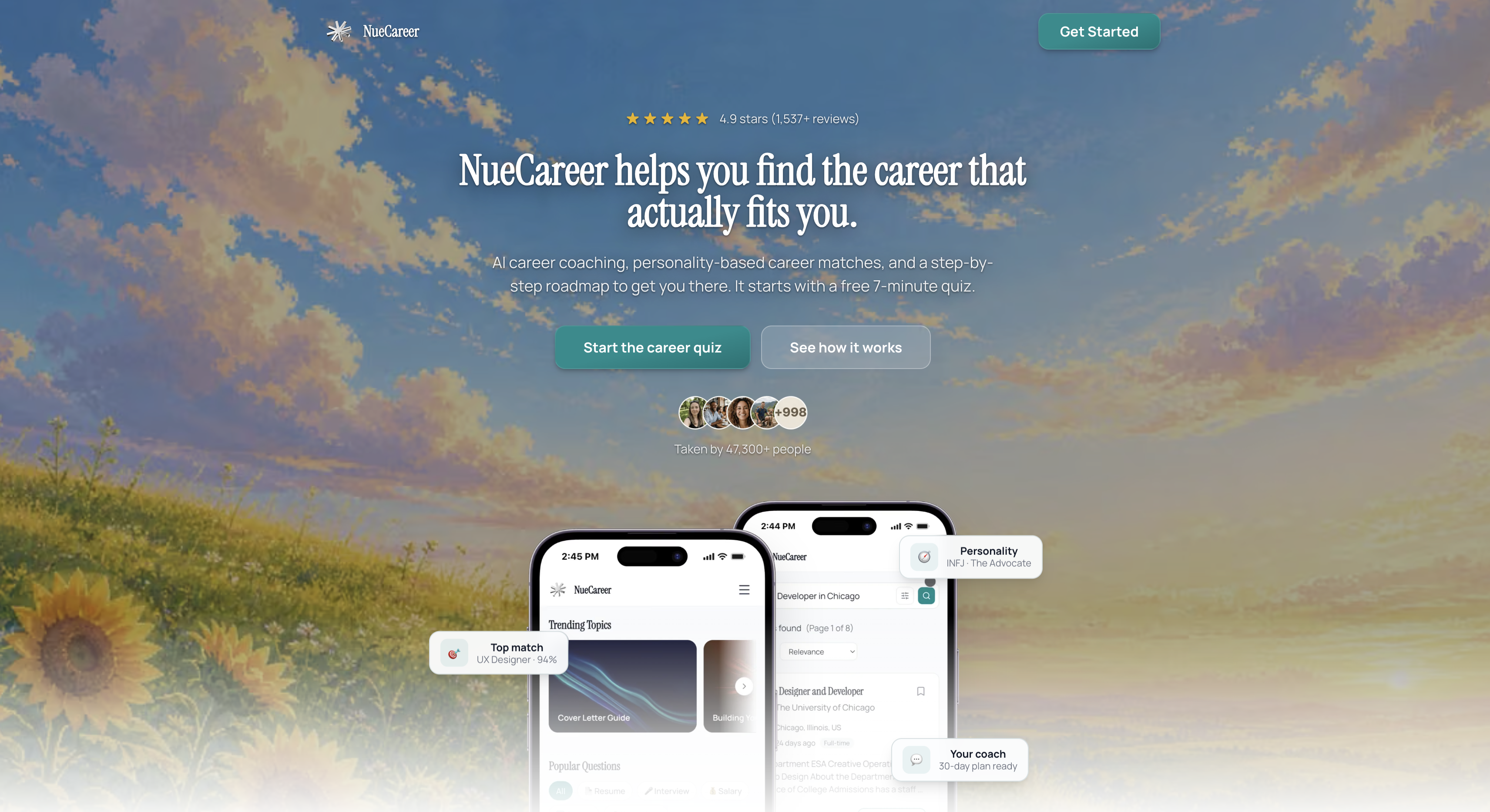
Once you have chosen a direction, the NueCareer tools include a Cover Letter Generator, ATS Resume Checker, Mock Interview Practice and a Salary Negotiation Email, so you can start applying with confidence. For a fuller view of what the platform offers, see nuecareer.com. If you want the broader process around your shortlist, our step-by-step career change guide and career change roadmap pick up where this article ends, and our career change resume tips help you present your transferable experience.
FAQ
How many careers should be on my shortlist?
Three to five is a practical range. That is few enough to have a real conversation and review real job postings for each, and enough that one disappointing discovery does not send you back to zero. Rank them first, second and third so you know where to start.
How do I find career paths I have never considered?
Browse occupation groups instead of job titles, read what the work involves, and use an assessment to surface fields that match your strengths. The NueCareer quiz takes 7 minutes and matches you to career paths, including ones you may not have come across on your own.
What if my shortlist options all require more education?
Compare the time and cost of each barrier directly. The Occupational Outlook Handbook lists the typical education, training and certification for each occupation, so you can rank options by how quickly and affordably you can reach entry. Many people also find that transferable skills shorten the path, so list those first.
How long should I spend building a shortlist?
Many people can get a first draft in a weekend and spend the following few weeks testing it with conversations and postings. Set checkpoints, such as a decision date about 8 to 12 weeks out, so the process ends in action rather than endless research.
Can I change my shortlist later?
Yes. Career paths are rarely linear, and your interests will shift as you learn. Treat the shortlist as a working document and revisit it at each checkpoint.
Sources
- Yale Office of Career Strategy: The Five-Step Career Decision Making Process
- Harvard Extension School: 5 Tips for Changing Careers
- U.S. Department of Labor: My Next Career Move Participant Guide
- UNC Kenan-Flagler: Career Choice and Change
- University of Iowa Pomerantz Career Center: Exploring Majors and Careers
- Marist University: Career Planning Guide
- BLS Occupational Outlook Handbook: Occupation Finder
- BLS Career Outlook: Business career options
- CareerOneStop: Choose best options
- Post University: How to Decide on a Career Path
- Utah State University Career Guide
- UC Santa Barbara Career Services: Make a Decision