
Career Change Roadmap Step by Step: Your 2026 Guide

Discover a clear career change roadmap step by step. Plan your transition, build skills, and network effectively to land your dream job.
TL;DR:
- Most successful career changes follow a structured plan that includes self-assessment, financial preparation, skill development, and networking. Starting early and treating the transition as a phased project improves the chances of landing a new role within 6 to 12 months. Building relationships beforehand and showcasing transferable skills are crucial for a smooth and effective career pivot.
A career change roadmap step by step is a structured plan that moves you from honest self-reflection through financial preparation, skill building, and networking to landing your first role in a new field. 78% of working adults make at least one significant career change in their lifetime. That number tells you something important: this is not a rare or reckless move. It is a normal part of a working life. What separates people who land well from those who stall is planning. Financial experts recommend a 6–12 month savings runway before you resign. Nuecareer's career guidance platform is built specifically to support adults at every stage of this process.
What is a career change roadmap step by step?
A career change roadmap is a phased, written plan that breaks your transition into specific milestones with deadlines. It is the opposite of quitting on a bad day and hoping something works out. Adults with specific deadlines for transition milestones succeed at higher rates than those who move without a timeline. That gap exists because deadlines create accountability and force you to test assumptions early.
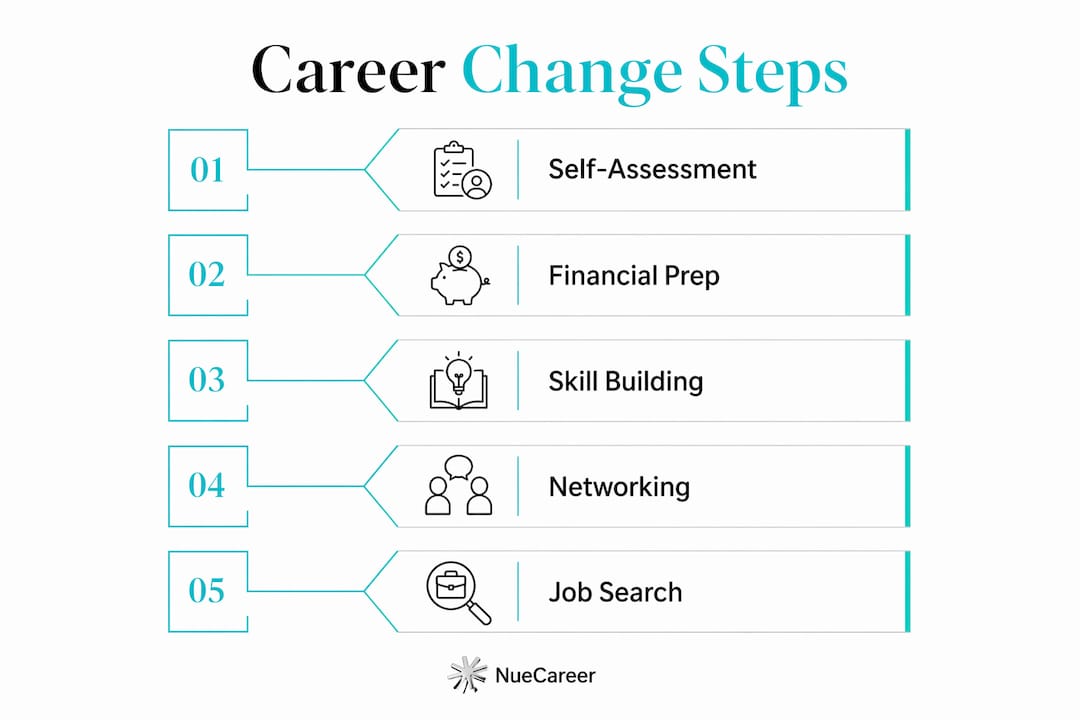
The roadmap typically covers four phases: self-assessment, financial preparation, skill building and networking, and active job search. Each phase feeds the next. You cannot build a convincing resume around transferable skills you have not yet identified. You cannot network confidently in a new industry if you have not done the financial work to give yourself time. The structure matters as much as the effort.
Career change planning is not the same as career change wishful thinking. A plan names the target role, sets a timeline, identifies the gaps between where you are and where you want to be, and assigns actions to close those gaps. That specificity is what makes a roadmap useful.
How do I assess my current situation and decide if a career change is right?
The discovery phase is the most skipped and most consequential step in any career transition. Skipping deep self-assessment leads to ineffective career changes and dissatisfaction with the new path. Many adults leave a job only to recreate the same problems in a different industry because they never identified what they actually disliked.
Start by separating three distinct sources of dissatisfaction:
- The job itself. Do you dislike the daily tasks, the type of work, or the skills you use?
- The company. Is the culture, management, or compensation the real problem?
- The career field. Does the entire profession feel misaligned with your values and energy?
Only the third answer justifies a full career change. The first two often call for a job search within your current field, not a complete pivot. This distinction saves months of misdirected effort.
Once you have identified the real source of dissatisfaction, audit your core values. Ask what kind of work gives you energy, what kind drains it, and what you would do differently if salary were not a factor. Tools like career identity frameworks and structured reflection exercises help you move from vague frustration to a clear target. Nuecareer's career path clarity resources walk you through this process with prompts designed for working adults.
Pro Tip: Write your answers down. Spoken reflection fades. Written answers reveal patterns you can act on.
What financial planning steps should I take before changing careers?
Financial preparation is the foundation that determines how much time and confidence you have during your transition. Financial experts recommend saving 6–12 months of essential living expenses before making a career change. That runway gives you room to train, network, and wait for the right offer without accepting the first desperate option.

| Financial Step | What to Do |
|---|---|
| Build your runway | Save 6–12 months of essential expenses in a liquid account before resigning. |
| Budget for transition costs | Account for training fees, certifications, new equipment, and income gaps. |
| Protect retirement accounts | Roll over or keep accounts intact. Never cash out early due to tax penalties and lost compound growth. |
| File for unemployment promptly | Most U.S. states replace 30–60% of income for up to 26 weeks if you qualify. |
| Secure health insurance | Identify COBRA, marketplace, or spouse plan options before your last day. |
Cashing out retirement accounts during a transition is one of the most damaging financial decisions a career changer can make. Tax penalties reduce the withdrawal immediately, and the lost compound interest costs far more over time. Use liquid savings instead.
For adults pursuing a career change in their 40s, a financial plan also needs to account for mortgage payments, dependent care, and college savings timelines. The career change 40s financial plan looks different from a plan built at 28. Your expenses are higher, but so is your earning history and your ability to negotiate.
Pro Tip: Run your monthly budget on your transition income before you resign. Live on it for 60 days. If it works, you are ready. If it does not, you know exactly what to fix.
How do I identify and build transferable skills for my new career?
Transferable skills are abilities you have developed in one context that apply directly in another. They are the core argument of every career changer's resume and interview. The most effective career changes are lateral moves that leverage existing expertise rather than starting from the bottom. That means your goal is not to erase your past. It is to reframe it.
Start with a skills audit that goes beyond your job title. List every outcome you have produced: projects managed, teams led, systems built, clients retained, problems solved. Then map those outcomes to the requirements of your target role. The overlap is almost always larger than you expect.
Common ways to fill genuine skill gaps include:
- Certifications. Google, Coursera, LinkedIn Learning, and professional associations offer recognized credentials in most fields.
- Side projects. Build something real in your target field. A portfolio entry beats a certificate every time.
- Freelancing or consulting. Paid work in your new field is the fastest credibility builder available.
- Volunteering. Nonprofits and community organizations often need skills that translate directly to corporate roles.
Leading with outcomes and transferable skills on your resume is more effective than listing job titles. Hiring managers skip candidates whose titles seem irrelevant. They stop for candidates who show measurable impact. Nuecareer's career change resume tips show you exactly how to structure this on the page.
Never apologize for your background in a cover letter or interview. Framing your experience as a logical progression rather than an explanation increases your hiring chances. Your past is a competitive advantage. Present it that way.
What strategies can I use to build a network in my target industry?
Networking is not optional in a career transition. Most roles are filled through relationships before they are posted publicly. The goal is to build genuine connections in your target field before you need them.
- Start with informational interviews. Reach out to people doing the work you want to do. Ask for 20 minutes to learn about their path. Most people say yes. These conversations give you language, insight, and warm contacts.
- Join professional associations. Every major field has one. Membership gets you access to events, job boards, and people who take your interest seriously.
- Use LinkedIn with intention. Follow thought leaders in your target field, comment on their posts with substance, and connect with people after real interactions.
- Attend industry events. Conferences, meetups, and workshops put you in the same room as hiring managers and peers. One conversation at an event can move faster than 50 cold applications.
- Freelance or consult before you commit. Career transitions benefit from experimentation such as freelancing or consulting before full-time commitment. This approach builds credibility and tests whether the industry actually fits.
The timing matters. Start networking while you are still employed. You have more leverage, less urgency, and more credibility when you are not actively job hunting. Maintain your existing professional relationships too. Former colleagues and managers are often the fastest path to introductions in a new field.
How do I execute the job search and land the role?
The execution phase is where preparation meets persistence. A 90-day structured plan accelerates career change success by breaking tasks into manageable steps. Start with applications, move through interviews, and iterate based on feedback.
Key steps for the active job search phase:
- Tailor every resume and cover letter. Generic applications fail. Use Nuecareer's free job description analyzer to understand exactly what each employer wants, then mirror that language.
- Prepare your career change narrative. Interviewers will ask why you are switching. Rehearse a clear, confident answer that focuses on what you are moving toward, not what you are leaving behind.
- Set a realistic timeline. Career transitions typically take 6–12 months from decision to offer. Build that into your financial plan and your expectations.
- Track your applications. Use a simple spreadsheet to log every application, follow-up, and outcome. Patterns in rejections tell you where to adjust.
- Get professional feedback. Career coaching, resume reviews, and mock interviews accelerate the process. Nuecareer's 24/7 coaching chat gives you access to guidance without scheduling delays.
Pro Tip: Treat every rejection as data. If you reach the interview stage but do not get offers, your resume is working but your narrative needs work. If you are not getting interviews, the resume needs adjustment.
Key takeaways
A successful career change requires a structured roadmap that integrates self-assessment, financial preparation, skill building, and targeted networking before the job search begins.
| Point | Details |
|---|---|
| Start with honest self-assessment | Separate job, company, and career dissatisfaction before committing to a full pivot. |
| Build a 6–12 month financial runway | Save essential living expenses and protect retirement accounts before resigning. |
| Lead with transferable skills | Frame your experience as a progression, not an apology, in resumes and interviews. |
| Network before you need to | Build industry relationships while employed to create warm leads before you apply. |
| Use a 90-day structured plan | Break your transition into phases with deadlines to maintain momentum and measure progress. |
Why most career changes fail before they start
Career changers rarely fail because they lack talent. They fail because they underestimate how much preparation the transition actually requires. I have seen this pattern repeat more times than I can count: someone decides to change careers, updates their resume over a weekend, applies to 20 jobs, and then wonders why nothing is moving. The problem is not the resume. The problem is that the work that makes a career change succeed happens in the months before the resume is written.
The adults who transition well share one habit: they treat the career change as a project with phases, not an event with a single decision point. They spend real time in the discovery phase. They do the financial math before they feel ready. They start building skills and relationships in the new field while still employed. By the time they apply, they are not hoping to be considered. They are already known.
The other thing I have learned is that career transitions are almost never linear. You will identify a target field, start building toward it, and then realize through an informational interview that a slightly different role is a better fit. That is not failure. That is the process working correctly. The roadmap gives you structure, but it also has to flex. Rigidity in a career change is as dangerous as having no plan at all.
If you are in your 40s, the financial and identity stakes feel higher. They are. But so is your leverage. You have skills, relationships, and a track record that a 25-year-old cannot replicate. Use the career strategy frameworks designed for experienced professionals. Start earlier than you think you need to. The preparation time is never wasted.
— Shane
Nuecareer's free tools for your career transition
Knowing the steps is one thing. Having the right tools to execute them is another.
Nuecareer offers a suite of free career tools built specifically for adults in transition. The free skills assessment tool helps you identify and articulate your transferable skills in the language hiring managers actually use. The free cover letter generator creates tailored letters that frame your career change as a strength, not a liability. And the 7-minute Nuecareer quiz matches you to career paths aligned with who you are, including roles you may never have considered. These tools give you a concrete starting point when the process feels abstract.
FAQ
What is a career change roadmap?
A career change roadmap is a structured, phased plan that guides you from self-assessment through financial preparation, skill building, networking, and job search to a successful transition into a new field.
How long does a career change typically take?
Most career transitions take 6–12 months from the initial decision to a job offer. Building a financial runway and starting your network early shortens that timeline.
Should I quit my job before finding a new one?
Financial experts recommend saving 6–12 months of essential expenses before resigning. Staying employed while you prepare gives you more negotiating leverage and reduces financial pressure.
How do I explain a career change in an interview?
Frame your previous experience as a logical progression toward your new field. Focus on what you are moving toward and the transferable skills you bring. Never apologize for your background.
What are transferable skills and why do they matter?
Transferable skills are abilities developed in one role that apply directly in another, such as project management, communication, or data analysis. They are the foundation of every effective career changer's resume and interview narrative.