

To evaluate career fit, look at five things: your values, interests, skills, personal style and current situation. Then research the careers that match, and test them in small, low-risk ways before you commit. A career fit assessment is a good first step, but it is a place to begin, not a verdict. If you feel stuck or unsure, that is normal, and this guide walks you through the process one step at a time.
TL;DR
- Career fit comes from five inputs: values, interests, skills, personal style and situation. Look at all five, not just one.
- An assessment suggests areas to explore. It cannot define you or tell you what to do, so treat the results as a research list.
- Compare each career on tasks, education, wages, local openings and outlook, using your own goals and constraints as the yardstick.
- Test before you leap: read, talk to someone in the field, then try a short project.
- Fit moves as your life does, so plan to check in with yourself again.
Table of Contents
- What career fit really means
- Step 1: Map the five inputs
- Step 2: Use a career fit assessment as a starting point
- Step 3: Turn results into specific occupations
- Step 4: Test the fit before you commit
- A simple scorecard for comparing careers
- Perspective: why we built NueCareer around fit
- How NueCareer can support your evaluation
- When to re-check your fit
- FAQ
- Sources
What career fit really means
Career fit is the overlap between who you are and what a role asks of you every day. It is not a single personality label or a job title that sounds impressive. A role can look perfect on paper and still drain you if the daily tasks, pace or environment pull against your strengths.
It helps to think of fit as having two sides. One side is you: what you enjoy, what you value, what you do well and what your life can currently support. The other side is the work: what people in that role actually do, what they earn, what it takes to get in and where the field is heading. Evaluating fit means putting those two sides next to each other honestly.
That is also why a quick quiz alone rarely settles the question. The quiz describes you. You still have to check the career.

Step 1: Map the five inputs
Before you look at any job title, get clear on what you are matching against. Career services offices at universities describe the same core process: assess your values, interests, skills, personal style and situation, then research fields and keep checking in with yourself as you go.
Values: what has to be true for you to feel good at work
Values play a major role in long-term fulfillment, and they can include financial security, independence and making an impact. Two people with identical skills can want very different things from a job. One needs predictability because of family obligations. Another wants autonomy and will accept a lower salary to get it.
Write down your top five. Then rank them, because you will not get all of them in every role. If you want a structured way to do this, our career values assessment guide walks through it.
Interests: what you enjoy doing
University career counselors note that interests are the strongest predictor of job satisfaction. The Holland code approach, which sorts interests into six themes, is one of the most common ways to connect interests with occupations. You can read about the research in why interests guide career decisions, or take the free Holland Code test to see your type.
A quick check: think of the last three times you lost track of time at work or outside it. What were you doing? Those moments often point to your real interests better than a job description does.
Skills: what you already do well
Skills fall into a few groups: adaptive or self-management skills, job skills, and transferable or functional skills. The same source describes an activity for finding the skills you not only have but enjoy using. That second part matters. Being good at something you dread is a trap many career changers fall into.
If you are changing fields, transferable skills are your bridge. Our guide to identifying transferable skills for a career change shows how to translate your past work, and the list of transferable skills examples can jog your memory.
Personal style and environment
This is the input people skip. Consider your preferred work environment: work-life balance, schedule, geographic limits and stress tolerance. Do you recharge alone or around people? Do you like fast, shifting priorities or steady routines? Do you need remote flexibility?
Your situation
Finally, be realistic about constraints. The same Monster guide advises weighing salary expectations and education requirements against your current financial and time constraints. That is not a reason to shrink your goals. It is a reason to build a timeline that fits your life.
Step 2: Use a career fit assessment as a starting point
Assessments are useful because they give you language and a structure for things you may have felt but never named. They also surface options you have not considered.
Be clear about what they do. Yale's career office says assessments help you develop self-understanding and suggest areas for further exploration, but they cannot define you or tell you what to do. Another university guide calls an assessment a great place to start, but not a one-stop shop for career development.
Here is how to get the most out of one:
- Answer for who you are now. Not who you think an employer wants, and not who you were ten years ago.
- Take more than one lens. An interest-based result (like a Holland code) and a values or strengths result look at different things. Overlap between them is a strong signal.
- Read the whole list, not only the top match. Matches ranked fifth or tenth often hold the surprise you needed.
- Mark what resonates and what does not. Your reactions are data too.
- Add your own judgment. Research on career planning has found that adding self-estimates of work-relevant abilities to test estimates substantially improved validity. In plain terms, what you know about yourself makes the results better.
If you want to understand the mechanics first, see our practical guide on how career aptitude tests work.
Step 3: Turn results into specific occupations
A result like "Social and Investigative" is still abstract. The next move is to connect it to real jobs and check them against your goals.
The U.S. Department of Labor's CareerOneStop suggests using an interest assessment to find fitting careers, then reviewing a skills checklist and occupation profile, comparing tasks, education, wages, local openings and outlook with your goals and location. That last part is the one most people skip, and it is where fit becomes practical.
For each career on your shortlist, answer these questions:
- What does a normal day look like? What are the main tasks?
- What education or credentials are required, and how long would they take?
- What do people in this role earn, and does that meet your needs?
- Are there openings near you, or is the work remote-friendly?
- Where is the field headed over the next several years?
If you want a sense of which jobs cluster under each interest type, our RIASEC careers list is a good place to browse.
Step 4: Test the fit before you commit
This is the step that separates a confident decision from a hopeful guess. You do not have to quit your job to find out whether a career suits you. 80,000 Hours recommends a low-cost sequence: read about the field for 2 to 5 hours, speak to someone working in it, then try a short project or volunteer role before considering a longer commitment such as an internship.
They frame it as a scientific approach. Form a hypothesis about a possible fit, list what you are unsure about, and run small, cheap tests such as informational interviews or short projects to learn more.
A simple testing plan
- Write your hypothesis. For example: "I think I would enjoy user research because I like talking to people and spotting patterns."
- List your biggest unknowns. Pay, daily tasks, how hard it is to break in, whether the work is mostly solo.
- Read for a few hours. Job postings, occupation profiles and industry articles all count.
- Hold two or three informational conversations. Ask what the best and worst parts of the week are.
- Run a small project. A volunteer task, a short course project or a side assignment gives you a real taste of the work.
- Reflect. Did you feel energized or drained? Yale's guidance suggests reflecting on your experiences and remembering that entry-level positions may have less desirable components but can be stepping stones.
For more ideas, see our guide on how to test a new career before quitting your job.
A simple scorecard for comparing careers
When you have two or three finalists, put them in one table. Score each from 1 to 5 on the criteria below, using what you learned in the steps above. The numbers are yours, so there is no right answer, only a clearer picture.
| Criteria | What to ask yourself | Career A | Career B | Career C |
|---|---|---|---|---|
| Values | Does this role protect my top three values? | |||
| Interests | Would I enjoy the main daily tasks? | |||
| Skills | Do I already use skills I enjoy? | |||
| Work style | Does the pace and setting suit me? | |||
| Pay and outlook | Does it meet my financial needs? | |||
| Path to entry | Is the time and cost to switch realistic? | |||
| Test result | How did I feel after a small trial? |
Look at where a career scores low. A low score is not a stop sign. It tells you what to plan around, whether that is a training timeline, a salary bridge or a conversation with your family.
Perspective: why we built NueCareer around fit
We hear the same story again and again from working adults: you are good at your job, but something does not fit, and you cannot say what. Nobody has ever asked you to describe your strengths in a way that points to a next step.
That is why our quiz takes about seven minutes and focuses on who you are, not on the job titles you already know. We designed it to match you with career paths built around your strengths, including careers you may never have considered, because most people can only choose from the options they have already heard of.
We also believe a result should lead somewhere. A list of matches is only useful if it becomes a roadmap, a way to ask questions at 11 p.m. when doubt kicks in, and tools that help you apply with confidence. Our platform is designed to connect those pieces so you are never left holding a result with no next move.
Evaluating fit is not about finding the one perfect job. It is about making a well-informed choice and giving yourself permission to adjust it.
Shane
How NueCareer can support your evaluation
If you would like a structured starting point, the 7-minute career quiz is designed to identify your strengths and match you with career paths built around them. From there, our platform is designed to help you act on what you find.
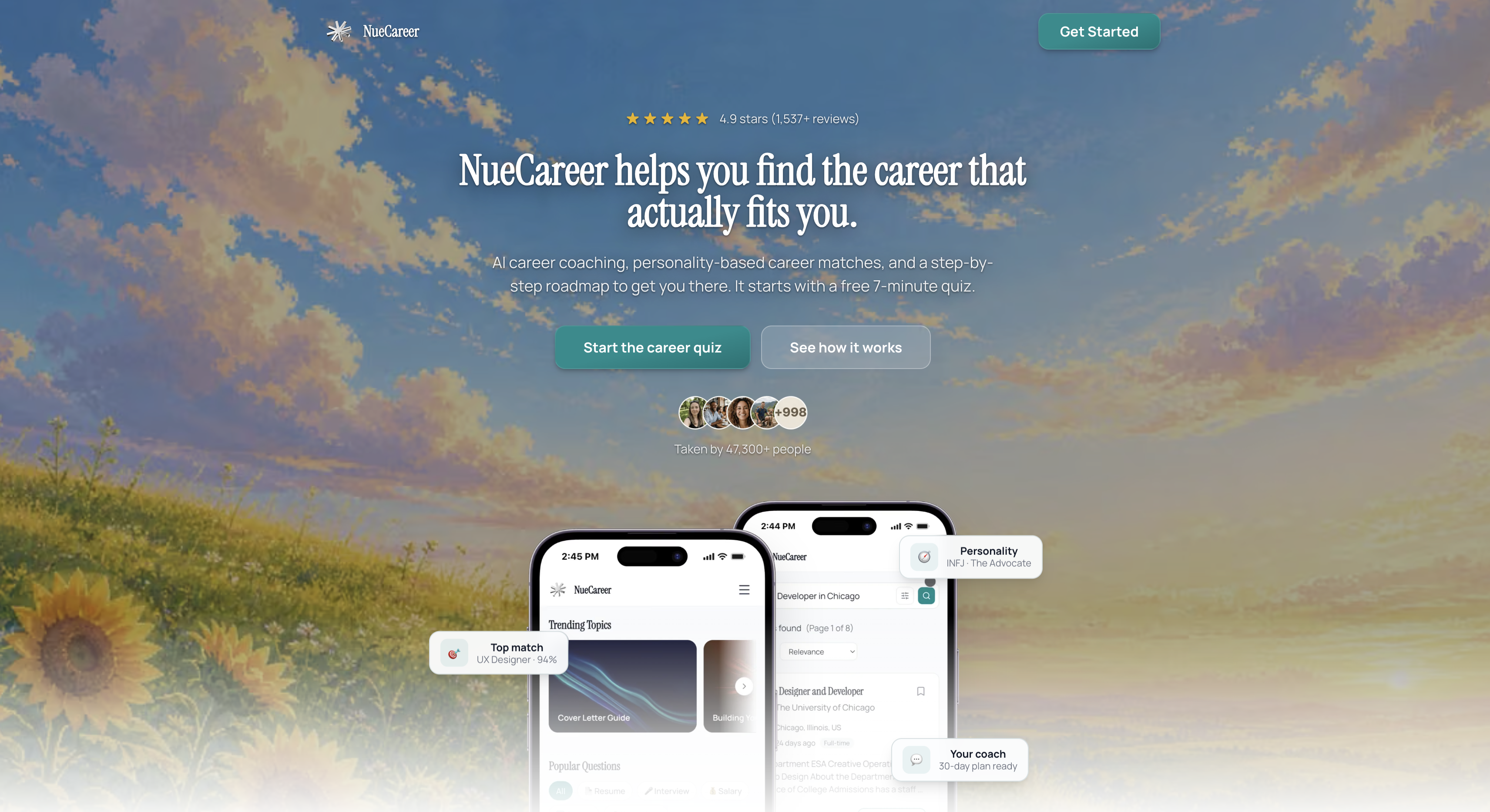
Inside the platform you will find a career directory, a personalized transition roadmap, 24/7 AI career coaching chat, a job board tailored to your target roles, and resume and cover letter tools. There are also free tools such as a Holland Code test, career clusters, an ATS resume checker and mock interview practice. If you prefer to see the whole platform first, start on the NueCareer homepage.
When to re-check your fit
Your first evaluation is not your last. MIT's career advising office puts it simply: career fit can be a moving target, so make time throughout your life to reassess what you want and what makes you happy.
Good moments to revisit your scorecard:
- After a major life change, such as a move, a new family situation or a health shift
- When your daily work starts to feel flat for more than a few months
- After a promotion, layoff or reorganization
- Once a year, as a short check-in with your top five values
A reassessment does not mean you made a mistake. It means you grew. For a deeper walk-through with a 2026 lens, see our guide on how to evaluate new career path fit.
FAQ
How do I know if a career is a good fit for me?
Look at your values, interests, skills, personal style and situation, then compare them with what the career really involves day to day. Research the field, talk to someone in it and try a small project. If the tasks energize you and the lifestyle works, that is a strong sign of fit.
How accurate is a career fit assessment?
Assessments are good at giving you a structured view of yourself and a list of ideas to explore. They cannot define you or tell you what to do, according to Yale's career office. Combine the results with your own self-knowledge and real-world research for the best picture.
Should I take more than one assessment?
It is a good idea. An interest-based test and a values or strengths exercise look at different parts of you. When the same careers show up across more than one, you have a promising lead worth researching further.
How long does it take to evaluate career fit?
The self-assessment can take an hour or two, and a quiz can take minutes. The research and testing take longer: a few hours of reading, a couple of conversations and a short project. Many people spend a few weeks on the full process before they feel confident.
Can I evaluate career fit while still working full time?
Yes. Reading, informational interviews and small projects all fit into evenings and weekends. That is the point of low-cost testing: you learn what you need without putting your income at risk.
Sources
- Finding your fit, University of Colorado Career Services
- How to Choose a Career Path in 12 Steps, Monster
- Career Planning Process, University of Wisconsin HR
- The Five-Step Career Decision Making Process, Yale Office of Career Strategy
- CMC Career Guide
- Career Planning Validity of Self-Estimates and Test Estimates, Wiley
- Choose your career, GetMyFuture, CareerOneStop
- How to find the right career for you, 80,000 Hours
- Self assessment, MIT Career Advising and Professional Development