
How Career Roadmaps Work: Your 2026 Planning Guide

Discover how career roadmaps work to transform your professional life. Create a strategic plan to achieve your goals by 2026.
TL;DR:
- A career roadmap is a dynamic, milestone-based strategic plan that links your current role to a specific professional destination through measurable steps. Maintaining regular reviews and focusing on capability milestones instead of job titles enhances flexibility and long-term success, especially during career transitions. Consistently updating and using your roadmap as a decision filter helps you make intentional choices aligned with your evolving goals.
A career roadmap is a dynamic, milestone-based strategic plan that connects your current position with a specific professional destination through measurable steps and timelines. Unlike a vague career wish list, it gives you a living document you can act on, revise, and rely on when opportunities or setbacks arrive. Research by Dr. Gail Matthews at Dominican University found that written goals improve achievement rates by 42%. That single finding explains why so many professionals who feel stuck stay stuck. Understanding how career roadmaps work is the first step toward changing that.
How career roadmaps work: a step-by-step build
Building a career roadmap takes roughly 30 minutes to set up and a consistent review habit to maintain. The structure is straightforward, but each step requires honest reflection rather than wishful thinking.

1. Audit your current position
Start by mapping what you actually have: skills, experiences, credentials, and relationships. Be specific. "Good communicator" is not a skill audit. "Led cross-functional product launches at a 50-person SaaS company" is. Use a tool like Nuecareer's free skills assessment to surface gaps you might not see on your own.
2. Define a clear direction
Your destination should describe a role, function, or capability level, not just a job title. "Become a data-informed marketing director at a mid-size consumer brand within three years" is a direction. "Get promoted" is not. Specificity here determines whether every later decision feels aligned or arbitrary.
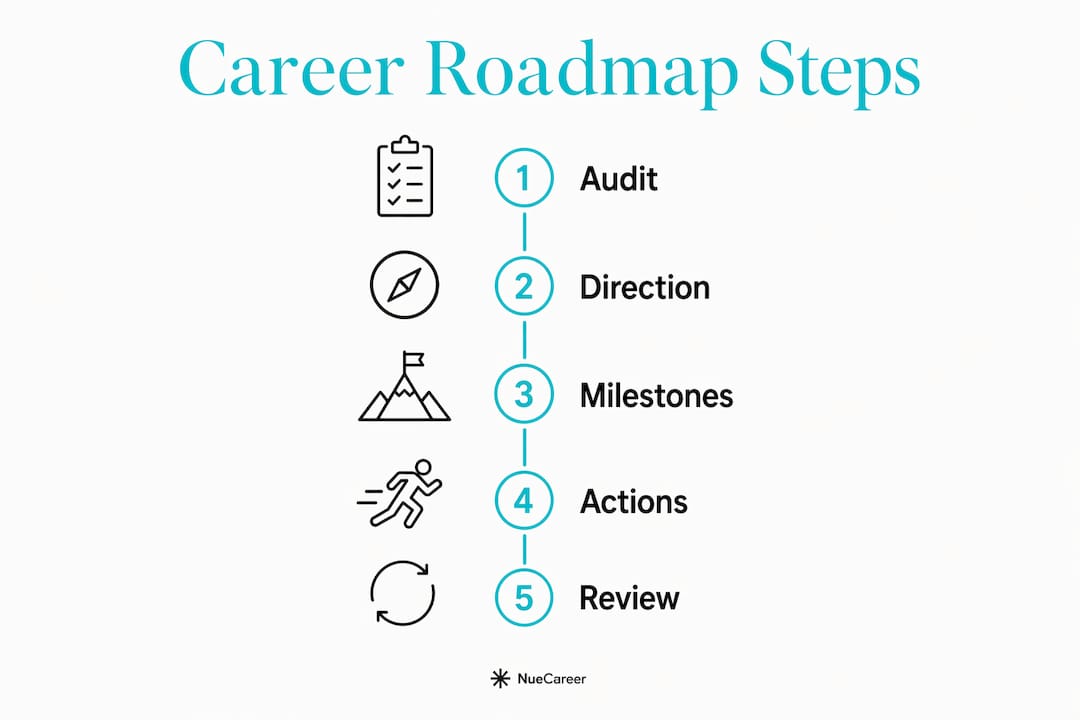
3. Break the path into 3 to 5 milestones
Each milestone should represent a meaningful capability or positioning shift, not just a task. Most career roadmaps cover 18 to 24 months per milestone window, specific enough to be actionable yet long enough to show real progress. A milestone might be "Complete a data analytics certification and apply it to one live campaign by Q3."
4. Identify the actions and resources each milestone requires
For every milestone, list the skills to build, the relationships to develop, the experiences to seek, and the visibility moves to make. This is where the roadmap separates from a career plan. It tells you what to do next week, not just where you want to be in five years.
5. Set a review rhythm and protect it
Schedule a 15-minute monthly check-in and a one-hour quarterly review. These sessions are where you measure progress, adjust timelines, and decide whether your destination still fits. Without this rhythm, even the best roadmap becomes a forgotten document.
Pro Tip: After your first quarterly review, rewrite your destination statement from scratch without looking at the original. If it still matches, you have real clarity. If it shifts, that shift is valuable data about what you actually want.
What makes a career roadmap effective
Not every written plan qualifies as a roadmap. The difference between a roadmap and a simple career plan lies in specificity, measurability, and adaptability.
The most effective roadmaps share these core components:
- A defined destination with a timeframe. "Senior UX researcher at a healthcare tech company within two years" beats "work in UX research."
- Measurable, time-bound milestones. Each milestone has a clear outcome and a deadline. Vague intentions do not count.
- A gap analysis across four dimensions. Career growth involves managing Skills, Visibility, Relationships, and Positioning. Your roadmap should identify gaps in all four, not just skills.
- Actionable steps for each milestone. Every milestone breaks down into specific weekly or monthly actions.
- A built-in revision process. The roadmap is a living document. Treating it as fixed is one of the most common reasons it fails.
The table below shows how a roadmap differs from a standard career plan:
| Feature | Career plan | Career roadmap |
|---|---|---|
| Focus | Job titles and aspirations | Capability milestones and actions |
| Timeframe | Often vague or long-range | 18 to 24 months per milestone |
| Flexibility | Typically static | Regularly revised |
| Decision support | Limited | High. Filters every opportunity |
| Measurability | Low | Built-in milestones and timelines |
The most effective roadmaps focus on capability milestones rather than job titles. This keeps the plan flexible enough to accommodate unconventional paths, lateral moves, or entirely new directions that still move you toward your core destination.
How to use a career roadmap for smarter decisions
A roadmap is not just a planning document. It is a decision-making filter. Every time a new opportunity appears, a project lands on your desk, or a recruiter reaches out, your roadmap tells you whether to say yes, no, or "not yet."
This is where career path planning pays off in ways most people do not anticipate. Consider a marketing manager offered a lateral move into operations. Without a roadmap, that move feels like a step sideways. With a roadmap that includes a milestone around cross-functional leadership, it looks like exactly the right next step.
Positioning moves over 12 months, such as volunteering for high-visibility projects, taking lateral roles, or building relationships outside your immediate team, often accelerate long-term growth faster than waiting for a direct promotion. This is especially true in mid-career, where social capital surpasses human capital as the primary driver of advancement.
Pro Tip: Review your roadmap before every significant career conversation, whether that is a performance review, a networking coffee, or a job interview. Knowing your milestones makes you a sharper, more intentional participant in those moments.
Here is how to apply your roadmap as a live decision tool:
- Evaluate new roles against your milestones. Does this opportunity close a gap or open a new one?
- Use it to guide networking. Identify two or three people whose current role sits one milestone ahead of yours and build those relationships deliberately.
- Adjust for market shifts. If your target industry contracts or a new skill becomes critical, update the roadmap. Rigidity is not discipline. It is a liability.
- Track visibility moves. Speaking at a team meeting, writing an internal report, or presenting to leadership all count as positioning actions. Log them.
The 80,000 Hours career research organization recommends that professionals focus 80% of effort on best next steps while keeping a flexible long-term vision. That ratio maps directly onto how a well-maintained roadmap functions: clear near-term actions, adaptive long-term direction.
Common pitfalls and how to maintain your roadmap
Most career roadmaps fail not because they were built wrong, but because they were never maintained. Treating a roadmap as a rigid, linear plan and skipping regular reviews are the two most consistent causes of stagnation.
Here is how to avoid the most common traps:
- Do not confuse a roadmap with a script. Your path will not unfold in a straight line. A layoff, a new mentor, or a market shift can redirect you. The roadmap helps you recalibrate, not predict.
- Start simple. A one-page roadmap with three milestones beats a 20-page document you never open. Complexity can grow as your clarity grows.
- Protect your review cadence. Monthly 15-minute check-ins and quarterly one-hour reviews are the maintenance rhythm that separates professionals who grow from those who drift.
- Revise without guilt. Changing your destination is not failure. It is evidence that you are paying attention. Update the roadmap and keep moving.
- Celebrate milestone completions. Acknowledging progress reinforces the behavior of following through. It also gives you data about what kind of work energizes you.
"The secret to roadmap success is consistent maintenance. Setting a disciplined review cadence makes the plan a live, actionable guide rather than a forgotten document." — Career development planning guide
The professionals who get the most from career mapping are not the ones with the most detailed plans. They are the ones who show up to their monthly check-ins, ask honest questions, and adjust without drama.
Key takeaways
A career roadmap works because it converts vague professional ambition into specific, measurable milestones that guide decisions, surface gaps, and adapt as your goals and market conditions evolve.
| Point | Details |
|---|---|
| Definition matters | A roadmap is milestone-based and actionable, not just a list of aspirations. |
| Written goals drive results | Dr. Gail Matthews' research shows written goals improve achievement rates by 42%. |
| Four growth dimensions | Skills, Visibility, Relationships, and Positioning all need attention for sustained progress. |
| Maintenance is the real work | Monthly and quarterly reviews keep the roadmap alive and prevent drift. |
| Capability over titles | Milestones built around capabilities stay flexible and open to unconventional paths. |
Why I stopped treating my roadmap like a five-year plan
I built my first career roadmap the wrong way. It was a detailed, color-coded document with job titles mapped out to the year. It felt organized. It also became useless within eight months when the role I was targeting was restructured out of existence.
What I learned from that experience is that the value of a roadmap is not in the destination. It is in the clarity it gives you about what to do this week. When I rebuilt it around capability milestones instead of titles, something shifted. I started saying no to opportunities that felt exciting but pointed the wrong direction. I started saying yes to a lateral move that looked like a step down on paper but gave me the cross-functional exposure I needed.
The other thing I got wrong early on was skipping reviews. I thought the plan was solid enough to run on autopilot. It was not. The quarterly review is where the real thinking happens. That is where you notice that a skill you planned to build is no longer relevant, or that a relationship you overlooked has become the most important one in your network.
If you are considering a career change right now, the benefits of career path clarity are not abstract. They show up in how confidently you walk into a conversation, how quickly you recognize the right opportunity, and how much less time you spend second-guessing yourself. Start with one honest milestone. Build from there.
— Shane
Start building your roadmap with Nuecareer
If you are ready to move from reading about career roadmaps to actually building one, Nuecareer gives you the tools to do it without guesswork.
Start with the career clusters quiz to identify which career paths align with your strengths, including directions you may never have considered. From there, use the skills gap assessment to map exactly where you stand and what your first milestone should target. Nuecareer's personalized roadmaps, 24/7 coaching chat, and job boards are all built around your specific direction, not a generic template. You do not need to figure this out alone. The tools are free, and the first step takes seven minutes.
FAQ
What is a career roadmap?
A career roadmap is a dynamic, milestone-based strategic plan that connects your current professional position with a specific destination through measurable steps and timelines. It differs from a general career plan by being actionable, revisable, and focused on capability development rather than job titles.
How long should a career roadmap cover?
Most career roadmaps are structured around milestones of 18 to 24 months, which is specific enough to drive action and long enough to show meaningful progress. A full roadmap typically includes three to five milestones.
How often should I review my career roadmap?
A 15-minute monthly check-in and a one-hour quarterly review are the recommended maintenance rhythm. These sessions keep the roadmap current and prevent the plan from becoming a static document you ignore.
What is the difference between a career roadmap and a career plan?
A career plan typically lists goals and aspirations. A career roadmap goes further by defining specific milestones, identifying skill and relationship gaps, and providing actionable steps for each stage. Roadmaps are also designed to be revised regularly as circumstances change.
Can a career roadmap help with a career change?
A roadmap is especially useful during a career change because it forces you to define a clear direction, audit transferable skills, and identify the gaps between where you are and where you want to go. It turns an overwhelming transition into a series of manageable, concrete steps.