
Career Change Resume Tips That Get You Hired

Unlock your potential with these career change resume tips! Learn how to showcase your transferable skills and get hired in a new field.
TL;DR:
- Effective career change resumes emphasize transferable skills, tailor each application, and utilize the combination format to balance clarity and ATS compatibility. A compelling summary explains your new professional identity, highlights relevant strengths, and frames the transition as deliberate and valuable. Adding certifications strategically demonstrates commitment and helps bridge experience gaps, increasing credibility with recruiters.
Career change resume tips are targeted strategies that reframe your existing experience to match a new industry's expectations, helping you pass ATS filters and earn recruiter attention. If you are switching fields, a standard chronological resume built for your old career will work against you. The good news: your past experience has more value than you think. The key is knowing how to present it. This article covers the most effective resume tips for career changers, from identifying transferable skills to choosing the right format, so you can apply with clarity and confidence.
1. Lead with your transferable skills
Transferable skills are the abilities you carry from one role or industry into another. Communication, project management, data analysis, problem-solving, and adaptability are consistently valued across industries. These skills are your strongest asset when you lack direct experience in a new field, and they deserve prominent placement on your resume.
The most effective approach is to match your transferable skills directly to the language in the job description. If a marketing role asks for "data-driven decision-making" and you spent five years analyzing sales performance in retail, that experience is directly relevant. You just need to name it in terms the recruiter recognizes.
- Communication: Managing client relationships, writing reports, or leading team meetings all count.
- Problem-solving: Resolving operational bottlenecks, troubleshooting systems, or mediating conflicts translate across roles.
- Project management: Coordinating timelines, budgets, or cross-functional teams applies in almost every industry.
- Adaptability: Rapid onboarding, process changes, or multi-role experience signals flexibility to new employers.
Using numbers to quantify impact strengthens every skill claim. Instead of "managed client accounts," write "managed 40+ client accounts, maintaining a 94% retention rate." Numbers make your experience concrete and credible, even when the industry context is different.
Pro Tip: Use Nuecareer's free skills identifier tool to surface transferable skills you may be overlooking. Many career changers underestimate how much of their experience crosses industry lines.

2. Tailor your resume for every application
A generic resume is the single biggest mistake career changers make. Tailored resumes aligned with job postings help recruiters understand your story and demonstrate genuine interest in the specific role. Sending the same document to twenty employers signals low effort, and ATS systems will filter you out before a human ever reads your name.
Here is a practical process for tailoring each application:
- Copy the job description into a plain text document and highlight every skill, tool, and qualification mentioned.
- Compare it to your resume and identify where your experience overlaps, even if the context differs.
- Rewrite your summary to reflect the specific role title and the top two or three requirements from the posting.
- Adjust your skills section to mirror the exact language used in the job description, since ATS systems scan for keyword matches.
- Reorder your bullet points so the most relevant achievements appear first under each role.
Incorporating keywords from the target role is a core tactic for passing ATS screening. Tools like Nuecareer's job description analyzer can identify the exact terms a posting prioritizes, so you stop guessing and start matching.
Pro Tip: Create a "master resume" with every role, skill, and achievement you have ever held. Then pull from it selectively for each application. This saves time and keeps your tailored versions accurate.
3. Choose the right resume format for a career change
Resume format determines what a recruiter sees first. For career changers, this choice carries more weight than it does for someone staying in the same field. Three formats are worth understanding:
| Format | Structure | Best for |
|---|---|---|
| Chronological | Work history listed newest to oldest | Staying in the same industry |
| Functional | Skills grouped by category, experience listed briefly | Significant career gaps or pivots |
| Combination | Skills summary at top, followed by work history | Career changers with strong transferable experience |
Functional and skills-based resumes highlight transferable skills at the top and place experience lower, which improves clarity for hiring managers reviewing your pivot. However, some ATS systems struggle to parse functional formats, which is why the combination format is often the strongest choice for career changers. It gives you the narrative control of a skills-first layout while preserving the chronological structure that ATS systems and recruiters expect.
The resume format guide from Nuecareer breaks down which layout works best for different transition scenarios, including industry-specific advice for 2026.
4. Write a resume summary that explains your pivot
The resume summary is the most underused tool in a career changer's kit. The summary section can explain who you are, why you are changing careers, and how your previous experience benefits the transition. Without it, recruiters are left to guess your story, and they rarely guess in your favor.
A strong career change summary follows this structure:
- Who you are: Your professional identity in the new field, not your old one. "Operations professional transitioning into UX research" is clearer than "10-year retail manager."
- What you bring: Two or three transferable skills or achievements that directly support the new role.
- Why the change: A brief, forward-looking statement that frames the pivot as intentional, not reactive.
- What you want: A concise statement of the value you will add in the new role.
Replace outdated objective statements entirely. Objective statements focus on what you want from the employer. Summaries focus on what you offer. Recruiters respond to the latter. Nuecareer's resume objective writer can generate a tailored summary in seconds, which is useful when you are applying to multiple roles across different fields.
5. Keep your resume focused and concise
Limiting your resume to two pages and removing unrelated detail keeps the focus on skills and achievements that support your career goals. Recruiters spend an average of six to seven seconds on an initial resume scan. Every line that does not support your target role is a distraction.
For career changers, this means making deliberate cuts. A ten-year history in a previous field does not need five bullet points per role. Condense older or less relevant positions to two lines that highlight transferable achievements only. Prioritize depth in the roles and projects that connect most directly to your new direction.
Simple formatting and thorough proofreading are non-negotiable. Typos signal a lack of attention to detail, which is especially damaging when you are already asking a recruiter to take a chance on an unconventional candidate. Use a clean, single-column layout with consistent fonts and clear section headers.
6. Add certifications and recent education strategically
Certifications are one of the fastest ways to close a credibility gap during a career change. Adding certifications related to the target role strengthens your credentials and signals to recruiters that you have invested in the transition, not just applied on a whim.
Here is how to position them effectively:
- Place a certifications section near the top of your resume if the credential is directly relevant to the role. For example, a Google Analytics certification belongs near the top of a resume targeting a digital marketing position.
- List the issuing organization and completion date so recruiters can verify credentials quickly. Coursera, LinkedIn Learning, Google, HubSpot, and AWS are all recognized names that carry weight.
- Include bootcamp projects or capstone work if you completed a structured program. A data science bootcamp project analyzing real datasets is more persuasive than a course title alone.
- Mention relevant coursework from degree programs if it directly supports the new role, even if the degree itself is in a different field.
Continuous learning is a strong signal to recruiters. It shows self-direction and commitment, two qualities that matter enormously when you are asking someone to hire you for a role you have not held before.
Key takeaways
A career change resume succeeds when it leads with transferable skills, uses a combination format, and includes a clear summary that frames your pivot as intentional and valuable.
| Point | Details |
|---|---|
| Lead with transferable skills | Identify and quantify skills that apply across industries and match them to job description language. |
| Tailor every application | Adjust your summary, skills section, and bullet points to mirror each specific job posting. |
| Choose the combination format | This layout gives you skills-first clarity while maintaining the ATS-friendly structure recruiters expect. |
| Write a strong summary | Use it to explain who you are in the new field, what you bring, and why the transition is intentional. |
| Certifications close gaps | Prominently placed credentials from recognized providers signal commitment and reduce recruiter hesitation. |
What I have learned from watching career changers succeed and fail
Most career changers I have worked with make the same mistake: they write a resume that defends their past instead of selling their future. They list every job they have ever held in full detail, as if volume of experience compensates for a mismatch in industry. It does not. Recruiters are not looking for a complete biography. They are looking for a reason to say yes.
The resumes that actually work are the ones that make a clear argument in the first ten seconds. The summary does the heavy lifting. The skills section reinforces it. The work history provides evidence. When those three elements align around the target role, the career change stops looking like a risk and starts looking like a deliberate, well-prepared move.
One thing I rarely see discussed: the caregiving-to-career transition is one of the hardest pivots to write a resume for, because so much of the relevant experience is unlisted and undervalued. The same principle applies to any non-traditional background. Your job is to translate that experience into professional language, not to apologize for it.
The other thing I would tell anyone in a career transition: update your resume every time you complete a new course, project, or certification. Do not wait until you are actively job searching. The best career change resumes are built over months, not assembled in a weekend.
— Shane
Start your career change with the right tools
If you are ready to put these strategies into practice, Nuecareer has the tools to make it faster and less stressful. Start with the Career Clusters Quiz to identify which career paths align with your strengths and interests. From there, Nuecareer's resume and cover letter suite helps you build targeted applications for each role you pursue.
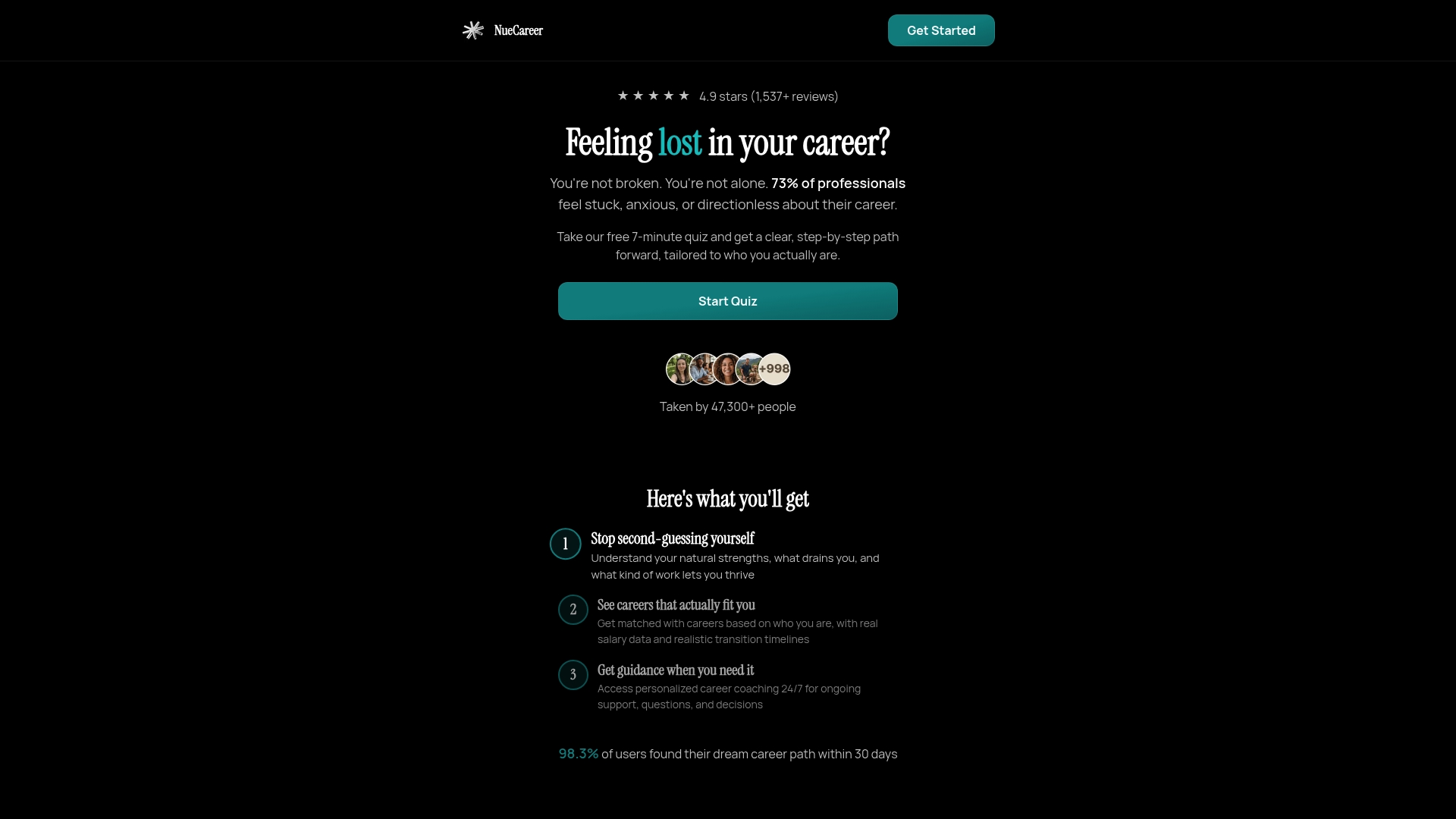
Whether you are writing your first career change resume or refining one that has not been getting responses, Nuecareer's 24/7 coaching chat and personalized roadmaps give you a clear path forward. You do not have to figure this out alone.
FAQ
What is the best resume format for a career change?
The combination format works best for most career changers because it places a skills summary at the top while preserving the chronological work history that ATS systems expect. Functional formats can work but may be harder for automated screening tools to parse.
How do I explain a career change on my resume?
Use the resume summary section to frame your pivot clearly. State your professional identity in the new field, highlight two or three transferable skills, and explain the transition as a deliberate move toward a better fit, not a departure from failure.
Should I include all my previous work experience on a career change resume?
No. Keep your resume to two pages and condense or omit roles that do not support your target position. Older or unrelated experience can be summarized in one or two lines rather than listed in full detail.
How do certifications help a career change resume?
Certifications related to the target role signal commitment and close experience gaps. Credentials from recognized providers like Google, HubSpot, Coursera, or AWS carry particular weight with recruiters reviewing unconventional candidates.
How do I pass ATS when changing careers?
Incorporate keywords from the job description directly into your resume, particularly in your summary and skills sections. Use Nuecareer's ATS resume checker to verify your resume is formatted and optimized correctly before submitting.