
What Does Job Fit Mean? A Clear Career Guide

Discover what job fit means and how it impacts your career satisfaction. Align your skills and values with the right job for you.
TL;DR:
- Job fit refers to the alignment between an individual's characteristics and the specific demands of a job. It includes person-job, person-organization, and person-group fit, each predicting different outcomes related to satisfaction and retention. Assessing all three dimensions thoroughly ensures a better match and long-term career success.
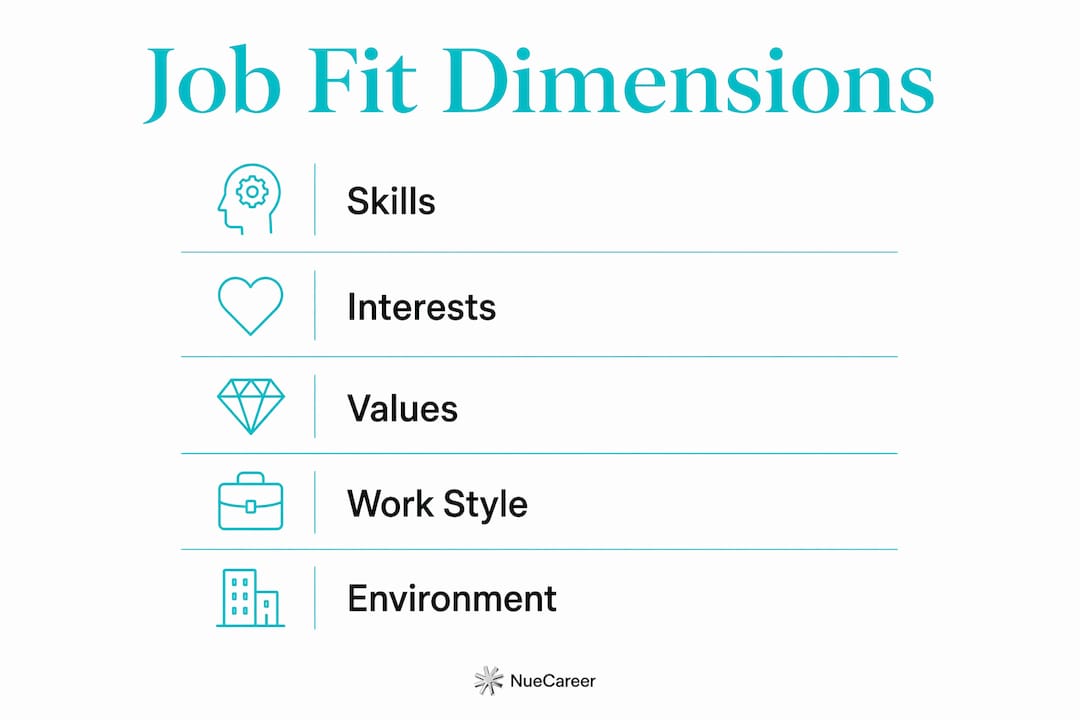
Job fit is defined as the degree of alignment between your personal characteristics — skills, values, interests, and preferred work style — and the specific demands and environment of a job role. This concept sits at the heart of person-environment fit theory, which links congruence between a person and their work context to measurable outcomes like satisfaction, commitment, and tenure. Most career explorers focus on whether they can do a job. Job fit asks a deeper question: will this role actually work for who you are? Tools like the O*NET Interest Profiler, Edgar Schein's Career Anchors framework, and job inventory questionnaires all exist because that question is harder to answer than it looks.
What does job fit mean across its key dimensions?
Job fit is not a single measure. Researchers and career professionals recognize at least three distinct types, and each one predicts different outcomes.
- Person-job fit is the match between your skills, abilities, and motivations and the actual demands of the role. A 2026 study confirmed that person-job fit predicts job engagement specifically, meaning how absorbed and energized you feel doing the work itself.
- Person-organization fit measures alignment between your values and the culture, mission, and norms of the employer. The same research found this type predicts organizational engagement, which is your sense of commitment to the company rather than just the role.
- Person-group fit reflects how well your working style meshes with your immediate team. This dimension is often overlooked during job searches, yet it shapes your daily experience more than almost anything else.
These distinctions matter because vague impressions of "feeling like a good fit" collapse all three into one fuzzy judgment. You might love the role but clash with the culture. You might share the company's values but find the team's pace exhausting. Separating the dimensions gives you a clearer picture of where alignment exists and where it does not.
The RIASEC model, developed by psychologist John Holland, offers a structured way to assess interest fit. It categorizes work personalities into six types: Realistic, Investigative, Artistic, Social, Enterprising, and Conventional. Matching your RIASEC profile to occupational codes in the O*NET database is one of the most research-backed approaches to evaluating career path fit.

Pro Tip: Assess all three fit dimensions before accepting any role. A job that scores well on skills match but poorly on culture or team fit will drain your energy within months.
Why is job fit important for satisfaction and performance?
The research on this is direct. The Kristof-Brown et al. (2005) meta-analysis, one of the most cited studies in organizational psychology, shows that strong person-job fit correlates positively with job satisfaction, organizational commitment, supervisor satisfaction, performance, and tenure, while reducing the intention to quit.
That finding has a practical implication most job seekers miss. Competence alone does not guarantee you will stay, thrive, or find meaning in a role. A technically skilled software engineer placed in a highly structured, low-autonomy environment may perform adequately for a year and then burn out. The skills were there. The fit was not.
"Person-job fit explains why technically competent workers may still lack satisfaction and retention. Motivation and job conditions matter as much as ability." — Frontiers in Psychology, 2025
Misfit signals are worth learning to recognize. Overqualification leads to boredom, while underqualification produces chronic overwhelm. Both states erode satisfaction over time and predict eventual departure. If you have ever felt restless in a role you were objectively good at, that is overqualification misfit in action.
Career fit research consistently shows a larger impact on long-term satisfaction and career longevity than compensation in most studies. Salary matters, but it does not compensate for work that conflicts with your values or drains your energy every day.
How can you assess your own job fit?
Practical assessment follows a clear sequence. Each step builds on the last, and skipping steps is where most people go wrong.
Complete a job inventory questionnaire. A job inventory questionnaire evaluates your skills, values, interests, and work style against actual job demands. This differs from a standard resume review because it surfaces what you need from a role, not just what you can offer.
Identify your environmental preferences. Define the conditions that affect your energy and performance: autonomy versus structure, fast-paced versus methodical, collaborative versus independent. Mapping these environmental conditions against specific roles reduces superficial fit judgments and gives you concrete criteria to evaluate.
Use Edgar Schein's Career Anchors. Schein's framework identifies eight core career motivators, including technical competence, security, autonomy, and entrepreneurial creativity. Knowing your anchor tells you which trade-offs you will and will not accept over a full career.
Run informational interviews. Conduct 5 to 10 informational interviews with people currently in roles you are considering. Ask specifically about what energizes them versus what drains them, what a typical Tuesday looks like, and what surprised them most about the role. This is the fastest way to close the gap between a job description and reality.
Validate with the O*NET Interest Profiler. The O*NET Interest Profiler is a free, research-backed tool from the U.S. Department of Labor. It maps your interest profile to hundreds of occupations with detailed data on tasks, work styles, and required skills. Use it to confirm or challenge your assumptions after completing the earlier steps.
Pro Tip: Never rely on a job description alone to assess fit. Job descriptions describe the ideal candidate, not the actual daily work. The real demands of a role only emerge through direct conversation with people doing the job.
A skills assessment can also help you identify where your abilities genuinely sit before you start mapping them to roles. Knowing your real skill level, not your assumed one, makes every subsequent step more accurate.
Job fit vs. skills fit: how are these concepts different?
These terms are often used interchangeably, but they describe different things. Understanding the distinction helps you avoid a very common career mistake.
| Concept | What It Measures | What It Predicts |
|---|---|---|
| Skills fit (ability match) | Whether your technical abilities meet role requirements | Short-term performance and hiring eligibility |
| Person-job fit | Alignment of skills, values, interests, and motivations with role demands | Job engagement, satisfaction, and retention |
| Person-organization fit | Alignment of your values with company culture and mission | Organizational commitment and belonging |
| Person-group fit | Compatibility with team working style and interpersonal dynamics | Daily energy, collaboration quality, and team tenure |
| Job description match | Alignment with the written role profile | Interview success, not necessarily real-world fit |
Skills fit is a threshold question: do you meet the minimum requirements? Person-job fit is a sustainability question: will this role keep you engaged and growing over time? A candidate can clear the skills threshold and still be a poor fit if the work conflicts with their values or requires a work style that depletes them.
The definition of job fit in academic literature specifically includes motivations and preferences alongside abilities. That broader scope is what separates it from a simple skills match. When you explore career personality types, you start to see how much of fit lives outside the skills column entirely.
Job descriptions add another layer of confusion. They describe an idealized version of the role, written for recruiting purposes. The actual daily demands often differ significantly. Treating the job description as the full picture of a role is one of the most reliable ways to misjudge fit before you start.
Key takeaways
Job fit is the single strongest predictor of long-term career satisfaction, outperforming both compensation and job title in research on employee wellbeing and retention.
| Point | Details |
|---|---|
| Job fit defined | Alignment between your skills, values, interests, work style, and actual role demands. |
| Three fit dimensions | Person-job, person-organization, and person-group fit each predict different outcomes. |
| Skills fit is not enough | Competence meets the hiring bar; full job fit determines whether you stay and thrive. |
| Assessment tools | Use job inventory questionnaires, Career Anchors, O*NET, and informational interviews together. |
| Job descriptions mislead | Real fit requires understanding daily work realities, not just the written role profile. |
The part most career advice gets wrong
I have spent years watching people evaluate job opportunities almost entirely on two criteria: the job title and the salary. Both are visible, easy to compare, and ultimately poor predictors of whether someone will be satisfied two years in.
The more honest conversation is about what the work actually feels like on a Wednesday afternoon. Does the pace match how you process information? Does the level of autonomy align with how you do your best work? Does the team's communication style energize or exhaust you? These questions feel softer than salary negotiations, but the research is unambiguous. Fit on these dimensions predicts retention and satisfaction more reliably than compensation does.
The other mistake I see constantly is treating self-assessment as the final step. Self-knowledge is the starting point, not the destination. You need external validation through informational interviews, structured tools like O*NET, and honest conversations with people already in the roles you are considering. Blending internal reflection with external data is what separates a well-reasoned career decision from an expensive guess.
If you are exploring a career change right now, give yourself permission to slow down and assess fit deliberately. The time you invest before committing to a path saves you years of misalignment on the other side.
— Shane
Ready to find roles that actually fit you?
Understanding job fit is one thing. Knowing which roles align with your specific strengths, values, and work style is another. Nuecareer makes that second step concrete.
The free career skills assessment on Nuecareer identifies your real strengths and skill gaps in minutes, giving you a clear baseline before you start evaluating roles. From there, the free job description analyzer breaks down exactly what any role demands, so you can compare it directly against your profile. Together, these tools turn a vague sense of "does this fit me?" into a structured, evidence-based answer. If you are exploring career options and want to stop guessing, start with what you actually know about yourself.
FAQ
What does job fit mean in simple terms?
Job fit means how well your skills, values, interests, and work style match the demands and environment of a specific role. Strong fit predicts higher satisfaction, better performance, and longer tenure.
Is job fit the same as being qualified for a job?
No. Qualifications measure whether you can do the work. Job fit measures whether the role aligns with your motivations, values, and preferred work conditions, which determines whether you will stay engaged over time.
How do i know if i have good job fit?
Use structured tools like the O*NET Interest Profiler, Edgar Schein's Career Anchors, and a job inventory questionnaire. Then validate your conclusions through informational interviews with people currently in the role.
What are the main types of job fit?
The three main types are person-job fit (role demands vs. your abilities and motivations), person-organization fit (company culture vs. your values), and person-group fit (team style vs. your working preferences).
Can you have good skills fit but poor job fit?
Yes. A technically competent person placed in a role that conflicts with their values or requires a draining work style will often underperform or leave, even when their skills fully meet the job requirements.