
How to Identify Transferable Skills for a Career Change

Discover how to identify transferable skills for a career change and streamline your job search process in just one week.
You can identify transferable skills for a career change and build a prioritized list in about a week by following a focused four-stage process: evaluate your past roles, inventory your skills hands-on, map them to your target career, then close the gaps. The payoff is real: candidates who name their transferable skills clearly tend to move through job searches faster, with less retraining time and stronger resume language from day one.
Here's your first move, starting today:
- Days 1-2: List your five favorite tasks from your last three roles
- Days 3-4: Run a skills inventory (we'll show you how below)
- Days 5-6: Pull 15-20 target job postings and highlight repeated language
- Day 7: Match your top 3 skills to that language
A good result looks like this: "Stakeholder reporting, cross-team negotiation, and process documentation" — not "good communicator, team player, detail-oriented." That specificity is the whole game.
Key Takeaways
Identifying transferable skills for a career change works when you name specific competencies, validate them through a structured inventory, and match them to language your target industry actually uses.
| Point | Details |
|---|---|
| Name competencies, not traits | Use terms like "vendor negotiation," not "team player," since hiring managers need observable outcomes. |
| Follow the four-stage framework | Evaluate roles, run an inventory, map to target pain points, then close gaps with action steps. |
| Most skills are transferable | Roughly 75% of on-the-job skills transfer across industries, according to Transferable Skills Scale research. |
| Mirror job posting language | Collect 15-20 target postings and match repeated phrases to your real examples before rewriting your resume. |
| Use Nuecareer to speed stage two | The 7-Minute Career Quiz identifies your strengths and matches them to career paths in minutes, not weeks. |
Table of Contents
- What Are Transferable Skills and Why Do They Matter?
- What Are Common Transferable Skills Across Industries?
- How Do I Identify My Own Transferable Skills?
- How Do I Map Skills to Job Postings and Resume Bullets?
- How Do You Close a Transferable Skills Gap Fast?
- Quick Templates to Use Right Now
- How Nuecareer Speeds Up Skills Identification
- Sources
- FAQ
What Are Transferable Skills and Why Do They Matter?
Transferable skills are named, demonstrable competencies you built in one role that produce value in another, like vendor negotiation, stakeholder reporting, or budget forecasting. They're not the same as personality traits. "Good communicator" tells a hiring manager nothing. "Reduced client churn by simplifying quarterly reports" tells them exactly what you can do on day one.
This distinction matters for three practical reasons:
- Reduced perceived risk. Employers hesitate to hire outside their industry because they can't picture your output. Named skills fix that.
- Faster contribution. Transferable skills reduce training time because you're not learning the underlying competency, just the context.
- Broader role options. Naming skills instead of job titles opens roles you'd never have searched for.
One number worth sitting with: research on the Transferable Skills Scale suggests roughly 75% of on-the-job skills are transferable, while only about 25% are technical. Most of what makes you good at your job isn't tied to your industry at all.
What Are Common Transferable Skills Across Industries?
Print this out. Check off what applies. This is your first-pass inventory before you get more rigorous in the next section.
Communication
- Stakeholder reporting — a nurse briefing a physician on patient status; a project manager updating a client on scope changes.
- Persuasive writing — a teacher writing parent communications; a marketer drafting a sales page.
Execution
- Vendor negotiation — a restaurant manager negotiating with a produce supplier; a procurement analyst negotiating software contracts.
- Process documentation — a warehouse supervisor writing safety procedures; a software engineer writing onboarding docs.
People
- Conflict de-escalation — a retail manager handling an upset customer; an HR generalist mediating a team dispute.
- Cross-functional coordination — an event planner syncing vendors and venues; a product manager syncing engineering and design.
Thinking
- Data analysis — a retail buyer forecasting seasonal demand; a financial analyst modeling revenue.
- Root-cause troubleshooting — an IT technician diagnosing network failures; a manufacturing lead diagnosing line defects.
Adaptability
- Rapid reprioritization — an ER nurse triaging patients; a startup operations lead shifting priorities weekly.
The naming rule matters here: a skill only counts as transferable if a hiring manager could ask you for an outcome and it shows up in job postings outside your current industry. "Team player" fails that test. "Cross-functional coordination" passes it.
Pro Tip: Treat this checklist as a living document. Revisit it every time you apply to a new type of role, since the language that resonates shifts depending on the target industry.
How Do I Identify My Own Transferable Skills?
This is where most career changers get stuck. They know they're good at their job, but they can't translate "good at my job" into words a stranger would understand. A structured framework fixes that. Berkeley's career mobility framework breaks the work into four stages, and it typically takes several weeks to work through properly as part of a real transition plan.
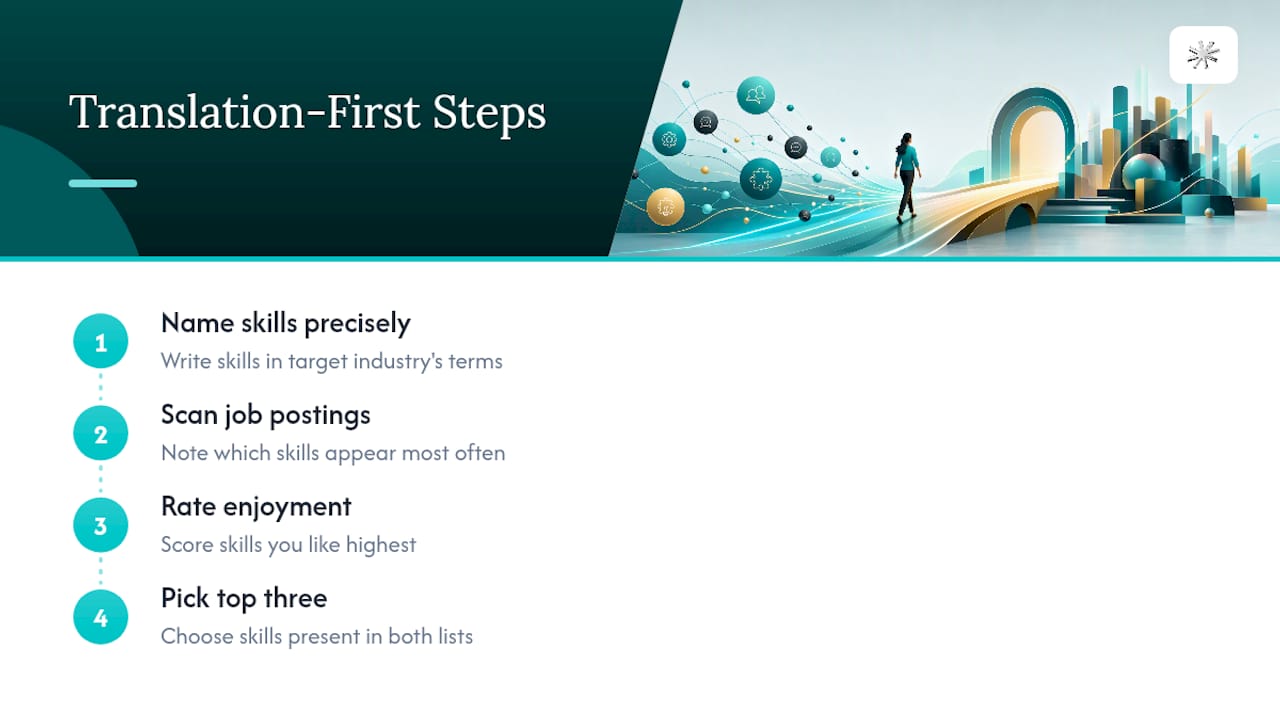
- Evaluate your roles. For each job you've held, list your three favorite tasks and one accomplishment you're proud of. Don't filter for relevance yet, just capture what energized you.
- Run a hands-on skills inventory. Use a structured tool. CareerOneStop's skills assessment rates you across dozens of skill areas and links strong scores to matching occupations.
- Map your skills to your target career's pain points. What does that industry struggle with? Slow onboarding? Vendor churn? Match your named skills to those specific problems.
- Reflect and build gap-closing steps. Whatever's missing becomes your 30/60/90-day plan (more on that below).
Turn this into a worksheet with three columns: Skill, Proficiency (1-5), and Evidence. Here's a filled example:
| Skill | Proficiency | Evidence |
|---|---|---|
| Vendor negotiation | 4 | Cut supplier costs 12% across 3 contracts |
| Data analysis | 3 | Built weekly sales dashboard used by 6-person team |
Pro Tip: Rate enjoyment alongside proficiency. A skill you're great at but dread using won't sustain you through a career change, so weigh both before you commit to a target role.
How Do I Map Skills to Job Postings and Resume Bullets?
Once you have your rated list, the next job is translation. A practical mapping workflow starts by collecting 15-20 target job descriptions and highlighting the skill language that repeats across them. Then match each repeated phrase to a real example from your own history.
- Collect target job postings for roles you actually want.
- Highlight competencies that show up in at least 3 of them.
- Match each one to a specific memory, not a vague sense that you "have that."
- Rewrite your resume bullets using that exact language.
Sample transformations, task to competency to result:
- Answered customer calls → Conflict de-escalation → Resolved 90% of escalated complaints without manager involvement
- Tracked inventory in spreadsheets → Data analysis → Reduced stockouts 18% through demand forecasting
- Trained new hires → Process documentation → Cut onboarding time by writing a 12-page training guide
For interview stories, build one STAR example (Situation, Task, Action, Result) per top skill. Our career changer interview guide walks through the format in detail, and our resume tips for career changers covers bullet structure beyond these examples.
How Do You Close a Transferable Skills Gap Fast?
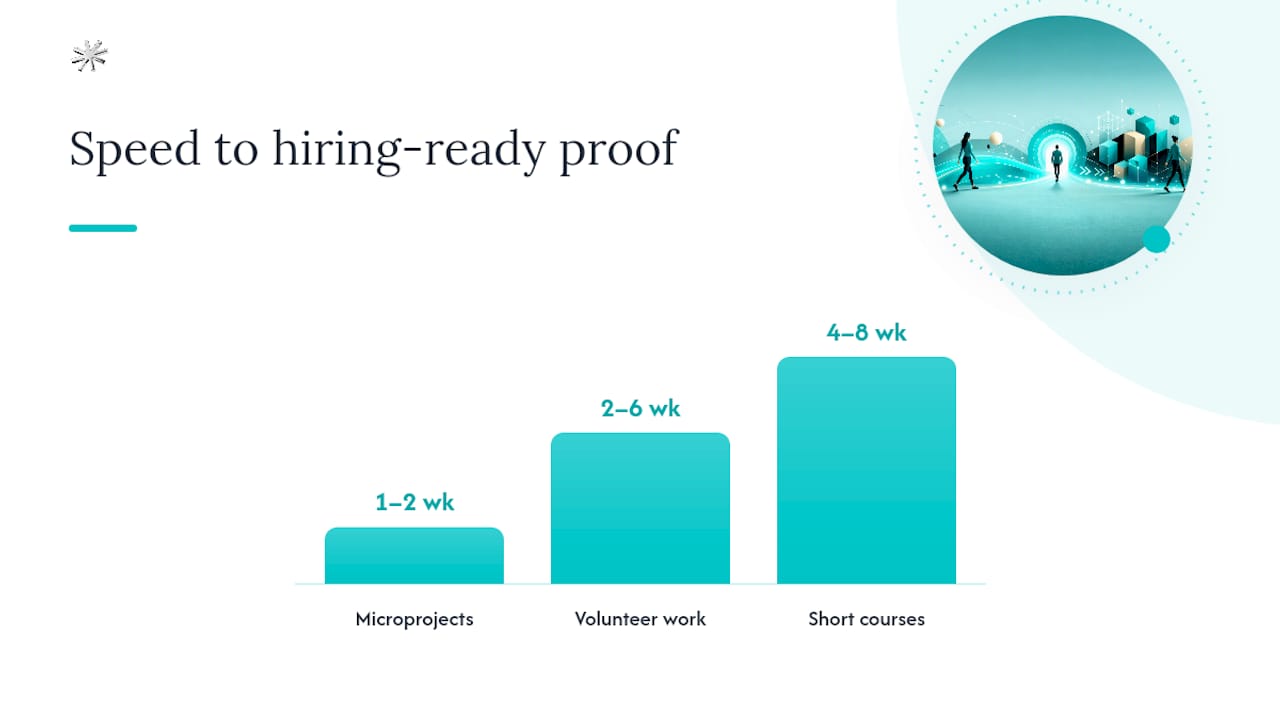
Found a gap? Don't panic and enroll in a two-year program. Short, applied learning often produces hiring-ready evidence faster than long certifications because it results in a deliverable you can show, not just a certificate you can claim.
30/60/90-day plan for one critical gap:
- Days 1-30: Complete a short course or applied workforce training program with a project deliverable.
- Days 31-60: Apply it through a microproject, volunteer role, or paid side gig.
- Days 61-90: Document the outcome and add it to your resume and portfolio.
Ranked by speed to proof:
- Microprojects (1-2 weeks): fastest, but limited in scope
- Volunteer work (2-6 weeks): builds real evidence, often with a testimonial
- Short courses with deliverables (4-8 weeks): structured, credential-adjacent
- Shadowing or side gigs (ongoing): slowest, but deepest exposure
Quick Templates to Use Right Now
Three templates you can copy directly into your job search materials today.
Resume bullet formula: [Task] led to [named competency] resulting in [measurable result]. Example: "Managed monthly budget reconciliation, developing financial analysis skills that identified $8,000 in recoverable costs."
LinkedIn headline: "Operations professional bringing vendor negotiation, process documentation, and cross-functional coordination to [target industry]."
7-day plan:
- Days 1-2: Assessment.
- Days 3-4: Skills mapping.
- Days 5-6: Resume/LinkedIn updates.
- Day 7: Outreach to 5 contacts in your target field.
Why the Translation-First Approach Actually Works
Most career-change advice tells people to "find their passion" without ever making them write down what they're good at in language a stranger could verify. That's backward. The gap most career changers face isn't a capability gap; it's a vocabulary gap. You already have the skill. You just haven't named it the way your target industry names it.
The framework above works because it forces specificity before it allows optimism.
Pro Tip: Pick your top 3 skills by asking which ones show up most often in your target job postings AND which ones you rated highest for enjoyment. Skills that hit both criteria move your search fastest.
How Nuecareer Speeds Up Skills Identification
Working through four stages of self-assessment on your own takes real time, and most career changers stall out at stage two: the hands-on skills inventory. The 7-Minute Career Quiz compresses that stage into minutes instead of weeks, matching your strengths to career paths you may not have considered, including ones outside your current industry entirely.
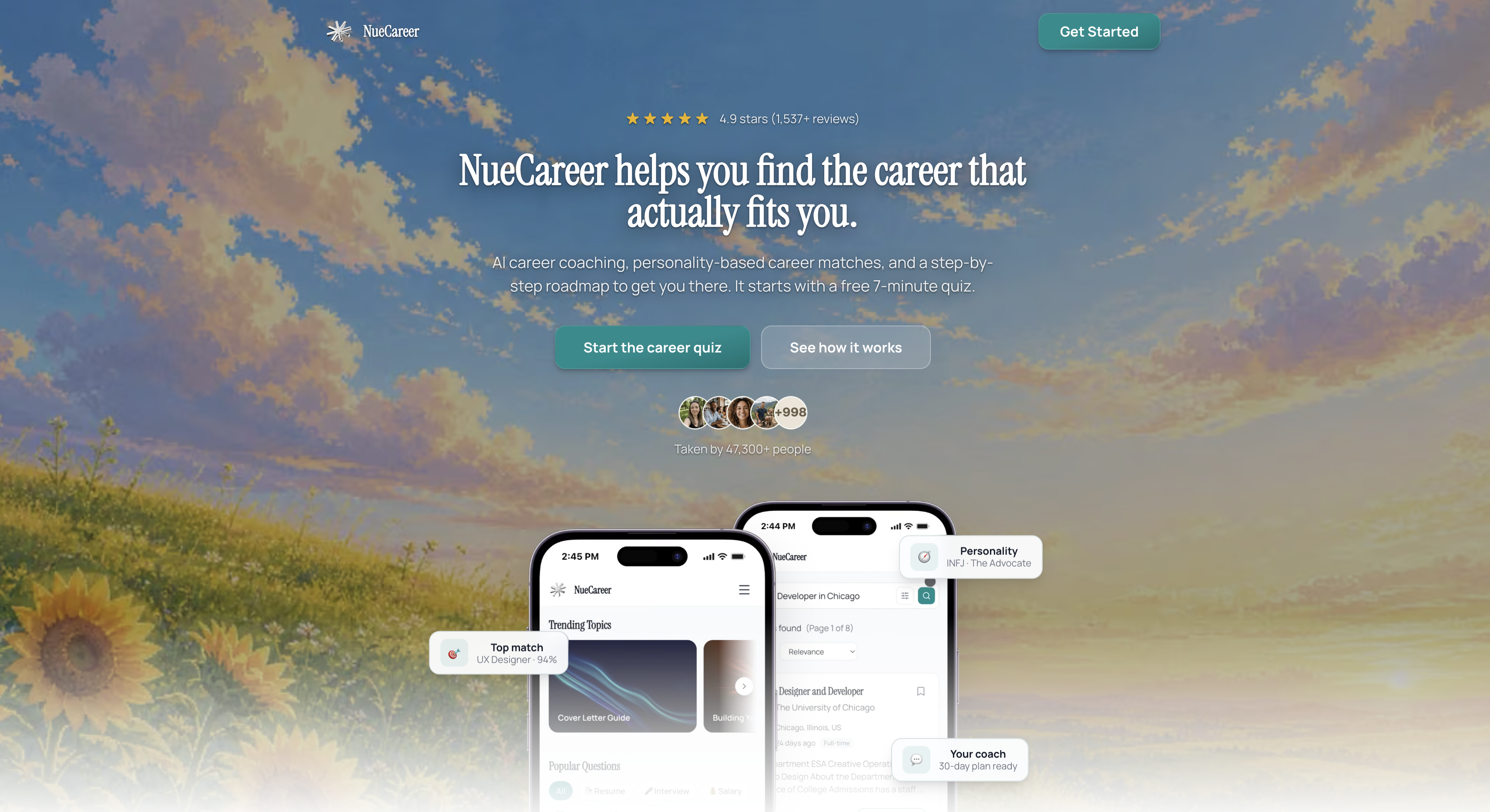
From there, Nuecareer's platform handles stage three for you: personalized roadmaps map your quiz results directly to target roles, and the built-in resume and cover letter tools translate your named skills into application-ready language automatically. Add 24/7 coaching chat for when you're stuck on a specific gap, and tailored job boards so you're not scrolling through irrelevant postings. Free tools get you started; paid features unlock the full roadmap and coaching. Take the 7-minute quiz today and see which career paths match the skills you already have.
Sources
FAQ
What are 5 examples of transferable skills?
Vendor negotiation, stakeholder reporting, data analysis, process documentation, and conflict de-escalation all count as concrete, named transferable skills that show up across industries.
What are the top 10 transferable skills?
Beyond the five above, add cross-functional coordination, persuasive writing, rapid reprioritization, root-cause troubleshooting, and budget forecasting. Prioritize whichever ones repeat most often in your target job postings.
How do I identify my own transferable skills?
Follow the four-stage framework: evaluate your favorite past tasks, run a skills inventory like CareerOneStop's assessment or Nuecareer's 7-Minute Career Quiz, map results to your target career's needs, then build steps to close any gaps.
Are transferable skills more important than technical skills for a career change?
Not more important, but often more numerous.
How often should I update my transferable skills list?
Treat it as a living document and refresh it monthly or quarterly, or any time you shift your target role, since the language that resonates changes with the industry you're targeting.