

TL;DR:
- Thorough career research combines self-assessment, market data, task analysis, and informational interviews. It helps individuals identify the best-fit careers and reduces costly mistakes. Avoid narrow options by exploring multiple paths and validating choices through conversations and data.
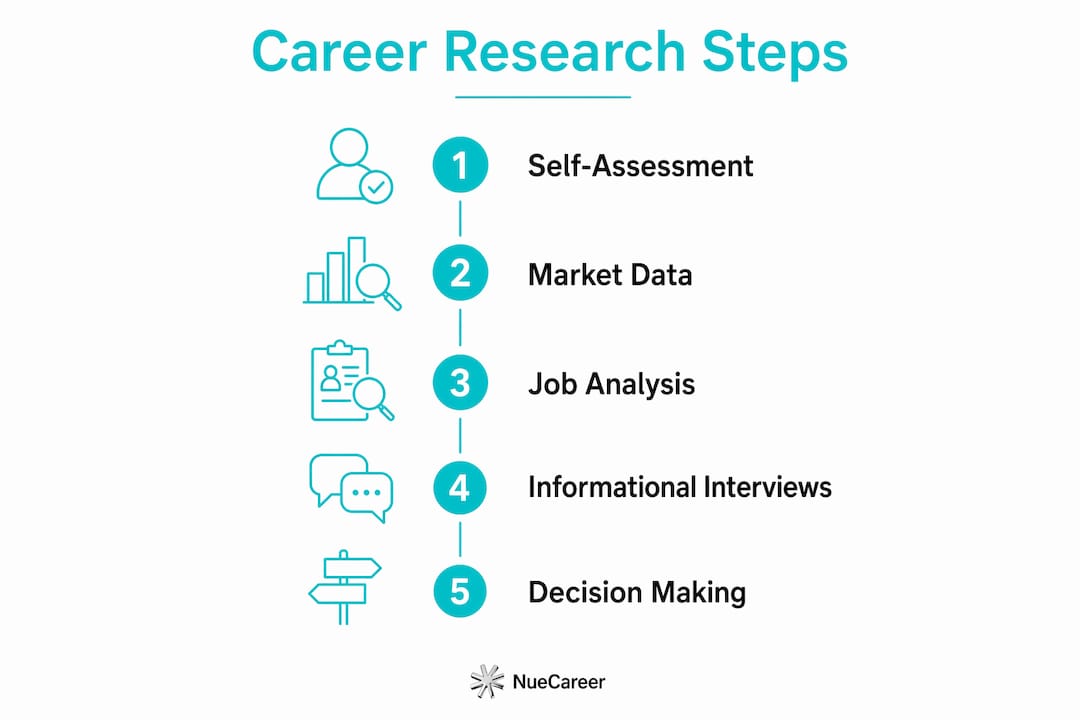
Researching new career paths thoroughly means using a structured, data-driven approach combined with honest self-reflection to find career options that genuinely fit your skills, values, and life. Career path research is not just browsing job boards or following advice from friends. It is a deliberate process that combines an inward-first self-assessment with real market data, task-level job analysis, and direct conversations with professionals already working in your target field. Done right, it reduces costly missteps and replaces vague anxiety with clear, confident direction. Nuecareer's tools cover this entire process, from identifying your strengths to analyzing job descriptions, so you can move forward with a plan that is built around who you actually are.
How to research new career paths thoroughly: start with self-assessment
The foundation of any successful career change is an honest inventory of what you bring to the table. Successful career transitions start with comprehensive documentation of your technical skills, your transferable skills, and a clear articulation of your core values and work preferences. This inward-first approach acts as a filter, narrowing your research to careers that have a real chance of working for you.
Start by listing your technical skills. These are the specific, teachable abilities you have built in your current role, such as data analysis, project management, or client communication. Then list your durable skills, the ones that transfer across industries, like critical thinking, written communication, and team leadership.
Next, define your non-negotiables. Ask yourself what you absolutely need from work:
- Work environment: Do you need remote flexibility, or do you prefer a structured office setting?
- Mission alignment: Does the organization's purpose need to connect with your values?
- Growth pace: Do you want fast promotion tracks, or do you prefer deep expertise in one area?
- Income floor: What is the minimum salary that keeps your life stable?
These answers become your personal career filter. Every path you research gets measured against them.
Pro Tip: Use Nuecareer's free career skills assessment to get a structured picture of your strengths and gaps before you start researching specific roles. It takes the guesswork out of the inventory step.
Where to find reliable data on career options and market outlook
Once you know what you are looking for, you need authoritative data to evaluate whether a career path is actually viable. Gut feelings about "growing industries" are not enough. You need numbers.

The U.S. Bureau of Labor Statistics Occupational Outlook Handbook provides reliable projections on job growth, median pay, and education requirements for hundreds of occupations. This data helps you validate whether a career you are excited about is actually expanding or contracting over the next decade.
Beyond the BLS, structured career exploration tools give you broader coverage. Career navigator assessments can match you against more than 1,800 careers using real-time labor market data, including salary ranges and demand levels across different locations. That scale matters because it surfaces careers you would never have considered on your own.
Use a combination of sources to build a complete picture:
- BLS Occupational Outlook Handbook: Job growth projections, median salaries, and required education levels
- Real-time job market platforms: Current demand signals, skill frequency in postings, and geographic salary variation
- Industry association reports: Sector-specific trends that government data sometimes lags behind
- LinkedIn Salary and Jobs data: Actual hiring volume and compensation ranges by region
Do not limit your research to obvious choices. Emerging fields like climate technology, health informatics, and financial engineering often show strong demand before they appear prominently in traditional career guides. Exploring financial engineering pathways is one example of how a specialized field can offer strong long-term prospects for adults with analytical backgrounds.
| Data source | Best used for | Limitation |
|---|---|---|
| BLS Occupational Outlook Handbook | Long-term growth projections | Updated annually; may lag emerging roles |
| Real-time job market platforms | Current demand and skill frequency | Reflects only posted jobs, not all hiring |
| Industry association reports | Sector trends and professional standards | May carry industry bias |
| Informational interviews | Day-to-day reality and culture | Subjective; limited sample size |
How to analyze job descriptions to identify real skill requirements
Job titles are misleading. A "Project Manager" at a tech startup and a "Project Manager" at a hospital system share a title but almost nothing else in terms of daily work. Task-level analysis cuts through that noise.
Analyzing 10–15 detailed job descriptions in your target field reveals the specific tasks, software tools, methodologies, and certifications that employers actually value right now. This approach exposes the atomic tasks of a role, giving you far more precise insight than any job title alone.
Here is how to run a task-level analysis:
- Collect 10–15 job postings for your target role from multiple employers and regions. Use job boards, company career pages, and LinkedIn.
- Highlight recurring keywords. Look for specific software names, methodologies, and certifications that appear in at least half the postings.
- List the core tasks. Separate what the role actually does daily from the aspirational language employers use to attract candidates.
- Map your current skills against the list. Mark what you already have, what you can build quickly, and what requires significant investment.
- Identify the critical gaps. Focus on the skills that appear most frequently and carry the most weight in the postings.
This process turns a vague career interest into a concrete skill development plan. You stop asking "Could I do this job?" and start asking "What exactly do I need to learn, and how long will it take?"
Pro Tip: Nuecareer's job description analyzer automates this process. Paste any job posting and it extracts the key skills, tools, and requirements so you can map your gaps immediately.
How do informational interviews validate your career research?
Data tells you what a career pays and how fast it is growing. Informational interviews tell you what it actually feels like to do the work on a Tuesday afternoon. Both are necessary.
Informational interviews and field experiments validate career choices by providing qualitative insights into day-to-day tasks, culture, and real challenges. They reduce decision uncertainty in ways that no spreadsheet can replicate.
Prepare five to seven focused questions before each conversation. Strong questions include:
- What does a typical week look like in your role?
- What skills do you wish you had developed before entering this field?
- What do most people get wrong about this career from the outside?
- What would you tell someone considering this path who is currently in a different industry?
Beyond interviews, run small real-world experiments. Volunteer for a project that uses skills from your target field. Take on a freelance assignment. Complete a micro-internship through a platform that connects professionals with short-term projects. These pilots give you direct experience before you commit to a full transition.
"The goal of an informational interview is not to get a job offer. It is to get an honest answer to the question: 'Is this actually the life I want?' Most people skip this step and regret it."
Adjust your research based on what you hear and experience. If three separate professionals in a field mention the same frustration, that frustration is real and you need to factor it into your decision.
What are the most common career research pitfalls, and how do you avoid them?
The single most damaging mistake in career research is narrow framing. Considering too few career options undermines decision quality. Rating each option against three to seven high-importance factors, such as career capital, personal fit, and exploration value, produces significantly better outcomes than a simple pros and cons list.
Most adults in career transition anchor on two or three familiar paths and then try to choose between them. That is not research. That is a false choice. Force yourself to generate at least eight to ten genuinely different options before you start eliminating.
Two cognitive techniques help here. The first is the pre-mortem: imagine it is two years from now and your career change failed completely. Write down every reason it went wrong. This surfaces risks you are currently ignoring. The second is the pre-party: imagine the same two years have passed and the change was the best decision of your life. Write down what made it work. Pre-mortem and pre-party exercises broaden your risk and reward assessment and break you out of anchoring on mediocre middle-ground outcomes.
Pro Tip: After completing your analysis, check your gut. If the data points clearly to one option but something feels wrong, that feeling is data too. Investigate it before you commit.
| Research approach | Strength | Common failure mode |
|---|---|---|
| Pros and cons list | Simple and fast | Treats all factors as equally important |
| Rating against weighted criteria | Structured and comparable | Requires honest self-knowledge to work |
| Gut-only decision | Fast and emotionally satisfying | Ignores market realities and skill gaps |
| Pre-mortem and pre-party | Surfaces hidden risks and rewards | Skipped when people feel time pressure |
Use the career clusters quiz to generate a broader set of options before you apply any of these frameworks. It is much easier to rate ten real options than to manufacture them from scratch under pressure.
Key takeaways
Thorough career path research combines an inward-first self-assessment, authoritative market data, task-level job analysis, and direct validation through informational interviews to produce confident, well-grounded career decisions.
| Point | Details |
|---|---|
| Start with self-assessment | Document technical and transferable skills, then define your non-negotiable values before researching any specific role. |
| Use authoritative market data | Combine BLS projections with real-time job market tools to validate long-term demand and salary for each option. |
| Analyze job descriptions at the task level | Read 10–15 postings per target role to identify the specific skills, tools, and certifications employers actually require. |
| Validate with real conversations | Conduct informational interviews and run small field experiments before committing to any career path. |
| Avoid narrow framing | Generate at least eight to ten options and rate each against weighted criteria to avoid false choices. |
What I have learned from watching people research careers the wrong way
Shane here. After years of working with adults in career transition, the pattern I see most often is not laziness. It is premature narrowing. Someone decides they want to "get into tech" or "move into healthcare" and then spends months researching only two or three roles within that space. They never question whether the space itself is the right fit.
The adults who make the best transitions are the ones who stay genuinely curious for longer than feels comfortable. They research fields that seem unlikely. They talk to people in roles they would never have considered. And then, almost always, they find something they had not expected. That surprise is not a detour. It is the point.
I have also seen how much damage a single bad informational interview can do. One negative conversation with someone who is burned out in their field can kill a perfectly good career option. The fix is simple: talk to at least three people in any field before you draw a conclusion. One person's experience is anecdote. Three people's experiences start to look like a pattern.
The other thing I would tell you is that your research is never finished. Markets shift. New roles emerge. The field you research today will look different in three years. Build the habit of reviewing your career assumptions annually, not just when you feel stuck. The adults who do this consistently are the ones who never feel blindsided by change.
— Shane
Nuecareer makes thorough career exploration faster
Researching a career change on your own takes weeks of scattered effort across dozens of sources. Nuecareer brings the core tools into one place so you can move from self-assessment to confident decision without losing momentum.
The 7-minute career quiz matches you to career paths built around your actual strengths, including paths you have likely never considered. From there, Nuecareer's job description analyzer, career clusters quiz, and 24/7 coaching chat give you everything you need to go from research to application. The platform integrates personal profiling with real labor market data so your exploration is grounded in both self-knowledge and market reality. If you are ready to move from stuck to clear, Nuecareer is built for exactly that moment.
FAQ
What does it mean to research a career path thoroughly?
Thorough career path research combines self-assessment, labor market data analysis, task-level job description review, and direct validation through informational interviews. It goes well beyond browsing job titles or reading general industry articles.
How many career options should I consider before choosing one?
Structured decision frameworks recommend evaluating at least several distinct options rated against high-importance factors like career capital and personal fit. Limiting yourself to two or three options significantly reduces decision quality.
What is the best free tool to start career path research?
The BLS Occupational Outlook Handbook provides reliable salary and job growth data at no cost. Nuecareer's free career skills assessment and career clusters quiz add a personal profiling layer that government data cannot provide.
How do informational interviews fit into career research?
Informational interviews provide qualitative insight into daily work, culture, and real challenges that quantitative data cannot capture. Aim for at least three conversations per target field before drawing conclusions.
How long does thorough career research take?
The timeline varies by field complexity and how many options you explore, but a structured process covering self-assessment, market research, job description analysis, and informational interviews typically requires four to eight weeks of consistent effort.