

Yes, you can change careers without direct experience. The fastest, most reliable routes are mapping your transferable skills, building quick proof of ability, using bridge roles, and networking your way into opportunities that resumes alone won't open. Several fast-growing occupations prioritize training and demonstrated skill over years in the field, and we built NueCareer's tools around exactly this kind of entry point.
TL;DR:
- List tasks, skills, and outcomes from your last two or three roles, then compare them with recurring language in three to five target job postings.
- Build one portfolio project that mirrors real work and finish it within two to four weeks; document the process and quantify results where possible.
- Before paying for training, check whether employers list the credential and favor programs with portfolio projects; full degrees mainly suit fields with licensure requirements.
- Wind turbine service technician and solar installer jobs are projected to grow 50% and 42% from 2024 to 2034, while nurse practitioner roles require advanced licensure.
Table of Contents
- Map your transferable skills and pick bridge roles
- Build proof fast with projects, gigs, and volunteer work
- Networking and informational interviews that convert to opportunities
- Rewrite your resume and cover letter for a career change
- Choose efficient training and understand timelines and costs
- High-opportunity jobs and sectors worth targeting
- How our platform supports every step of your transition
- Staying motivated when the pivot feels slow
- Ready to find your next role? Start with the quiz
- FAQ
- Sources
Map your transferable skills and pick bridge roles
Before you touch a resume or apply anywhere, you need a clear picture of what you already bring to the table. Most career changers underestimate this because they're thinking in job titles instead of skills. The fix is a simple inventory exercise that takes about thirty minutes and changes how you talk about yourself.
Start by listing your last two or three roles, even if they feel unrelated to where you're headed. For each one, write down the specific tasks you handled, then the underlying skill each task required, then the outcome you delivered. A retail shift lead who resolved customer complaints was practicing conflict resolution and de-escalation. A parent who organized a school fundraiser was running project management and stakeholder coordination. The skill was always there, it just lived under a different label.
Once you have your list, pull three to five job postings in your target field and highlight the recurring verbs and nouns: "coordinate," "analyze," "manage vendor relationships," "present findings." Match these against your inventory. Where you find overlap, that's language you can use immediately in applications. Where you find gaps, that's where a bridge role helps.
A bridge role is a job that sits between where you are and where you want to be, often in the same industry you're leaving or adjacent to the one you want. Someone leaving teaching for corporate training might first take an instructional design contract role. Someone leaving retail management for operations might take a logistics coordinator position first. Bridge roles shorten the perceived gap on paper while you build the specific experience hiring managers expect.
To speed this process up, our 7-Minute Career Quiz surfaces career clusters that match your actual strengths and suggests bridge roles you might not have considered, often pulling in directions people never think to explore on their own.
- Inventory your last three roles by task, skill, and outcome.
- Highlight recurring language in five target job postings and match it to your list.
- Identify a bridge role that shares significant overlap of core skills with your target job.
- Use a quick strengths assessment to surface career clusters and bridge-role ideas you hadn't considered.
Pro Tip: Keep your skills inventory in a running document and add to it every few weeks. It becomes the raw material for your resume, cover letters, and interview answers.
For a deeper worksheet-style approach to this exercise, our guide on identifying transferable skills walks through additional mapping techniques.
Build proof fast with projects, gigs, and volunteer work
Hiring managers rarely hire potential alone. They hire evidence. The good news is that evidence doesn't require a job title, it requires a finished thing you can point to and explain. Building that proof is the single highest-leverage activity available to you right now, and it doesn't need to take months.
- Scope a project that mirrors real work. Pick something small enough to finish in two to four weeks but substantial enough to show judgment, not just effort. A future data analyst might clean and visualize a public dataset. A future marketer might run a mock campaign for a local nonprofit and track the results.
- Find short gigs and volunteer roles that match your target skill. Freelance platforms, local nonprofits, and community organizations constantly need help with exactly the tasks career changers want to practice: writing, design, basic analysis, event coordination, customer communication.
- Document everything as you go. Screenshots, before-and-after comparisons, short write-ups of your process. This becomes your portfolio, even if the work was unpaid or informal.
- Quantify your results wherever possible. "Increased newsletter open rate from 12% to 19% over six weeks" tells a hiring manager far more than "helped with email marketing."
- Turn each project into a two-sentence story for applications and interviews: the problem, what you did, and the measurable result.
Career experts at Harvard Extension School frame this as treating your transition like a strategic project rather than an open-ended learning phase: pick one target role, choose one proof project that matters to employers in that field, and build it with intention instead of collecting scattered certificates.
One project that demonstrates real-world judgment often does more for a career changer's credibility than a stack of completed courses, because it shows you can apply a skill under realistic constraints, not just pass a quiz.
If you want a structured way to pace this work without quitting your current job, our 90-day fast track plan lays out a week-by-week sequence for building proof while still employed.
Networking and informational interviews that convert to opportunities
Cold applications are a numbers game you're likely to lose without a track record. Conversations are not. Informational interviews remain one of the most effective ways to learn how a field actually works and to get your name in front of people who make hiring decisions, and Harvard Extension School's career guidance consistently points to them as a top-tier tactic for career changers specifically.
Start by identifying five to ten people in your target field, one or two steps removed from your network: former colleagues who pivoted, alumni from your school, people you follow for their work. A short, specific message works better than a vague one: introduce yourself, name the role or field you're exploring, and ask for fifteen to twenty minutes of their time, not a job.
Once you're in the conversation, three questions tend to produce the most useful information:
- "What does a typical week actually look like in this role, beyond the job description?"
- "What's one skill you wish you'd developed earlier when you were starting out?"
- "Is there anyone else you'd suggest I talk to as I explore this path?"
That last question is the one that compounds. Each informational interview that ends with a referral puts you one conversation closer to an opening, and referrals consistently outperform cold applications at getting past automated screening, according to career transition guidance from OU Online.
Pro Tip: Follow up within 48 hours with a short thank-you that references one specific thing they said, then check back in six to eight weeks with an update on your progress. People remember who followed through.
A follow-up conversation is also the natural moment to ask for a small trial task, a short volunteer project, or an introduction to a hiring manager. For word-for-word outreach scripts and a step-by-step sequence for these conversations, see our guides on networking strategies for career changers and running an informational interview.
Rewrite your resume and cover letter for a career change
Your resume's job is different when you're pivoting. It's not there to list your history in order, it's there to make the connection between your past and your target role obvious within the first ten seconds of a hiring manager's attention.
Open with a two- to three-sentence transition summary that states where you're headed and why your background supports it. Something like: "Operations manager transitioning into supply chain analytics, bringing five years of vendor coordination and a recently completed data visualization project analyzing regional distribution costs." This single block does more work than any other part of the document, and OU Online's career transition guidance specifically recommends it as the opening move for a career-change resume.
Below that, a skills summary mapped directly to the target role gives automated tracking systems and human readers the keyword overlap they're scanning for. Mirror the exact language from job postings where it's honest to do so: if three listings all say "cross-functional collaboration," use that phrase rather than a synonym.
- Lead with a transition summary, not a chronological job history.
- Mirror job-description language in your skills section to pass ATS screening.
- Treat your proof project as a bullet point with a measurable result, not a side note.
- Keep your cover letter's first paragraph focused on the role, not your career story.
Your cover letter follows the same logic in reverse order of emphasis. Open with relevance: why this role, why now. Then tell the pivot narrative in two or three sentences, framing your background as preparation rather than a detour. Close with two or three bulleted proof points, the same quantified results from your projects and gigs, so the hiring manager doesn't have to dig for evidence.
For full examples and templates built specifically around this structure, our resume tips for career changers page breaks down each section with sample language. Our built-in Cover Letter Generator and ATS Resume Checker apply this same framework automatically to your own background.
Choose efficient training and understand timelines and costs
Not every course or certificate is worth your time or money, and figuring out which ones are is its own skill. The criteria that matter most are employer recognition, whether the program produces a portfolio piece, and what alumni actually go on to do, according to Northeastern's guidance on switching careers without experience.
Before enrolling in anything, ask three questions: Do employers in this field actually mention this credential, or is it mostly marketed to career changers? Does the program end with a project you can show, not just a certificate? Can you find examples of recent graduates who landed roles in your target field within a reasonable window?
- Favor programs with a capstone project over ones that end in a multiple-choice exam.
- Check whether the credential is named in actual job postings for your target role.
- Ask providers directly for recent graduate outcomes rather than assuming industry reputation.
A full degree program tends to make sense when your target field has licensure requirements or hard credentialing gates, like nursing or accounting. For most other pivots, a shorter, project-based credential plus demonstrated proof work gets you further, faster. Partner providers like Oxford Training Centre offer accredited short courses across fields like project management and compliance, which can work well as a recognized credential without the time commitment of a full degree.
Timelines vary widely by field and starting point, but most career changers who combine a focused course with a proof project report meaningful movement within three to six months, a pace consistent with the project-based approach Northeastern's career guidance recommends over open-ended study. Costs range from free, through community college extension classes and library resources, up to several thousand dollars for bootcamp-style programs, so it's worth matching the investment to how firm your target role's credentialing requirements actually are.
High-opportunity jobs and sectors worth targeting

Not every growing field is equally accessible without experience. The roles that work best for career changers combine real hiring volume, reasonable training time, and a hiring culture that values demonstrated skill over tenure.
Several of the fastest-growing occupations between 2024 and 2034 fit this pattern well: wind turbine service technicians are projected to grow 50%, solar photovoltaic installers 42%, and nurse practitioners 40%, and all three typically hire through certification or focused training programs rather than years of prior industry tenure. On the volume side, home health and personal care aide roles are projected to add 739,800 new jobs, making it one of the most accessible entry points by sheer hiring need, alongside software developer roles, projected to add 267,700 positions for those who build a coding portfolio rather than wait for a computer science degree.
| Occupation | Projected growth or new jobs (2024-34) | Typical entry path |
|---|---|---|
| Wind turbine service technicians | 50% growth | Short technical certification |
| Solar photovoltaic installers | 42% growth | On-the-job training or certificate |
| Nurse practitioners | 40% growth | Advanced licensure program |
| Home health and personal care aides | 739,800 new jobs | Short-term training or certification |
| Software developers | 267,700 new jobs | Portfolio and bootcamp or self-study |
When you're narrowing down a target, weigh four factors together rather than chasing growth rate alone: how fast the field is adding jobs, what it typically pays, how long training realistically takes, and how many openings actually exist in your area. A high-growth field with few absolute openings can be harder to break into than a steadier field with constant hiring demand.
How our platform supports every step of your transition
Everything we've walked through so far, mapping your skills, building proof, networking, and rewriting your application materials, works better with a clear starting point and a plan that adapts as you go. That's the gap our platform is built to close.
The process usually looks like this: you start with our 7-Minute Career Quiz, which identifies your core strengths and matches them to career paths, including ones you likely haven't considered on your own. From there, you get a personalized transition roadmap built around your specific match, not a generic checklist. Many people use that roadmap to scope a focused proof project over roughly ninety days, the same kind of targeted evidence-building we covered earlier.
Once you have something to show, our application toolkit takes over: AI-assisted resume rewrites and a Cover Letter Generator that mirror your target job description, an ATS Resume Checker that flags gaps before a hiring manager ever sees them, and Mock Interview Practice to prepare for the conversations that follow. Our 24/7 coaching chat stays available throughout, whether you're stuck on how to phrase a transition summary at midnight or second-guessing a bridge role at 6 AM before work.
Our job boards are tailored to the roles your quiz results point toward, so you're not sorting through postings that have nothing to do with where you're headed. Together, these pieces turn the scattered advice in this article into a sequence you can actually follow, one step after the next, without having to figure out what comes after each win on your own.
Staying motivated when the pivot feels slow
The hardest part of changing careers without experience is rarely the skills gap. It's the stretch of weeks where you've done the work, sent the messages, and heard very little back. That silence gets misread as proof you made the wrong choice, when it's usually just the normal lag between effort and response.
The reframe that helps most: you're not behind, you're early. Almost everyone who successfully pivots goes through a phase where the input clearly outweighs the visible output. Treat that phase as data collection, not failure.
Two habits make the waiting period survivable. First, set a weekly outreach quota, three to five informational interview requests or applications, and track it regardless of response rate. Second, commit to your ninety-day proof project and protect time for it the way you'd protect a paid commitment, because it's the thing most likely to change your trajectory.
Track your milestones somewhere visible: messages sent, conversations held, project progress. Rejection stings less when you can see the larger pattern of activity around it, and you'll notice what's working faster if you're actually writing it down.
— Shane
Ready to find your next role? Start with the quiz
Everything in this guide works faster when you know which direction you're actually headed, and that's exactly what our quiz is built to answer in seven minutes.
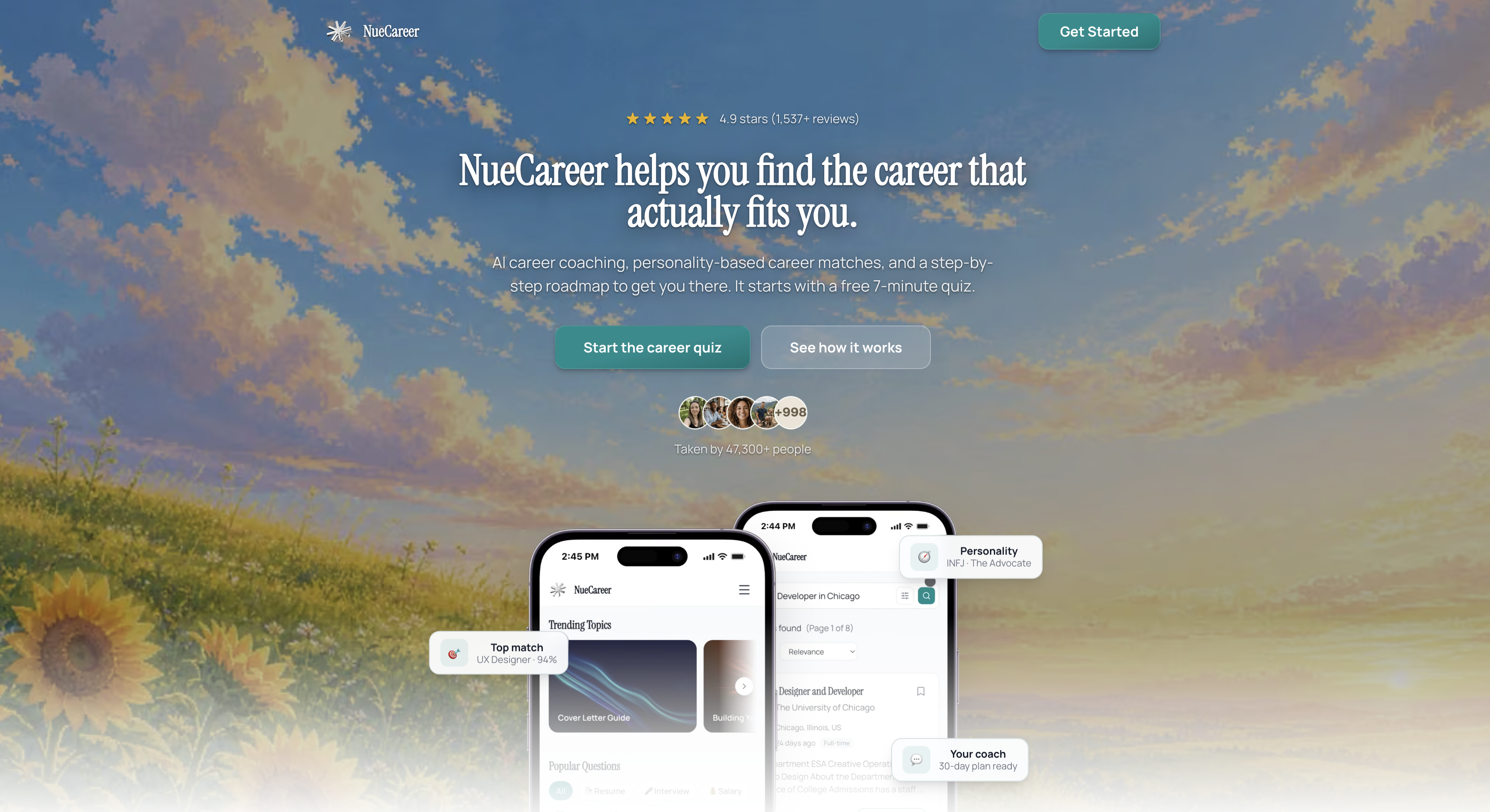
Take the 7-Minute Career Quiz to get matched to career paths built around your real strengths, including ones you may never have considered. From there, you'll get a personalized roadmap, 24/7 coaching chat for the moments you get stuck, and a tailored job board so you're not sorting through irrelevant listings.
- Get matched to career paths based on your strengths, not just your resume.
- Receive a transition roadmap scoped to your specific target role.
- Use our resume, cover letter, and interview prep tools once you're ready to apply.
Start the quiz now and turn today's uncertainty into a plan you can actually follow.
FAQ
What are some good things to do during unemployment?
Use the time to build proof of ability in your target field through a short project, freelance gig, or volunteer role, since employers respond more to demonstrated work than a gap explanation. Pair that with a steady schedule of informational interviews and applications so you're building both evidence and connections at the same time.
How do I start a new job after switching careers?
Spend your first few weeks observing how work actually gets done before trying to prove yourself with big ideas, since the written job description rarely captures the full picture. Ask your manager what success looks like in the first ninety days and check in regularly to make sure your understanding matches theirs.
Why am I not interested in any career path right now?
This often points to misalignment between your daily tasks and your natural strengths rather than a lack of ambition, and a structured strengths assessment can surface directions you hadn't considered. Our 7-Minute Career Quiz is built specifically to identify those matches when nothing on your current list feels right.
What should I do if I'm struggling in a new job?
Identify whether the struggle is a skills gap, a fit issue, or a ramp-up timeline that simply needs more weeks, since each calls for a different response. Ask directly for feedback from your manager early rather than waiting for a formal review, and give yourself the same ninety-day runway you'd expect from any genuine transition.
Sources
- Fastest Growing Occupations : Occupational Outlook Handbook : U.S. Bureau of Labor Statistics
- 5 Tips for Changing Careers | Harvard Extension School
- How to Change Careers Successfully: Tips, Resume and Transition Guide | OU Online