
How to Identify the Right Career Before Applying

Learn how to identify the right career before applying with our step-by-step guide. Avoid mistakes and find your perfect fit confidently!
TL;DR:
- Effective career selection involves systematically testing hypotheses about your fit, interests, and values through external experience. Using structured assessments, diverse options, and iterative real-world tests helps reduce bias and uncertainty, leading to better-informed decisions. Continuous reassessment and cautious interpretation of tools are essential for sustained career satisfaction and growth.
Identifying the right career before applying is a process of forming evidence-based hypotheses about your fit, interests, and values — then testing them before you commit. Most people skip this step entirely, sending applications based on gut feelings or a single personality quiz. That approach wastes time and leads to roles that drain rather than energize you. The good news: career clarity comes from external experience, not from waiting for an internal epiphany. This guide walks you through a systematic, research-backed process for choosing a suitable profession with confidence.
How to identify the right career before applying
The standard industry term for this process is career fit evaluation, and it goes well beyond asking yourself what you enjoy. Career fit evaluation combines self-assessment, structured research, and real-world testing to produce a ranked list of options you can act on. The goal is not to find a perfect answer on day one. The goal is to make the best-informed decision possible with the evidence you have right now.

Individuals spend roughly 80,000 hours in their careers over a lifetime. That number alone makes a systematic approach worth the effort. Treating career selection like a research project, where you generate leads, gather data, and update your conclusions, produces far better outcomes than relying on passion or a single moment of inspiration.
Two frameworks anchor this process. The RIASEC model (Realistic, Investigative, Artistic, Social, Enterprising, Conventional) maps your interest profile to work environments. The 80,000 Hours career guide adds a layer of impact and sustainability, rating careers on factors like career capital, personal fit, and long-term engagement. Together, they give you a starting structure for evaluating career options before you write a single cover letter.
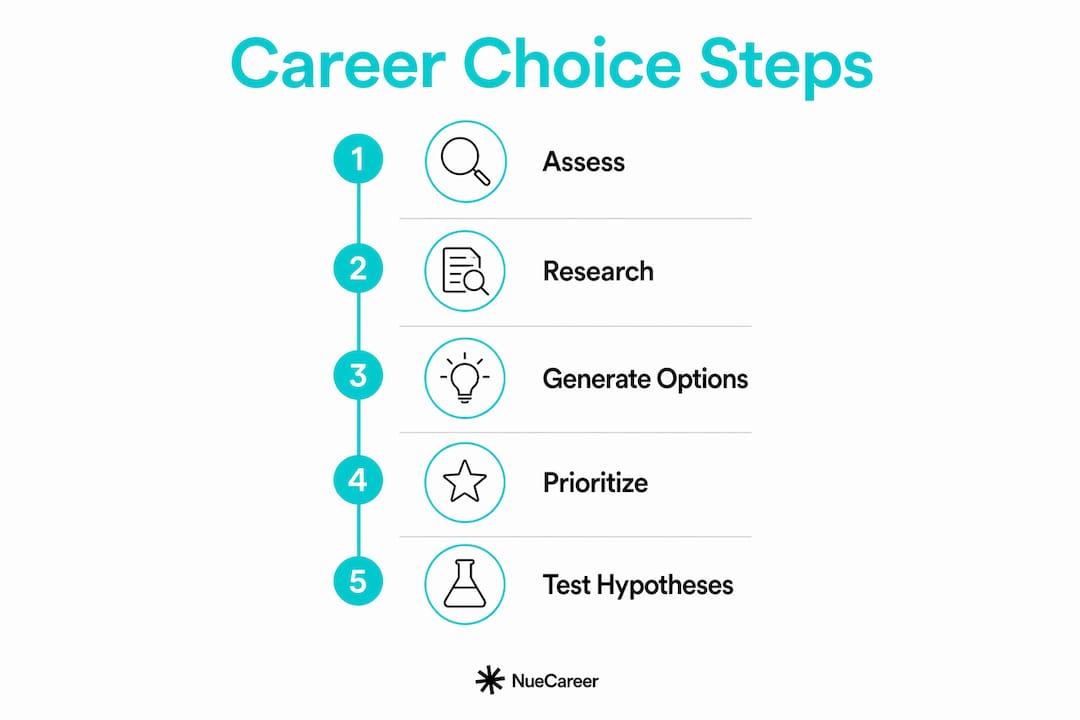
What tools and assessments do you need first?
Before generating career options, you need reliable data about yourself. Validated career assessments combine cognitive aptitude tests, RIASEC-based interest inventories, and Big Five personality measures. No single test gives you the full picture. When two assessments disagree, that disagreement is useful information pointing to areas that need real-world testing rather than more introspection.
Here are the core tools worth using at this stage:
- RIASEC interest inventories such as the Career Key or O*NET Interest Profiler map your work style to occupational categories.
- Big Five personality assessments (available through reputable academic platforms) reveal how your traits align with specific work environments.
- Cognitive aptitude tests identify your strongest reasoning modes, whether verbal, numerical, or spatial, which predict performance in different fields.
- Informational interviews with professionals in fields you are considering provide ground-level data that no test can replicate.
The NYU Wasserman Center recommends researching field demand over the next five to ten years as part of any serious career exploration. A role that fits your profile today may be structurally declining by the time you reach mid-career. Pairing self-assessment with labor market research protects you from that blind spot.
Pro Tip: Review the best career assessment tools before committing to any single platform. Scientific validity varies widely, and using two or three complementary tools produces more reliable results than relying on one.
Career assessments provide structured self-knowledge that supports informed decisions, but they must not be treated as oracles. Use them as a starting point, not a final verdict.
How do you generate and prioritize career options?
Most people consider two or three career paths at most. That is a cognitive trap called narrow framing, and it significantly increases the risk of a poor decision. Generating more career options and rating them against multiple factors reduces this bias and helps you avoid analysis paralysis later.
Here is a structured process for building your career options list:
- List every role that appears in your assessment results. Include careers you have not considered before. If your RIASEC profile suggests data science and you have never thought about it, put it on the list.
- Add roles from informational interviews. People already working in fields adjacent to your interests often name roles you would never find through a search engine.
- Rate each option on four to seven factors. The 80,000 Hours framework suggests: career capital (skills and credentials you will build), personal fit (realistic probability of performing well), impact (contribution to something meaningful), and day-to-day engagement (whether the work itself energizes you).
- List your top three uncertainties for each option. What do you not know about this role that would change your rating if you found out? These uncertainties become your research questions.
- Rank your options by a combination of your ratings and the urgency of your uncertainties. The career with the highest rating and the most answerable uncertainties goes to the top of your investigation list.
This process transforms a vague question ("What should I do with my life?") into a concrete research agenda. You are no longer searching for inspiration. You are testing hypotheses.
Pro Tip: Use a simple spreadsheet to score each career option across your chosen factors. Seeing the numbers side by side removes a lot of the emotional noise from the career decision-making process.
How do you test career hypotheses before committing?
A ladder of cheap tests is the most practical method for validating career hypotheses without quitting your job or enrolling in a degree program. The ladder moves from low-cost, low-commitment activities to higher-investment experiences, and you stop climbing when you have enough information to make a confident decision.
The four rungs of the ladder are:
- Reading and online research (two to five hours). Read industry reports, job descriptions, and professional forums. This step alone eliminates options that looked appealing from the outside but do not match your actual preferences.
- Informational interviews (two to twenty hours). Reach out to two or three professionals in your target field. Ask specific questions: What does a typical Tuesday look like? What skills do you wish you had developed earlier? What do most people get wrong about this field?
- Short projects or volunteering (one to four weeks). Take on a freelance project, contribute to an open-source initiative, or volunteer with an organization in your target sector. This is the most underused step and often the most revealing.
- Internships or trial periods (two to twenty-four months). If earlier steps confirm strong fit, a structured short-term role gives you the clearest signal before a full commitment.
"Career clarity arises from external experience — testing and gathering evidence — rather than waiting for internal epiphanies." — 80,000 Hours
After each rung, update your career rankings. If a field that ranked second on paper feels energizing during an informational interview, move it up. If your top-ranked option feels flat after two weeks of project work, that is data. The career fit evaluation process is iterative by design. You are not looking for certainty. You are reducing uncertainty one step at a time.
Job satisfaction correlates moderately with alignment between personal interests and work environment. That correlation is meaningful but not deterministic, which is exactly why real-world testing matters more than assessment scores alone.
What are the most common pitfalls when choosing a career?
Even with the right tools, several patterns derail the career decision-making process. Recognizing them early saves significant time and frustration.
- Overreliance on a single assessment. A RIASEC profile or Myers-Briggs result is a starting hypothesis, not a prescription. Treating assessments as fixed answers rather than starting points leads to choices that look good on paper but feel wrong in practice.
- Analysis paralysis from too much research. Gathering information indefinitely without moving to the testing phase is a form of avoidance. Set a deadline for each rung of the investigation ladder and stick to it.
- Ignoring gut reactions entirely. Intuition is not infallible, but it carries information. The 10:10:10 reflection exercise asks you to check how you feel about a career decision at ten minutes, ten months, and ten years after making it. Persistent unease at any time horizon is worth investigating, not suppressing.
- Treating career fit as permanent. Career fit is dynamic, not static. What aligns with your strengths and values at 28 may not align at 38. Building in a regular reassessment habit, even once a year, prevents the slow drift toward dissatisfaction that many professionals experience.
Pro Tip: If you feel stuck between two options, run a quick career quiz for adults to surface blind spots. Quizzes work best as a tie-breaker or a prompt for reflection, not as a primary decision tool.
Key takeaways
Finding the right career before applying requires combining validated self-assessment, structured option generation, and real-world hypothesis testing rather than relying on intuition or a single quiz result.
| Point | Details |
|---|---|
| Start with multiple assessments | Combine RIASEC, Big Five, and aptitude tests to build a reliable self-profile before generating options. |
| Generate more options than feels comfortable | Narrow framing is the most common career decision error; rating five or more options reduces this bias significantly. |
| Use the investigation ladder | Move from reading to informational interviews to short projects before committing to any path. |
| Treat gut reactions as data | The 10:10:10 exercise converts vague unease into a specific research question rather than a reason to stall. |
| Reassess regularly | Career fit evolves with your skills and values; schedule an annual review of your career hypothesis. |
Why I think most career advice gets the process backwards
Most career guidance tells you to "follow your passion" or "find your purpose" before you do anything else. I spent years watching that advice paralyze people. Purpose is not something you discover through reflection alone. It emerges from doing things, getting feedback, and noticing what energizes you versus what drains you.
The scientific framing, treating your career choice as a hypothesis to be tested rather than a truth to be revealed, is genuinely liberating once you internalize it. It removes the pressure of finding the "right" answer and replaces it with the much more manageable task of running the next experiment. That shift in framing is the single biggest mindset change I have seen help people move forward.
I also think people underestimate how much a single good informational interview can clarify. Thirty minutes with someone doing the job you are considering is worth more than ten hours of reading job descriptions. The texture of their answers, what they hesitate on, what they light up about, tells you things that no career assessment can capture.
The uncomfortable truth is that career fit is never fully knowable in advance. You will make your best decision with the information available, act on it, and then update. That is not a failure of the process. That is the process working exactly as it should.
— Shane
Start applying with confidence using Nuecareer
Once you have identified your target career paths, the next challenge is translating that clarity into a strong application. Nuecareer's free career tools are built specifically for working adults who know what they want but need help presenting it effectively. The job description analyzer breaks down exactly what employers are looking for in any role, so you can tailor your materials with precision. The cover letter generator produces personalized letters in minutes, matched to your target role. And the skills assessment tool helps you identify and articulate the strengths you already have. Nuecareer also offers a 7-minute quiz that matches you to career paths built around who you are, including options you may never have considered.
FAQ
What does "career fit evaluation" mean?
Career fit evaluation is the process of comparing your skills, interests, and values against the demands and culture of a specific role or field. It combines self-assessment tools, market research, and real-world testing to produce an evidence-based career decision.
How many career options should I consider before deciding?
Research on career decision-making suggests evaluating at least five options to avoid narrow framing. Rating each option on factors like career capital, personal fit, and day-to-day engagement produces a more reliable ranking than comparing two or three choices.
Are career assessment tests accurate enough to rely on?
Career assessments provide useful starting data but should not be treated as definitive answers. Combining two or three validated tools, such as a RIASEC inventory alongside a Big Five personality measure, produces more reliable results than any single test alone.
How long does the career hypothesis testing process take?
The investigation ladder ranges from a few hours of reading to several weeks of project work. Most people can gather enough information to make a confident career decision within four to eight weeks if they move through each rung deliberately rather than stalling at the research phase.
What should I do if I still feel uncertain after testing?
Persistent uncertainty usually signals a specific unanswered question rather than a lack of information overall. Use the 10:10:10 reflection exercise to identify exactly what is causing the unease, then target that question directly with one more informational interview or a short project.