

Start by assessing your strengths, values, and transferable skills before you touch a job board. That single step, done in a short, focused session, tells you what to look for instead of leaving you to guess at job titles. Skip it and you'll job-hunt based on panic or prestige, not fit. Anchor your search in real data through the Occupational Outlook Handbook and a structured career assessment tool, and you'll move faster with far less second-guessing.
TL;DR:
- Focusing on real data from sources like the Occupational Outlook Handbook helps validate job prospects based on growth, pay, and regional demand before committing.
- Short, targeted exercises in interests, values, and skills streamline self-assessment and reduce overthinking, guiding a more precise career shortlist.
- Testing options through inexpensive research, informational interviews, and small projects decreases the risk of misalignment before making large commitments.
- Building a realistic transition timeline includes completing necessary training within 12 months and planning a full switch within two years to stay on track.
- Prioritizing work-life balance during career decisions prevents accepting roles that may offer high pay but negatively impact personal priorities and overall satisfaction.
Table of Contents
- Assess Yourself: Interests, Values, and Transferable Skills
- Explore Career Ideas and Build a Shortlist
- Test Your Top Options Before You Commit to Anything
- Build a Realistic Timeline and Budget for the Switch
- Rebrand Yourself: Resumes, Portfolios, and Interviews
- Tools and Data That Speed Up the Search
- Preparing Yourself Emotionally for the Change
- What to Do When the Transition Gets Hard
- How to Finally Decide Between Your Top Options
- Weighing Work-Life Balance Before You Choose
- What I've Learned Watching Adults Change Careers
- Ready to Turn Self-Assessment Into a Shortlist?
- Where This Advice Comes From
- Sources
- FAQ
Assess Yourself: Interests, Values, and Transferable Skills
You don't need a therapist or a semester of soul-searching. You need three short exercises and a timer.
Interest patterns. List five moments at work (any work, paid or not) when time disappeared. Look for the common thread: solving puzzles, coaching people, building something tangible.
Values checklist. Rank these against each other, forced choice, no ties: autonomy, income, stability, creativity, impact, recognition, flexibility. Your top three become your filter for every option later.
Skills inventory. Write ten things you're good at, then translate each into language a hiring manager would recognize. "Good at keeping projects on track" becomes "coordinated cross-functional timelines," which maps directly onto skill categories in O*NET.
- Interest scan: a brief, focused time
- Values ranking: a short, ranking exercise
- Skills inventory with resume phrasing: a dedicated half-hour or so
If you want this compressed into a single guided session, The 7-Minute Career Quiz does the pattern-matching for you and returns career matches based on your answers.
Pro Tip: Set a hard stop. Ninety minutes of honest reflection beats three weeks of overthinking, and the extra hours rarely produce new insight.
Explore Career Ideas and Build a Shortlist
Once you know your skills and values, generate ideas from three directions: adjacent job titles in your current industry, entire industry clusters that use your core skill, and a reverse search where you start from your top skill and ask what roles need it most.
Cross-check every idea against real numbers. Pull up the job posting volume and required qualifications on a major job board, then check median pay and projected growth in the BLS Occupational Outlook Handbook. A role that sounds exciting but has flat projected growth and scarce postings in your region is a weak bet.
Run your longer list through quick filters:
- Does it use two or more of your top five skills?
- Does it align with at least two of your top three values?
- Is the entry path realistic given your timeline and finances?
- Are there actual postings for this role within 50 miles or remote?
An example shortlist for someone leaving retail management might land on operations coordinator, UX research assistant, healthcare administration, and technical support lead. Each survived the filters; the rest didn't.
Test Your Top Options Before You Commit to Anything
Career decisions feel permanent, but they don't have to be. Treat each shortlisted option as a hypothesis and run it through an experiment ladder, cheapest test first.
- Read (2 to 5 hours). Industry blogs, subreddits, BLS profiles, one or two books written by practitioners.
- Talk (2 to 10 hours). Three to five informational interviews. Ask what a typical Tuesday looks like, what surprised them, and what they'd change.
- Try (1 to 4 weeks). A small paid or volunteer project, a freelance gig, or a certificate's capstone assignment.
- Commit. Only after the first three rungs hold up.
The 80,000 Hours framework for career testing recommends setting your decision rule before you start; for instance, "if three interviews say this role is mostly paperwork, I rule it out." That single rule saves you from rationalizing a bad fit after you've already invested time.
Pro Tip: Book informational interviews as 20-minute calls, not 60. People say yes faster, and you get sharper answers under time pressure.
Build a Realistic Timeline and Budget for the Switch
Pick your primary option based on which one survived the most experiment rungs with the strongest signal, and name a backup in case training costs or timelines shift.
A workable milestone map:
- Month 3: Finish core research and testing; enroll in any required certificate or course.
- Month 12: Complete training, land a portfolio piece or two, start applying.
- Month 24: Fully transitioned, one to two years into the new role.
Budget for both tuition and the earnings gap; a part-time certificate might run a few thousand dollars but cost less in lost income than a full-time program. Check whether your current employer offers tuition assistance or an internal transfer path first. Detailed timeline templates are available in NueCareer's career change timeline guide, which breaks the 3/12/24-month map down by industry.
Rebrand Yourself: Resumes, Portfolios, and Interviews
Career changers don't start from zero. Employers hire for demonstrable skill and improvement potential, and short projects or portfolios often carry more weight than a matching job title on your resume, according to Indeed's guide to switching careers.
- Rewrite bullet points around outcomes, not tasks: "reduced onboarding time by two weeks" beats "handled onboarding."
- Build one portfolio piece, even a small side project, that proves you can do the new job.
- Reach out regularly to new contacts with a short message: who you are, what you're exploring, one specific question.
- Follow up once, five to seven days later, if you don't hear back.
In interviews, explain your transition as a decision, not an escape. Name what you tested and what you found. NueCareer's resume tips for career changers walks through reframing language line by line.
Pro Tip: Lead your cover letter with the outcome you'll produce in the new role, not your backstory. Hiring managers skim for relevance first.
Tools and Data That Speed Up the Search
You don't need dozens of apps. You need a few reliable sources used consistently.
- BLS Occupational Outlook Handbook and O*NET for validated pay ranges, growth projections, and job duties.
- NueCareer's free skills assessment for a quick inventory before you build your shortlist.
- The Freelance PM Club if freelance or project-based work is one of your test rungs.
Paid coaching or a subscription tool earns its cost once you've narrowed to two or three real options and need help building the roadmap, not before.
Preparing Yourself Emotionally for the Change
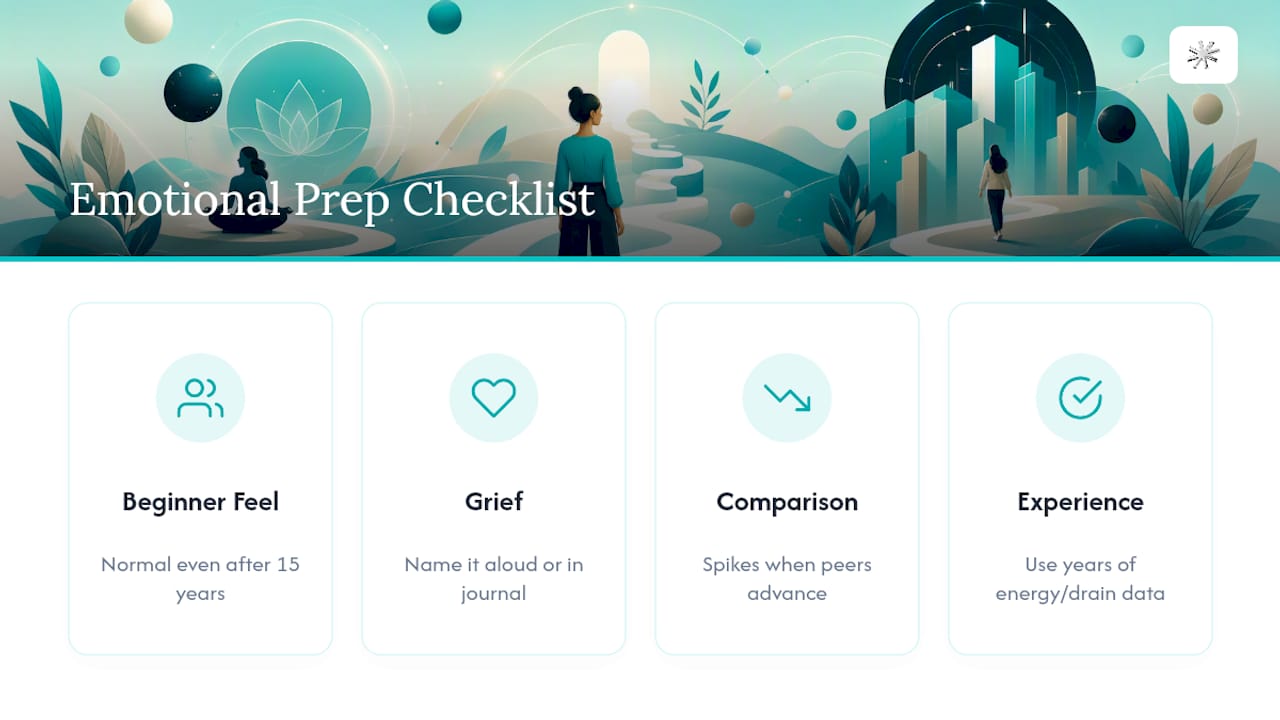
Career changes rattle people in ways job searches within the same field don't, mostly because identity gets tangled up with title. Expect a stretch where you feel like a beginner again, even with fifteen years of experience behind you. That's not a sign you chose wrong. It's a sign you're doing something genuinely new.
Grief shows up more often than people admit. Leaving a field you trained for, or one that used to define you at parties, can trigger real loss even when the move is the right one. Naming that directly, out loud to a friend or in a journal, tends to shrink it faster than pushing through silently.
Comparison will spike too. Watching former peers get promoted in your old field while you're a beginner in a new one stings. Adults have one real advantage here: existing evidence about what actually energizes or drains you, built from years of work experience, according to Careerkit's guidance for adult career changers. That's usable data younger job seekers don't have yet.
Give yourself permission to feel behind without believing you are. Most successful transitions include a period of financial tightening, ego bruising, and slower progress than hoped. Build that expectation in now, and it stops feeling like proof you made a mistake.
What to Do When the Transition Gets Hard
Setbacks are close to guaranteed, not a signal to abandon the plan. Rejections pile up faster in a new field because you're competing without the pattern-matching resume that made your old job search easy.
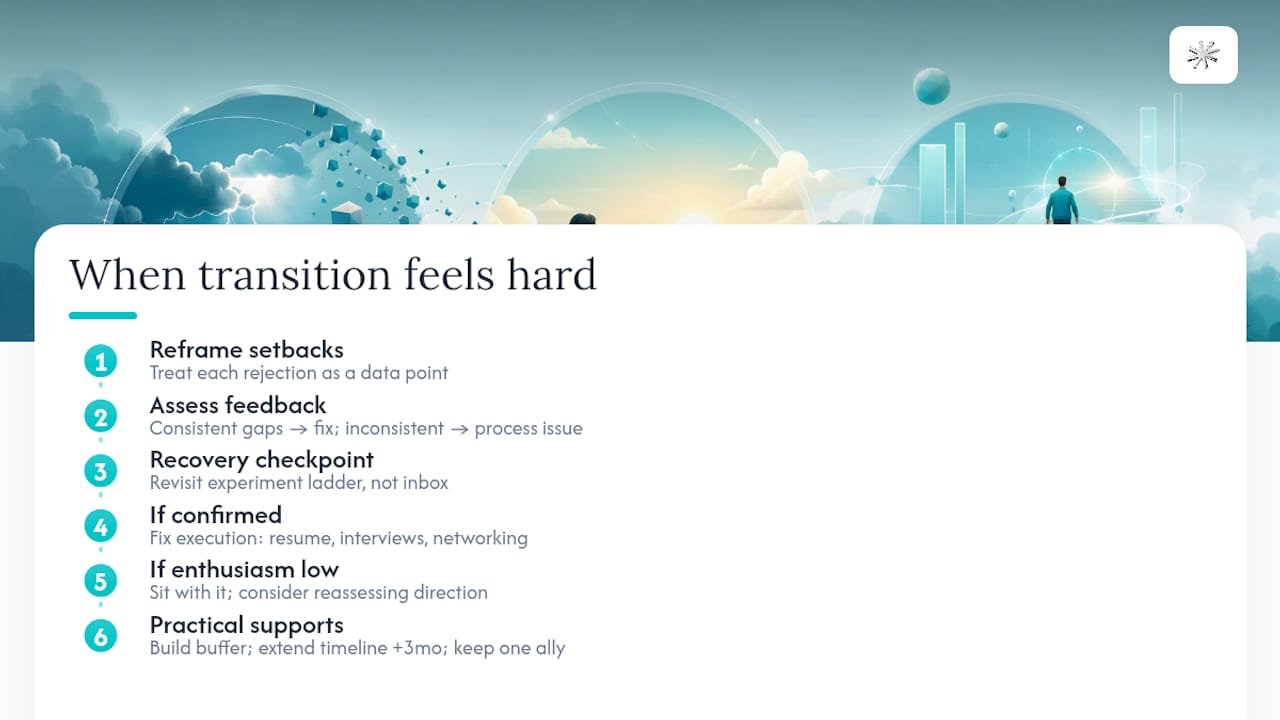
Treat each rejection as a data point, not a verdict. If three interviewers all flag the same gap, that's useful information; fix it. If the feedback is inconsistent or vague, it says more about the hiring process than about you.
Build in recovery checkpoints. After a string of rejections, revisit your experiment ladder results instead of your inbox. Did the informational interviews and short projects still confirm this is the right direction? If yes, the setback is about execution (resume wording, interview framing, networking reach), which is fixable. If your enthusiasm has quietly dropped too, that's worth sitting with honestly.
Money pressure is the obstacle people underestimate most. Build a buffer before you start, even a small one, and revisit your transition timeline if the runway gets tight. Stretching the timeline by three months beats abandoning a direction that was actually working.
Finally, keep at least one person in your corner who knows the full plan, not just the highlight reel. Isolation makes every normal setback feel bigger than it is.
How to Finally Decide Between Your Top Options
By this stage you likely have two or three options that survived testing. Choosing between them isn't about finding the "perfect" one. It's about picking the option with the strongest evidence and the fewest deal-breakers.
A simple weighted framework works well: list your top five decision factors (pay, growth potential, day-to-day fit, training cost, lifestyle fit), score each option 1 to 5 on every factor, then multiply by how much that factor matters to you. Totals rarely lie, even when your gut wants to argue.
Tim Urban's take on career selection, from Wait But Why, offers a useful gut check: evaluate options by your rate of improvement in them and the minimum level of success that would feel genuinely fulfilling, rather than chasing the most prestigious title on your list. A career that lets you improve steadily and meets a realistic bar for satisfaction usually beats one that looks impressive but stalls you.
Set your decision rule before scores come in, the same way you set stop rules for your experiment ladder.
Weighing Work-Life Balance Before You Choose
A high-paying role that destroys your evenings and weekends isn't a win, even if it looks like one on paper. Lifestyle fit deserves equal weight with salary and title in your decision framework, not an afterthought after you've already accepted an offer.
Get specific about what you're protecting. Is it flexible hours for childcare, predictable evenings, remote work, minimal travel, or low on-call stress? Name your non-negotiables before you're deep in an interview process and susceptible to talking yourself out of them for a bigger paycheck.
Ask direct questions in interviews: typical weekly hours, how often people work weekends, whether the culture actually supports the flexibility listed in the posting. Vague answers are answers. If you can, talk to someone currently in the role, not just someone in leadership, about what a real week looks like.
The values ranking from your initial self-assessment matters most here. If autonomy and flexibility ranked in your top three, a role that scores high on prestige but low on those factors will wear on you within a year, regardless of the salary bump.
What I've Learned Watching Adults Change Careers
The biggest mistake isn't picking the wrong career. It's skipping the testing phase and jumping straight to a full retrain, or endlessly researching without ever talking to a real person in the field. The fix for both is the same: read a little, talk to people fast, and let small evidence override big feelings.
— Shane
Ready to Turn Self-Assessment Into a Shortlist?
NueCareer gets you past the guesswork stage faster than piecing together quizzes, forums, and BLS tables on your own. The 7-Minute Career Quiz turns your strengths and interests into matched career paths, including ones you probably haven't considered, plus a quick roadmap for what to do next.
Take the quiz, then run your top two or three matches through the experiment ladder: read a little, talk to someone doing the job, try a small project. That combination, structured assessment plus cheap real-world testing, gets you a workable direction in weeks instead of months of drifting. Start with the quiz and see what it surfaces.
Where This Advice Comes From
- BLS Occupational Outlook Handbook for job outlook and pay data
- 80,000 Hours and Harvard Extension School for career-change methodology
Sources
- How to find the right career for you | 80,000 Hours
- 5 Tips for Changing Careers | Harvard Extension School
- Occupational Outlook Handbook | Bureau of Labor Statistics
FAQ
What's a good new career to start?
The best new career depends on which of your transferable skills and values matched a growing field during your research phase; roles in healthcare support, data analysis, and skilled trades currently show strong demand per the BLS Occupational Outlook Handbook.
What is the happiest job in the world?
There's no single verified "happiest job" ranking; job satisfaction correlates more with autonomy, values alignment, and manageable workload than with any specific title.
How can I make $10,000 a month without a degree?
Reaching that income without a degree usually means building specialized, in-demand skills (sales, skilled trades, technical support, or freelance project work) and proving them through a portfolio or short projects rather than a diploma.
What job pays $400,000 a year without a degree?
Very few roles at that income level skip a degree entirely; the closest paths are typically sales leadership, entrepreneurship, or specialized trades with significant experience and often certifications instead of a four-year degree.
How long does a career change typically take?
Most people move from decision to a fully transitioned role in 12 to 24 months, depending on how much retraining the new field requires and how quickly they build proof-of-skill through projects or informational interviews.