
Career Personality Types Explained: Find Your Best Fit

Discover career personality types explained and find your best fit! Unlock your strengths to enhance engagement and job satisfaction.
TL;DR:
- Career personality types reveal how individuals naturally approach work, influencing job satisfaction and performance. Utilizing frameworks like RIASEC, MBTI, and archetypes together helps identify environments and roles that align with personal strengths for greater engagement. Recognizing that these types evolve over time enables better self-awareness and more informed career decisions.
Career personality types are distinct professional archetypes that define how you naturally approach work, solve problems, and measure success. Understanding these types, through frameworks like Holland's RIASEC, the Myers-Briggs Type Indicator (MBTI), and research-backed models, gives you a concrete starting point for aligning your strengths with roles that actually fit. People who align with their natural strengths are six times more engaged at work and three times more likely to report excellent quality of life on the job. That's not a minor edge. It's the difference between a career that drains you and one that energizes you.
1. What are career personality types and why they matter
Career personality types explained simply: they are patterns in how you think, communicate, make decisions, and respond to workplace demands. They are not fixed labels or measures of intelligence. They are observations about your natural operating style, shaped by personality, work history, and environment.
The practical value is significant. Career satisfaction is driven more by alignment between your daily work and your natural cognitive and motivational style than by job title or industry. A software engineer who thrives on social collaboration will burn out in a solo-coding role, regardless of the salary. Understanding your type helps you spot that mismatch before it costs you years.
Frameworks like RIASEC, MBTI, and modern archetype models each approach this from a different angle. Used together, they give you a fuller picture of who you are at work and what environments bring out your best.
2. The most recognized career personality frameworks
Three frameworks dominate the field of career personality assessment, and each serves a different purpose.
Holland's RIASEC Model is the most widely used in formal career counseling. Developed by psychologist John Holland, it groups six personality types into an acronym: Realistic, Investigative, Artistic, Social, Enterprising, and Conventional. Here's a quick breakdown:
- Realistic: Prefers hands-on, technical, or physical work. Thrives in engineering, construction, or skilled trades.
- Investigative: Analytical and curious. Drawn to research, science, and data-driven roles.
- Artistic: Values creativity and self-expression. Fits well in design, writing, and performing arts.
- Social: Motivated by helping and connecting with others. Natural fit for education, counseling, and healthcare.
- Enterprising: Competitive and persuasive. Excels in sales, management, and entrepreneurship.
- Conventional: Detail-oriented and organized. Thrives in accounting, administration, and compliance.
A typical RIASEC assessment contains about 30 items and takes roughly six minutes to complete. That brevity makes it one of the most accessible starting points for career exploration.
The Myers-Briggs Type Indicator (MBTI) takes a different approach. It categorizes personalities into 16 types based on four preference dichotomies: Introversion/Extraversion, Sensing/Intuition, Thinking/Feeling, and Judging/Perceiving. An INTJ, for example, tends toward strategic, independent work, while an ESFJ gravitates toward team-oriented, service-focused roles.
Modern research-backed archetypes like the Visionary, Builder, Connector, and Analyst go beyond preference scales. They describe how people actually behave under pressure, what motivates them day to day, and where they tend to stall. These models are less standardized but often more immediately recognizable to working adults.
Pro Tip: No single framework tells the whole story. Use RIASEC to identify broad career fields, MBTI to understand your communication and decision-making style, and archetype models to recognize your behavioral patterns at work.
3. Key career personality types and their workplace behaviors
Modern career research has identified several archetypes that go beyond academic frameworks. These types reflect how people relate to work, including the coping strategies they develop in response to workplace culture.
The Inbox Zero Architect is driven by order, completion, and measurable outcomes. They thrive in roles with clear deliverables: project management, operations, finance, and systems design. Their blind spot is rigidity. When processes break down or priorities shift rapidly, they can become visibly stressed and resistant.

The Chaos Agent operates best in ambiguity. They generate ideas quickly, pivot without hesitation, and energize teams during crises. Startups, creative agencies, and turnaround roles are natural homes. The challenge: they often struggle with follow-through and can frustrate colleagues who need consistency.
The Social Glue is the person who holds teams together. They read interpersonal dynamics intuitively, mediate conflict without being asked, and make new hires feel welcome before HR sends the welcome email. They belong in people-facing roles: HR, community management, client success, and team leadership. Their risk is absorbing others' stress and neglecting their own boundaries.
The High-Functioning Burnout is one of the most important types to recognize, because it often looks like success from the outside. These individuals are highly productive, reliable, and self-sacrificing. But their motivation comes from anxiety rather than genuine engagement. They are often misaligned with their environment and need roles that reward depth and autonomy rather than constant output.
The Strategic Escape Artist is always thinking three moves ahead. They are not disloyal; they are simply wired for growth. They excel in consulting, strategy, and entrepreneurship. If their current role offers no upward or lateral movement, they disengage fast.
Underlying all of these types are measurable personality traits. Conscientiousness predicts job performance with a correlation of 0.27 across diverse occupations, while neuroticism correlates negatively at 0.31. This means that regardless of your archetype, building self-awareness around emotional regulation and follow-through directly improves your work outcomes.
Pro Tip: If you recognize yourself in the High-Functioning Burnout type, the fix is rarely working harder. It's finding roles where your natural strengths are rewarded, not just your capacity to endure.
4. Comparing popular career personality models
Each framework has distinct strengths, and knowing which to use when saves you time and confusion.
| Model | Focus | Number of types | Assessment length | Best used for |
|---|---|---|---|---|
| Holland's RIASEC | Career interests and environments | 6 | ~6 minutes | Initial career exploration |
| Myers-Briggs (MBTI) | Cognitive and communication preferences | 16 | 20-30 minutes | Team dynamics, communication style |
| Research-based archetypes | Behavioral patterns and work style | Varies (5-8 typical) | 10-15 minutes | Self-awareness, role alignment |
RIASEC is the most research-validated for career matching. MBTI is widely used in corporate settings for team-building, though its test-retest reliability has been debated in academic literature. Modern archetype models are less standardized but often more immediately useful for adults who already have work experience and want to understand their patterns.
Combining multiple frameworks gives a more complete picture than relying on any single model. Think of it like getting a second opinion. Each framework illuminates a different dimension of who you are at work.
One important caveat: personality frameworks are tools for self-reflection, not measures of intelligence or skills. A high RIASEC score in the Investigative category does not mean you are qualified for research roles. It means you are drawn to analytical thinking. Qualifications still matter. Fit matters more than you might expect, but it does not replace competence.
5. How to use career personality types to find fulfilling work
Understanding your type is only useful if you act on it. Here is a practical sequence for applying this knowledge.
Take a structured assessment. Start with a RIASEC-based career personality test or the MBTI to establish a baseline. Note your top two or three types, not just the dominant one.
Map your current role against your type. Ask yourself honestly: does your daily work align with your natural cognitive and motivational style? If you are a Social type spending 80% of your time on solo data entry, the mismatch is the problem, not your work ethic.
Identify the gap. Career unhappiness often results from misalignment between your natural operating style and your environment, not from the work content itself. Naming the gap is the first step toward closing it.
Explore roles that reward your natural style. Use your type profile to generate a list of roles you may not have considered. An Artistic type with strong Investigative tendencies might thrive in UX research, a field that blends creativity with analytical rigor.
Allow for evolution. Career personality types can shift with experience. Your dominant type tends to remain stable, but secondary types develop over time, increasing your versatility. A Builder archetype who spends five years managing people often develops strong Connector tendencies.
Seek environments, not just job titles. Career success depends more on finding environments that reward your natural operating style than on changing yourself to fit a role. A Conventional type in a chaotic startup will struggle no matter how skilled they are.
Pro Tip: Nuecareer's 7-minute quiz is built specifically for working adults who feel stuck. It identifies your strengths and matches you to career paths built around who you are, including paths you may never have considered on your own.
Key takeaways
Career personality types are the most direct tool for matching your natural strengths to roles and environments where you will perform and feel fulfilled.
| Point | Details |
|---|---|
| Types are patterns, not labels | Career personality types describe how you work, not who you are as a person. |
| RIASEC is the best starting point | Holland's six-type model is research-validated and takes about six minutes to complete. |
| Alignment drives satisfaction | Daily work aligned with your natural style predicts engagement more reliably than job title or salary. |
| Combine frameworks for depth | Using RIASEC, MBTI, and archetype models together gives a fuller picture than any single test. |
| Types evolve with experience | Your dominant type stays consistent, but secondary types develop and expand your career options over time. |
Why I think most people use personality types backwards
I have worked with hundreds of adults exploring career options, and I see the same pattern repeatedly. Someone takes a career personality test, gets a result, and then spends the next six months trying to find a job that matches the label. That is backwards.
The most useful thing a personality framework does is help you recognize what you already know about yourself but have not had language for. When a client tells me they feel exhausted by their job but cannot explain why, and then they see themselves clearly in the High-Functioning Burnout archetype, something shifts. It is not the label that helps them. It is the recognition.
The limitation I always flag: the most accurate assessments come from biographical data and real conversations with practitioners, not abstract test scores alone. A quiz can point you in a direction. Actual experience in a role tells you whether the direction is right.
Use these frameworks as a starting point for honest self-reflection, not as a destination. Your type is a compass, not a contract.
— Shane
Discover your career personality with Nuecareer
If this article has you thinking about where you actually fit, the next step is a structured assessment built for working adults.
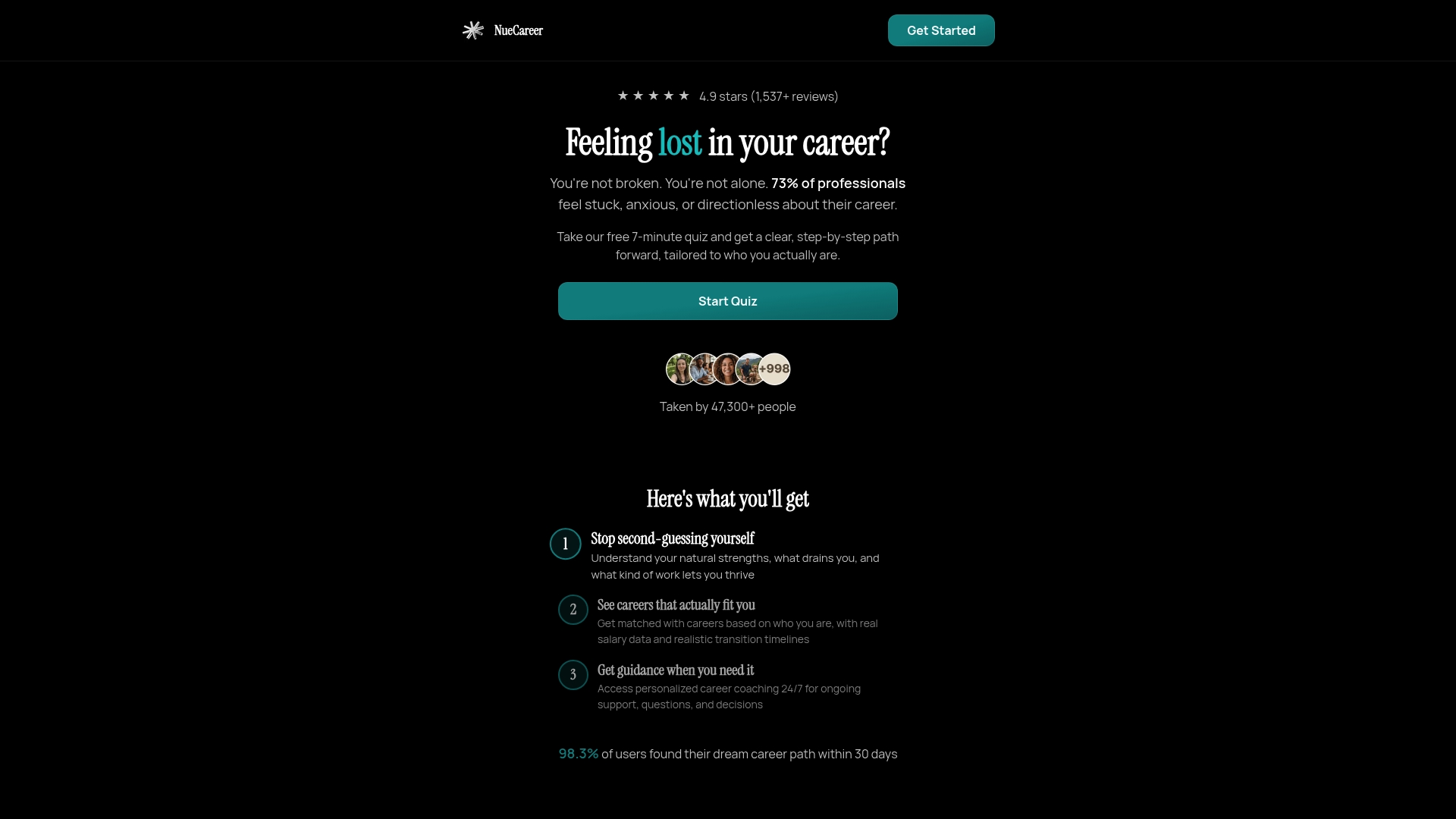
Nuecareer's free Career Clusters Quiz takes seven minutes and matches you to career paths based on your strengths and natural working style, including careers you may never have considered. Beyond the quiz, Nuecareer offers a free skills assessment to identify your gaps and strengths, plus personalized roadmaps, a 24/7 coaching chat, and a full suite of resume and cover letter tools. Whether you are starting from scratch or pivoting from a role that no longer fits, Nuecareer gives you everything you need to move forward with confidence.
FAQ
What is a career personality type?
A career personality type is a pattern that describes how you naturally approach work, make decisions, and respond to workplace demands. Frameworks like Holland's RIASEC and the MBTI are the most widely used systems for identifying these types.
How do I find my career personality type?
Take a structured assessment such as a RIASEC-based career aptitude test or the MBTI, then map your results against your actual work experience to see where the alignment holds and where it breaks down.
Can my career personality type change over time?
Yes. Your dominant type tends to remain stable, but secondary types develop with experience, increasing your range and versatility across different roles and industries.
Are career personality tests accurate?
Personality tests are reliable tools for self-reflection and identifying broad tendencies, but they are not definitive measures of skill or job suitability. The most accurate picture of career fit comes from combining test results with real work experience and direct conversations with people in roles you are considering.
Which career personality framework is best?
RIASEC is the most research-validated for initial career exploration. MBTI is useful for understanding communication and team dynamics. Modern archetype models work well for adults who already have work experience and want to understand their behavioral patterns. Using all three together gives the most complete picture.