

TL;DR:
- Career aptitude tests reveal your strengths and interests but do not prescribe specific careers.
- Using multiple assessments and real-world exploration helps turn test results into meaningful career insights.
If you've ever wondered whether a quiz can tell you what to do with your life, you're not alone. Understanding how career aptitude tests work is the first step toward using them wisely. These assessments don't hand you a career on a silver platter. What they do is surface patterns in your abilities, interests, and preferences that you might not have noticed on your own. This guide breaks down what these tests actually measure, how they function under the hood, and how to turn your results into real career momentum.
Table of Contents
- Key Takeaways
- How career aptitude tests work: aptitude vs. interest inventories
- Formats, scoring, and how adaptive testing works
- Interpreting and using your results effectively
- Popular career aptitude and interest tests worth knowing
- Limitations you should know before trusting your results
- My honest take on what tests can and can't do for you
- Take your next step with Nuecareer
- FAQ
Key Takeaways
| Point | Details |
|---|---|
| Tests reveal, not decide | Career assessments show likely strengths and interest patterns, not guaranteed career paths. |
| Aptitude vs. interest | True aptitude tests measure cognitive ability; most free tests measure preferences and interests instead. |
| Scoring uses comparisons | Norm-referenced scoring compares your results to a reference group, not a fixed right-or-wrong scale. |
| Results need context | Pair test results with informational interviews and real-world exploration to validate findings. |
| Multiple tests work better | Taking several assessments helps identify consistent patterns and reduces the risk of misreading one result. |
How career aptitude tests work: aptitude vs. interest inventories
Before you trust any test result, you need to know what kind of test you actually took. This distinction matters more than most people realize.
A true aptitude test measures your cognitive abilities. Think spatial reasoning, numerical problem-solving, verbal comprehension, or logical sequencing. These tests present actual problems you must solve, often under time pressure. They are designed to assess what you can do, not what you enjoy doing.
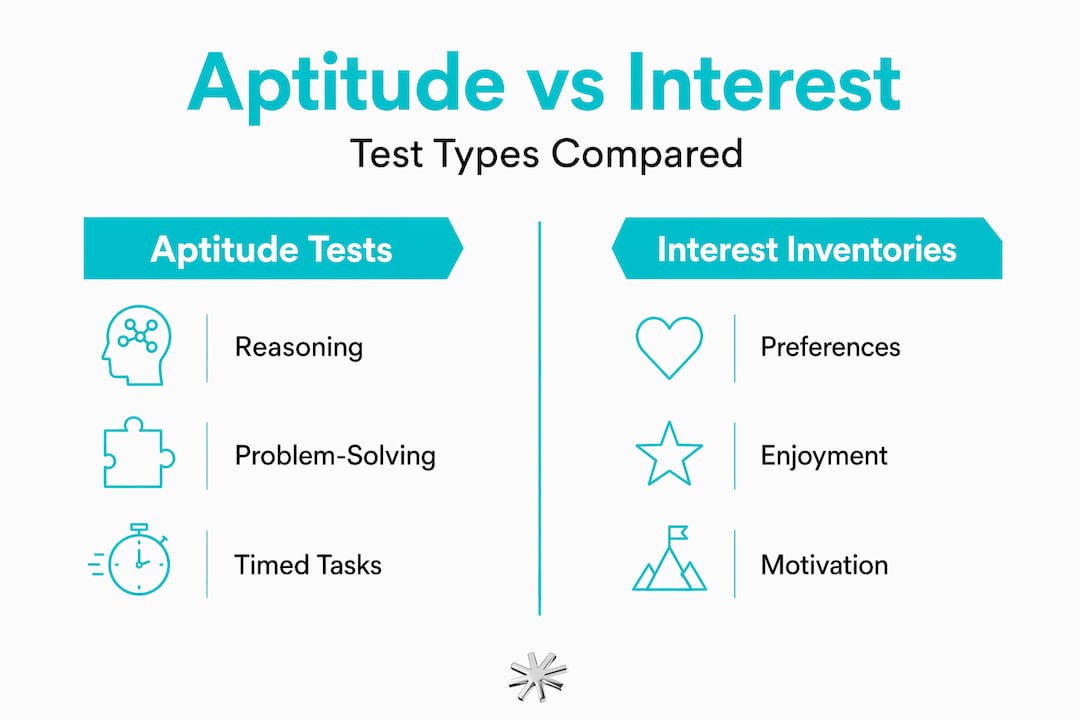
An interest inventory, on the other hand, asks what you prefer. Would you rather organize data or lead a team? Do you enjoy working outdoors or in a structured office? Most free tests marketed as "career aptitude tests" are actually interest inventories. They measure preferences, not raw cognitive ability.
Why does this matter for interpretation? Because a high score on a spatial reasoning test tells you something different from "I enjoy designing spaces." One reflects demonstrated ability; the other reflects current preference. Both are useful, but they answer different questions.
| Aptitude Tests | Interest Inventories | |
|---|---|---|
| What they measure | Cognitive abilities and skills | Preferences and enjoyment |
| Format | Timed problem-solving tasks | Self-reported questionnaires |
| Example | Numerical reasoning under time pressure | "Do you prefer working with people or data?" |
| Best used for | Identifying natural cognitive strengths | Exploring what energizes and motivates you |
| Limitation | Doesn't capture passion or values | Depends on self-awareness accuracy |
Pro Tip: Before interpreting any test result, check whether the test was timed and problem-based or preference-based. That one detail changes how you should read your scores.
Formats, scoring, and how adaptive testing works
Most career assessment tests follow a structured format, but the mechanics vary more than people expect.
Standard aptitude tests typically include 15 to 40 questions with strict time limits per section. The time pressure is intentional. It doesn't just measure whether you get the right answer. It measures how quickly and accurately you process information under realistic work conditions. Interestingly, roughly half to 70% of test-takers don't finish all questions. That's by design, not a flaw.
Modern assessments increasingly use adaptive testing formats. Here's how that works:
- You answer a question at a moderate difficulty level.
- If you answer correctly, the next question gets harder.
- If you answer incorrectly, the next question gets easier.
- The test converges on a stable ability estimate by continuously refining based on your responses.
This approach is more precise than a fixed test because it targets the exact difficulty range where your ability sits. You're not wasting time on questions that are far too easy or far too hard.
Scoring is where many people get confused. Most aptitude tests use norm-referenced scoring, which means your raw score is compared to a reference group, not an absolute standard. The output might be a percentile (you scored higher than 72% of the norm group), a stanine (a 1-9 scale), or a T-score (a standardized scale with a mean of 50). None of these tell you "you passed" or "you failed." They tell you where you stand relative to others who took the same test.
Pro Tip: Always answer every question, even if you're unsure. Leaving questions blank guarantees zero points for those items. An educated guess gives you a chance.
Interpreting and using your results effectively

Getting your results is the beginning, not the end. This is where most people either get the most value or make the biggest mistakes.
Here is a practical process for turning results into real career insight:
Read for patterns, not prescriptions. Your results show tendencies and likely strengths. A high score in verbal reasoning doesn't mean you must become a writer. It means language-heavy work probably comes more naturally to you.
Cross-reference across multiple tests. Taking several assessments and comparing patterns is far more reliable than putting all your weight on one result. If three different tools consistently point toward roles involving analysis and independent work, that's a signal worth exploring.
Bring results to a counselor or mentor. Interest inventory results are specifically designed to be reviewed with a career counselor. A professional can help you see connections you might miss and challenge assumptions you didn't know you were making.
Use results to research, not to decide. Look up the occupations linked to your results. Read job descriptions. Talk to people in those roles. Your test pointed a direction; now you need to explore whether that direction actually fits your life.
Run low-stakes experiments. Before committing to a major career shift, try a related volunteer project, freelance gig, or informational interview. Real-world exposure tells you things no test can.
"Test results should guide structured self-reflection rather than be taken as fixed proof of your aptitude or destiny." — Strong Interest Inventory guidance, Northeastern University
The goal is to treat your results as a hypothesis, not a conclusion. You're gathering evidence about yourself, and the test is just one data point in a larger picture.
Popular career aptitude and interest tests worth knowing
Not all career assessment tests are created equal. Here's a breakdown of the most widely used options and what makes each one useful:
O*NET Interest Profiler: One of the most respected free tools available. It includes about 60 questions and takes roughly 30 minutes to complete. Results connect directly to 900+ occupations in the O*NET database, giving you concrete job titles to explore rather than vague personality descriptions.
RIASEC-based tools (Holland Code): The RIASEC framework classifies people into six vocational types: Realistic, Investigative, Artistic, Social, Enterprising, and Conventional. RIASEC self-assessment tools improve self-knowledge by mapping your personality type to work environments where you're most likely to thrive. Most free career tests are built on this framework.
Skills-based assessments: These ask you to rate your proficiency or comfort level across specific skill categories. They're less about personality and more about what you can actually do. Tools like Nuecareer's free skills assessment fall into this category and are particularly useful for working adults who already have experience but need clarity on their transferable strengths.
Values-based assessments: These explore what matters most to you in a work environment. Autonomy? Security? Creative expression? Values assessments often reveal why someone is unhappy in a technically "good" job.
Cognitive aptitude tests: These are the truest form of aptitude testing. They measure raw reasoning ability through timed problem sets. Employers use them in hiring; individuals can use them to identify where their natural cognitive strengths lie.
For a curated overview of the most useful tools available right now, the best career assessment tools guide from Nuecareer is a solid starting point.
Limitations you should know before trusting your results
Career tests are genuinely useful. They are not magic. Knowing their limits makes you a smarter user of the information they provide.
Self-awareness shapes accuracy. Self-assessment depends heavily on how well you currently understand yourself. If you're early in your career or going through a major life transition, your answers may reflect where you've been more than where you're headed.
No free test predicts long-term satisfaction. There is no longitudinal evidence that any free career aptitude test reliably improves long-term career happiness. Tests measure present preferences and abilities, not future fulfillment.
Measurement noise is real. Forced-choice question designs can limit precision. A slightly different mood or framing on the same day could shift your results. This is why patterns across multiple tests matter more than any single score.
Tests can't measure passion or purpose. They can point toward areas of interest and ability. They cannot tell you what will make you feel genuinely alive in your work. That requires reflection, experience, and honest self-examination.
Prescriptive use narrows options prematurely. If you treat results as a definitive answer, you risk closing doors before you've had a chance to look through them. Use tests to open possibilities, not close them.
My honest take on what tests can and can't do for you
I've worked with a lot of people who came to career assessments with high hopes and left feeling either validated or confused. Both reactions make sense. Here's what I've actually learned from watching people use these tools.
The most useful thing a test ever did for someone I worked with wasn't confirm what they already suspected. It was surface something they had dismissed. One person consistently scored high on investigative and analytical dimensions but had spent years in sales because "that's where the money was." Seeing those patterns spelled out clearly gave them permission to take their curiosity seriously.
What I've found is that tests work best when you're genuinely open to being surprised. If you go in hoping for confirmation, you'll find it, and you'll miss the more interesting signal underneath. The surprising results are usually the ones worth sitting with.
I've also seen people over-rely on a single result and make major decisions based on it. That's where things go sideways. A test is a starting point for a conversation, ideally with a career coach or counselor who can help you interpret the nuance. On its own, a test score is a rough sketch. With the right support, it becomes a map.
Stay curious. Try things. The test tells you where to look. Your experience tells you what's actually there.
— Shane
Take your next step with Nuecareer
Career assessments give you a starting point. Nuecareer gives you everything that comes after. The 7-minute Nuecareer quiz goes beyond surface-level interest matching. It identifies your real strengths and connects you to career paths you may never have considered, including a personalized roadmap, 24/7 coaching chat, and job boards tailored to your target roles.
Once you know your direction, Nuecareer's free career tools help you act on it. The career clusters quiz, skills assessment, and job application skills tool all work together to deepen your self-knowledge and get you applying with confidence. Whether you're just starting to explore or ready to make a move, Nuecareer meets you where you are and helps you take the next step forward.
FAQ
What do career aptitude tests actually measure?
Career aptitude tests measure cognitive abilities like reasoning, spatial thinking, and verbal comprehension through timed tasks. Many tests labeled as "aptitude tests" are actually interest inventories that measure preferences rather than raw ability.
How is scoring on aptitude tests calculated?
Most aptitude tests use norm-referenced scoring, which compares your raw score to a reference group and converts it to a percentile, stanine, or T-score. Your score reflects how you performed relative to others, not a pass-or-fail threshold.
How many career assessments should I take?
Taking two to four different assessments and comparing patterns across results is more reliable than relying on a single test. Consistent themes across multiple tools are a stronger signal than any one score.
Can a career test tell me exactly which job to pursue?
No career test can definitively tell you which job to pursue. Results highlight likely strengths and interest areas that serve as starting points for research, informational interviews, and real-world exploration.
Are free career aptitude tests worth taking?
Free tests are a useful first step, though they come with limitations. No free career test has longitudinal evidence proving it improves long-term career satisfaction, so treat results as one input among many rather than a final answer.