

TL;DR:
- Many believe excitement about a job title signifies a good fit, but deeper assessment is necessary. Evaluating skills, work conditions, market demand, and lifestyle compatibility ensures a successful career transition. Self-awareness, real job testing, and lifestyle analysis are essential for making evidence-based career decisions.
Most people contemplating a career change assume that excitement about a job title means the role is a good fit. It rarely does. To evaluate new career path fit with any real accuracy, you need to go deeper than surface appeal. You need to assess skills, daily work conditions, market demand, and lifestyle compatibility together. This guide walks you through a systematic process that working adults can realistically apply, so you can make a career decision based on evidence rather than enthusiasm.
Table of Contents
- Key takeaways
- Evaluate new career path fit starting with self-assessment
- Research market demand and real job requirements
- Test your fit before fully committing
- Lifestyle compatibility and long-term satisfaction
- Common mistakes when analyzing career transitions
- My take on what actually makes or breaks a career change
- Let Nuecareer help you find your fit
- FAQ
Key takeaways
| Point | Details |
|---|---|
| Self-assessment comes first | Map your transferable skills and identify what energizes versus drains you before researching any new field. |
| Skill-match percentages guide decisions | Roles above 90% skill match are strong fits; under 60% typically leads to unsuccessful outcomes. |
| Test before you commit | Freelance projects, volunteering, and side work validate fit with far less risk than resigning first. |
| Lifestyle alignment predicts burnout | Daily work conditions like pace, flexibility, and hours matter as much as the role itself. |
| Financial runway protects your judgment | Career changers with 12+ months of savings accept better offers and make clearer decisions under less pressure. |
Evaluate new career path fit starting with self-assessment
Before you research any specific field, you need a clear picture of who you are professionally. Career fit evaluation is the process of systematically matching your skills, motivations, and work style to a role's real demands. It sounds straightforward. Most people skip it.
Start with a skills inventory. Write down every skill you use in your current role, including the ones that feel obvious or basic. Then sort them into two columns: skills you enjoy using and skills you are good at but find draining. This distinction matters more than most career guides acknowledge. A skill you dislike using will not become enjoyable just because the industry changes.
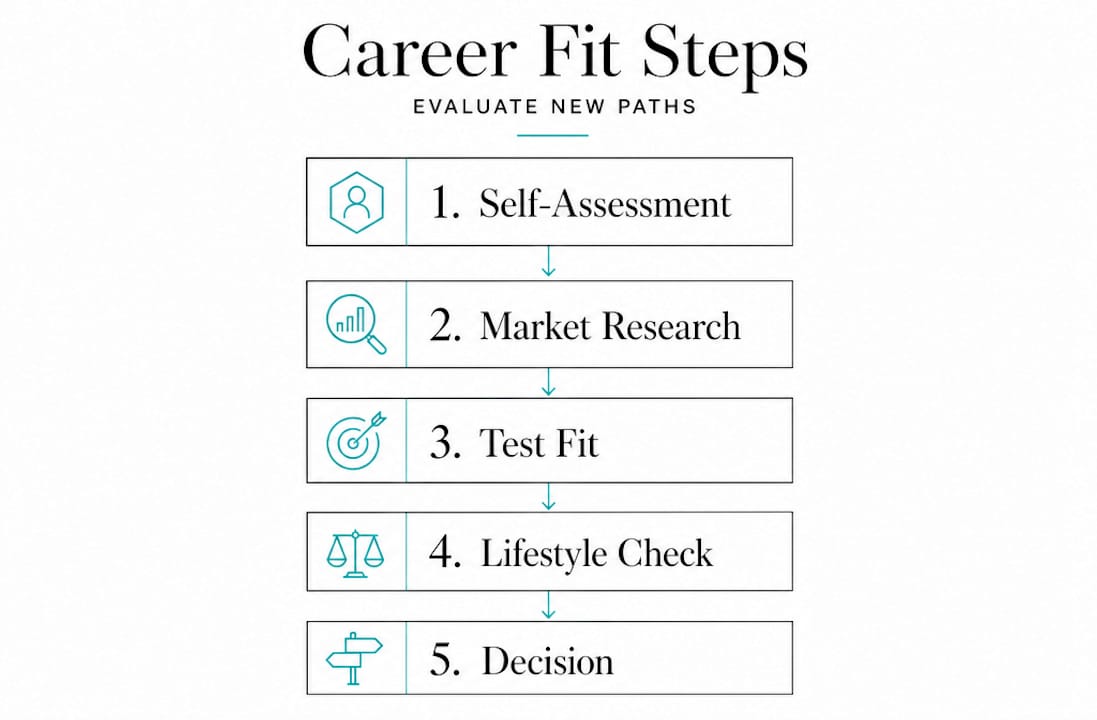
Next, get honest about your motivators. Ask yourself whether you are moving toward something specific (a new challenge, a mission-driven field, more creativity) or primarily running away from your current situation. Both are valid, but they require different strategies. Evaluating both pull and push factors alongside your skills leads to more durable career satisfaction over time.
Here is where most self-assessments fall short. They measure interests but ignore avoidance. Research shows that most career dissatisfaction comes from tasks that drain energy, not simply from a lack of interest in the subject. Document what you actively avoid in your current work. Constant interruptions? Repetitive data entry? Client-facing pressure? These are your friction factors, and they are just as predictive of long-term satisfaction as what you enjoy.
- Use a structured career skills assessment to identify gaps and transferable strengths
- Categorize skills as energizing vs. draining, not just present vs. absent
- Note recurring friction points in your current role as avoidance data
- Consider which motivators are role-specific and which are industry-wide
Pro Tip: Write down your five biggest work complaints right now. If any of them would exist in the new career you are considering (tight deadlines, ambiguous feedback, solo work), that is a compatibility signal worth addressing before you move forward.
Research market demand and real job requirements
Once you understand your profile, it is time to assess what the new career actually demands. This is where a lot of career changers get tripped up. They research the field in general terms, fall in love with the concept, and underestimate the day-to-day specifics.
Pull up ten to fifteen real job postings in your target role. Read them carefully. Separate the hard requirements from the "nice-to-haves." Hard requirements appear in every posting. Nice-to-haves appear in a few. Most candidates mistake lengthy job descriptions for an impossible standard when, in reality, employers expect a strong match on three to five core requirements.
Pay attention to skill-match percentages when you have a tool to measure them. A 90% or above match signals a strong fit worth prioritizing. A 70 to 85% match is competitive and achievable with targeted preparation. Below 60% generally leads to unsuccessful outcomes, meaning your energy is better spent on a better-matched role or closing those gaps first.
Informational interviews fill in what job postings cannot tell you. A 20-minute conversation with someone already in your target role gives you real-world intel on daily work, hiring expectations, unwritten culture norms, and realistic timelines. Ask specifically about what surprises people who transition into the field. The answers are almost always revealing.
- Use the Nuecareer job description analyzer to break down postings for skill requirements and culture signals
- Track which requirements appear across multiple postings as non-negotiable
- Contact two to three people in your target role for informational interviews
- Note lifestyle signals in job descriptions: travel requirements, on-call expectations, team size
Pro Tip: When you read a job description, highlight every task you would genuinely enjoy doing in one color and every task that triggers resistance in another. If the second color dominates, the role may not fit as well as the title suggests.
Test your fit before fully committing
Analyzing a career on paper is necessary. It is not sufficient. At some point, you need real exposure to determine job suitability with confidence. The good news is that you do not have to resign to get it.
Here is a practical sequence for testing fit before a full transition:
- Build a financial runway. Career changers with 12 or more months of liquid savings make significantly better decisions because they are not forced into urgency. Aim for nine to twelve months minimum before stepping away from your current income.
- Take on freelance or side projects. Portfolio work and freelance projects are the most honest pre-resignation validation available. If you are considering UX design, take a small paid project. If you are eyeing nonprofit work, volunteer for a specific deliverable.
- Set a decision threshold. Before you start testing, define what "good enough" looks like. For example, complete two freelance projects and receive positive client feedback, or shadow three people in the role and feel energized, not deflated.
- Close your biggest skill gaps now. Targeted education before leaving your current job, through certificates, bootcamps, or portfolio builds, increases both your candidacy and your confidence when you do make the move.
- Build a support network inside the field. One mentor with direct experience in your target role is worth more than a dozen general career books.
| Validation method | Time investment | Risk level | Quality of insight |
|---|---|---|---|
| Job description research | Low (2 to 4 hours) | None | Surface-level |
| Informational interviews | Medium (5 to 10 hours) | Very low | High |
| Freelance or volunteer project | High (20 to 80 hours) | Low | Very high |
| Part-time or contract work | Very high (ongoing) | Low to medium | Highest |
Pro Tip: Treat each validation step as a data point, not a final verdict. One bad freelance project does not disqualify a career. One great informational interview does not confirm it. You are building a body of evidence.
Lifestyle compatibility and long-term satisfaction
Here is what salary comparisons and job title searches will never tell you: whether you can actually live with this career every day for the next decade. High prestige or high salary focus often leads to dissatisfaction when daily lifestyle demands do not align with who you are.

Design your ideal workday before you evaluate any role. What hours do you want to work? How much autonomy do you need? Do you do your best work alone or in collaboration? How much unpredictability can you handle before it stops feeling exciting and starts feeling exhausting? These are not preferences to negotiate away. They are compatibility factors.
When you assess career change options, use a side-by-side comparison of your current reality against your target role across these lifestyle dimensions:
| Lifestyle factor | What to assess in the new role | Red flag signal |
|---|---|---|
| Work hours and flexibility | Typical weekly hours, remote work options | "Startup pace" or "always-on culture" language |
| Pace and unpredictability | Project cycles, client demands, deadline frequency | High variability with no autonomy to manage it |
| Social interaction level | Team size, client-facing requirements | Mismatch with your energy style |
| Mission and purpose | Whether the work aligns with what matters to you | Roles that are prestigious but feel hollow to you |
Traditional career assessments often miss the avoidance dimension entirely. This is the data that predicts burnout. If a career requires constant behavior that drains you, no amount of interest in the subject will protect you from wearing down over time.
Common mistakes when analyzing career transitions
Even well-prepared career changers make a handful of predictable errors. Knowing them in advance puts you in a better position to sidestep them.
The most damaging mistake is the all-or-nothing mindset: the belief that you must either stay exactly where you are or make a complete and immediate leap into the new field. Breaking the transition into small steps eases anxiety and produces better outcomes. Most successful career pivots are not dramatic jumps. They are sequences of deliberate, low-risk moves.
A second mistake is setting rigid deadlines. "I need to be in a new career by the end of this year" is a goal, not a plan. Deadlines create urgency. Urgency shortcuts research, compresses testing, and pushes people into roles that are close enough but not right. Treat career transition as a readiness-based process, not a calendar-based one.
Another common error: overvaluing prestige. A role with an impressive title at a well-known company can mask serious daily friction. Ask yourself whether you would want this job if no one knew the company name. If the answer changes, prestige is doing more work than fit in your decision.
"Career anxiety improves when fears are specifically documented and addressed rather than pushed aside. Write your specific fears down, then test each one against the evidence you actually have."
- Watch for warning signs in postings: vague success metrics, unusually high turnover language, or "wear many hats" phrasing without structure
- Do not confuse the cost of making a move with the cost of staying. Chronic career dissatisfaction compounds over time and carries its own significant price
- Check yourself for premature commitment: have you gathered at least some real-world exposure before deciding?
My take on what actually makes or breaks a career change
I have worked with a lot of people who made career changes and a lot who tried and stalled. The ones who stalled almost always had one thing in common: they treated the decision like a single moment rather than a process with stages.
In my experience, the biggest saboteur is the self-imposed deadline. Someone decides they want to be out of their current job within six months, and that timeline starts driving every decision. They skip informational interviews because there is no time. They take the first offer that seems close to what they wanted. Then, twelve months later, they are dissatisfied again, and the only thing that changed is the logo on their paycheck.
What actually works is slowing down to gather data while you are still employed. That financial runway matters not just for security. It removes the desperation that distorts judgment. I have seen people turn down genuinely good offers because they were scared and rushed, and I have seen others accept genuinely bad ones for the same reason.
The other thing I would push back on: do not skip the avoidance inventory. Most self-assessments focus entirely on what you want. The more honest and useful question is what you cannot tolerate. Once you know that, you can switch careers with a much clearer filter. You stop chasing interesting-sounding fields and start pursuing roles that actually match how you are wired to work.
— Shane
Let Nuecareer help you find your fit
If you have read this far, you already know that evaluating a new career takes more than a gut check. It takes structured self-knowledge, real market data, and the right tools to connect the two. Nuecareer was built for exactly this moment.
Start with the free skills assessment to get a clear map of your transferable strengths and the gaps that need closing before you apply anywhere. Then use Nuecareer's job description analyzer to decode real postings and understand exactly where you stand against what employers want. If you are earlier in the process and still figuring out which direction to head, the career clusters quiz matches you to fields built around who you actually are, including options you may not have considered. No guesswork. Just clarity.
FAQ
What does "evaluate new career path fit" actually mean?
It means systematically assessing whether a new career aligns with your skills, motivations, lifestyle needs, and the real demands of the role, not just whether the title sounds appealing.
How do I know if I have the right skills for a new role?
Compare your current skills against requirements that appear across multiple job postings in your target role. A skill-match of 90% or above signals strong fit; below 60% suggests the gap may require significant preparation first.
How can I test a new career without quitting my job?
Take on freelance projects, volunteer for relevant work, or pursue part-time contracts in your target field. These low-risk validation steps give you real data on fit before you resign.
Why does financial runway matter for a career change?
Savings remove urgency from your decisions. Career changers with 12 or more months of liquid savings tend to accept better offers and avoid accepting roles out of financial pressure rather than genuine fit.
What is the biggest mistake people make when choosing a new career?
Treating the career change as a single all-or-nothing decision instead of an iterative process. Breaking it into research, testing, and readiness stages consistently produces better outcomes and less anxiety.