

A RIASEC careers list sorts jobs by the interests they tend to reward: Realistic, Investigative, Artistic, Social, Enterprising and Conventional. Each job gets a three-letter Holland code, such as RCI for an electrician or IRS for a veterinarian. Below you will find sample careers for each type, how to read the letters, and how to turn your own code into a shortlist you can act on.
If you are a working adult wondering what else you could do, this is a good, low-pressure place to start. You do not need to know your answer yet. You only need a clearer picture of what kind of work energizes you.
TL;DR
- RIASEC (also called Holland codes) groups people and jobs into six interest types. Your top three letters, in order, are your code.
- The first letter usually carries the most weight, and most people and most jobs blend two or three types.
- Sample matches: electrician (RCI), software developer (ICR), registered nurse (SIC), architect (AIE), financial advisor (ECS).
- Treat a code as a tool for reflection, not a verdict. Use it to widen your list, then research real roles.
- You can find your own code with our free Holland Code test and explore matches from there.
Table of Contents
- What the six RIASEC types mean
- How to read a three-letter Holland code
- RIASEC careers list by type
- How to turn your code into a real career shortlist
- Common questions career changers have about their code
- Our perspective: interests are the right place to start
- From a list of careers to a plan
- Other ways to explore after your Holland code
- FAQ
- Sources
What the six RIASEC types mean
RIASEC is an acronym for the six interest areas in John Holland's model. The U.S. Department of Labor's O*NET Interest Profiler measures these same six types: Realistic, Investigative, Artistic, Social, Enterprising and Conventional. Its results link to over 900 occupations in O*NET OnLine and My Next Move.
Here is the plain-English version of each type:
| Type | What it tends to enjoy | Typical work setting |
|---|---|---|
| Realistic (R) | Building, fixing, operating equipment, working outdoors or with your hands | Shops, job sites, labs, outdoors |
| Investigative (I) | Analyzing, researching, solving complex problems | Labs, clinics, offices, data teams |
| Artistic (A) | Creating, designing, expressing ideas, working without a rigid script | Studios, stages, design teams |
| Social (S) | Teaching, helping, caring for, and working with people | Schools, clinics, community organizations |
| Enterprising (E) | Leading, persuading, selling, taking initiative | Sales floors, firms, startups, management |
| Conventional (C) | Organizing, following clear procedures, working with details and data | Offices, finance, administration, records |
The letters are a shorthand, not a personality label. Someone with a Social code can be quiet, and someone with an Enterprising code can love spreadsheets. The code describes the kind of activities you tend to find engaging.
How to read a three-letter Holland code
Your code is your top three types, ranked. A code like ICR means Investigative is your strongest interest, Conventional second and Realistic third.
Three things help you read it well:
- Start with the first letter. The Delaware Department of Labor's guide, What Is My Holland Code?, notes that your first letter usually carries the most weight when you interpret your code.
- Expect blends. Nebraska Wesleyan University's career handout points out that most people and most jobs are a combination of two or three of the interest areas.
- Look at neighbors on the hexagon. The six types sit around a hexagon. Adjacent types, such as Social and Artistic, are considered the most closely related, so a code made of neighbors is read as more consistent than one that pairs, say, Social with Realistic, as one overview of Holland's theory explains. A code that spans opposite sides is not a problem. It often describes people who can bridge two worlds, like a nurse who loves both science and people.
One practical note: codes for the same job can differ slightly between publishers. The Nebraska Wesleyan handout lists architect as RAI, while the Delaware guide lists it as AIE. Both agree the job blends Realistic, Artistic and Investigative interests. Focus on the letters that repeat.
RIASEC careers list by type
The examples below come from the Delaware Department of Labor's guide, which organizes occupations by their dominant first letter and shows the full three-letter code for each. These are samples, not a complete directory.
Realistic careers (R)
Realistic careers suit people who like tangible results: something built, repaired or running smoothly at the end of the day.
| Career | Holland code |
|---|---|
| Aircraft mechanic | RCI |
| Civil engineer | RIC |
| Electrician | RCI |
| Plumber | RCI |
Notice how often Conventional and Investigative show up as the second and third letters. Skilled trades reward following codes and procedures (C) and diagnosing problems (I) as much as working with your hands.
Investigative careers (I)
Investigative careers fit people who want to understand how things work and enjoy a hard problem.
| Career | Holland code |
|---|---|
| Chemical engineer | IRC |
| Dentist | IRS |
| Software developer | ICR |
| Veterinarian | IRS |
If you are a career changer drawn to this group, remember that "Investigative" does not always mean a doctorate. Software development, for example, sits here, and many adults enter it through structured training and portfolio work.
Artistic careers (A)
Artistic careers suit people who want room to originate ideas and put their own stamp on the work.
| Career | Holland code |
|---|---|
| Actor | AES |
| Architect | AIE |
| Choreographer | ASE |
| Fashion designer | AER |
The Nebraska Wesleyan handout adds art director (AE) and video game designer (AIE) to this territory. If you have an Artistic code but a practical streak, look at jobs where creativity pairs with Investigative or Realistic interests, like architecture or product and game design.
Social careers (S)
Social careers center on helping, teaching, guiding and caring for others.
| Career | Holland code |
|---|---|
| Arbitrator | SEC |
| Elementary teacher | SAC |
| Registered nurse | SIC |
| School counselor | SAE |
This group is broader than most people expect. An arbitrator and a nurse look nothing alike on paper, yet both are built around working directly with people in high-stakes moments. If teaching appeals to you, our careers-for-teachers quiz looks at where classroom skills can go next.
Enterprising careers (E)
Enterprising careers reward people who like to lead, persuade and take responsibility for outcomes.
| Career | Holland code |
|---|---|
| Chef or head cook | ERA |
| Chief executive | ECS |
| Financial advisor | ECS |
| Lawyer | EIA |
| Sales manager | ECS |
The repeated ECS pattern is worth noticing: leadership plus structure plus people skills. That combination shows up in many management and client-facing jobs.
Conventional careers (C)
Conventional is the type that best describes people who like order: clear processes, accurate records, reliable systems. It often appears as a supporting letter, as you saw in electrician (RCI), software developer (ICR) and financial advisor (ECS). A Conventional-leading code is a strong signal for roles built around organizing information and keeping things running correctly.
The most reliable way to see jobs that lead with C is to enter your code into a government database, which we cover next.

How to turn your code into a real career shortlist
A list of sample jobs is a starting point. Here is how we suggest working from it.
- Get your code. Take an interest-based assessment. The O*NET Interest Profiler has 30 items for each of the six types, 180 in total, and self-scoring produces six type scores from which your primary and secondary interest areas are identified, according to its reliability and validity report. Our Holland code test is a quicker way to get a code.
- Match on your top two or three letters. Do not limit yourself to jobs that match all three in exact order. Try each permutation of your letters.
- Search a government database. O*NET, run by the U.S. Department of Labor, lets you learn about occupations based on your RIASEC code through the Interest Profiler. A 2024 ERIC paper on Holland's hexagon describes it as covering over 1,016 occupations as of August 2023.
- Underline what excites you. Read the task lists and highlight the activities you would happily do on a Tuesday afternoon, not just the job title.
- Check the practical side. For each finalist, look at typical pay, training requirements and demand in your area.
- Talk to someone doing the job. One 20-minute conversation will tell you more than a dozen job descriptions.
Use the code to widen your thinking
The Nebraska Wesleyan handout is clear on this point: majors and careers do not always line up neatly, so the code works best as a tool for reflection and for expanding your thinking. If your results surprise you, that is often useful. A teacher with an Investigative-heavy code might not want to leave education at all, but may discover instructional design, curriculum research or education data analysis.
Common questions career changers have about their code
What if my interests do not match my current job?
That is common, and it is not a failure. Many people chose their first career based on availability, family expectations or a degree they picked at 18. A mismatch simply tells you which parts of your day feel flat. You can often keep the skills and shift the setting.
What if two of my letters seem to pull in opposite directions?
Blends are normal. Pair them on purpose. An Artistic and Conventional mix might fit design operations or editing. An Investigative and Social mix points toward health care, counseling research or education.
Does a code tell me what I am good at?
No. Interests and abilities are different things. A code describes what you enjoy. Skills can be built, and many of yours transfer. That is why we pair interest results with a skills picture before suggesting a path.
Our perspective: interests are the right place to start
Many working adults who come to us feel stuck, not because they lack ability, but because nobody ever helped them see the whole field of options. A job title is a narrow window. A Holland code opens it wider, because it describes the kind of work you enjoy rather than the label on a business card.
That is why we built our approach around a short, 7-minute quiz that identifies your strengths and matches you to career paths, including ones you may never have considered on your own. A list like the one above is a great way to get oriented. The next step is where most people stall: turning a promising idea into a plan.
We designed NueCareer to help with that step. Your matches connect to a personalized roadmap, 24/7 coaching chat, job boards tailored to your target roles, and resume and cover letter tools, so exploring and applying live in the same place. You deserve to feel confident about a change, and confidence comes from seeing a clear path in front of you.
Shane
From a list of careers to a plan
When you are ready to move from browsing to doing, our 7-minute career quiz matches you to career paths built around your strengths, then builds a roadmap for the ones you choose. If you want to understand how interest-based tools work first, our guides on career personality types and why interests guide career decisions are a good next read.
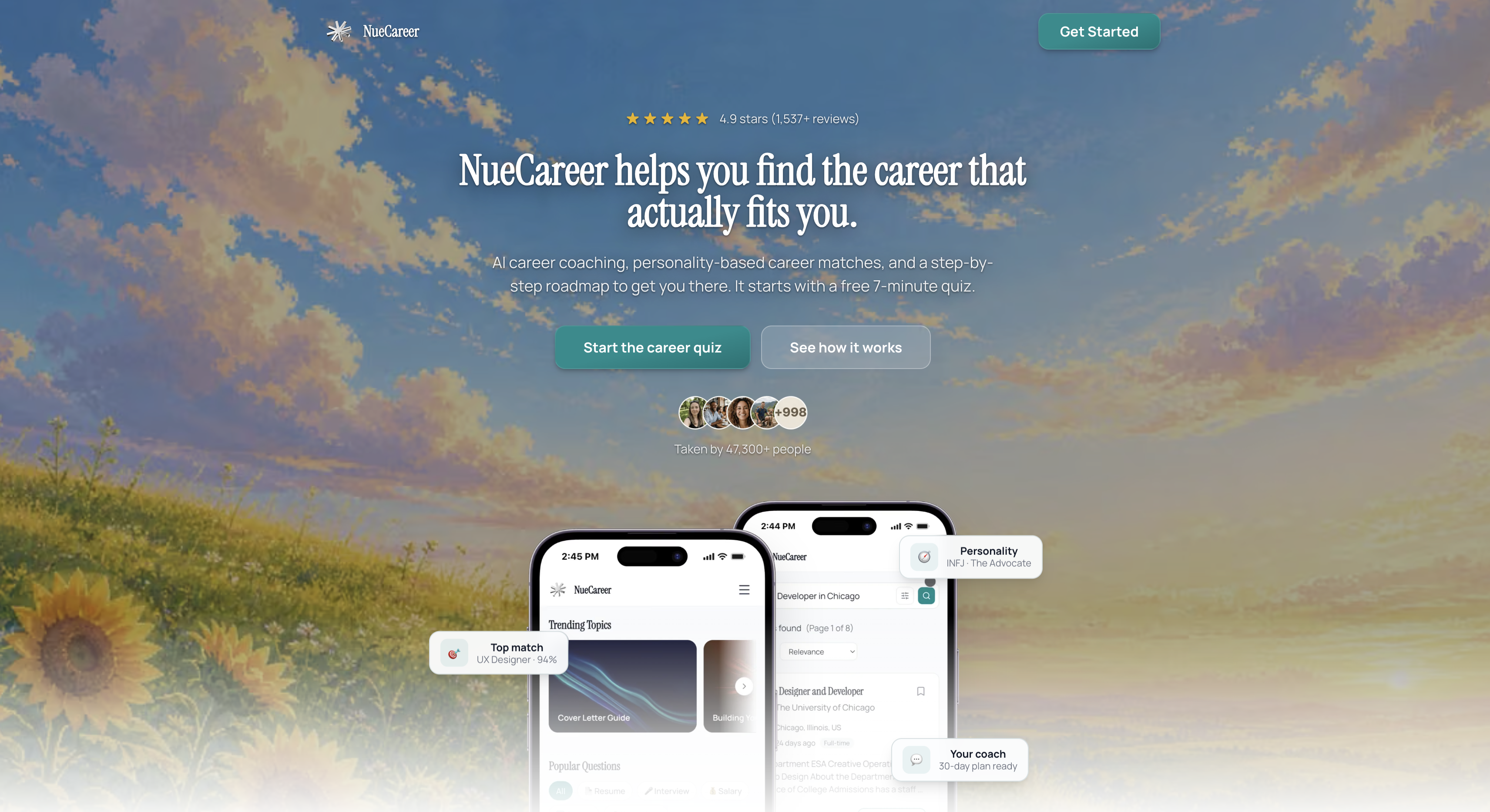
Once you have a target role, the NueCareer platform covers the practical steps: a personalized transition roadmap, AI career coaching, a job board, resume rewrites, cover letters and mock interviews. Our free tools page also includes an ATS resume checker and a cover letter generator you can try as you narrow your list.
Other ways to explore after your Holland code
Holland codes are one lens. Combining lenses gives you a sturdier shortlist:
- Aptitudes: what you can do well now. Try our career aptitude test, or read how career aptitude tests work.
- Industries: the 16 career clusters group jobs by field, which helps if your code points to several industries.
- Scoring: curious how results are calculated? See how career assessments are scored.
- Adult exploration: why career quizzes help adults weigh options without committing.
FAQ
What does RIASEC stand for?
RIASEC stands for Realistic, Investigative, Artistic, Social, Enterprising and Conventional. These are the six interest types in Holland's model, and they are the same six measured by the U.S. Department of Labor's O*NET Interest Profiler.
Are Holland codes and RIASEC the same thing?
Yes, in everyday use. "Holland code" refers to the three-letter result, named for psychologist John Holland, and RIASEC names the six types the letters come from. People use the terms interchangeably when they search for careers by code.
How many letters should I use to search for careers?
Start with your top two, then try all orderings of your three letters. Since most jobs blend two or three interest areas, a narrow exact-match search can hide good options. Your first letter usually carries the most weight, so give it the most attention.
Is my Holland code permanent?
It is a snapshot of what interests you now, so use it as a prompt to reflect rather than a fixed label. Many adults find that new experiences shift which activities appeal to them. Retaking an assessment after a few years can show you what has changed.
Sources
- Interest Profiler (IP) at O*NET Resource Center
- What Is My Holland Code? (Delaware Department of Labor)
- Nebraska Wesleyan University career handout
- Holland's Theory, iResearchNet
- O*NET Interest Profiler: Reliability, Validity, and Comparability
- Holland's RIASEC Hexagon (ERIC)