
Why Interests Guide Career Decisions: A Research-Backed Look

Discover why interests guide career decisions. Learn how identifying your preferences can lead to career success and fulfillment at any age.
TL;DR:
- Career interests influence work choices across all adult life stages and predict outcomes well into older age.
- Task-based interest assessments outperform broad categories in predicting job satisfaction and turnover intentions.
Career interests are personal preferences and motivators that direct individuals toward work environments and tasks where they are most likely to thrive. Understanding why interests guide career decisions is not a soft concept. It is grounded in decades of vocational psychology research, including frameworks like the RIASEC model developed by psychologist John Holland, which organizes interests into six broad types: Realistic, Investigative, Artistic, Social, Enterprising, and Conventional. A 2026 Michigan State University study tracking over 8,000 adults for 11 years confirmed that vocational interests predict life outcomes well into adulthood, not just during youth. That finding changes how you should think about career planning at any age.
Why interests guide career decisions across every life stage
The idea that career interests only matter when you are young is one of the most persistent myths in career planning. Research tells a different story. A longitudinal study involving 3,596–8,904 participants aged 25–67 found that interests predict work and life outcomes across the full span of adulthood, with the strength of those predictions shifting by life stage.
The patterns are specific and worth knowing:
- Mid-career adults show the strongest links between interests and work outcomes like income and leadership advancement.
- Early adulthood shows stronger connections between interests and relationship and community outcomes.
- Enterprising interests (those oriented toward leadership, persuasion, and business) show the broadest predictive power across multiple life domains.
- Investigative and Artistic interests predict more narrowly, often linking to specific occupational outcomes rather than broad life satisfaction.
This variation matters because it means your interests are not static background noise. They are active forces shaping what you pursue, what you notice, and where you invest energy. If you are in your 30s or 40s reconsidering your career path, your interests are still highly relevant data. Researchers Lena Roemer and Kevin Hoff emphasize that interest assessments should be used as ongoing tools throughout adult life, not as a one-time test you take at 18 and forget.
Does measuring interests by task give better career guidance?

Traditional interest assessments use broad categories. Holland's RIASEC model, for example, tells you whether you lean toward Social or Investigative work. That is useful as a starting point, but it leaves a lot of precision on the table.
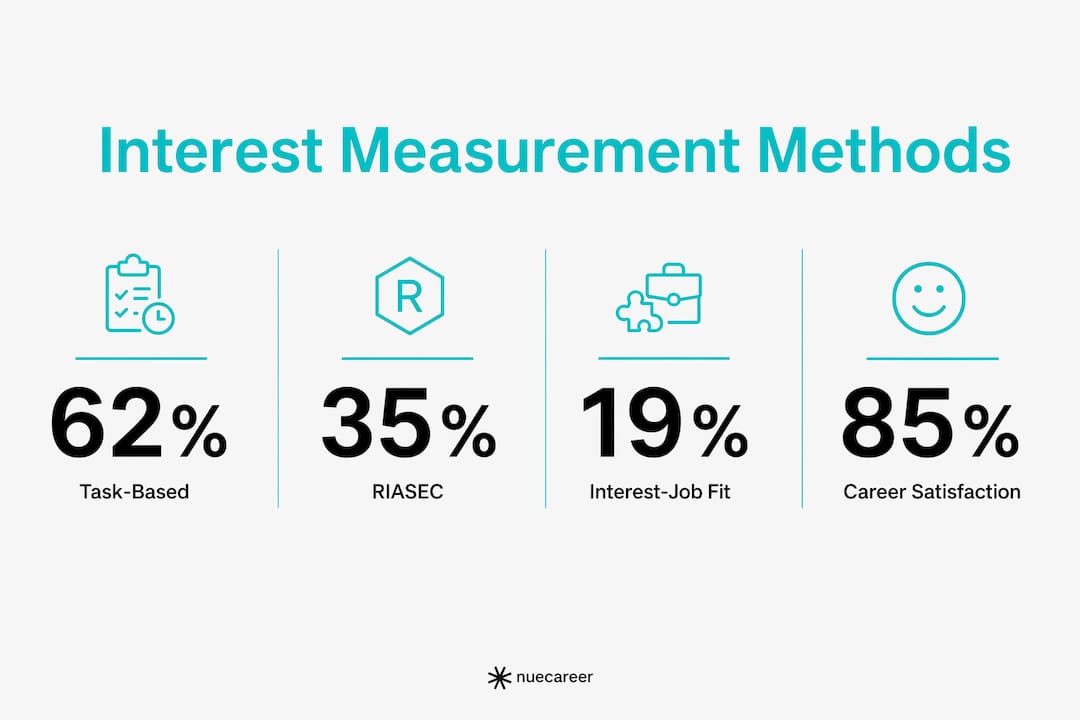
A 2025 study published in the Journal of Business and Psychology compared task-based interest scores against traditional RIASEC measures. The results were clear: task-based interest measures outperform broad profiles in predicting job satisfaction and turnover intentions. Task-based assessments use specific occupational task statements drawn from O*NET, the U.S. Department of Labor's occupational database, to measure what kinds of actual work activities energize you.
| Approach | What it measures | Predictive strength |
|---|---|---|
| Broad RIASEC categories | General interest type (e.g., Social, Investigative) | Moderate for broad fit |
| Task-based interest measures | Specific occupational tasks from O*NET | Stronger for satisfaction and turnover |
The practical implication is direct. If you are choosing between two roles that both fall under "Social" interests, a task-based assessment can reveal whether you are energized by counseling, teaching, or managing, which are three very different jobs. Broad categories mask that distinction.
Pro Tip: When taking a career interest assessment, look for tools that ask about specific work activities rather than just broad themes. The more specific the question, the more useful the result.
Is interest-job fit enough to predict career satisfaction?
Interest alignment matters, but it does not tell the whole story. Meta-analyses covering over 100 studies found that interest-job fit correlates with job satisfaction at only r=0.19 on average. That is a real but modest relationship. It means interest fit explains only a fraction of why people feel fulfilled at work.
"Competence and performance drive fulfillment more than passive interest alignment. Building high-value skills typically precedes and fosters genuine career passion and satisfaction." 80,000 Hours, career research organization
Several factors beyond interest match shape whether a job feels rewarding:
- Skill development: Becoming genuinely good at something creates its own sense of meaning and engagement.
- Autonomy: Control over how and when you work predicts satisfaction more reliably than interest fit alone.
- Supportive colleagues: Workplace relationships consistently rank among the top drivers of job satisfaction.
- Mission alignment: Believing your work contributes to something meaningful amplifies fulfillment beyond interest match.
The research on career capital and interest alignment shows that successful career transitions focus on building valuable skills and experiences before high interest-match or passion fully develops. This does not mean interests are irrelevant. It means they are one input in a larger equation, not the entire formula.
Pro Tip: Pair your interest assessment results with a skills assessment to identify where your interests and competencies already overlap. That overlap is your strongest starting point.
How to use your interests to guide a career change
Knowing your interests is only useful if you act on that knowledge. These steps translate interest awareness into concrete career movement.
Reassess your interests now. Do not rely on a test you took years ago. Interests shift with experience, and a current assessment reflects who you are today. Use a career aptitude quiz that covers specific work activities, not just broad themes.
Map interests to specific tasks. List the work activities that have energized you most in past roles. Cross-reference those with O*NET task descriptions for roles you are considering. Look for overlap.
Conduct informational interviews. Talk to people in roles that align with your interests. Ask what a typical Tuesday looks like. Real-world task descriptions often differ significantly from job postings.
Identify your motivational pathways. Research on the PIMS (Personality-Interest Motivational Sequences) framework shows that vocational interests arise from personality facets, not just environmental exposure. Understanding what personality traits drive your interests gives you a deeper map to work from.
Build skills in your interest area before committing fully. Take on a project, volunteer role, or side assignment in your target field. Skill-building in an area of interest accelerates both competence and passion.
Work with a career coach. A coach trained in interest-based career guidance can help you interpret assessment results and connect them to real opportunities. Career coaching for adults is particularly effective during major transitions.
Pro Tip: If you feel pulled in multiple directions, that is normal. Research shows that broad interest categories like "Social" contain diverse motivational pathways. Narrowing down to specific tasks, not just categories, is the fastest way to find clarity.
Common misconceptions about career interests you should drop
Several widely held beliefs about career interests actively harm career planning. Knowing what is false protects you from wasted time and poor decisions.
Misconception 1: Your interests are fixed. Studies document that interests shift meaningfully over five or more years. A career interest profile from your early 20s may not reflect your motivations at 35 or 50. Treating a past assessment as permanent is a planning error.
Misconception 2: You have one true passion waiting to be found. The "find your passion" framing implies passion pre-exists and just needs to be discovered. Research on evolving interests and passion development shows that passion typically grows from skill and experience, not the other way around. You build passion by getting good at meaningful work.
Misconception 3: A single interest test gives you your answer. No single assessment captures the full picture. Broad interest categories mask significant motivational diversity within each type. Two people who both score high on "Social" interests may be energized by entirely different activities.
- Avoid eliminating career options solely because an assessment scores them low.
- Treat interest results as hypotheses to test, not verdicts to follow.
- Revisit assessments after major life or career transitions.
- Combine interest data with skill inventories and real-world exploration.
Misconception 4: Interests matter less as you get older. The MSU longitudinal study directly refutes this. Vocational interests remain significant predictors of work outcomes well into your 60s. Mid-career adults, in particular, show strong links between interests and income and leadership outcomes.
Key Takeaways
Interests guide career decisions most effectively when treated as dynamic, task-specific inputs combined with skill development, not as fixed categories that define a single correct path.
| Point | Details |
|---|---|
| Interests predict outcomes across adulthood | MSU research confirms vocational interests shape work and life outcomes from age 25 to 67. |
| Task-based assessments outperform broad categories | O*NET-based task measures predict job satisfaction and turnover better than RIASEC profiles alone. |
| Interest fit alone is a weak predictor | Meta-analyses show interest-job fit correlates with satisfaction at only r=0.19; skills and autonomy matter too. |
| Interests evolve throughout life | Passion develops through skill-building and experience, not as a pre-existing trait waiting to be found. |
| Reassess regularly during transitions | Career interest tests work best as ongoing tools used at each major life or career transition. |
What I've learned about interests and career decisions after years of watching people get this wrong
Most people treat a career interest test like a verdict. They take it once, get a result, and either chase it blindly or dismiss it entirely. Both responses miss the point.
What I have seen work is treating interest data as a starting hypothesis. You take the assessment, note what lights up, and then go test it in the real world through conversations, projects, and small experiments. The PIMS research on personality-interest motivational sequences confirms what good career coaches have known for years: interests are not random. They emerge from who you are at a deeper level. That means they are worth taking seriously, but they also mean you need to dig past the broad label.
The readers who make the best career moves do not wait until they feel passionate. They build skills in an area of genuine interest, and passion follows. Aligning your career identity with your evolving interests is an active, ongoing process, not a one-time revelation.
— Shane
Nuecareer's free tools put your interests into focus
If this article has you thinking seriously about your next career move, the right tool makes the next step concrete rather than abstract. Nuecareer's 7-minute career quiz uses an evidence-based approach to match your strengths and interests to career paths you may never have considered, including roles that fit who you are right now, not who you were five years ago.
The platform also offers a free career clusters quiz that maps your interests to specific career clusters, giving you a clearer picture of where your energy naturally points. From there, Nuecareer's free career tools hub connects you to skill assessments, personalized roadmaps, and 24/7 coaching chat, all built for working adults who are ready to move forward with clarity and confidence.
FAQ
Why do interests matter so much in career decisions?
Interests reflect your core motivations and predict which work environments will sustain your energy and engagement over time. A 2026 MSU study confirmed that vocational interests predict work and life outcomes across adulthood, not just in early career stages.
Can my career interests change as I get older?
Yes. Research documents meaningful interest shifts over five or more years, and passion typically develops through skill-building rather than existing in advance. Reassessing your interests after major life transitions gives you more accurate career guidance.
Is following my passion enough to choose a career?
No. Meta-analyses show interest-job fit correlates with job satisfaction at only r=0.19, meaning other factors like skill level, autonomy, and workplace relationships contribute significantly to fulfillment. Interests are one important input, not the complete answer.
What is the difference between RIASEC and task-based interest measures?
RIASEC measures group interests into six broad types, while task-based measures assess your interest in specific occupational activities drawn from O*NET. Task-based measures predict job satisfaction and turnover more accurately than broad RIASEC profiles.
How often should I take a career interest assessment?
Career researchers recommend reassessing interests at each major life or career transition rather than relying on a single result from years ago. Interests evolve, and current data produces more relevant career guidance than outdated profiles.