

TL;DR:
- Career testing involves low-risk experiments to explore new fields while maintaining current employment. Methods like trial job changes, shadowing, and side projects provide valuable insight without significant commitment or risk. Preparing by assessing dislikes, defining criteria, and building a clear plan increases the chances of making informed career decisions.
Career testing is defined as running low-risk, time-limited experiments in a new field while keeping your current job and income intact. The practice moves professionals from blind commitment to informed decisions, replacing costly resignations or expensive degree programs with small, structured trials. Methods like trial job changes, career shadowing, and informational interviews let you gather real evidence about a new role before you commit. Nuecareer's 7-minute quiz adds a critical first step: identifying which paths are worth testing in the first place. If you want to test new career before quitting, the goal is clarity through experience, not guesswork through hope.
What are the most effective low-risk methods to test a new career before quitting?
The most practical way to explore new career paths without resigning is to treat each method as a controlled experiment with a defined start date, end date, and success criteria. Career experiments move you from uncertainty to confidence through iteration, not through a single dramatic leap.

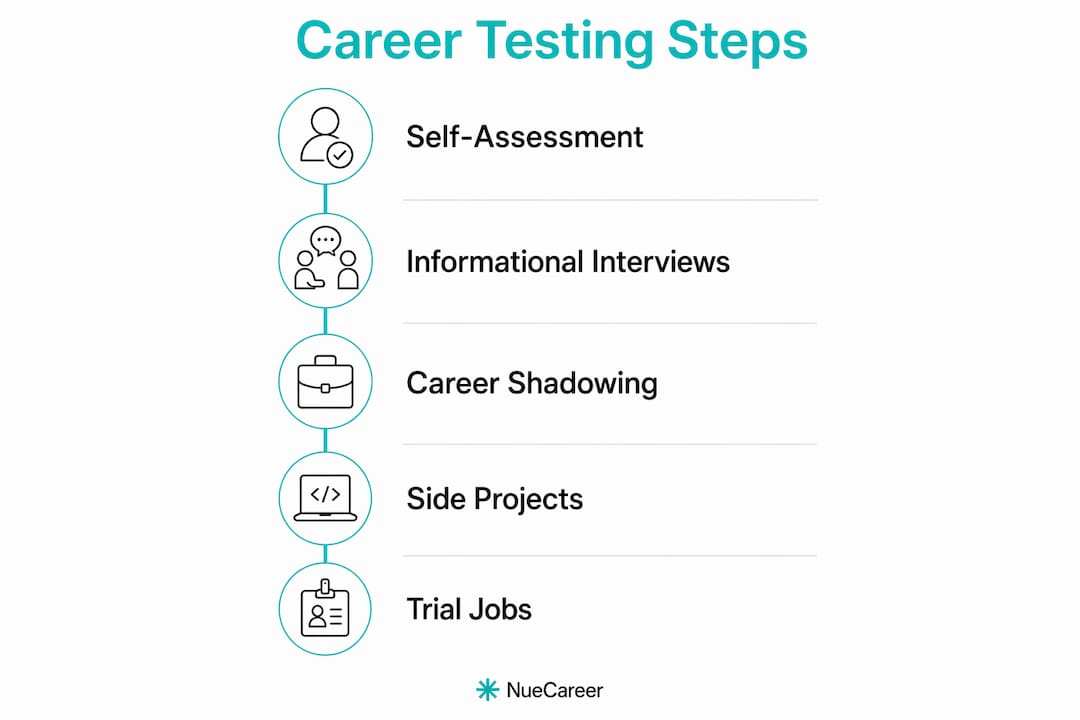
Trial job changes are the most immersive option. You perform real work for a prospective employer under a short-term freelance or side contract, typically lasting 1–3 months. This format lets both you and the employer assess work attitude, skills, and cultural fit before anyone makes a permanent commitment. The financial risk stays low because you keep your primary income throughout.
Career shadowing and informational interviews sit at the lower-commitment end of the spectrum. Shadowing means spending a day or a week observing a professional in your target role. Informational interviews are structured 30-minute conversations where you ask specific questions about daily tasks, career trajectory, and compensation realities. Both methods cost nothing but time and deliver direct, unfiltered insight.
Side projects, freelance gigs, and skill swaps occupy the middle ground. A side project lets you build a portfolio sample in the new field. A skill swap means trading expertise with someone already in your target role, giving both parties practical experience. Effective career tests combine several of these methods because each one reveals a different dimension of fit.
| Method | Commitment level | Duration | Financial risk | Primary outcome |
|---|---|---|---|---|
| Trial job change | High | 1–3 months | Low (side income) | Deep role and culture fit data |
| Career shadowing | Low | 1–5 days | None | Day-in-the-life clarity |
| Informational interview | Very low | 30–60 minutes | None | Industry and compensation insight |
| Side project | Medium | 4–8 weeks | Low | Portfolio proof and skill gap data |
| Freelance gig | Medium | 2–6 weeks | Low | Real client feedback on new skills |
| Mini-course | Low | 1–4 weeks | Low ($) | Foundational knowledge check |
Pro Tip: Set a firm reflection date before you start any experiment. Decide in advance what you will evaluate: culture fit, skills match, compensation potential, and growth ceiling. Without preset criteria, you will rationalize any experience as positive or negative based on mood rather than evidence.
How can you prepare and plan to test a new career effectively while employed?
Preparation separates professionals who gain real clarity from those who spin their wheels. Before you run a single experiment, you need to know what you are testing for and what constraints you are working within.
The single most underused starting point is examining what you dislike about your current role. Focusing on what frustrates you now is more reliable than guessing what you might enjoy in a new field. If you hate isolated desk work, a role with heavy client interaction becomes a testable hypothesis, not just a wish.
Use a career aptitude assessment to surface transferable skills and personality patterns before you invest time in any experiment. These tools evaluate interests, strengths, and working styles, giving you a data-backed shortlist of fields worth exploring. Nuecareer's 7-minute career quiz takes this further by matching your profile to specific career paths, including ones you may never have considered.
Preparation checklist before starting any career trial:
- Review your employment contract. Check for non-compete clauses, moonlighting restrictions, and intellectual property policies. Some employers prohibit side work in adjacent industries.
- Define your non-negotiables. Write down the minimum salary, work schedule, and values alignment you require in any new role. This prevents you from rationalizing a poor fit during testing.
- Build a target field shortlist. Limit yourself to two or three fields to test. Spreading across five or six dilutes your time and produces shallow data.
- Identify entry points. Search for volunteer roles, freelance platforms, professional associations, and local meetups where you can access people already working in your target field.
- Block protected time. Assign specific hours each week to career testing activities. Treat these blocks as fixed appointments, not optional extras.
- Tell a trusted contact. Accountability increases follow-through. One person who knows your plan and checks in monthly makes a measurable difference.
For a structured path through this preparation phase, Nuecareer's career change roadmap walks you through each step with role-specific guidance.
How do you execute trial experiences and reflect on their outcomes?
Execution quality determines whether a career trial produces usable data or just a vague impression. The professionals who get the most from career testing treat every trial like a short-term professional engagement, not a casual observation.
Show up with full professionalism during any trial period. Arrive prepared, ask specific questions, take notes, and contribute where you can. Your attitude during a trial signals to potential employers whether you are worth hiring. It also signals to yourself whether the environment energizes or drains you. Both signals matter equally.
Structured reflection converts raw experience into a career decision. After each trial, answer these four questions in writing: Did the daily work align with my skills? Did the culture match my values? Does the compensation ceiling meet my non-negotiables? Does this role offer the growth I need in the next five years? Written answers force specificity. Vague feelings fade; written observations stay.
Gather perspectives from multiple people in the field, not just one contact. Networking with at least five individuals in your target field reduces confirmation bias. A single enthusiastic mentor can make any career sound appealing. Five diverse voices, including people at different career stages and company sizes, give you a realistic picture.
Pro Tip: After each informational interview or shadowing session, write a one-paragraph summary within 24 hours while the details are fresh. Note one thing that surprised you, one thing that confirmed your expectations, and one question you still need to answer. This running log becomes your decision-making record when you are ready to choose.
For a deeper framework on assessing fit after your trials, Nuecareer's guide on evaluating career path fit covers the specific criteria worth measuring.
What common challenges arise in testing a new career and how to overcome them?
Career testing is not frictionless. Most professionals hit at least one of four predictable obstacles, and knowing them in advance makes them far easier to manage.
Time constraints are the most common barrier. A full-time job leaves limited hours for side experiments. The solution is not to find more time but to use existing time more deliberately. A 30-minute informational interview at lunch, a weekend freelance project, or a four-week online mini-course requires no dramatic schedule overhaul.
Employer restrictions create real limits for some professionals. Non-compete clauses or moonlighting policies may block direct work in adjacent fields. The workaround is to focus on transferable skills and adjacent team projects within your current organization. Volunteering for cross-functional projects exposes you to new roles without violating any employment terms.
Unclear signals frustrate professionals who expect a trial to produce a definitive answer. One shadowing session rarely delivers certainty. The fix is to run multiple experiments across the same field before drawing conclusions. Patterns across several data points are reliable; single impressions are not.
| Common pitfall | Why it happens | Recommended solution |
|---|---|---|
| No time for testing | Full schedule, no protected blocks | Schedule fixed weekly testing hours |
| Employer restrictions | Non-compete or moonlighting clauses | Focus on internal cross-functional projects |
| Unclear signals after one trial | Single data point, no comparison | Run 3+ experiments before deciding |
| Over-commitment to one option | Emotional attachment to first test | Test at least two fields in parallel |
| Anxiety about results | Fear of confirming the wrong choice | Reframe each trial as information, not judgment |
Anxiety about what testing might reveal is also real. Many professionals avoid career experiments because they fear confirming that they are in the wrong field. Reframing each trial as information gathering, not a verdict, removes that pressure. A trial that reveals a poor fit is not a failure. It is data that saves you from a costly mistake.
If you want to find careers you have never considered, starting with a structured self-assessment before your first trial gives you a much clearer shortlist to test against. You can also explore analytical skills for career change to understand how your existing strengths transfer to new fields more readily than you might expect.
Key Takeaways
Testing a new career before quitting requires structured experiments, clear evaluation criteria, and multiple data points gathered while your current income stays protected.
| Point | Details |
|---|---|
| Start with self-assessment | Use a career quiz or aptitude tool to build a shortlist of fields worth testing before investing time. |
| Use low-risk trial methods | Trial job changes, shadowing, and side projects deliver real data without requiring you to resign first. |
| Set criteria before you start | Define culture fit, compensation, and growth requirements in advance so reflection stays objective. |
| Network with at least five contacts | Diverse perspectives across a field reduce confirmation bias and produce more reliable career insights. |
| Treat poor fit as useful data | A trial that reveals a bad match saves you from a costly, permanent career mistake. |
The part of career testing nobody talks about enough
Most career advice focuses on the mechanics: how to find a shadowing opportunity, how to structure an informational interview, how to negotiate a freelance trial. Those mechanics matter. But the professionals I have seen make the best career moves share one trait that has nothing to do with tactics. They are honest about what they already know.
Every professional I have watched go through a career transition successfully started by admitting what they could not stand about their current role, not by romanticizing a new one. That honesty is uncomfortable. It requires you to acknowledge that the career you built, sometimes over years, is not the right fit. That is a hard thing to sit with. But it is also the most useful starting point you have.
The second thing I have noticed is that patience is not passive. The professionals who test careers well are not waiting for clarity to arrive. They are actively creating small experiments, gathering evidence, and updating their thinking. They treat career exploration the way a good scientist treats a hypothesis: with curiosity, not attachment.
The biggest mistake I see is treating the first positive trial as a final answer. One good week of shadowing does not mean a career is right for you. It means you have one useful data point. Collect five. Then decide.
Small steps, taken consistently and reflected on honestly, produce better career decisions than any single dramatic leap. The goal is not to find the perfect career on the first try. The goal is to build enough evidence that your next move is informed, not impulsive.
— Shane
Nuecareer can help you find what to test next
Knowing you want a change is one thing. Knowing which careers are actually worth testing is another. Nuecareer's 7-minute career quiz gives you a concrete starting point by matching your strengths, values, and working style to specific career paths, including ones you have likely never considered.
The quiz takes less time than a coffee break and gives you a personalized shortlist of roles to explore. From there, Nuecareer provides roadmaps, a 24/7 coaching chat, and resume tools tailored to your target roles. You do not have to figure out what to test next on your own. Take the quiz and let your results guide your first experiment.
FAQ
What does it mean to test a new career before quitting?
Career testing means running low-risk, time-limited experiments in a new field while keeping your current job. Methods include trial job changes, shadowing, informational interviews, and side projects.
How long should a career trial period last?
Trial job changes typically last 1–3 months under a freelance or side contract. Shorter experiments like shadowing or informational interviews can deliver useful data in a single day or one conversation.
How do I avoid bias when evaluating a new career?
Talk to at least five people already working in your target field. A single enthusiastic contact creates confirmation bias; diverse perspectives across career stages and company sizes give you a realistic picture.
Can I test a new career if my employer has a non-compete clause?
Yes. Focus on internal cross-functional projects, volunteer work, or skill-building courses that do not violate your employment terms. Transferable skills developed in adjacent areas still build your readiness for a future move.
Where should I start if I have no idea which career to test?
Start with a structured self-assessment. Nuecareer's career quiz identifies your strengths and matches you to specific paths, giving you a data-backed shortlist before you invest time in any experiment.