
Informational Interview Tips for a Successful Career Change

Discover effective tips for conducting informational interviews that enhance your career change. Build connections and gain valuable insights.
Use short, timeboxed informational interviews to test a target field before you commit to it, then act on what you learn. These are not job interviews. They are 20 to 30 minute conversations built to gather real insight and, ideally, a referral to your next contact.
Here's what to do right now: pick one person, send a two-sentence message asking for 20 minutes, and prepare three priority questions before you hit send.
A few facts worth knowing before you start:
- Most informational interviews run 20 to 45 minutes, with 30 minutes as the sweet spot for a first conversation.
- The goal is research and relationship building, not a pitch for an open role.
- For career changers specifically, these conversations reveal which skills actually matter in your target field and help you practice how you talk about your pivot.
Key Takeaways
Informational interviews reduce the risk of a career change by giving you firsthand insight before you commit, and a prioritized question bank makes every conversation count regardless of how much time you get.
| Point | Details |
|---|---|
| Keep it short and clear | Ask for 20 to 30 minutes and state the time upfront in your outreach message. |
| Prioritize your questions | Rank questions into must-ask, useful-if-time, and optional tiers before every call. |
| Follow up fast | Send a thank-you within 24 to 48 hours and a progress update within 2 to 4 weeks. |
| Look for patterns across calls | Talk to 3 to 5 people before drawing conclusions about a target field. |
| Use Nuecareer to prep faster | The strengths quiz and job-description analyzer help you target roles and sharpen questions before you reach out. |
Table of Contents
- How to Find People to Interview for a Career Change
- How to Request an Informational Interview
- Preparing Before the Interview
- Conducting the Informational Interview
- Following Up After the Conversation
- Career-Change Specific Interview Tactics
- Mistakes That Derail Informational Interviews
- How Nuecareer Speeds Up Interview Prep and Tracking
- How to Use Informational Interview Insights to Make a Real Decision
- How Long Should an Informational Interview Take?
- When Exploration Should Turn Into Action
- Try Nuecareer's Free Tools Before Your Next Conversation
- Sources
- FAQ
How to Find People to Interview for a Career Change
Start with people who already know you. A referral from a friend, former colleague, or mentor gets you a warmer reception than any cold message ever will, and it's the fastest route to a "yes."
Once you've exhausted your first-degree network, work outward:
- Recent switchers. People who made a similar jump one to three years ago remember exactly what confused them. Their advice is often the freshest.
- Second-degree LinkedIn connections. Filter by target company, then by "connections of connections" to find a warm-ish path in.
- Alumni networks. Most university alumni directories let you filter by industry and location, which turns a giant list into five or six realistic names.
- Bylines and event speakers. If someone wrote an article or spoke on a panel you found useful, that's a built-in reason to reach out.
- Professional associations. Many publish member directories or host low-key networking events built for exactly this kind of ask.
Prioritize by what you need most:
- Referral contacts for speed. They already have a reason to talk to you.
- Recent career switchers for the clearest, most relatable perspective on the transition itself.
- Hiring managers and recruiters for insider detail on what gets someone hired in that field.
If two follow-up attempts to a cold contact go nowhere, it's usually time to move on rather than push a third time. That guidance holds up across multiple university career-center recommendations.
Pro Tip: When time is tight, favor quality over volume. Five well-chosen conversations with people in different roles almost always teach you more than fifteen rushed chats with people who all do the same job.
How to Request an Informational Interview
Brevity gets replies. A message that takes fifteen seconds to read and answers "what do you want and how long will it take" almost always outperforms a longer, more polished pitch.
Email template A: warm referral request
Subject: Quick question from [Referrer]'s recommendation Hi [Name], [Referrer] suggested I reach out. I'm exploring a move into [field] and would love 20 minutes to hear how you got started and what surprised you along the way. Would a short call work sometime in the next couple of weeks?
Email template B: cold outreach with a specific hook
Subject: Question about your work in [field] Hi [Name], I read your [article/talk] on [specific topic] and it changed how I'm thinking about a move into [field]. Could I get 20 to 30 minutes of your time to ask a few questions? Happy to work around your schedule.
LinkedIn connection request:
I'm exploring a transition into [field] and would value your perspective. Would you be open to a brief chat sometime soon?
LinkedIn InMail:
Your background in [role/company] is exactly the kind of path I'm researching. Could I ask you three or four quick questions about it, in 20 minutes or less?
If a week passes with no response, one polite follow-up is fair. Reference your original note, restate the ask in one sentence, and offer two specific times. After that, let it go.
Preparing Before the Interview
Spend 15 to 20 minutes on research before any call: skim the person's LinkedIn history, read one recent piece of their work, and check for company news from the last month. Save three notes: their career path in one line, one specific thing you want to ask about, and the single outcome you most want from the call.
Then build your questions in three tiers, so the conversation stays useful no matter how much time you get:
- Must-ask (top 3). These are the questions you'd regret not asking if the call got cut short.
- Useful-if-time (next 3 to 5). Good detail, but not essential to your decision.
- Optional follow-ups. Probing questions that only make sense depending on how the conversation unfolds.
Adjust the mix based on who you're talking to. A peer in the role gives you day-to-day texture. A manager gives you hiring criteria and team structure. A recruiter gives you market and salary reality. A recent switcher gives you the clearest map of the transition itself.
Pro Tip: Build two versions of your question list: a 10-minute set with just your top three, and a full 30-minute set with all three tiers. If someone offers you less time than expected, you'll never be scrambling.
Conducting the Informational Interview
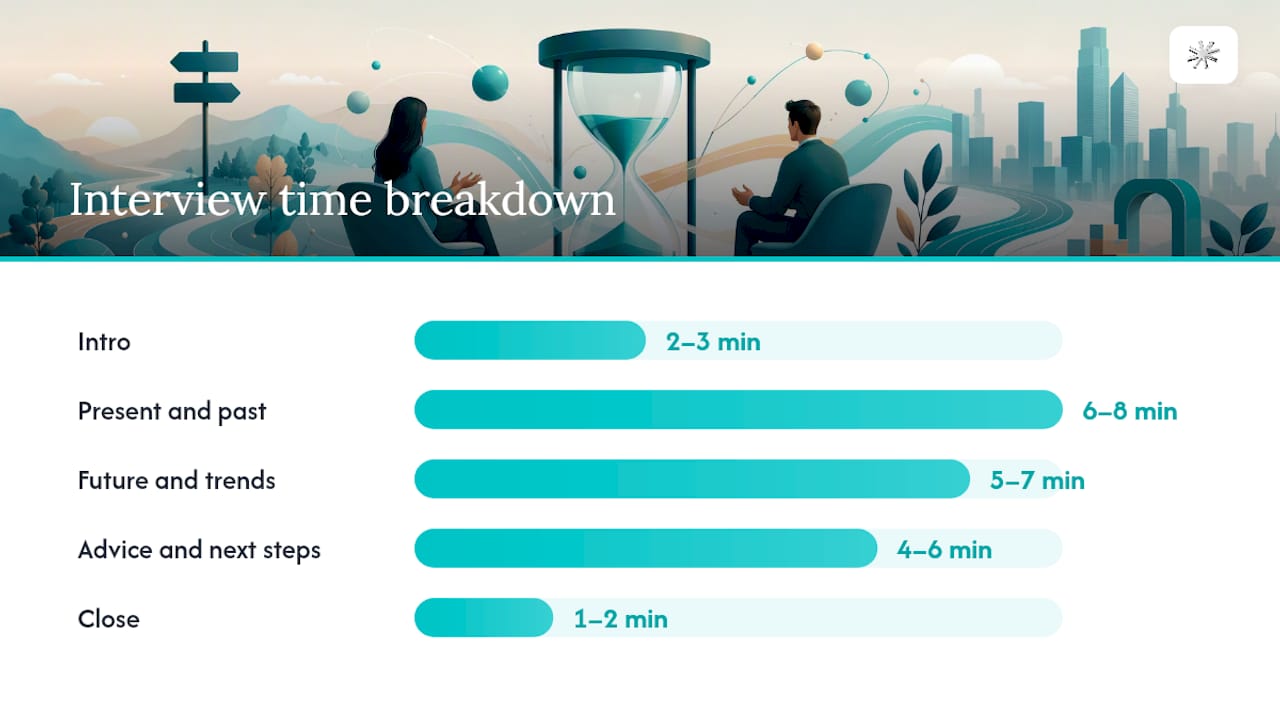
A 20 to 30 minute call has a natural shape. The UCSF career guide frames it as an arc: present, past, future, advice, and support. Here's how that plays out minute by minute:
- Intro (2 to 3 minutes). Thank them, restate why you reached out, and confirm how much time you have.
- Present and past (6 to 8 minutes). Ask about their current role, then how they got there.
- Future and trends (5 to 7 minutes). Ask where the field is headed and what's changing.
- Advice and next steps (4 to 6 minutes). Ask what they'd do in your position.
- Close (1 to 2 minutes). Thank them again and ask for one referral.
A prioritized question bank you can swap in and out by time budget:
10-minute set (must-ask only):
- What does a typical week look like in your role?
- What skill matters more than people expect coming in?
- Who else would you suggest I talk to?
20-minute set (add these):
- What surprised you most about this field once you were in it?
- What's a common misconception outsiders have?
- What would you look for in someone switching in from [your current field]?
30-minute set (add these):
- How is this field changing over the next few years?
- What does the hiring process actually look for beyond the resume?
- If you were starting over today, what would you do differently?
Take notes by hand or on a phone in short phrases, not full sentences. Full sentences pull your attention away from listening. Circle anything that sounds like an action item so it's easy to find later.
Save the referral ask for the very end, and frame it as curiosity, not a favor: "Is there anyone else you think I should talk to as I keep learning about this?" That question rarely feels transactional. If they ask about your job search, be honest that you're exploring, not actively applying yet. That answer keeps the conversation low-pressure for both of you.
Pro Tip: If the conversation runs long because they're enjoying it, let it. Just check in around the agreed time: "I promised you 20 minutes. Happy to wrap up or keep going if you have a few more."
Following Up After the Conversation
Send a thank-you within 24 to 48 hours; consider using tailored Mandarin networking phrases for professionals to make your message stand out in multilingual contexts. That window matters more than the wording. A short, specific note beats a long generic one every time.
Thank-you template:
Hi [Name], thank you for the time today. Your point about [specific piece of advice] really reframed how I'm thinking about this. I'm going to look into [thing they suggested], and I'd love to stay in touch as I move forward. If anyone else comes to mind who'd be worth talking to, I'd appreciate the introduction.
Right after each call, log four things while they're fresh:
- Date and their role.
- Top three takeaways.
- Names of anyone they suggested you contact.
- Anything you promised to follow up on.
Send one more update, not a request, within two to four weeks: a quick note on what you did with their advice. That single move is often what turns a one-time chat into an ongoing referral relationship over the following three to six months.
Career-Change Specific Interview Tactics
When you don't have a matching title on your resume, language does the heavy lifting. Instead of "I was a teacher," try "I managed 30 stakeholders daily and translated complex material for different audiences." That's the same experience, reframed around the skill the new field actually cares about.
Ask direct skill-transfer questions:
- Which three skills matter most in this role, regardless of background?
- What tools or software should I know before I apply?
- How would someone from my background prove they can do this job?
Career switchers on the other end of these calls almost always suggest concrete next steps. Common ones include:
- A short volunteer project to build a portfolio piece.
- A micro-certificate that signals baseline competence fast.
- A shadow day to see the actual workflow up close.
Propose these yourself if they don't come up: "Would it be reasonable to ask about shadowing for a day, or is that not common in this field?" These conversations also double as rehearsal. Each time you explain your pivot out loud, the story gets tighter, which pays off directly when you reach a real job interview later.
Mistakes That Derail Informational Interviews
The fastest way to lose a contact is asking for a job in the first message. Keep the ask about learning, and state the time clearly: "20 minutes" beats "whenever you're free."
During the call, avoid talking more than you listen, and don't skip the referral ask. Afterward, a missing thank-you or silence after promising an update quietly closes the door on future help.
Quick fixes: template your outreach so the ask is always clear, end every call with "who else should I talk to," and set a two-week reminder to send your update.
How Nuecareer Speeds Up Interview Prep and Tracking
Preparing for an informational interview gets a lot faster when you already know what you're aiming for. Nuecareer's strengths quiz matches you to career paths built around your actual skills, so you walk into a conversation with a specific target instead of a vague direction.
From there, its job-description analyzer breaks down what a real posting in your target field is actually asking for, which makes your must-ask questions sharper. Say your quiz points toward operations roles: run one real job post through the analyzer, turn the gaps it finds into three questions, and you've built a focused 20-minute interview plan in about ten minutes flat.
How to Use Informational Interview Insights to Make a Real Decision
One good conversation is a data point, not a verdict. The value shows up once you've talked to three to five people and start comparing notes.
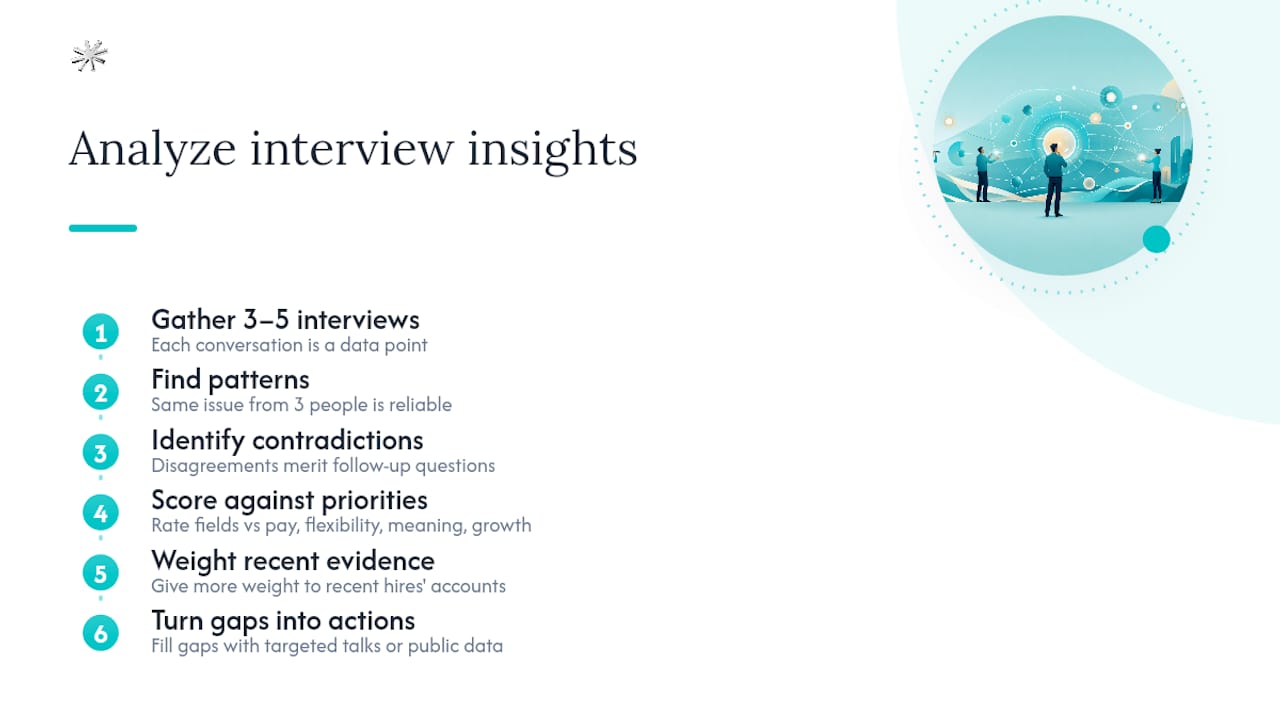
Look for patterns first. If three different people mention the same frustrating part of the job, that's more reliable than one person's opinion. Look for contradictions too. If two recruiters disagree on what actually gets someone hired, that's worth a follow-up question rather than a guess.
Score your findings against what you actually want from a change, not just what sounds exciting. Go back to the outcomes you set before you started reaching out: is this about pay, flexibility, meaning, or growth? Rate each field you're exploring against those, using specific quotes and details from your calls rather than general impressions.
Weight recent information more heavily. Someone describing hiring trends from five years ago carries less weight than someone who was hired last quarter. Fields shift fast, especially anything touching technology or regulation.
Finally, treat unanswered questions as your next action, not a dead end. If nobody could tell you what entry-level pay looks like, that's a gap to fill with one more targeted conversation or a look at public salary data, not a reason to guess. A structured roadmap helps turn these scattered insights into an actual sequence of next steps rather than a pile of notes you never revisit.
How Long Should an Informational Interview Take?
Thirty minutes is the standard length, though 20 minutes works fine for a focused conversation and some contacts will offer up to 45. Ask for less than you think you need. It's far easier to let a great conversation run long than to claw back time from someone who agreed to 45 minutes and now feels boxed in.
The timeline around the conversation matters just as much as the call itself. Here's a realistic week-by-week view:
- Day 0: Send your outreach message.
- Day 5 to 7: Send one polite follow-up if you haven't heard back.
- Call day: Keep it to the time you asked for.
- Within 24 to 48 hours: Send your thank-you note.
- 2 to 4 weeks later: Send a short update on what you did with their advice.
- 3 to 6 months later: Check in again, especially if they offered a referral or mentorship.
Spread across a career change, most people run five to ten of these conversations over four to eight weeks, layering in the volunteer projects or micro-courses that come up along the way. That pacing keeps the process from stalling out, which is a real risk when career transitions drag on without a structure behind them.
When Exploration Should Turn Into Action
Informational interviews work because they let you test a pivot before you've burned any bridges or savings on it. The risk drops with every honest conversation you have.
That said, curiosity has a shelf life. Once a pattern repeats across several calls, stop researching and run the small experiment someone suggested.
Try Nuecareer's Free Tools Before Your Next Conversation
You don't need a career coach on retainer to walk into an informational interview prepared. Nuecareer gives you the same clarity for free, starting with a 7-minute quiz that matches your actual strengths to real career paths, so you know exactly which fields and roles are worth your limited outreach time.
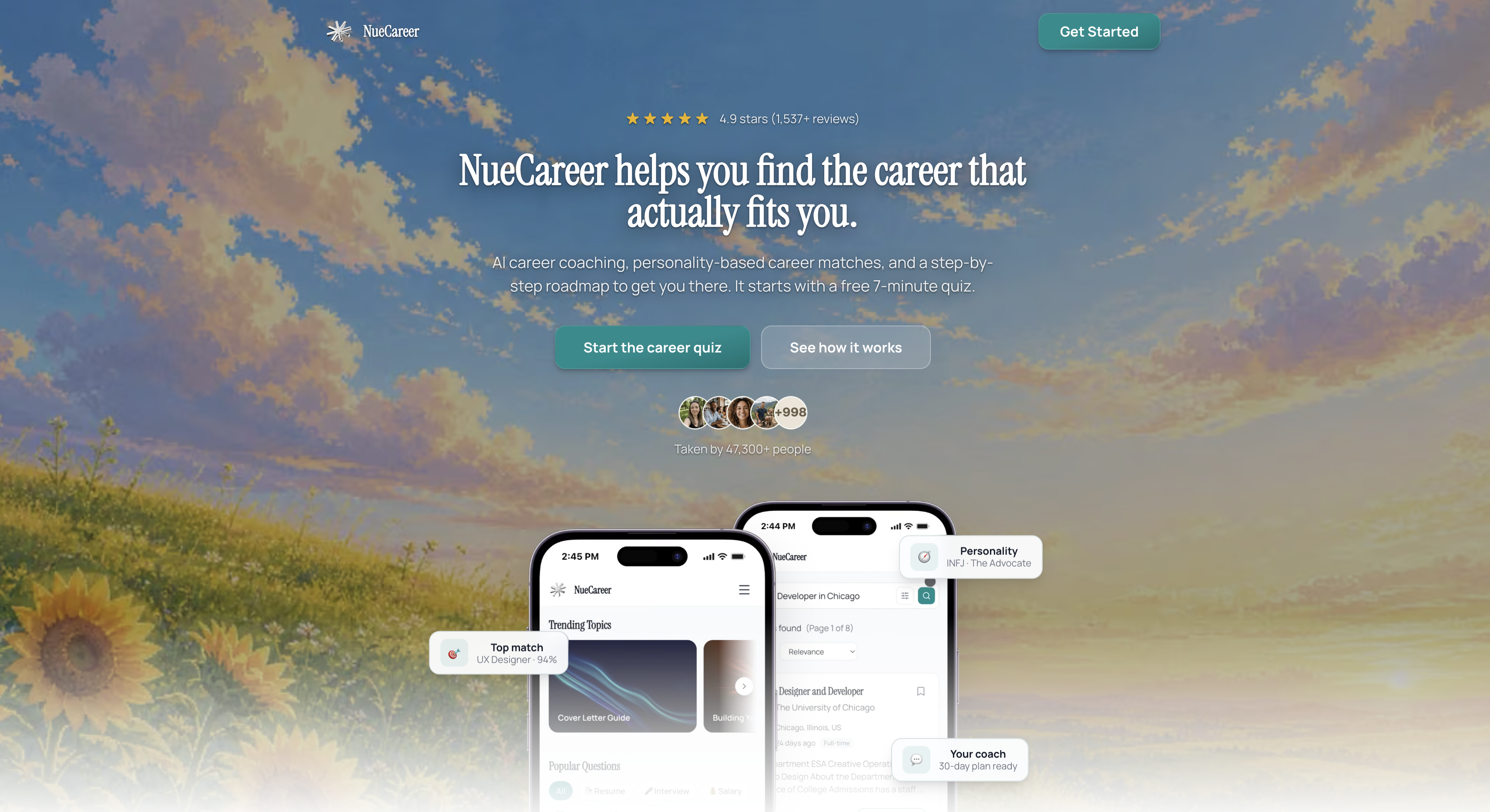
From there, the job-description analyzer turns any posting in your target field into a shortlist of what actually matters, which makes for sharper must-ask questions and stronger follow-up. Once your conversations turn into real direction, the cover letter generator helps you act on what you learned instead of letting it sit in your notes. Take the free career clusters quiz now and walk into your next informational interview with a clear target instead of a guess.
Sources
- Informational Interviews - Berkeley Career Engagement
- Informational Interview: A Guide to Preparing for the Conversation (UCSF)
- Want to Change Careers? Here’s How Informational Interviews Can Help – Center for Career Development | Boston University
- Best practices for landing an informational interview (Yale CDO)
FAQ
What is the 30-60-90 rule in an interview?
It's a first-days planning framework used after you're hired, not for informational interviews. It's not something a career-change interview conversation is built around.
What is the 80/20 rule in interviewing?
In an informational interview, your job is to draw out their experience, not showcase your own.
How do I explain my career change in an interview?
Reframe past work using skill-first language: name the transferable skill before the old job title, and back it with one concrete example. Practicing this explanation during informational interviews makes it much smoother by the time you're in a real hiring conversation.
What are some tips for a successful informational interview?
Keep it to 20 to 30 minutes, bring three prioritized questions, focus on learning rather than job-seeking, and follow up with a thank-you within 24 to 48 hours plus one referral request.