
2–3 Projects That Make an Interview Portfolio Prove Your Career Change

Create an interview portfolio with 2–3 outcome focused projects, exact bridge sentences, and short case study scripts to prove your career pivot.
Yes, an interview portfolio belongs in your career change plan, and it has one job: prove you can already do the work in your new field, not just talk about it. The strongest ones lean on two or three real projects, like a translated case study from your old role, a small new-field sample, and a one-page summary interviewers can hold. NueCareer's 7-Minute Career Quiz can help you figure out which of your strengths deserve top billing before you build a single slide.
TL;DR:
- A career change portfolio should focus on two to three outcome-driven projects that demonstrate transferable skills with clear results.
- Digital, PDF, or print formats each suit different roles, but the portfolio link must be easy to find on resumes and profiles to avoid being overlooked.
- Effective portfolio content includes a hero statement, concise case studies, supporting evidence, a brief resume snapshot, and a reflective statement connecting past work to new goals.
- Use outcome reframing and skill mapping to translate previous responsibilities into relevant skills for the target role, supported by small, focused projects.
- Prioritize clarity and bridge language over visual polish, ensuring each project provides concrete evidence and context to make the pivot compelling for interviewers.
Table of Contents
- What Is an Interview Portfolio for a Career Change?
- Who Needs One, and Which Format Fits Your Interview?
- What to Include: A Copyable Contents Checklist
- How to Prove Transferable Skills and Tell Your Pivot Story
- How to Present Your Portfolio in the Interview
- How NueCareer Helps You Build a Portfolio That Fits Your Pivot
- Real Portfolio Examples From People Who Made the Leap
- Common Portfolio Mistakes Career Changers Make
- Keeping Your Portfolio Current as Your New Skills Grow
- Handling Gaps and Inconsistencies in a Career Change Portfolio
- Why Translation Matters More Than Talent Here
- Build Your Portfolio Around the Right Strengths First
- Sources
- FAQ
What Is an Interview Portfolio for a Career Change?
An interview portfolio is a curated set of work samples, case studies, and evidence you bring to an interview to show, not just tell, what you can do. A resume lists your history. A portfolio proves it. That distinction matters most when your job titles do not map cleanly onto the role you want.
Hiring managers trust portfolios because they replace claims with evidence. Anyone can write "strong problem solver" on a resume. A portfolio that shows the problem, the method, and the measurable result gives that claim something to stand on. Career-services guidance from Texas State University recommends exactly this: tailored samples and a reflective statement connecting old experience to new goals.
Portfolios pay off most in these situations:
- You're pivoting into a field where output is visible, like design, marketing, product, UX, data, or education.
- Your resume undersells you because your old title doesn't translate ("Retail Manager" doesn't scream "Operations Analyst," even if the work does).
- The role explicitly values demonstrated skill over pedigree, which is increasingly common in tech and creative hiring.
Who Needs One, and Which Format Fits Your Interview?
Not every career change needs a full portfolio. If you're moving into a role where credentials or licenses drive hiring decisions, like nursing, law, or accounting, a portfolio adds little. But for creative, product, UX, marketing, data, and education pivots, it often becomes the deciding factor between two similarly qualified candidates.
Format depends on how you'll use it:
- Digital portfolio site or link: best for design, product, UX, and marketing roles where reviewers expect to click through work at their own pace.
- Downloadable PDF: best when you want full control over layout and need something easy to email or attach to an application.
- Printed packet: best for in-person interviews in traditional industries like education or nonprofit management, where a leave-behind still carries weight.
Add your portfolio link directly in your resume header and LinkedIn profile, not buried in a cover letter, so it survives applicant tracking systems that strip formatting from attachments.
What to Include: A Copyable Contents Checklist
Build your portfolio in this order, and keep every section tight enough to review in under ten minutes.
Hero statement. One sentence naming your target role and briefly signaling why you're making the move. Resume guidance from Mirrai Careers recommends this exact move: name the destination before anyone asks why you left the last one. Example: "Former high school science teacher transitioning into UX research, bringing eight years of translating complex information for diverse audiences."
Two to three case studies. Each one follows a simple structure: goal, your role, your method, and the outcome. A product design template from MySeera uses this same four-part shape: problem, role and approach, tools used, and measurable result. Sample bullet: "Redesigned the onboarding flow for a 200-student pilot program. Cut average setup time from 12 minutes to 4 by simplifying the form logic."
Supporting evidence. Certificates, short code snippets or screenshots, testimonials, and any metric you can defend under questioning.
Resume snapshot. A condensed, one-page version of your resume formatted for a fast read during the interview itself.
A short reflective statement. Two or three sentences linking your past work directly to your new field's demands, per the same Texas State career-services guidance cited above.
Always get permission before including work from a former employer, and anonymize client names or proprietary data where you're not sure it's cleared for sharing.
Pro Tip: *Portfolios built around outcomes, not job duties, consistently land better in interviews. "Managed a team of six" tells them what you did.
How to Prove Transferable Skills and Tell Your Pivot Story
Two techniques do most of the heavy lifting here: outcome reframing and skill mapping.
Outcome reframing takes a duty from your old role and restates it as a result. "Handled customer complaints" becomes "Resolved 40+ weekly customer issues, reducing escalations by identifying root-cause patterns." Skill mapping pairs an old responsibility with its new-field equivalent: classroom management maps to stakeholder communication; sales quota tracking maps to KPI analysis; financial reconciliation maps to data auditing.
Use this bridge formula in your hero statement or cover letter: "In [old role], I [did X], which taught me [transferable skill] — now I want to apply that to [new field] by [specific action]."
Four ready-to-use variations:
- "In classroom teaching, I built lesson plans around learner data, which taught me to design for user needs, not assumptions."
- "In sales, I diagnosed objections in real time, which taught me the pattern recognition that data analysis now demands."
- "In finance, I reconciled discrepancies across thousands of transactions, which taught me the attention to detail data integrity work requires."
- "In retail management, I ran daily operations under shifting demand, which taught me the prioritization skills product management rewards."
Quick project ideas by pivot: teachers moving into UX can conduct a five-person usability test on an app they already use. Salespeople moving into marketing can build a one-page campaign plan with mock metrics for a local business. Finance professionals moving into data can clean and visualize a public dataset from a source like Kaggle. Keep the scope small. A tight, well-documented three-day project beats a half-finished ambitious one. Our guide on identifying transferable skills for a career change walks through more mapping exercises if you want to go deeper before building.
Pro Tip: When you quantify limited-scope work, be specific about the scale. "Tested with 5 users over 3 days" reads as credible and honest. A vague "extensive testing" claim on a project everyone knows was small reads as a red flag.
How to Present Your Portfolio in the Interview
Timing and delivery matter as much as content. Use this sequence:
- Open with one line. "I brought a portfolio with a couple of projects that show how my background applies directly to this role, if it's helpful to walk through one."
- Walk through one case study in 90 to 120 seconds. State the goal, your approach, and the result, then stop. Don't narrate every slide. "The goal was to cut onboarding friction for new students. I mapped the process, found the bottleneck was a confusing intake form, redesigned it, and cut setup time by two thirds."
- Match the medium to the moment. Share your screen in video interviews, hand over a printed one-pager in person, and send a digital link for anything remote or async.
- Handle the pivot question directly. When interviewers push on commitment or lack of direct experience, point back to the portfolio: "That's actually why I built this project, to show the skill transfers even though the title doesn't."
- Reference it again in your thank-you note. A short line like "Happy to share the full case study I mentioned" keeps the evidence fresh after the interview ends.
Our career-changer interview answers guide has more full scripts for handling pivot-specific questions if you want to rehearse beyond this structure.
How NueCareer Helps You Build a Portfolio That Fits Your Pivot
Figuring out which strengths to lead with is often the hardest part of building a portfolio from scratch. NueCareer's 7-Minute Career Quiz identifies your core strengths and matches them to career paths, including ones you may not have considered, so you know which two or three projects actually deserve a spot in your portfolio.
From there, the platform's features support the rest of the build:
- 24/7 coaching chat for talking through which case study best fits a specific job description.
- Personalized roadmaps that sequence quiz results into project selection, then portfolio assembly, then interview prep.
- Resume and cover letter tools that keep your hero statement and resume snapshot consistent with the rest of your application.
NueCareer contributor Shane covers related ground in posts on transferable skills and pivot resumes, worth a read once your quiz results are in.
Real Portfolio Examples From People Who Made the Leap
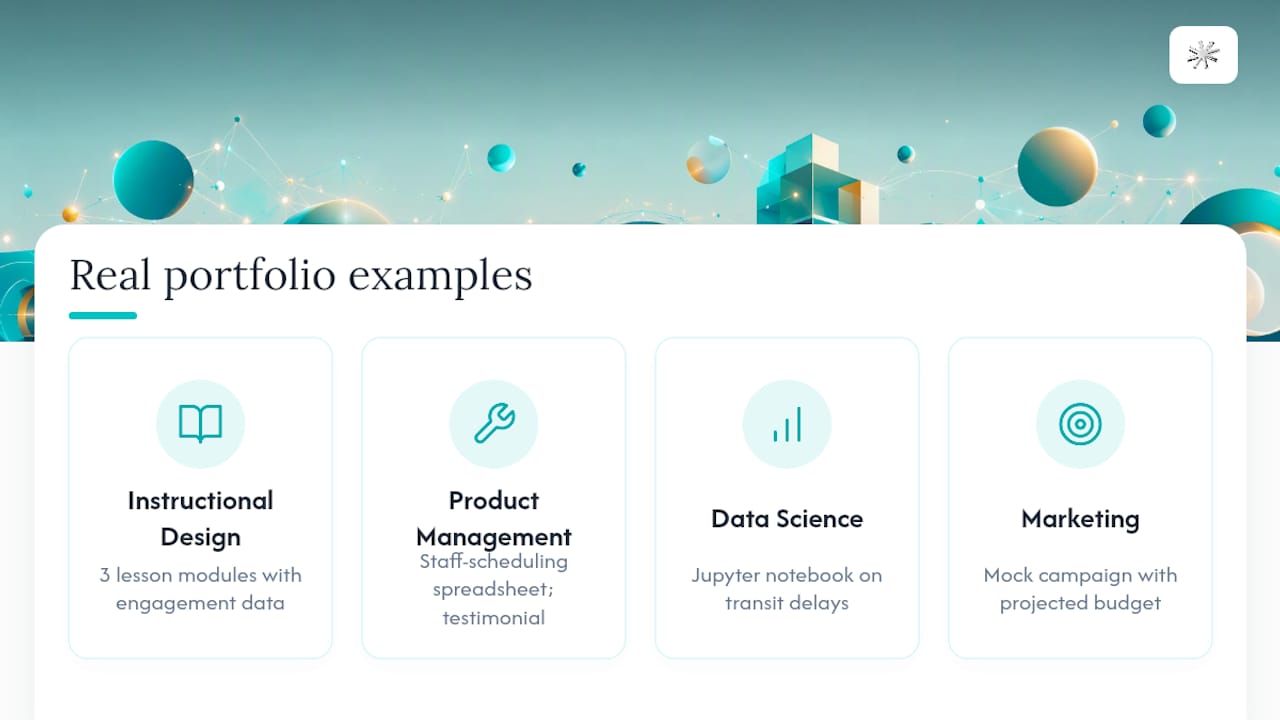
A former high school teacher pivoting into instructional design built a portfolio around three redesigned lesson modules, each with before-and-after engagement data pulled from a classroom pilot. The hero statement led with "Former educator, now designing learning experiences that scale beyond one classroom." That single line did the work of a paragraph.
A retail store manager moving into product management built one case study around a staffing scheduling problem she solved with a simple spreadsheet tool, framed exactly like a product sprint: problem, research, prototype, result. She included a screenshot of the tool and a two-line testimonial from a former colleague confirming the time savings.
A financial analyst pivoting into data science skipped flashy visuals entirely and built a portfolio around one clean Jupyter notebook analyzing public transit delay data, with clear commentary on his methodology. Reviewers in technical fields often care more about your reasoning than your design polish.
A salesperson pivoting into marketing built a mock campaign for a real local coffee shop, complete with a projected budget and sample ad copy, even though it was never run. The project idea itself, showing initiative to build something unprompted, became a talking point in every interview he had.
None of these required professional experience in the new field. Each one required a small, finished project and a clear line connecting it to a transferable skill.
Common Portfolio Mistakes Career Changers Make
The single biggest mistake is including too much. A portfolio with eight mediocre projects reads weaker than one with two excellent ones. TailorCV's guidance on career change portfolios backs this directly: two to three well-documented new-field projects outperform a long list of thin examples, because depth signals competence and breadth without depth signals padding.
A second common error: describing duties instead of outcomes. "Responsible for customer onboarding" tells an interviewer nothing they couldn't guess. "Redesigned onboarding, cutting drop-off by a third" gives them something to ask about.
A third mistake is skipping the bridge language entirely and letting the portfolio speak for itself. It rarely does. Interviewers need the connective sentence that says "here's why this old-field project proves I can do the new-field job." Leaving that unsaid puts the burden of translation on the interviewer, and busy interviewers won't always do that work for you.
A fourth mistake: using unpolished or unfinished samples. A half-built project signals the pivot itself is half-committed. If a project isn't finished enough to defend under questioning, leave it out or finish it first.
Finally, watch for stale contact information or broken links on digital portfolios. Nothing undercuts a confident interview performance faster than a link that returns a 404 error the moment a hiring manager tries to follow up.
Keeping Your Portfolio Current as Your New Skills Grow
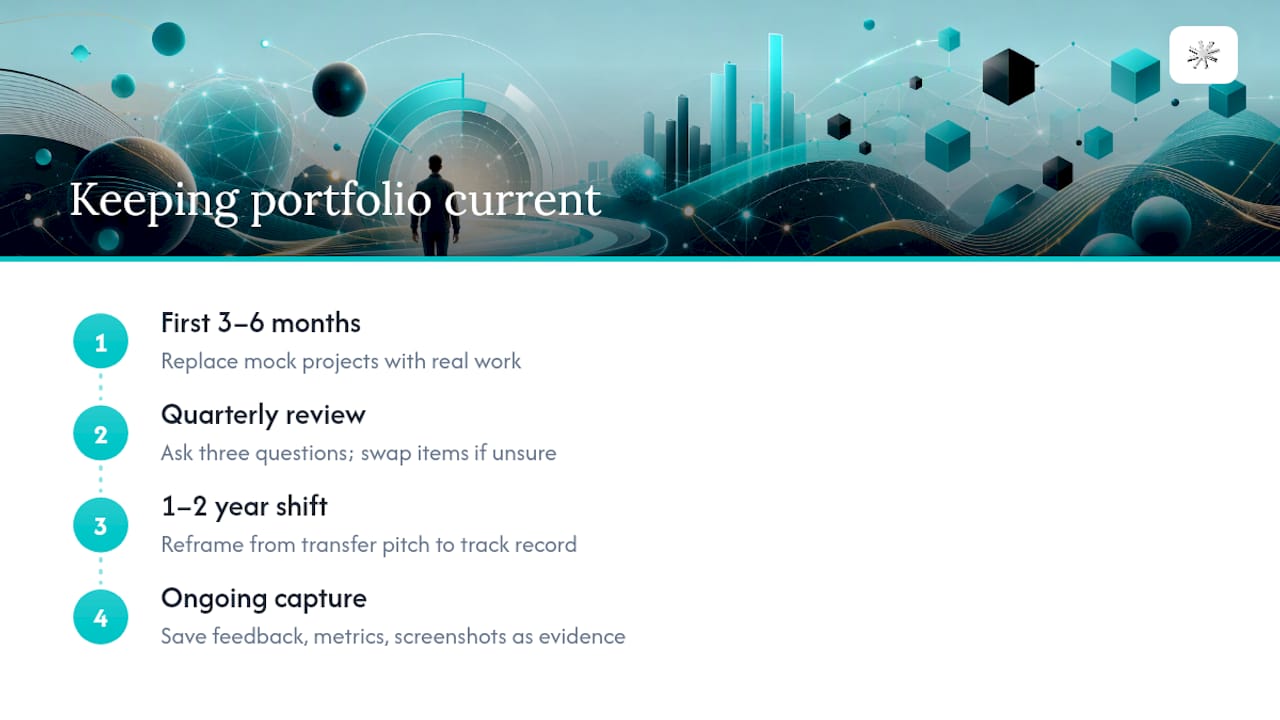
Treat your portfolio as a living document, not a one-time project for your job search. Once you land the new role, your first three to six months will generate real work product, and that should replace your mock or self-initiated projects fast. A real project with a real employer, even a modest one, will always outperform a simulated exercise built to prove potential.
Set a quarterly reminder to review what's in there. Ask three questions each time: Is this still my strongest example? Does it still reflect where I'm trying to go next? Would I be embarrassed to have a future interviewer see this compared to what I can do now? If any answer gives you pause, swap the item out.
As you gain traction in the new field, your reflective statement should evolve too. What starts as "I'm making a case for why my background transfers" should shift, over a year or two, into "here's a track record in this field." That shift in framing matters more than most people realize, because a portfolio that still reads like a pitch two years into a new role starts to work against you rather than for you.
Keep a running folder, digital or physical, of anything that could become a future case study: a positive piece of feedback, a metric you tracked, a screenshot of results. Building the habit of capturing evidence as you go is far easier than trying to reconstruct wins from memory six months later when you need a portfolio refresh for the next promotion or move.
Handling Gaps and Inconsistencies in a Career Change Portfolio
Every career change portfolio has at least one obvious inconsistency: a title that doesn't match, a gap in employment while you retrained, or a mix of paid and unpaid work samples. Address it directly rather than hoping no one notices.
For employment gaps during retraining, name the gap and what filled it in your reflective statement: "During a six-month transition, I completed a UX certificate and built three independent case studies," rather than leaving a blank stretch on your resume timeline unexplained.
For title mismatches, lean on the hero statement to reframe the narrative up front, before an interviewer has a chance to form their own conclusion about the gap.
For a mix of professional and self-initiated work, be transparent about which is which. Label mock or practice projects clearly rather than letting them pass as client work. Interviewers respect honesty about scope far more than they penalize a project for being self-driven. According to Indeed's guidance on answering career-change interview questions, interviewers are primarily evaluating transferable skills and commitment, and a well-explained gap paired with concrete evidence of new-field ability tends to satisfy both concerns at once. Consistency between what you say and what your portfolio shows matters more than a perfectly clean history.
Why Translation Matters More Than Talent Here
The conventional advice on career-change portfolios spends too much time on design polish and not enough on the sentence-level work of explaining why a past project counts as evidence for a future role. A beautifully designed portfolio with no bridge language still leaves the interviewer doing translation work they didn't sign up for, and busy hiring managers often won't finish that work on your behalf.
What the research actually supports is narrower and more useful: two or three outcome-focused projects, paired with explicit bridge sentences, beat a large, polished, but unexplained collection every time. LinkedIn-cited reporting on portfolio impact suggests candidates with visible work samples advance further in hiring processes, but that advantage disappears if the samples don't connect clearly to the target role.
If you take one thing from this article, prioritize the translation sentence over the portfolio's visual design. Build the bridge language first, then build the projects to support it. Most career changers do the opposite, and it's why so many strong portfolios still fail to land the job.
— Shane
Build Your Portfolio Around the Right Strengths First
Most career changers spend hours building portfolio slides before they've clearly identified which strengths actually matter for their target role, and that backwards order wastes real time. NueCareer flips that sequence: start with the 7-Minute Career Quiz, get matched to career paths built around your actual strengths, and then build portfolio projects that speak directly to what those roles require.
From there, NueCareer's personalized roadmaps sequence your next steps, whether that's a specific project to build, a certificate to pursue, or a mock interview to rehearse before the real one. The 24/7 coaching chat gives you a place to test bridge language and project ideas before you commit hours to building them out, and the resume and cover letter tools keep every piece of your application consistent with the story your portfolio tells. If you're not sure which strengths to lead with yet, take the quiz and let your results guide the next project you build.
Sources
Career-services offices offer some of the most reliable structural guidance available, including Texas State University's portfolio guide and Capella University's overview of portfolio benefits. For case-study structure specifically, product design examples from MySeera offer a template worth adapting. For interview-answer framing around your pivot itself, Indeed's career-change interview guide is worth bookmarking. Reflection frameworks from Leaderly's writing on reflective learning can also sharpen the reflective statement that ties your portfolio together.
- Portfolio guide — Texas State University Career Services
- Interview question: 'Tell me about yourself' (career change) — Indeed Career Guide
FAQ
What Should I Say in an Interview About My Career Change?
Lead with your transferable skills, name your target role directly, and back it up with a concrete example, ideally from your portfolio, that proves you can already perform the core tasks the new role demands.
What Is the 30-60-90 Rule in an Interview?
It's a plan outlining what you intend to accomplish in your early days on the job, and career changers often use it to show they've thought concretely about ramping up despite coming from a different field.
What Is the Biggest Red Flag in a Career-Change Interview?
Vague, unsubstantiated claims about transferable skills without any evidence to back them up is one of the biggest red flags, which is exactly why a portfolio with concrete case studies carries so much weight.
Do I Need Professional Experience in My New Field to Build a Portfolio?
No. Two or three small, well-documented self-initiated projects, like a mock campaign or a short usability test, can demonstrate capability just as effectively as paid work when they're framed with clear goals and measurable outcomes.
How Many Projects Should Go in a Career-Change Portfolio?
Two to three well-documented projects tend to outperform a longer list of weaker examples, since depth and clarity matter more to hiring managers than volume.