
180 Day Proof Plan to Switch Careers in the U.S. Without a Degree

Map your transferable strengths, follow a 180 day proof plan, and use NueCareer's 7 Minute Career Quiz to pick a no degree U.S. career path.
Yes, you can switch careers without a degree, and it happens every day. The fastest route is to pick a target role that fits your existing strengths, build visible proof of your skills, and go after the right people directly instead of mass-applying online. If you're not sure which direction fits you, NueCareer's 7-Minute Career Quiz is a quick way to surface roles built around who you already are.
TL;DR:
- Skilled trades, tech bootcamps, and sales roles can lead to high-paying careers without a degree, often within 3 to 9 months of focused effort.
- Building proof through projects, certificates, or apprenticeships outweighs formal education and is crucial for demonstrating capability to employers.
- Networking, informational interviews, and direct outreach significantly accelerate hiring prospects compared to mass applications or relying solely on job boards.
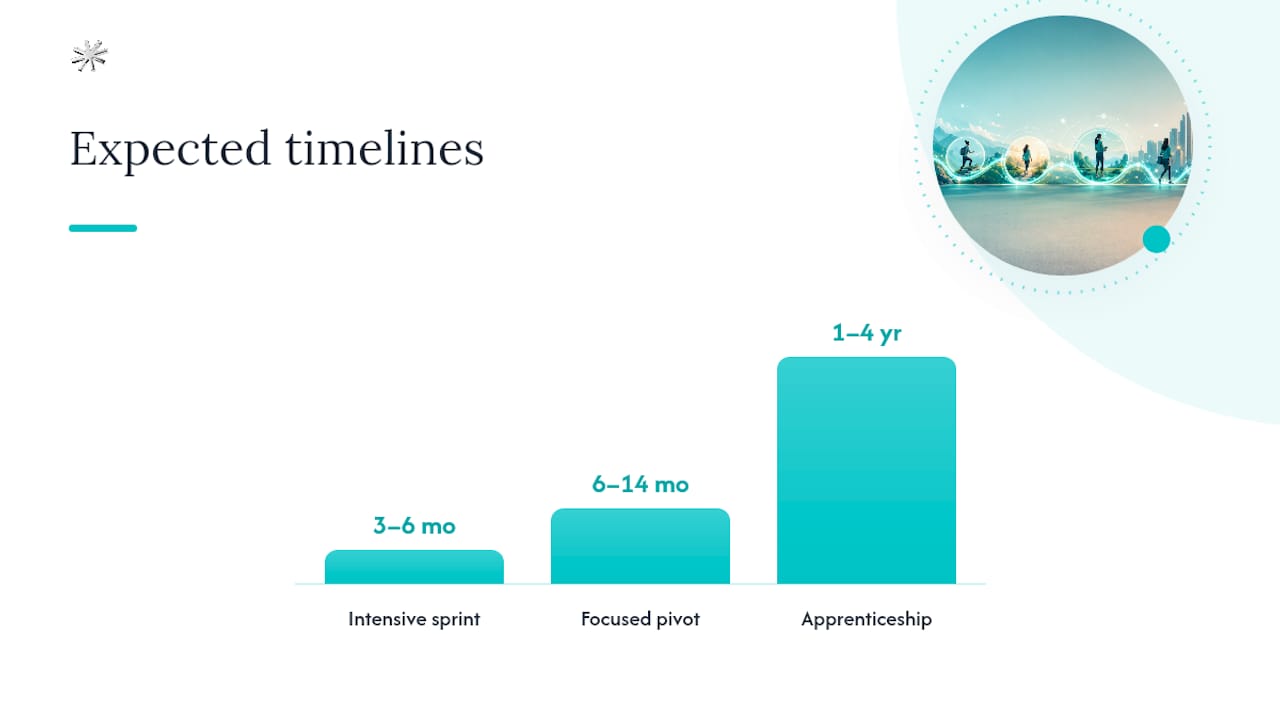
- Most career pivots to non-regulated fields take between 6 to 14 months, but apprenticeships can span one to four years with ongoing wages.
- If switching to licensed professions like nursing or law, completing formal education and licensing is unavoidable; otherwise, portfolio and experience are key.
Table of Contents
- High-Absorption Career Paths That Don't Require a Degree
- How Do You Pick the Right Path for You?
- How to Build Proof When You Don't Have a Degree
- Getting Hired: Resumes, LinkedIn, and Interviews Without a Degree
- What Timeline and Pay Should You Realistically Expect?
- Building Experience Before You Have the Job Title
- Where to Learn New Skills for Free or Cheap
- Using Your Network and Finding a Mentor
- Overcoming Employer Bias Against Non-Degree Candidates
- Managing Money During a Career Transition
- Why Evidence Beats Credentials, and Why That's Good News
- Where NueCareer Fits Into Your Career Switch
- Sources
- FAQ
High-Absorption Career Paths That Don't Require a Degree
You don't need a diploma to break into fields that are actively hiring right now. What you need is proof that you can do the work, and some industries make that easier to build than others.
Skilled trades remain some of the most reliable no-degree paths in the country. Electricians, HVAC technicians, and solar installers typically enter through paid apprenticeships, and U.S. News ranks several of these among the best-paying jobs that don't require a college degree. Tech roles like web development, IT support, and data analysis increasingly hire off bootcamp certificates or a portfolio of finished projects rather than a computer science degree. Sales and account management value closing ability and communication over credentials, and many companies promote from entry-level customer support into these roles within a year. Digital marketing rewards people who can show real campaign results, even from a side project or a small business they helped. Healthcare support roles, like medical assistants or pharmacy technicians, often require a short certificate program instead of a four-year degree. Project coordination, which keeps teams and timelines on track, is frequently filled by people who prove organizational skill in a completely different job first.
Here's how those paths typically open up:
- Trades: paid apprenticeship, 1 to 4 years, wages rise as you advance through levels
- Tech: bootcamp or self-taught portfolio, 3 to 9 months of focused building
- Sales: entry-level role plus a track record, 3 to 6 months to first promotion
- Marketing: certificate plus a personal campaign case study, 2 to 5 months
- Healthcare support: short certificate program, 4 to 12 months depending on the role
- Project coordination: internal transfer or certificate like CAPM, 3 to 8 months
Some fields stay off-limits without formal credentials. Nursing, teaching, accounting that requires a CPA, and law all require licensure regardless of how strong your portfolio is. If you're eyeing one of those, formal education is not optional. For everything else, the Bureau of Labor Statistics Occupational Outlook Handbook is the place to check real pay ranges and job growth projections before you commit months to a new direction. Indeed's guide to jobs without a degree also lists sample entry salaries worth comparing against your current income.
Pro Tip: Before picking a path, search "[job title] salary" on the BLS site and compare it to three job postings in your city. National averages can be misleading if your local market pays differently.
How Do You Pick the Right Path for You?
Choosing a lane is often the hardest part, not the actual skill building. Most people either freeze from too many options or chase whatever sounds impressive instead of what fits.
Start with an honest inventory of your transferable strengths. Write down five things you're good at using action verbs and outcomes, not job titles. "I trained new hires in under two weeks" tells you more than "I was a shift supervisor." The mapping rule is simple: a new role is worth pursuing if it reuses at least three of those strengths.
- List your strengths as verbs and outcomes, not titles or duties.
- Pull 10 to 30 job postings for roles that interest you and highlight every repeated required skill.
- Match your strengths against that list and rank roles by overlap.
- Pick one target role and one backup so you're not spreading effort thin.
- Run a 90 to 180 day micro-experiment: build one small project or take one course tied to your target, then reassess before going all in.
This process works because it removes guessing. You're not asking "what sounds interesting," you're asking "what do I already have proof of." NueCareer's career-change decision framework walks through a similar exercise if you want a structured version to follow.
Pro Tip: If two roles tie on strength overlap, pick the one with better documented pay growth on the BLS site. Interest matters, but so does not having to switch again in two years.
How to Build Proof When You Don't Have a Degree
Proof is the currency that replaces a diploma. Employers in most non-regulated fields have shifted toward valuing demonstrated capability over credentials, which means two solid, finished projects often outperform a stack of certificates.
What counts as proof depends on the field. In tech and creative work, it's shipped projects with measurable outcomes, even something as simple as a website that increased a local business's inquiries by a documented amount. In sales or marketing, it's case studies from real campaigns, freelance clients, or volunteer work. In healthcare support or the trades, it's the certificate or apprenticeship hours themselves, since those fields require formal sign-off regardless of how good your portfolio looks.
Decide whether a bootcamp or self-directed projects fit better for your situation:
- Choose a bootcamp or certificate when the field requires a credential to pass initial screening (healthcare support, some tech roles, project management).
- Choose self-directed projects when the field rewards visible work over paperwork (marketing, design, most sales roles).
- Choose an apprenticeship when you want to earn while you learn, especially in the trades, where programs are commonly run through unions, trade schools, or employer consortia.
A 180-day roadmap keeps the process from stalling out. Here's a version built for someone working a full-time job:
| Days | Focus | Weekly commitment |
|---|---|---|
| 1 to 30 | Pick target role, complete strengths inventory, start one course or cert | 5 to 7 hours |
| 90 | Build first project or complete certificate coursework | 6 to 8 hours |
| — | Build second project, start applying to 5 to 10 roles weekly | 8 to 10 hours |
| 180 | Interview, refine portfolio based on feedback, negotiate offers | 6 to 8 hours |
Apprenticeships run on a different clock. You're paid from day one, but expect 1 to 4 years depending on the trade, with wage increases tied to progression milestones rather than a single "you're hired" moment. NueCareer's list of part-time career-change courses is a reasonable place to start if you're working full-time and need something that fits around your schedule.
Getting Hired: Resumes, LinkedIn, and Interviews Without a Degree
Your resume's job is to prove capability fast, and that means restructuring it around impact instead of chronology. Lead with a short summary of your target role and top transferable skills, follow with 2 to 3 relevant projects or achievements quantified with numbers, then list work history with measurable outcomes for each role. Education goes near the bottom, not the top. Reordering the resume this way, and moving education down, helps recruiters see relevant proof before they notice what's missing.
On LinkedIn, skip the generic "open to work" post. Message hiring managers or team leads directly with a specific value statement: mention a problem you noticed in their industry and how your background addresses it. This works better than applying cold because it shows initiative before you've even been screened.
For applicant tracking systems, mirror the exact language from the job posting. If it says "cross-functional coordination," use that phrase, not your version of it. ATS software filters on keyword match, and specific, measurable outcomes tend to score better than vague descriptors:
- Use the job posting's own terms for required skills.
- Quantify every bullet where possible: percentages, dollar amounts, time saved.
- Skip degree-related fields entirely rather than leaving them blank or writing "N/A."
For interviews, prepare a 30-second pivot story: what you did before, why you're switching, and one piece of evidence that proves you can do the new role. Keep it tight and let your portfolio or project examples do the heavy lifting after that. NueCareer's resume tips for career changers and 8-step career switch framework both go deeper into outreach scripts if you want more detail here.
Pro Tip: Send your outreach message on a Tuesday or Wednesday morning. Response rates drop sharply on Mondays and Fridays when inboxes are either flooded or already checked out for the week.
What Timeline and Pay Should You Realistically Expect?
Career pivots in non-regulated fields typically run 6 to 14 months from focused effort to a job offer, though a tight sprint of 90 to 180 days is possible if you already have overlapping skills. Apprenticeships run longer, often 1 to 4 years, but you're paid throughout.
Pay research should happen before you commit, not after. BLS Occupational Outlook data gives median wages and job growth by occupation, and state licensure boards will tell you if a role requires a credential you don't yet have.
Some roles bend the degree requirement more than others. Many federal positions accept qualifying work experience in place of a degree, and some entry-level clerical roles need as little as three months of general experience. USAJOBS explicitly outlines how "specialized experience" language can substitute for formal education, worth checking before you assume a listing is out of reach.
Building Experience Before You Have the Job Title
Employers rarely hire someone with zero evidence in a new field, but that evidence doesn't have to come from a paycheck. Volunteering for a nonprofit's marketing push, managing a community event's logistics, or fixing a friend's small business website all count as real, citable experience once you're framing them correctly.

Freelance work, even unpaid or low-paid at first, is often the fastest way to accumulate proof in creative, tech, and marketing fields. Platforms like Upwork or Fiverr give you a public track record, but so does simply offering to help a local business for free in exchange for a testimonial and a case study you can show later. The goal isn't income at this stage, it's documented, reviewable work.
Internships aren't just for college students. Plenty of companies run adult return-to-work or career-change internship programs, and some startups will take on an unpaid or stipend-based project contributor if you pitch a specific, useful idea instead of asking generically "do you have any openings." Volunteering with skills-based organizations, like helping a nonprofit build out its scheduling system or ad campaigns, gives you the same kind of resume line without needing anyone's permission to call yourself qualified.
The common thread across all of these: pick something with a visible output. A finished website, a documented process improvement, or a campaign with real numbers attached will always outweigh a vague line like "volunteered with local organization."
Where to Learn New Skills for Free or Cheap
You don't need to spend thousands of dollars to build the skills a new career requires. A wide set of free and low-cost platforms now cover most no-degree career paths, from coding to healthcare terminology to project management fundamentals.
Coursera and edX offer university-taught courses, many free to audit, with paid certificates if you want something to list on a resume. Google's Career Certificates, available through Coursera, cover IT support, data analytics, UX design, and project management, and are specifically built for people without a traditional tech background. Codecademy and freeCodeCamp are strong, low-cost or free options for anyone building coding skills from scratch. For sales and marketing, HubSpot Academy offers free certifications that carry real weight with hiring managers because HubSpot is a recognized name in the space.
Trade-focused learning usually needs a different approach since hands-on hours matter more than video lectures. Community colleges frequently offer short, low-cost certificate programs for HVAC, electrical, and healthcare support roles that run months rather than years. Many of these double as a pipeline into local apprenticeships.
The mistake to avoid is course collecting. Finishing five free courses with nothing to show for them impresses no one. Pick one or two platforms tied directly to your target role, finish what you start, and turn the coursework into a project you can point to. NueCareer's list of part-time career-change courses narrows this down if you want fewer options to sort through.
Using Your Network and Finding a Mentor
Most career switches happen through a person, not a job board. Someone vouching for you, forwarding your resume internally, or simply telling you which skills actually matter in their field will move you faster than another round of cold applications.
Start with people who already know your work ethic, even if they're not in your target industry. A former manager, a coworker who moved into the field you want, or a friend of a friend who works at a company you admire are all reasonable first messages. Be specific about what you're asking for. "Can I ask you three questions about how you broke into this field" gets a response far more often than "any advice for someone switching careers."
Mentorship doesn't require a formal program to work. Many professionals will do a single 20-minute call if you approach them respectfully and come prepared with real questions instead of asking them to map out your whole plan. Industry-specific online communities, whether that's a trade association, a Slack group, or a subreddit for your target field, are often where the most practical, current advice lives.
Informational interviews are underused and worth the discomfort of asking. They rarely lead to an immediate job, but they consistently surface the unwritten rules of an industry, the terminology that signals you belong, and sometimes a direct introduction to a hiring manager. NueCareer's networking strategies for career changers walks through outreach scripts if starting that first conversation feels like the hardest part.
Overcoming Employer Bias Against Non-Degree Candidates
Some hiring managers still default to filtering by education, even when the job itself doesn't require it. You can't eliminate that bias entirely, but you can make it far less relevant by the time you're in front of a real decision-maker.
The first move is controlling the narrative before anyone else does. Your resume summary and LinkedIn headline should frame your background as an asset, not an apology. Instead of explaining why you don't have a degree, lead with what you can already do and let the proof speak.
Getting past automated filters matters just as much as impressing a human. Many large employers rely on ATS software that screens for degree fields before a resume ever reaches a person, so applying to smaller companies, startups, or roles posted directly rather than through a corporate portal often improves your odds. Referrals bypass this filter almost entirely, which is another reason networking outranks cold applications.
When bias does surface directly in an interview, a short, confident answer works better than a defensive one. Something like "I built my skills through hands-on projects instead of a classroom, and here's the work that proves it" reframes the gap as a deliberate choice rather than a shortfall. Certifications, even smaller ones, can also function as a credibility shortcut, giving a skeptical interviewer a familiar signal to anchor on while your portfolio does the real convincing.
Managing Money During a Career Transition
A career switch without stable income for a stretch is one of the biggest reasons people quit halfway through. Planning for the financial gap matters as much as planning the skills gap.
Start by calculating your bare minimum monthly expenses, not your current spending level. Knowing the true floor tells you exactly how much runway you need before you can safely reduce hours or take unpaid time for building projects. Most people underestimate this number until they actually track a full month of spending.
If you're keeping your current job while transitioning, treat your evenings and weekends as protected work time rather than leftover time. If you're planning to reduce hours or take a break, build a buffer of at least three to six months of essential expenses before you do, and consider part-time or freelance income in your target field to bridge the gap instead of an unrelated survival job when possible, since it doubles as proof of experience.
Apprenticeships change this math since they pay from day one, even if the wage starts lower than your current income. Factor that difference into your budget rather than assuming a pay cut is permanent. It typically rises on a fixed schedule tied to program milestones.
Cut discretionary spending before you cut savings contributions, and resist the urge to fund the transition entirely on credit. A stalled job search is stressful enough without compounding it with debt pressure that forces you into the wrong offer out of urgency.
Why Evidence Beats Credentials, and Why That's Good News
The most overlooked fact in this entire conversation is how normal it is to not have a bachelor's degree. Census data shows a substantial share of U.S. adults don't hold one, which means most hiring managers you'll talk to either don't have one themselves or have colleagues who don't. The stigma is smaller than it feels at 2 a.m. while you're doubting the whole plan.
What actually separates people who successfully switch careers from those who stay stuck isn't talent or luck. It's whether they built something they could point to. A course completion certificate sitting in an inbox convinces no one. A finished project, a documented result, or a paid gig, even a small one, does the convincing for you. That's the entire logic behind treating proof as the real credential.
If there's a mistake I'd flag most often, it's people spending six months "preparing" through courses alone with nothing to show for it. Preparation without a public artifact is invisible to an employer. Pick a target, build the smallest version of proof you can finish in a month, and let that momentum carry you into the next one.
NueCareer built The 7-Minute Career Quiz specifically for this starting point, matching your existing strengths to roles you may not have considered, then handing you a personalized roadmap instead of a generic list. Pair that with the 24/7 coaching chat and the resume and cover-letter tools, and the gap between "I want to switch careers" and "I have a plan" gets a lot smaller.
— Shane
Where NueCareer Fits Into Your Career Switch
NueCareer is the shortcut to clarity that generic advice and scattered course lists can't give you. Instead of guessing which no-degree path fits your strengths, The 7-Minute Career Quiz matches you to specific roles built around who you already are, then builds a personalized roadmap for getting there.
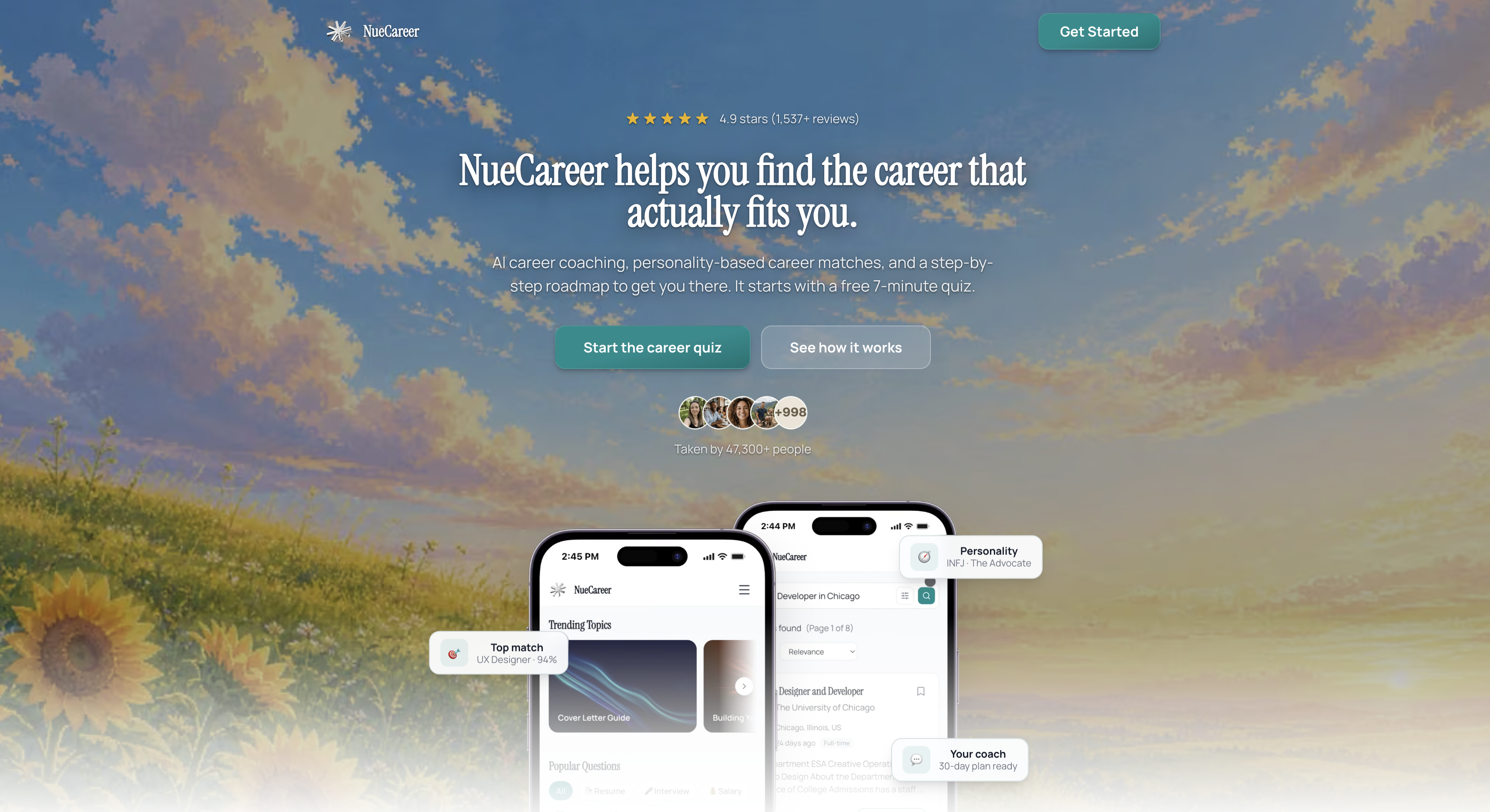
From that starting point, the platform offers various tools, including coaching chat available at any time, tailored job boards filtered to match your target roles, and a suite of resume and cover letter tools designed to help non-degree candidates lead with impact instead of apologizing for a missing credential. If you've been putting off the first step because you're not sure which direction to point yourself, taking a quiz can help identify a roadmap.
Sources
- Occupational Outlook Handbook (BLS)
- Educational attainment in the United States (Census press release)
- Qualifications: college degree (USAJOBS help)
FAQ
What Is the Easiest Career to Switch to Without a Degree?
Sales, customer support, and entry-level tech roles like IT support tend to be the easiest to break into because they weigh communication skills and demonstrated ability over formal credentials, and many companies actively hire and train for these positions.
What Career Pays the Most Without a Degree?
Skilled trades like electrician, HVAC technician, and solar installer, along with senior sales and tech roles built on a strong portfolio, rank among the highest-paying options without a college degree. Exact pay varies significantly by location and experience level, so check the BLS Occupational Outlook Handbook for figures specific to your area.
How Can I Make $10,000 a Month Without a Degree?
Reaching that income level typically requires either a commission-based sales role, a specialized trade with several years of experience, or freelance or consulting work in a skill you've built a strong portfolio around. It's achievable but usually takes 1 to 3 years of deliberate skill and reputation building rather than an immediate jump.
What Jobs Pay $4,000 a Week Without a Degree?
Very few entry-level roles pay that much immediately. Jobs that can reach that range, like senior sales positions, experienced trade specialists, or established freelancers and consultants, generally require significant experience or a proven track record first. Use the BLS Occupational Outlook data to check realistic pay ceilings for any specific role you're considering.
Do I Need to Go Back to School to Switch Careers?
No. For the majority of non-regulated fields, portfolio evidence, certificates, and relevant experience can substitute for a degree entirely. Only licensed fields like nursing, teaching, and law require formal schooling regardless of your other qualifications.