

A personal skill gap analysis compares what you can already do against what your target role actually demands, then hands you a prioritized list of gaps and a 90-day plan to close the ones that matter most. It works because it replaces guesswork with evidence: instead of enrolling in every course that looks relevant, you learn exactly what hiring managers screen for. The World Economic Forum has flagged how fast required skills shift, which is exactly why this process, paired with a tool like NueCareer's quiz, works better than a generic study plan.
TL;DR:
- Candidates should review 10 to 15 job postings for their target role and classify skills appearing in 60% or more as core requirements to focus their efforts effectively.
- A skills audit, including a quick proof test, helps distinguish between full gaps, proof gaps, and refresh gaps, preventing unnecessary retraining.
- Prioritizing high-impact, low-effort gaps using an impact-to-effort score yields a focused 90-day plan that produces tangible proof artifacts for job applications.
- Re-running the skill gap analysis quarterly or every six to eight weeks is essential in fast-changing fields to stay aligned with evolving requirements.
- Tools like NueCareer's quizzes and assessments can significantly speed up the process, providing a quick starting point that complements detailed role mapping.
Table of Contents
- Run a Skills Audit: Inventory What You Can Already Do
- Map the Target Role: What Do 10 to 15 Job Postings Actually Require?
- Classify and Validate Gaps: No Gap, Proof Gap, Refresh Gap, Full Gap
- Prioritize and Plan: A 90-Day, Evidence-First Roadmap
- When Are You Ready to Apply, Bridge, or Retrain Longer?
- Timeline Expectations and How Often to Repeat the Process
- Common Pitfalls That Derail a Skill Gap Analysis
- Tools and Software That Speed Up the Process
- Bringing in Mentors, Managers, or Peers for a Reality Check
- What This Looks Like Across Different Careers
- How NueCareer Applies This Method at Scale
- Get Your Skills Mapped in Under 10 Minutes
- Sources
- FAQ
Run a Skills Audit: Inventory What You Can Already Do
Most career changers skip straight to job boards and start applying, or worse, start signing up for courses before they know what they're missing. That backward approach costs months. A skills audit flips the order: you document what you actually have before deciding what to build, which means every hour of learning afterward targets a real gap instead of ground you've already covered.
The audit itself typically takes three to five hours and produces a single working document you'll reference for the rest of this process. Here's the method:
- List your last 12 to 18 months of tasks and projects, then convert each one into a named skill rather than a vague description ("managed vendor negotiations" becomes "contract negotiation," not "communication").
- Rate your proficiency on each skill from 1 to 5, based on evidence, not confidence.
- Classify each skill as transferable (works in almost any role), adjacent (needs light reframing), or role-specific (tied tightly to your current job title).
- Attach evidence to every rating: a work sample, a performance review line, an analytics dashboard you built, or a short demo project if you have no formal proof.
Your deliverable is a table with five columns: skill, category, proficiency, transferability, and evidence. A rigorous version of this audit also captures soft skills and leadership capabilities, not just technical ones, because hiring decisions weigh both. If you'd rather not build this table from scratch, NueCareer's free skills assessment generates a starting inventory in minutes, and its career guide walks through the same evidence-first logic.
Map the Target Role: What Do 10 to 15 Job Postings Actually Require?
Your audit means nothing until you compare it against a specific target. Pick one job title, one seniority level, and one industry. "Product manager" is too broad; "mid-level product manager, B2B SaaS" is a target you can actually map.
- Pull 10 to 15 live postings for that exact title from LinkedIn, company career pages, and a database like O*NET or Lightcast if you want industry-wide benchmarking data on top of individual listings.
- Separate each posting into "required" and "preferred" skills. Don't blend them; preferred skills matter less and shouldn't drive your priorities.
- Tally how often each skill appears across all 15 postings. A skill appearing in 60% or more of listings counts as a core requirement; anything under that threshold is secondary.
- Build a role requirements list ranked by frequency, with the posting count next to each skill.
This step is where most self-directed jobseekers go wrong. They read three job descriptions, feel overwhelmed by everything mentioned, and try to learn all of it at once. Fifteen postings averaged together tell you what the market actually wants, not what one hiring manager happened to type into a template. If SQL shows up in 12 of 15 postings and "Tableau" shows up in 2, you now know exactly where your time should go.
Classify and Validate Gaps: No Gap, Proof Gap, Refresh Gap, Full Gap
Once you've got your inventory and your role requirements list side by side, sort every required skill into one of four categories. This step is where a skills gap analysis earns its name, and where most people overestimate how much they actually need to learn.
- No gap: you already meet the bar, with evidence to prove it.
- Proof gap: you likely have the skill, but you lack documented evidence a hiring manager would trust.
- Refresh gap: you had the skill once but haven't used it recently and need a quick brush-up, not new instruction.
- Full gap: you genuinely don't have the skill and need to build it from close to zero.
The 10-minute proof test settles the ambiguous cases. Set a timer and attempt a small, real task tied to the skill: write one SQL query, draft one cold email sequence, build one basic financial model. If you complete it competently, downgrade the gap from "full" to "proof" or "refresh." If you can't get started at all, it's a genuine full gap.
Most people discover that what felt like a wall of full gaps is really a handful of proof gaps in disguise: career changers commonly overestimate how much retraining they need, when what they actually need is documentation. Run your self-ratings past a peer, mentor, or former manager, and cross-check anything uncertain against the posting frequency data from your role map. External validation catches the bias that self-assessment alone tends to miss.
Pro Tip: Before enrolling in any course, run the 10-minute proof test first. If you pass, you just saved yourself weeks of unnecessary study.
Prioritize and Plan: A 90-Day, Evidence-First Roadmap
Not every gap deserves equal attention. Score each one on two axes: impact (how many of your 15 postings required it) and effort (how long it would realistically take to produce proof). Divide impact by effort, and the gaps with the highest score go first.
- Rank your full and refresh gaps by this impact/effort score.
- Choose your top one to three gaps for the quarter. No more. Trying to close five or six gaps at once dilutes your progress and usually means none of them get closed convincingly.
- Break each 90-day sprint into weekly time blocks, with a milestone every two to three weeks and a specific proof artifact due at the end (a portfolio piece, a completed project, a certification with a practical component).
- Translate each closed gap into a resume bullet and an interview story before you consider it "done."
Skills change fast. Skills-based hiring keeps expanding, and the shelf life of a specific skill keeps shrinking, which is exactly why a focused 90-day sprint beats an open-ended, unstructured study plan. Once your sprint produces a real artifact, use NueCareer's job application skills tool to turn that evidence into resume language a recruiter will actually notice.
When Are You Ready to Apply, Bridge, or Retrain Longer?
You don't need every gap closed to start applying, and waiting for perfection usually backfires. Use this checklist to decide your next move:
- If your top three high-impact gaps have proof artifacts and your core skills clear the 60% posting threshold, start applying now.
- If two of three are closed but one full gap remains, consider an intermediate or bridge role that uses your strengths while you finish the sprint.
- If most required skills are still full gaps after your audit, longer structured retraining, a bootcamp, or a certificate program probably makes more sense than a 90-day sprint.
- Bring evidence to interviews: your proof artifacts, a portfolio link, and a one-line story for each closed gap that explains what changed and how you proved it.
Re-run this entire analysis every quarter as a baseline, faster if you're targeting a field where tools or requirements shift quickly, like data roles or anything touching AI tooling.
Timeline Expectations and How Often to Repeat the Process
A first full pass, audit, mapping, classification, and prioritization, usually takes a focused weekend or two evening sessions spread across a week. The audit alone runs three to five hours; mapping 15 postings adds another two to three; classifying gaps and running proof tests takes an afternoon. Budget a week if you're doing this around a full-time job.
The 90-day sprint that follows is where the real timeline lives. Three months is long enough to produce one solid proof artifact per priority gap without burning out, and short enough that the market hasn't shifted underneath you by the time you finish.
Re-running the analysis is not a one-time event. Set a quarterly baseline: at the start of each quarter, pull fresh job postings, because listings change, new tools get added to requirements lists, and skills that felt optional six months ago sometimes become core. If you're targeting a fast-moving field, tighten that cadence to every six to eight weeks instead of a full quarter. The postings themselves will tell you when something has shifted; if a skill that appeared in 3 of 15 listings last quarter now shows up in 10, that's your signal to reprioritize.
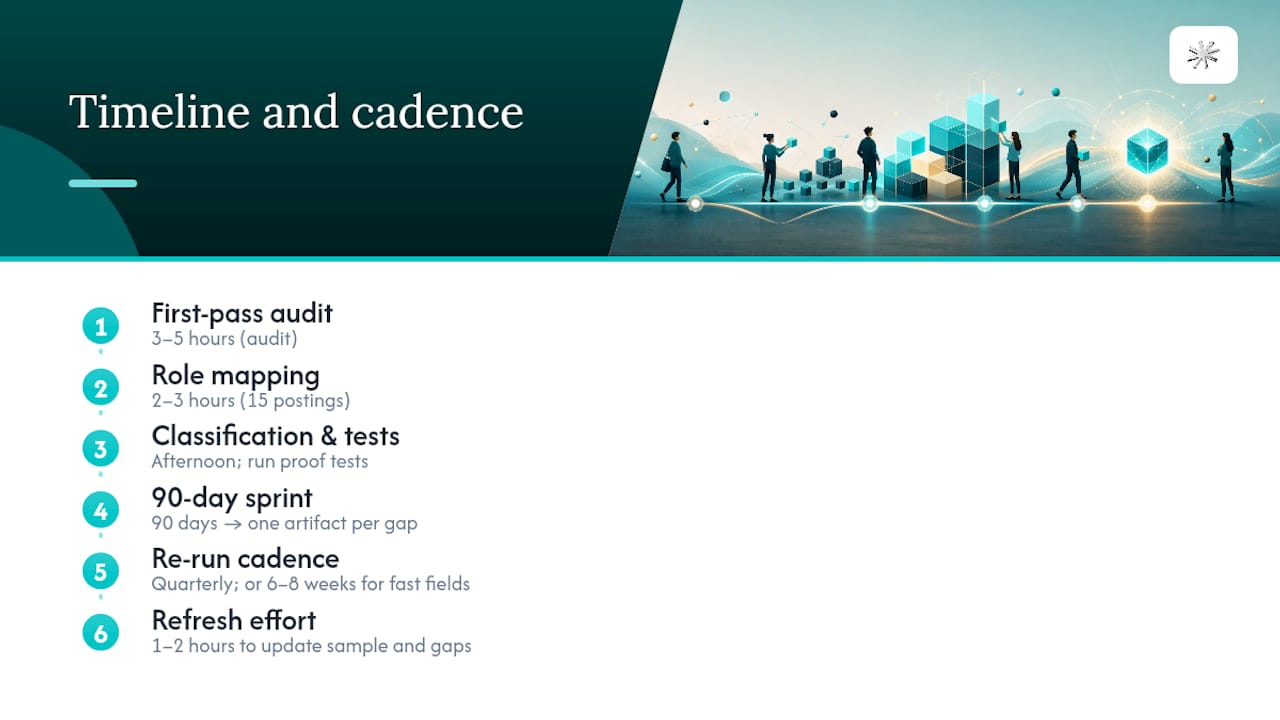
Treat each re-run as cheaper than the first pass. You already have your inventory table and your evidence log. You're mostly refreshing the job posting sample and updating your gap classifications, which usually takes an hour or two rather than a full weekend.
Common Pitfalls That Derail a Skill Gap Analysis
The most common mistake is skipping the audit and going straight to job postings. Without a documented baseline, you can't tell whether a "gap" is real or just unproven, and you end up learning things you already knew.
The second is sampling too few postings. Three or four job listings reflect one hiring manager's preferences, not the market. Stick to the 10 to 15 range so frequency data actually means something.
The third is confusing preferred skills with required ones. Job postings often list a wish-list of "nice to haves" alongside true requirements. Treating both as equally urgent spreads your effort too thin.
The fourth is self-assessment bias, rating yourself either too generously or too harshly without outside input. This is why peer review and the proof test both matter: they catch blind spots you can't see from inside your own head.
The fifth is trying to close too many gaps simultaneously. Ambition feels productive, but a sprint with six goals rarely finishes any of them well. Cap your active priorities at one to three per quarter.
The sixth is treating the analysis as a one-time exercise. Skills requirements move, especially in fields touched by new software or AI tools, so an analysis from a year ago is stale data guiding current decisions.
Tools and Software That Speed Up the Process
You can run every step of this method with a spreadsheet, a timer, and a stack of job postings. But several tools remove friction at specific stages.
For the audit itself, structured assessment tools save time over building an inventory table from a blank page. NueCareer's skills assessment guide and its free assessment tool both generate a starting proficiency map you can then refine with your own evidence.
For mapping target roles, O*NET gives you standardized skill taxonomies by occupation, useful for double-checking that you haven't missed a common requirement. Lightcast offers labor-market data at a more granular level if you want frequency benchmarks beyond your own 15-posting sample.
For organizations building similar audits at scale, training-focused platforms use comparable five-step audit logic; CertiCerts' breakdown of a training gap audit is a useful reference if you want to see how the same framework scales beyond an individual job search.
For turning proof artifacts into application material, NueCareer's resume skills guide and its job application skills tool translate closed gaps directly into resume language, which is often the hardest translation step for career changers to do well on their own.
Bringing in Mentors, Managers, or Peers for a Reality Check
Self-assessment has a blind spot: you're grading your own work. Involving someone outside your own head, a former manager, a mentor, a peer in your target field, catches errors you literally cannot see from the inside.
Ask a former manager to rate two or three of your claimed skills against real examples of your work. Their read on your negotiation skills or leadership style often diverges from your own, and that gap is useful information, not a discouragement.
If you have a mentor or contact already working in your target role, share your role requirements list and ask them to flag anything missing. Someone inside the field will often name an unwritten expectation that never shows up in a job posting, an internal tool everyone assumes you already know, a communication norm specific to that industry.
Peer review works even with someone outside your target field. A trusted colleague can still evaluate whether your proof artifact, a writing sample, a project summary, a demo, actually demonstrates what you claim it does. Fresh eyes catch gaps in clarity that you've stopped noticing.

Keep this input structured rather than a vague "does this look okay?" conversation. Ask specific questions tied to your gap classifications: "Would you call this a proof gap or a full gap based on what you've seen me do?" Specific questions get specific, useful answers.
What This Looks Like Across Different Careers
A marketing coordinator moving into data analytics might audit strong Excel and reporting skills, classify SQL as a full gap, and discover through the proof test that Python is actually closer to a refresh gap thanks to a college course years ago. Their 90-day sprint centers on one dashboard project using real company data, built specifically to prove SQL competency to a hiring manager.
A teacher transitioning into corporate training already has strong facilitation and curriculum design skills, both highly transferable. Their gap map often reveals that instructional design software and stakeholder reporting are the real full gaps, not the teaching skills themselves, which is the opposite of what most teachers assume going in.
A retail manager moving into operations management typically has strong people-management and inventory skills that transfer almost directly. Their full gaps tend to cluster around specific software platforms and formal process documentation, gaps a focused certificate or a short project can close inside a single quarter.
A finance analyst pivoting into product management usually has strong quantitative and modeling skills but a genuine full gap in user research and product roadmap communication. Their proof artifact is often a mock product spec built from a real market problem, submitted alongside their resume as evidence rather than a claim.
How NueCareer Applies This Method at Scale
Shane here. The mistake we see most often isn't laziness, it's skipping validation. People run the proof test once, feel confident, and never check their read against a peer or a posting. That single step catches most of the overconfidence errors that derail applications.
NueCareer's 7-Minute Career Quiz and free skills assessment exist to shorten the audit step specifically, not to replace the job posting map. Users pair the quiz output with their own 15-posting sample, then build proof artifacts, resume bullets, portfolio pieces, that get pulled directly into application materials. The combination works better than either piece alone: the quiz gives you a fast starting inventory, and the manual posting map keeps your priorities tied to what's actually hiring.
— Shane
Get Your Skills Mapped in Under 10 Minutes
Building the audit table, sampling 15 job postings, and running proof tests by hand works, but it takes a weekend most working adults don't have to spare. NueCareer's 7-Minute Career Quiz compresses the inventory step into a single sitting, mapping your strengths to career paths, including some you may never have considered, and generating a personalized roadmap you can layer directly onto the job posting method covered above.

Use the quiz output as your starting audit, then run it against your own 10 to 15 postings to confirm which skills carry real hiring weight. If you want a lighter first step before committing to the full quiz, NueCareer's free career skills assessment gives you a quick read on your strengths and gaps at no cost. Either way, the next move is the same: take the quiz, get your roadmap, and start closing the gaps that actually matter for the role you want.
Sources
FAQ
What Is a Skill Gap Analysis for a Career Change?
It's a comparison between your current skills and what a specific target role requires, resulting in a prioritized gap list and a 90-day plan to close the highest-impact ones.
How Many Job Postings Should I Review to Map a Role?
Review 10 to 15 live postings for your exact target title and treat any skill appearing in 60% or more of them as a core requirement.
What Is the 10-Minute Proof Test?
It's a quick, timed attempt at a real task tied to a skill you're unsure about; passing it downgrades a perceived full gap to a proof or refresh gap.
How Often Should I Re-Run My Skill Gap Analysis?
Re-run it quarterly as a baseline, and every six to eight weeks if you're targeting a fast-moving field where requirements shift quickly.
Can NueCareer Speed Up My Skills Audit?
Yes. NueCareer's 7-Minute Career Quiz and free skills assessment generate a starting inventory you can refine with your own evidence and job posting research.