
How to Convince an Employer to Hire You as a Career Changer

Learn how to convince an employer to hire you as a career changer. Discover key strategies to showcase your fit and reduce hiring risk.
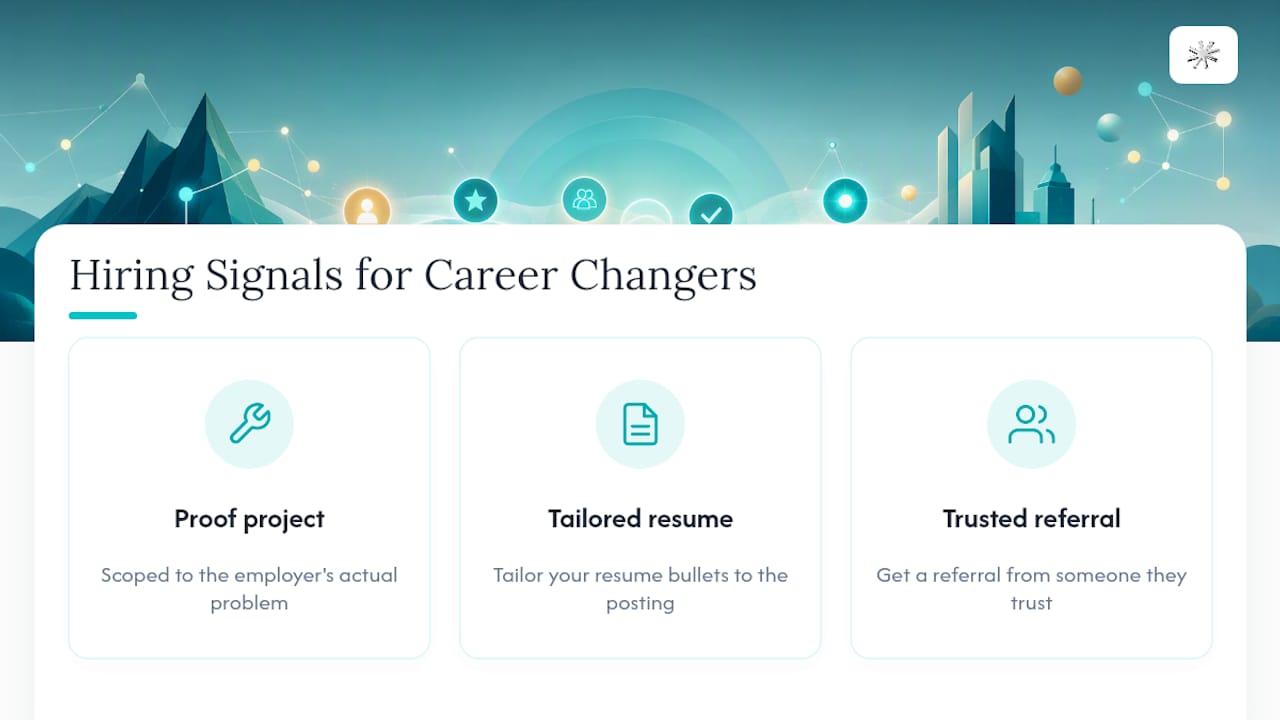
Employers hire career changers who reduce hiring risk in three specific ways: proving they can already do the work, showing clear relevance to the role, and arriving with a trusted referral or endorsement. Every tactic in this guide points back to one of those three levers. If you do nothing else today, do this:
- Scope one proof project tied to a real problem the employer likely has.
- Customize one application with two bullets rewritten for that exact job posting.
- Ask two contacts for a warm introduction or a 20-minute informational conversation.
None of these takes more than an hour to start. Momentum, not perfection, is what moves you from "interesting resume" to "let's talk."
Key Takeaways
Employers hire career changers who prove they can deliver a specific outcome, show clear relevance to the role, and arrive backed by a trusted referral.
| Point | Details |
|---|---|
| Lead with proof, not polish | Scope a short project tied to the employer's real problem before you apply. |
| Rewrite bullets as outcomes | Convert responsibilities into measurable results using the target job's own language. |
| Referrals cut hiring risk fastest | Ask directly for an introduction after a genuine informational conversation. |
| Plan for 6 to 18 months | Use the first 90 days for research and proof projects, then shift to outreach and interviews. |
| Start with a strengths diagnostic | Nuecareer's 7-Minute Career Quiz matches your strengths to career paths and builds your roadmap. |
Table of Contents
- What Hiring Managers Actually Look For in Career Changers
- Rewrite Your Resume and Cover Letter to Sell Outcomes and Relevance
- Create Immediate Proof: Portfolio Projects, Deliverables, and Trial Offers
- Turn Conversations Into Referrals
- Interview and Negotiation Playbook for Career Changers
- Timeline, Runway, and When to Upskill vs. Build Proof
- How Nuecareer and Shane Help You Execute This Plan
- The Judgment Call Most Career-Change Advice Gets Wrong
- Build Your Transition Plan With Nuecareer
- Sources
- FAQ
What Hiring Managers Actually Look For in Career Changers
Hiring is risk management dressed up as a conversation. A hiring manager weighs your fit against the cost of a bad decision: how long you'll take to ramp up, whether you understand the domain, and whether your judgment transfers to their problems. Career changers get filtered out early not because they lack talent, but because nothing on the resume answers those risk questions directly.
The candidates who break through send specific signals:
- A measurable outcome from past work, translated into the new field's language.
- A short, self-directed proof project that mirrors the employer's actual problem.
- An endorsement from someone the hiring manager already trusts.
Timelines back this up. SUCCESS reports that a career pivot realistically takes 6 months at minimum, with 12 to 18 months as the average window for upskilling, networking, and landing an offer. That's not a reason to slow down. It's a reason to start building proof now instead of waiting until your resume "feels ready."
Rewrite Your Resume and Cover Letter to Sell Outcomes and Relevance
Your resume's job is not to describe what you did. It's to prove you can produce a specific result the new employer needs. That distinction changes how you write every line.
- Translate responsibilities into outcomes. "Managed customer accounts" becomes "Reduced client churn 18% by rebuilding the onboarding sequence." Every bullet should answer "so what happened?"
- Build a skills-first section near the top. List the transferable capabilities the job posting names explicitly (data analysis, stakeholder management, budget ownership) before your chronological history. This is the backbone of any skills-based resume advice worth following.
- Write two tailored bullets per posting. Pull language straight from the job description and match it to your closest equivalent accomplishment. Generic resumes get generic rejections.
- Use the cover letter for the pivot, not the biography. One paragraph should connect a single major result from your past to a near-term need at the company you're applying to. Forbes notes that employers respond to evidence of long-term intent, not vague enthusiasm. Name the company's actual challenge and explain, briefly, why your background positions you to help.
A well-built career change cover letter does the persuading your resume alone can't. About half of hiring managers say cover letters genuinely help them evaluate a pivot's plausibility, so skipping one is a real cost, not a formality you can cut.
Create Immediate Proof: Portfolio Projects, Deliverables, and Trial Offers
Nothing lowers hiring risk faster than showing your work before you're asked to. 80,000 Hours frames the job search as a sales process: generate leads, prove you can deliver, then negotiate. The proving step is where most career changers skip straight to hoping.
Three project types work well across fields:
- A short redesign or proposal (2 to 4 pages) tied to a measurable KPI the employer already tracks.
- A mock audit of something public, like a company's onboarding flow, marketing funnel, or reporting process.
- A small trial deliverable offered directly to a hiring manager after a first conversation.
Present any of these as a compact case study: state the problem, your approach, and the outcome or projected outcome. The strongest deliverables are scoped to the hiring manager's actual top problem and include a low-cost way to test the idea, with a simple way to measure whether it worked.
Pro Tip: Offer a short trial period, one to two weeks, unpaid or low-cost, framed as a mutual evaluation. It signals confidence, not desperation, and gives the employer a low-risk way to see you work.

Multi-format proof, a PDF case study alongside a short video walkthrough, can carry more weight than either alone. JobAlign's guidance on positioning experience as a direct answer to an employer's problem applies just as well to how you frame these projects.
Turn Conversations Into Referrals
Referrals shortcut the entire risk calculation, because someone the hiring manager trusts is vouching for you. Most career changers either skip networking or approach it like a favor request, and both mistakes cost them the referral.
- Ask for 20 minutes, not a job. Request an informational interview specifically to learn about the role or team, not to pitch yourself. Come with three sharp questions about their actual challenges.
- Listen for a problem you can solve. Ask what's eating the most time on their team right now, or what a great new hire would fix in the first 90 days. That answer becomes the seed of your proof project.
- Ask for the introduction directly, near the end. Once rapport exists, say plainly: "Is there someone on the hiring team you'd feel comfortable introducing me to?" Directness reads as confidence, not as an imposition.
Interview and Negotiation Playbook for Career Changers
Two questions decide most career-changer interviews: why are you switching, and how fast will you ramp up? Answer both with specifics, not sentiment.
For "why the change," name the outcome you're chasing, not the thing you're escaping. "I want to own end-to-end product decisions instead of just executing them" beats "I was bored." For "how you'll ramp," walk through your proof project and what it told you about the domain's real problems.
- Bring your case study deliverable into the room and reference it when answering competency questions.
- Reframe past achievements as direct solutions to the interviewer's stated priorities, not general accomplishments.
- Negotiate more than salary: ask about a defined 90-day scope, a mentor or buddy assignment, and whether a short trial or contract-to-hire period is possible.
Pro Tip: If an employer hesitates on your lack of direct experience, offer the trial period yourself before they suggest it. It reframes the hesitation as solvable, not disqualifying.
Timeline, Runway, and When to Upskill vs. Build Proof
Plan on a minimum of 6 months and an average of 12 to 18 months for a full pivot, according to SUCCESS's step-by-step guide. A workable structure: the first 90 days for research, a target list, and two proof projects; months four through nine for active outreach and any trial work; months nine through 18 for interviewing and negotiating.
- Formal credentials matter mainly in regulated fields (nursing, law, accounting, engineering licensure). Outside those, employers weight projects and demonstrable skill higher than diplomas.
- Freelance work, part-time contracts, and bridge roles inside adjacent functions all reduce financial risk while you build proof, and they count as real experience on a resume.
- Save runway math for your own budget, not your pitch. Employers care about your capability timeline, not your bank account.
How Nuecareer and Shane Help You Execute This Plan
Every tactic above requires knowing which strengths to lead with, and that's the part most career changers guess at instead of testing. The 7-Minute Career Quiz solves that first: it maps your strengths, matches you to career paths (including ones you haven't considered), and builds a personalized roadmap you can use to scope your first proof project.
From there, Nuecareer's tools map directly to the tactics in this guide:
- The resume tool turns responsibilities into outcome-based bullets targeted at a specific posting.
- 24/7 coaching chat helps you draft and rehearse your "why the change" and "how you'll ramp" answers before an interview.
- Tailored job boards surface listings matched to your assessed strengths, cutting wasted applications.
Start with the quiz, then follow the full transition roadmap to sequence the rest.
The Judgment Call Most Career-Change Advice Gets Wrong
Most career-change content treats resume polish as the finish line. It isn't. A perfectly worded resume with no proof behind it still asks the employer to take your word for it, and hiring managers are paid to not take anyone's word for it.
The advice that actually moves the needle is uncomfortable in a specific way: it asks you to do unpaid, speculative work before anyone has offered you anything. A proof project, a trial engagement, a case study nobody requested. That feels backward if you're used to thinking of a job search as "apply, then prove yourself once hired." But for a career changer, the proof has to come first, because the credential that would normally vouch for you (the matching job title) doesn't exist yet.
Where I'd push back hardest on conventional wisdom: networking advice that stops at "build relationships" is incomplete. Relationships convince nobody. What convinces a hiring manager is a relationship that surfaces a real problem you then go solve, unprompted, in miniature. Prioritize that sequence over the size of your network. A dozen strong informational conversations that surface one real problem beat five hundred LinkedIn connections that surface nothing.
Build Your Transition Plan With Nuecareer
Nuecareer gives career changers what generic advice can't: a strengths-based starting point instead of a guess. Where most guides tell you to "identify your transferable skills" and leave you to figure out how, the quiz does that diagnostic work in seven minutes and hands you matched career paths, salary data, and a roadmap built around what you're actually good at.
That roadmap is what turns this article's tactics into a plan instead of a checklist. Once you know your target path, Nuecareer's coaching chat helps you script your pivot narrative, the resume and cover letter tools translate your background into outcome-focused bullets, and the tailored job boards keep you from wasting applications on roles that were never a fit. Take the 7-minute quiz now and get your first roadmap before the day ends.
Sources
- How to Change Careers at 30, 40 or 50: A Step-by-Step Guide | SUCCESS
- How to get a job (what actually works) | 80,000 Hours
- How To Convince An Employer You Want The Job -- Five Good Reasons And One To Avoid | Forbes
FAQ
How Do I Persuade an Employer to Hire Me Over an In-Field Candidate?
Show, don't tell: bring a proof project scoped to their actual problem, tailor your resume bullets to the posting, and get a referral from someone they trust. Together those three signals answer the risk questions a resume alone can't.
What Is the 30-30-30 Rule for Career Change?
There's no single, widely agreed-upon definition of a "30-30-30 rule" in career-change guidance, and this article doesn't rely on it. Focus instead on the sourced timeline: 6 months minimum, 12 to 18 months average, per SUCCESS.
What Is the 70/30 Rule in Hiring?
This isn't a standardized hiring framework, and no source in this guide defines it consistently. What is well supported is that hiring managers weigh demonstrated capability and referrals more heavily than a matching resume history alone.
Is 40 Too Late for a Career Change?
No. Changing careers at 30, 40, or 50 is common, and SUCCESS notes that outside regulated fields, employers prioritize demonstrable skills and project-based experience over age or degree history.
Do I Need a Degree to Switch Careers?
Generally no, unless you're entering a regulated field like nursing, law, or engineering that requires licensure. Elsewhere, a solid proof project or portfolio typically carries more weight with employers than a new credential.