
90 Day Fast Track Plan to Change Careers Without Quitting Your Job

Change careers while keeping your paycheck. Follow a 90 day two track plan, use a quick diagnostic, and build project evidence that wins interviews.
The fastest realistic ways to change careers are targeted short-term credentials, focused bootcamps, apprenticeships, and internal role moves, each of which can produce a first offer in weeks to about a year depending on the field. A quick diagnostic like The 7-Minute Career Quiz helps you pick a direction before you spend a dollar or an evening on training. From there, a focused 90-day plan run alongside your current job usually generates enough proof to start applying with confidence.
TL;DR:
- Short-term credentials and bootcamps generally take three to six months, while apprenticeships can extend up to six years, depending on the field.
- Effective programs must have recent employer connections, clear placement outcomes, and hands-on projects, not just certificates or vague promises.
- Your success depends on a realistic timeline based on weekly hours committed, with faster paths costing more in savings and slower ones requiring more patience.
- Prior experience in related areas significantly improves your chances of quick transition, while complete field overhauls often need longer retraining.
- Building a strong evidence portfolio and leveraging network outreach are essential for accelerating opportunities and avoiding common pitfalls in career pivots.
Table of Contents
- Fast-track training options: credentials, bootcamps, apprenticeships, and certifications
- How long each fast-track path really takes
- How to choose the right fast-track program without wasting months
- Your 90-day two-track plan for changing careers while employed
- Why fast-tracking works for some people and backfires for others
- Start your fast-track pivot with a clear direction
- Where to look next for the data behind this plan
- Sources
- FAQ
Fast-track training options: credentials, bootcamps, apprenticeships, and certifications
Every fast-track route trades something for speed: money, time, or certainty. Knowing which trade you are making helps you pick the one that fits your life right now.
Short-term credentials, often run through community colleges, are built for working adults who need a fast, employer-recognized qualification rather than a full degree. Many of these programs run under 15 weeks and can be stacked toward a longer credential later, which matters if you think you might want to keep building in the same field. Research on these programs shows they tend to work best when they are aligned with local employer demand, with wage and employment outcomes varying by state and by how closely the curriculum matches what hiring managers actually want.
Bootcamps compress three to six months of focused training into a schedule most people can manage around a job, particularly the evening and weekend formats. They tend to target roles with clear skill checklists: data analyst, cloud support technician, project coordinator, and cybersecurity analyst all show up often because employers can verify competence quickly through certifications or portfolio work. Costs vary widely by provider and format, and the ones worth paying for usually have a named employer network, not just a promise of "career services."
Apprenticeships work differently: you earn while you learn, often over one to six years depending on the trade or technical field, with wages rising as your skill level does. According to CareerOneStop, 94% of people who complete an apprenticeship stay employed afterward, with average annual earnings landing around $84,000. That retention number matters more than most marketing claims you will see from training providers, because it reflects what happens after the program ends, not just during it.
Certifications like CompTIA Security+ or AWS credentials do not replace experience, but they compress the time an employer needs to trust you with a specific technical task. A hiring manager screening cybersecurity resumes can use a certification as a fast filter, which shortens your path from application to interview even before you have direct job history in the field.

If you want proof of skill faster than any classroom can give it, freelance or contract work builds a track record while you are still learning. A handful of small paid projects, even at modest rates, gives you real deliverables to show and real client feedback to quote, both of which carry more weight in an interview than a certificate alone.
Consider these entry points based on your situation:
- If you need income stability: choose an apprenticeship or paid contract work over an unpaid bootcamp.
- If you have savings and want speed: a full-time bootcamp compresses the same content into fewer weeks.
- If you already have adjacent experience: a single certification may be enough to reposition you.
- If you are unsure which field fits: start with a short-term credential before committing to a longer path.
How long each fast-track path really takes
Timelines depend heavily on the target role and how many hours a week you can give it, so it helps to think in ranges rather than fixed dates. Data analyst roles typically take three to six months of focused study to reach an entry-level standard, cloud support certifications can be earned in six to ten weeks, and cybersecurity analysts often reach Security+ readiness in three to four months, according to a 2026 tech career change roadmap. Software engineering sits at the far end of the fast-track spectrum, typically requiring twelve to twenty-four months even with intensive study, because the skill depth expected by employers is simply larger.

Hours per week change these numbers more than almost anything else. Someone studying ten to fifteen hours a week around a full-time job will land at the slower end of every range above, while someone able to commit thirty or more hours a week, through a career break, reduced hours, or a full-time bootcamp, can often cut the timeline by a third or more. Neither pace is wrong: the faster path costs more in savings runway, and the slower path costs more in patience.
One in five jobs in high-growth fields didn't exist a decade ago. The Bureau of Labor Statistics projects strong growth for occupations including wind turbine technicians, solar installers, nurse practitioners, data scientists, and information security analysts through 2034, with substantial percent growth and solid median pay attached to several of these roles. That hiring capacity matters for a fast-tracker: a growing field has more entry points, more openings tolerant of nontraditional backgrounds, and more recruiters actively searching for candidates rather than sitting on a stack of resumes.
Cost tends to move in the opposite direction from speed. Community college short-term programs are usually the least expensive option, paid apprenticeships pay you while you train, and full-time bootcamps sit at the higher end of the price range precisely because they compress so much instruction into so little time. When you are comparing options, ask what the price actually buys: instructor access, employer connections, and job placement support cost more to build than prerecorded video content, and that difference shows up in both the price tag and the outcome.
How to choose the right fast-track program without wasting months
A good fast-track program earns its "fast" label by connecting you to real hiring managers, not just handing you a certificate. Before you commit money or time, run every option through the same checklist.
- Check employer alignment. Ask which companies actually hire from this program and how recently.
- Ask for placement outcomes. A program with real outcomes will share a completion-to-hire rate or connect you with recent graduates.
- Look for hands-on projects. Programs built around real deliverables prepare you better than ones built around quizzes and lecture videos.
- Review the career services offering. Resume help, interview prep, and recruiter introductions should be named services, not vague promises.
- Get cost and refund terms in writing. Know exactly what you pay, when, and what happens if you need to pause or withdraw.
- Confirm stackability. Find out whether this credential counts toward anything larger if you want to keep building later.
Ask providers directly: which employers hired your last three cohorts, can I speak to two recent graduates, and what happens if I need to defer for a few weeks. Their answers, or their hesitation, tell you almost everything.
Watch for red flags that suggest a program is selling hope rather than skill: vague "job guarantee" language with no contract behind it, no employer-reviewed capstone project, or credentialing that no hiring manager in your target field has ever heard of.
Pro Tip: Pick a program that maps to one specific role at one type of employer, not a broad promise to make you "job ready" for an entire industry.
Your 90-day two-track plan for changing careers while employed
A two-track plan means you keep your paycheck in one hand and build proof of your next career in the other. Here is how the twelve weeks typically break down.
- Weeks 1 to 2: Discovery. Take The 7-Minute Career Quiz to identify strengths and career paths that fit them, then pick one target role to focus on for the next 90 days.
- Weeks 3 to 4: Gap mapping. Use a personalized roadmap to compare your current skills against what your target role actually requires, then choose one credential, certification, or bootcamp module that closes the biggest gap.
- Weeks 5 to 8: Focused learning sprint. Dedicate consistent weekly hours to the training you chose, and start a project you can show, whether that is a dashboard, a small automation, or a mock client deliverable relevant to the role.
- Weeks 7 to 10: Network outreach. Run five to eight informational interviews with people already working in your target role, and mention your project when it comes up naturally.
- Weeks 9 to 12: Targeted applications. Apply only to roles that match your new evidence, tailoring your resume and cover letter to each one rather than sending a generic version everywhere.
If your target role exists inside your current company, tell your manager you are interested before a position opens, not after. Volunteering for a cross-functional project gives you a legitimate reason to build the exact skills you need, and it puts your name forward before a job posting ever goes live. Our guide on convincing an employer to hire you as a career changer walks through language that works for that conversation.
Deciding when to leave your current job is a financial decision as much as a career one. A written offer, three to six months of savings runway, or freelance income that already covers your basic expenses are the concrete triggers worth waiting for, not just a feeling that you are ready.
Pro Tip: Build your evidence project around a real problem at your current job when you can. It doubles as a portfolio piece and a pitch for an internal move.
For a longer version of this plan built around applying without a degree, see our 180-day proof plan.
Why fast-tracking works for some people and backfires for others
The two-track approach works best when you already have transferable experience adjacent to your target role, because you are compressing a skill gap rather than starting from zero. If you are moving into a field with no overlap at all, whether in subject matter or in the way you work day to day, a slower, fuller retraining path is often the more honest choice, even if it feels less exciting.
The pivots that stall almost always share the same three problems: no evidence beyond a certificate, no network inside the target field, and no financial runway to survive a slower job search than expected. A polished resume without a project to back it up rarely moves a hiring manager, and a job search without informational interviews tends to run longer than people plan for.
If your situation calls for a longer runway than 90 days, our detailed career transition timeline guide walks through savings planning and multi-month sequencing in more depth than a single article can cover here.
— Shane
Start your fast-track pivot with a clear direction
Most fast-track plans fail before they start, not because the training is wrong, but because the direction is unclear. The 7-Minute Career Quiz gives you a starting point built around your actual strengths, matching you to paths you might not have considered on your own, which is often the missing piece before any 90-day plan can work.
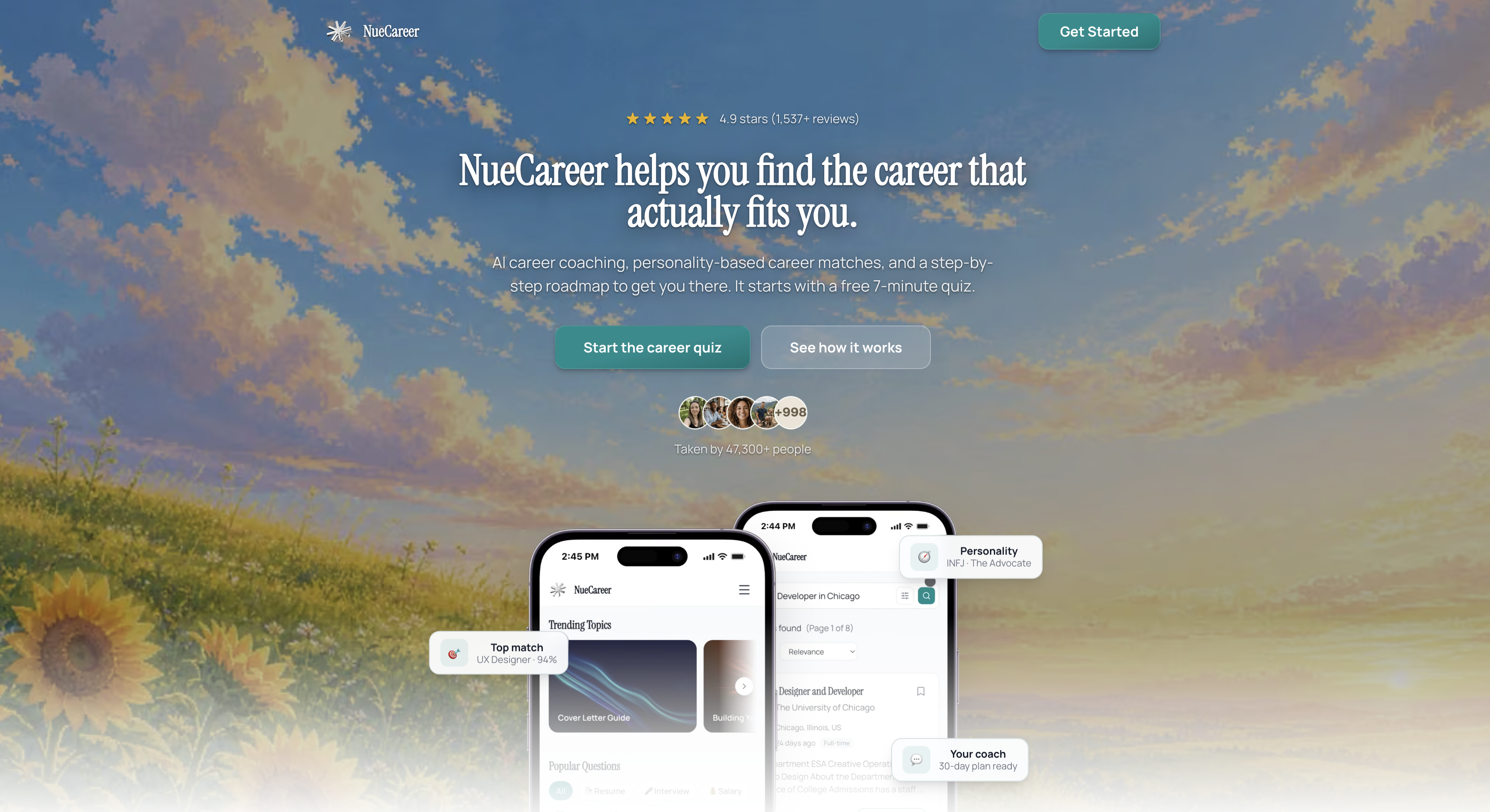
From there, NueCareer turns that match into a personalized roadmap that maps your skill gaps to your target role, backed by 24/7 coaching chat for the moments you get stuck or unsure. The platform's tools support the stages of the plan above with resume and cover letter tools to tailor applications, mock interview practice, a job board and career directory tailored to relevant paths, and an ATS resume checker to catch formatting issues before they cost you an interview.
Take the quiz, download your roadmap, and start week one of your sprint today.
Where to look next for the data behind this plan
The Bureau of Labor Statistics tracks fastest-growing occupations and median pay through 2034, useful for judging which fields have real hiring capacity. CareerOneStop lists apprenticeship programs by field and location along with outcome data. Community college research on short-term credential programs covers what makes these programs succeed or fall short for working adults.
Sources
- Apprenticeships | CareerOneStop
- Fastest Growing Occupations : Occupational Outlook Handbook : U.S. Bureau of Labor Statistics
- Short-term credential programs research (ERIC/ACCT report)
- Career Change Into Tech 2026: A Realistic 12-Month Roadmap
FAQ
What is the fastest career change you can make?
The fastest changes usually happen through an internal move or a short-term certification in a field adjacent to your current skills, sometimes in as little as six to ten weeks for a recognized credential. Moves into entirely new fields with no overlap in skills typically take three months to a year, depending on how deep the required training is.
Which jobs are considered more resistant to AI disruption?
Roles requiring hands-on physical work, direct human judgment, or in-person trust tend to hold up better, including many of the fastest-growing occupations the Bureau of Labor Statistics tracks, such as wind turbine technicians, solar installers, and nurse practitioners. No occupation is fully immune to change, so building adaptable, transferable skills matters more than picking a single "safe" title.
What are the easiest careers to switch into without starting over?
Roles that reward transferable skills, like project coordination, technical support, or data analysis, tend to be the easiest switches because they let you repackage existing experience rather than replace it. A short-term credential or certification often closes the remaining gap faster than a full retraining program would.
How can I earn a strong income without a four-year degree?
Fields like cloud support, cybersecurity, and skilled trades apprenticeships offer solid income paths without a degree, particularly once you add a recognized certification or complete an apprenticeship. CareerOneStop reports that apprenticeship completers average around $84,000 a year, with 94% remaining employed afterward, though actual pay varies by trade and location.