

Yes, you can volunteer to gain experience, and employers do notice it. The key is to treat it like a short, focused project: pick a role that builds a skill your target job needs, set a goal, keep a record of what you do, and turn the results into resume bullets. Done that way, unpaid hours become evidence you can point to in an interview.
If you feel stuck or are changing fields, this matters even more. You may not have a paid job title that matches where you want to go. Volunteering lets you build one piece of that story without waiting for permission.
TL;DR
- Volunteering can fill resume gaps, build skills and grow your network. The Social Security Administration's job-seeker site says it can add experience to your resume and help you explore job options.
- Choose the role by the skill you want to build, then check it against your real availability.
- Skills-based roles (marketing, bookkeeping, event planning, data work) often make the strongest resume material.
- On your resume, use a descriptive title, action verbs and numbers. You do not need to label the work unpaid.
- Keep a simple log from your first shift so your bullets are specific and honest.
Table of Contents
- Why volunteering works as experience
- Start with the skill, not the cause
- Volunteer roles that build career skills
- How to choose an opportunity that fits your life
- Make every hour count
- How to put volunteer experience on your resume
- Perspective: why we think experience should start before the job
- Pair volunteering with a clear direction
- A simple 30-day plan
- FAQ
- Sources
Why volunteering works as experience
Employers read a resume for two things: what you can do and whether you stay engaged. Volunteering speaks to both.
The Social Security Administration's Choose Work! site says volunteer work is a great activity to add to your resume during unemployment. It shows a potential employer that you kept busy and wanted to contribute. The same page says that even volunteer work unrelated to your career can still help on your resume and in your community.
There is research behind the job-search benefit too. A 2013 study by the Corporation for National and Community Service, reported by The NonProfit Times, found that unemployed people who volunteered over a two-year period had a 27 percent higher chance of being employed than those who did not volunteer. The study points to two reasons. Volunteering builds social capital (contacts who may lead you to jobs) and human capital (skills, knowledge and work experience).
That is an association from one study, not a promise. But the two mechanisms are the ones you can control: meet people, and learn things you can name.

What it does for a career changer
When you are switching fields, the hardest part is often the first line of proof. A volunteer role can be that line. One guide for job seekers notes that volunteering offers a chance to do something different, which can lead to new experience and new interests that make you consider other types of jobs.
In other words, it works in two directions. It builds credentials for a role you already want, and it helps you test roles you are only curious about.
Start with the skill, not the cause
Most people start by searching for a charity they like. That is a fine instinct, but if your goal is experience, start one step earlier: which skill is missing from your resume?
The University of California San Diego Career Center makes a useful point. Related and unrelated experiences can both be valuable, and once you have some exposure to your intended field, the skills you gain matter more than the type of experience. So the question is what you will be able to do afterward that you cannot do now.
A quick way to find the answer:
- Open three job postings for the role you want.
- Highlight the skills or tools that appear in all three.
- Circle the ones you have never used in a paid job.
- Look for volunteer roles that let you practice exactly those.
If you are not sure which skills you already have, our guide on how to identify transferable skills for a career change walks through it. It makes step 3 much easier.
Volunteer roles that build career skills
Not every shift builds a resume line. Packing boxes is valuable to the community, but if you want marketing experience, a different role will serve you better.
The AARP Foundation notes that many nonprofits need help with behind-the-scenes work such as accounting, marketing and event planning. That gives volunteers a chance to test whether a new kind of job is right for them. Here is how common role types map to career goals.
| Role type | Examples | Skills it can build | Good for changers moving toward |
|---|---|---|---|
| Skills-based | Bookkeeping, web updates, marketing, HR support, translation | Specific hard skills and portfolio samples | Finance, marketing, HR, communications |
| Behind the scenes | Data entry, logistics, inventory, committee work | Organization, process thinking, tools | Operations, administration, project work |
| People-facing | Tutoring, mentoring, welcoming visitors, phone calls | Communication, coaching, patience | Education, customer success, sales, social services |
| Hands-on service | Serving meals, sorting donations | Reliability, teamwork, customer service | Retail, hospitality, healthcare support |
The role categories come from a volunteer-matching guide that groups opportunities into four common types. The last column is our own suggestion on how to use them.
Skills employers recognize
The Choose Work! page lists public speaking, clerical tasks, fundraising, technology, time management and multitasking as in-demand skills volunteers can learn. It adds that thrift-store volunteering may teach customer service, organization and cashier skills.
The AARP Foundation separates them into soft skills, such as adaptability, collaboration, communication, leadership and problem-solving, and hard skills, such as database management, event planning, graphic design, project management and social media management.

AARP also makes a point that should take pressure off. Nonprofits run on limited budgets, so they often look first for a positive attitude and a willingness to learn, and they know they can train you on specific tasks. You do not need to be an expert to start.
Systems roles are underrated
If you come from operations, small business or administration, look past frontline service. A volunteer-matching guide points out that a nonprofit may need a better sign-up process, cleaner inventory tracking, standard operating documents or event logistics help. That work can be highly valuable even though it is less visible, and it makes strong resume material.
How to choose an opportunity that fits your life
A role you cannot sustain will not give you anything to put on a resume. Match the opportunity to your goals and your calendar.
AP News recommends a two-step approach: assess your goals, skills and passions first, then consider when you are available and for how much time. It notes that some nonprofits offer volunteer opportunities only during working hours, while others are more flexible.
Before you browse, answer these questions:
- Can you give weekdays, evenings, weekends or only certain seasons?
- Do you want a one-time shift, a recurring role or a defined project?
- Do you need remote or virtual work?
- Which skill from your gap list are you targeting?
A volunteer-matching guide also suggests treating your first shift as a trial before you commit long term. That is sensible for anyone with a full-time job or family obligations.
Where to look
Well-known national organizations such as the American Red Cross and United Way post opportunities, and sites dedicated to volunteering, such as Volunteer New York and VolunteerMatch, list many more, according to a job-search guide from First Find. Local volunteer centers and community nonprofits are also worth a direct email. Offer a specific skill: "I can build a simple donor spreadsheet" gets more attention than "I'd like to help."
Set a goal with the coordinator
The DePaul University Career Center advises choosing the organization and role that fit your skills, personality and interests, then setting goals for your involvement with input from the volunteer coordinator. A goal can be skill-specific, such as gaining experience with web analytics. Say it out loud in your first conversation. Coordinators often have projects waiting for someone with exactly that interest.
Make every hour count
Volunteering becomes career experience when you act like a professional in the role.
UCSD's career center suggests being inquisitive, taking initiative, challenging yourself, gathering a variety of skills, being professional and keeping a record of your activities. It also encourages volunteers to ask questions and use the chance to be exposed to professionals in the field.
In practice:
- Show up reliably. A dependable volunteer gets more responsibility.
- Ask for a project, not just tasks. Something with a beginning and an end gives you a result to describe.
- Talk to staff about their careers. Ask how they got there and what skills matter.
- Keep a log. After each shift, write one line: what you did, with what tool, for how many people, with what result.
- Ask for feedback. Honor Society advises volunteers to ask a supervisor for feedback and, when appropriate, whether they would serve as a reference.
The DePaul Career Center makes the same point about records: it recommends summarizing projects, tracking impact and keeping a journal, or continuously editing your resume as you go.
How to put volunteer experience on your resume
This is the part most readers come for, and it is where small choices make a big difference.
Use a real title
The University of Missouri's Office of Community Engaged Learning advises against the vague label "Volunteer." It suggests descriptive titles such as Community Project Volunteer Leader, Environmental Educator or Volunteer Health Program Assistant. Use a title that honestly reflects what you did, and confirm it with your coordinator if you are unsure.
Choose where it goes
The same university page suggests that if the experience is not directly related to your path, you can list it under "Additional Experience" or "Community Service History." If it is highly relevant, create a section such as "Relevant Experience" or "Community Engagement" and place it near the top. The AARP Foundation says you can list it in a professional experience, skills or separate volunteer section.
A good rule: if it matches the job posting, treat it like a job. If it does not, keep it short and lower on the page.
Write bullets with results
Missouri recommends action verbs and measurable metrics, with examples like creating an outreach plan that increased event attendance by 25 percent. It also advises using language from the job description to emphasize transferable skills. Virginia Tech's career office recommends PARQ statements (Problem, Action, Result, Quantify), with numbers that show scope, such as dollars, counts or percent changes.
Here is a before-and-after, using an invented example for illustration:
- Before: Helped with the food pantry.
- After: Redesigned the weekly volunteer sign-up sheet into a shared spreadsheet, cutting no-show gaps and covering all 12 weekly shifts for three months.
Only write numbers you can stand behind. Honor Society advises describing your own work and using verified outcomes rather than assuming the organization's overall impact belongs to you. That is also the safest approach in an interview, where you may be asked to explain every figure.
For more bullet ideas, see our resume accomplishments examples. If you are building a resume around skills rather than job titles, our skills-based resume guide shows how.
A model entry
One job-search guide shows a sample entry formatted with the organization, city, dates and title, followed by short bullets such as serving meals to 75 senior citizens. It also notes that there is no need to indicate the work is unpaid. Your layout can follow the same pattern:
Community Food Bank | Columbus, OH | 2025 to present Operations Volunteer
- Built an inventory tracking sheet used by 20+ volunteers each week
- Trained 6 new volunteers on intake procedures
The organization and numbers there are illustrative. Swap in your own.
Perspective: why we think experience should start before the job
We talk with working adults every day who believe they need a new job title before they can try a new career. We see it differently. Experience is something you can start building this month, in the hours you already have.
Our approach at NueCareer begins with understanding who you are: your strengths, your interests and the paths that could fit them, including ones you may never have considered. Volunteering is a natural second step. Once you know a direction, a small, well-chosen project lets you test it in the real world, and gives you something concrete to say in an interview.
The biggest mistake we see is volunteering without a plan. A skill target, a simple log and an honest, specific resume bullet turn a few hours a week into real proof. You do not have to be sure about your whole future to begin. You only need to pick one skill and one place to practice it.
Shane
Pair volunteering with a clear direction
Volunteering works best when it points somewhere. If you are not yet sure which field to aim at, our 7-minute career quiz matches your strengths to career paths, then gives you a personalized roadmap and AI-powered coaching you can use at any hour. Knowing your target role makes the skill-gap exercise above far faster.
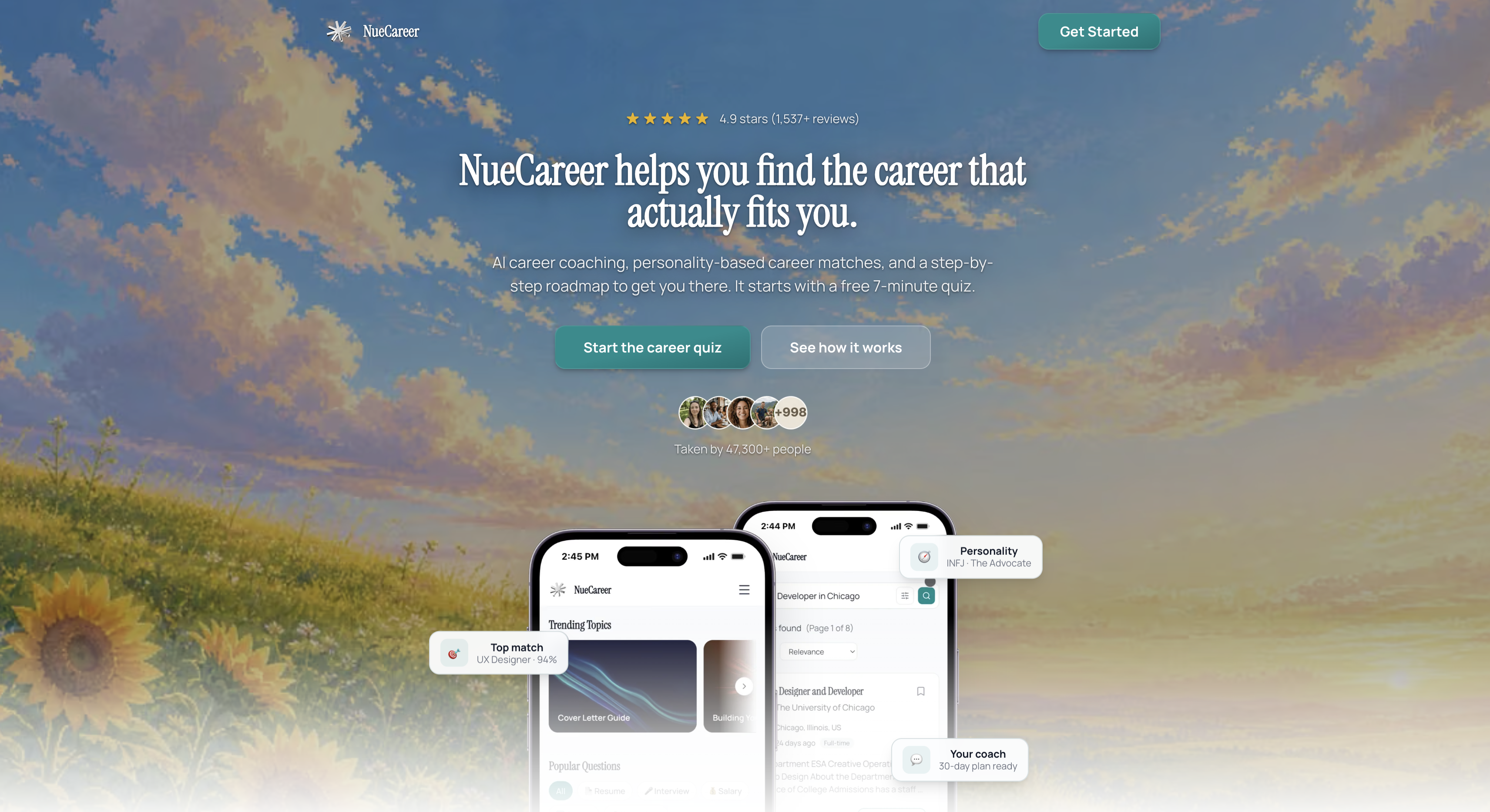
Once you have a few volunteer bullets written, our resume and cover letter tools can help you check how your resume reads and draft application materials around your new experience. NueCareer is built for working adults who want to move from feeling stuck to applying with confidence.
To go deeper on the strategy, read our guides on changing careers without experience by building proof and on researching new career paths thoroughly. If you want to name the skills you gained, the free job application skills tool is a quick place to start.
A simple 30-day plan
If you want to begin now, here is a plan that fits around a full-time schedule.
- Week 1: Pick one target role. List three skills from its job postings that you lack. Decide how many hours you can give each week.
- Week 2: Contact three organizations with a specific offer. Ask what project you could own.
- Week 3: Start your first shift or project. Treat it as a trial, and set one skill goal with the coordinator.
- Week 4: Review your log. Write two resume bullets with real numbers. Ask your supervisor for feedback.
After a month, you will know whether the work suits you, and you will have material to show for it. If it does not fit, you have still learned something valuable about the direction, and you can try a different role with little lost.
FAQ
Does volunteer experience count as real work experience?
Employers can treat it as relevant experience when you describe it in terms of skills and results. Choose Work! says volunteering can add experience to your resume, and the AARP Foundation says you can list it in a professional experience section. List it with a clear title, dates and accomplishments, the same way you would a paid role.
How many hours should I volunteer to make it worth putting on a resume?
There is no official threshold in the sources we reviewed. What matters is that you can describe specific work and outcomes. Regular involvement shows you can keep a schedule, and a single well-defined project can also produce strong bullets. Pick the format that fits your calendar, and keep a log either way.
Should I list volunteer work if it is unrelated to the job I want?
Yes, in most cases. Choose Work! says even unrelated volunteer work can help on a resume. Place it under a section such as Additional Experience or Community Service, keep it concise, and highlight the transferable skills the job description asks for.
Do I have to say the work was unpaid?
No. One job-search guide notes that there is no need to indicate volunteer work is unpaid. Use a descriptive title and focus on what you did and achieved. If asked in an interview, be open that it was a volunteer role.
Can volunteering help me explore a new career before I commit?
Yes. The AARP Foundation says nonprofits need help in areas like accounting, marketing and event planning, which lets you test whether a new kind of job is right for you. Choose Work! also says volunteering helps you explore job options by practicing new skills.
Sources
- Volunteer Your Way to Success in the Workforce, Choose Work!
- FAQs on Volunteering and Career Growth, Choose Work!
- Study: Volunteering Helps With Job Prospects, The NonProfit Times
- Are You Volunteering to Gain Experience and More?, First Find
- Maximizing Your Volunteer Experience, UCSD Career Center
- How Volunteering Can Help You Land a Better Job, AARP Foundation
- Best Volunteer Opportunities Near Me, Charities.link
- New to volunteering? A How-To Guide, AP News
- Make the Most of Your Volunteer Experience, DePaul University Career Center
- How Volunteering Can Help Your Job Search Build Evidence, Honor Society
- Service Experiences and Your Career, University of Missouri
- How to Write Strong Descriptions, Virginia Tech Career and Professional Development