
Career Changer Interview Answers Guide for Professionals

Navigate your career transition with confidence using this career changer interview answers guide. Master key techniques and prepare effectively.
TL;DR:
- A career changer interview evaluates both your core skills and the risk of failure during your transition. Preparation with frameworks like Pull-Path-Plan and STAR can help you confidently demonstrate motivation, relevant experience, and commitment. Focus on clear storytelling, honest skill gap addressing, and tailored answers to stand out to recruiters.
A career changer interview is a structured conversation where recruiters assess two things simultaneously: your baseline skills and the risk that your transition will fail. Mastering this dual assessment is the core challenge every professional faces when switching fields. This career changer interview answers guide gives you the frameworks, language, and preparation steps to walk in with confidence. The Pull-Path-Plan method and the STAR technique are the two most effective answer structures for career transition interviews. Use them together, and you shift the recruiter's focus from your gaps to your readiness.
What are the common career change interview questions and how to answer them?
Recruiters ask a predictable set of questions when they see a career pivot on your resume. Knowing these questions in advance gives you a significant advantage. The goal is not to memorize scripts but to build flexible answers grounded in real examples.
The top questions career changers face include:
- Why are you making this career change?
- What transferable skills do you bring to this role?
- How have you prepared for this transition?
- What do you know about our industry?
- Where do you see yourself in five years?
- What will you do if this transition doesn't work out?
- Why should we hire you over someone with direct experience?
- Describe a time you learned a new skill quickly.
The most loaded question on that list is the first one. Recruiters use your answer to judge both your motivation and your judgment. Successful career changers prepare a 45-second "Pull" focused answer that highlights what draws them toward the new field, not what pushed them away from the old one. That distinction matters enormously. Saying "I was burned out in finance" signals risk. Saying "I've been building data analysis skills for 18 months because I want to solve problems at scale" signals purpose.
For behavioral questions like "Describe a time you learned a new skill quickly," the STAR method is the clearest structure available. STAR stands for Situation, Task, Action, and Result. You describe the context briefly, name your specific responsibility, explain exactly what you did, and close with a measurable outcome. This framework works because it forces specificity, and specificity builds credibility.
Pro Tip: Prepare three STAR stories before any interview. Choose stories where the skill you demonstrated maps directly to a requirement in the job description. Rotate them across different questions as needed.
Two pitfalls undermine most career changer answers. The first is vagueness. Saying "I'm a people person" tells a recruiter nothing. Saying "I managed a cross-functional team of eight people across three time zones and delivered a product launch two weeks ahead of schedule" tells them everything. The second pitfall is negativity. Never frame your reason for leaving as frustration, boredom, or conflict. Recruiters hear those signals as red flags about your attitude, not your old employer.
How to showcase transferable skills in your interview answers
Transferable skills are abilities you developed in one context that apply directly in another. Project management, written communication, data analysis, client relationship management, and budget oversight are all transferable. The challenge is not identifying them. The challenge is translating them into language the new industry recognizes.

Start with the job description. Read it three times. The first time, highlight every hard skill listed. The second time, highlight every soft skill or behavioral trait. The third time, align your answers to those specific needs. Tailored answers stand out far more than generic responses, and recruiters notice the difference immediately.
Here is how to map your skills effectively:
Old skill: Managed vendor contracts worth $2 million annually. New framing: "I have direct experience negotiating and managing high-value partnerships, which translates directly to your supplier management role."
Old skill: Trained 30 new employees on compliance procedures. New framing: "I've designed and delivered training programs for large groups, which aligns with the onboarding responsibilities in this position."
Old skill: Analyzed customer feedback to reduce churn by 15%. New framing: "I used data to identify behavioral patterns and drive retention, which is exactly the kind of analysis your customer success team needs."
Concrete examples of past achievements using precise numbers and scenarios boost your credibility and help employers visualize your fit in the new role. A number anchors an abstract claim. Without it, your answer floats.
Preparation beyond the interview room also signals commitment. Completing a relevant certification, attending an industry conference, or finishing an online course shows you are already acting like a professional in the new field. Recruiters appreciate honesty about skill gaps paired with clear evidence of active upskilling. Pretending you have every skill is a short-term tactic that creates long-term problems.
Pro Tip: Use Nuecareer's free skills identification tool to map your existing strengths to roles you are targeting. It removes the guesswork from the translation process.
Strong communication skills also determine how well your transferable skills land in the room. You can have the right experience and still lose the interview if your delivery is unclear or hesitant.
How do you address recruiter concerns about a career transition?
Recruiters carry a specific fear when they interview career changers. Their concern is not whether you are capable in general. Their concern is whether your pivot will succeed, and whether they will have to rehire for the role in 18 months. Demonstrating a clear plan and showing you have already mitigated key skill gaps reduces that risk in their mind.
The most effective way to address this concern is to lead with your "pull" motivation, then describe your preparation, and then outline your plan going forward. This three-part structure gives the recruiter a complete picture. It shows you are not running away from something. It shows you are running toward something specific, with a map in hand.
"I've spent the past year completing a UX design certification, building a portfolio of three client projects, and attending monthly meetups with the local design community. This role is the next logical step in a transition I've been planning deliberately."
That kind of answer does three things. It proves preparation. It signals commitment. It removes the "what if this doesn't work" anxiety from the recruiter's mind.
When a recruiter asks directly, "What will you do if this transition doesn't work out?", do not panic. Answer honestly. You might say: "I'm confident in this direction because of the preparation I've done, but if I needed to course-correct, I have a strong foundation in operations that would keep me employable while I adjusted." That answer shows self-awareness without undermining your confidence.
Avoid overselling. Claiming expertise you don't have will surface during a skills assessment or in the first 90 days on the job. Positive framing and genuine enthusiasm make a strong impression without requiring exaggeration. Recruiters respond to authentic excitement about the new field because it signals intrinsic motivation, which is a stronger predictor of performance than credentials alone.
How to prepare your career change interview answers for maximum impact
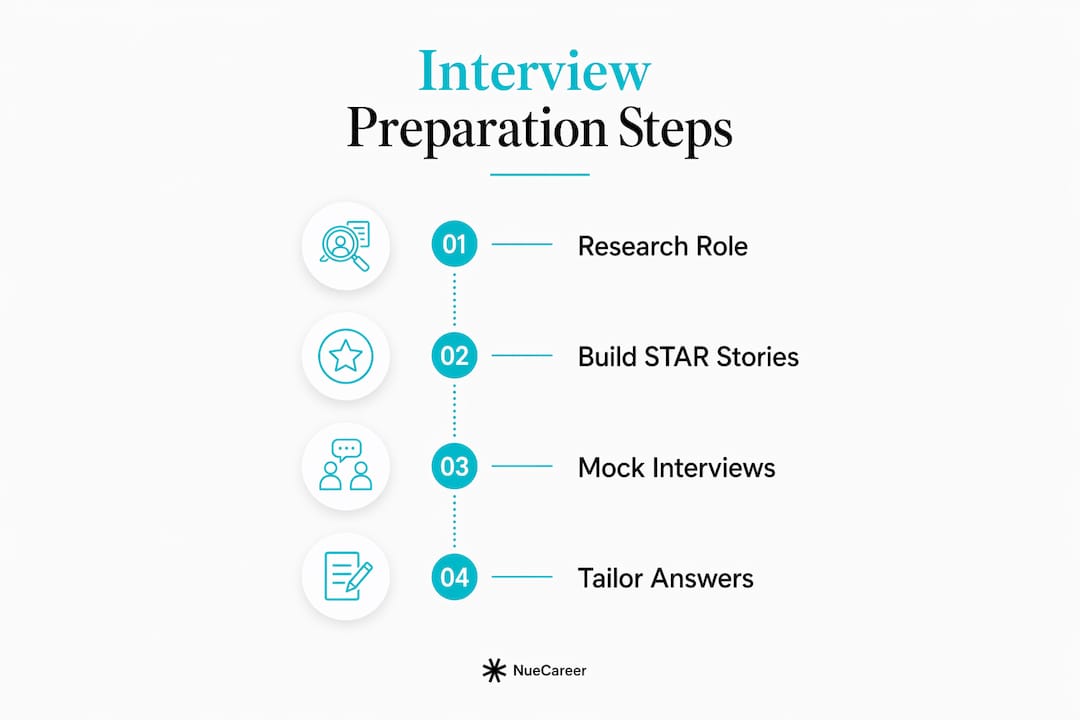
Preparation is the variable that separates a confident career changer from an anxious one. The process has four clear steps, and each one builds on the last.
Step 1: Research the role and company deeply. Read the job description three times as described above. Then read the company's website, recent press releases, and any industry news from the past six months. Know what problems the company is solving right now.
Step 2: Build your STAR story bank. Write out five to seven STAR stories from your career. Each story should demonstrate a different transferable skill. Practice telling each one in under two minutes.
Step 3: Practice with mock interviews. Regular practice through mock interviews reduces anxiety and helps you tailor answers to specific roles. Record yourself answering questions on video. Watch the playback and identify where you hesitate, ramble, or lose eye contact.
Step 4: Tailor every answer to the specific role. Generic answers signal low effort. Reviewing job descriptions carefully and aligning your answers to the specific skills listed shows attention to detail and genuine interest in the position.
| Preparation method | Primary benefit | Best used for |
|---|---|---|
| STAR story bank | Structures behavioral answers clearly | All behavioral questions |
| Mock interview recording | Reveals delivery weaknesses | Confidence and clarity |
| Job description analysis | Aligns answers to role needs | Tailoring every response |
| Industry research | Demonstrates genuine interest | Company-specific questions |
| Skills gap audit | Identifies upskilling priorities | Addressing recruiter concerns |
Pro Tip: Ask a trusted colleague or mentor to conduct a 30-minute mock interview with you. Real-time feedback from a human is more useful than self-review alone. If you don't have a mentor, Nuecareer's 24/7 coaching chat can walk you through practice questions at any hour.
For professionals who want a head start on the broader transition, the career switch roadmap at Nuecareer covers the eight foundational steps that make the interview stage easier to reach with confidence.
Key takeaways
Career changers who prepare specific answer frameworks and concrete skill evidence consistently outperform those who rely on general experience alone.
| Point | Details |
|---|---|
| Use the Pull-Path-Plan structure | Frame your "why change" answer around motivation toward the new field, not away from the old one. |
| Apply STAR for behavioral questions | Structure every behavioral answer with Situation, Task, Action, and Result for maximum clarity. |
| Translate skills with numbers | Attach precise figures to past achievements so recruiters can visualize your fit in the new role. |
| Address skill gaps honestly | Describe active upskilling efforts like certifications and workshops to show commitment and self-awareness. |
| Practice with mock interviews | Regular recorded practice reduces anxiety and reveals delivery weaknesses before the real interview. |
What I've learned from watching career changers succeed and stumble
Shane here. After years of watching professionals navigate career transitions, the pattern that separates those who land the role from those who don't is almost never about qualifications. It's about how clearly they can tell their own story.
The candidates who struggle most are the ones who apologize for their background. They walk in already defensive, pre-empting objections before the recruiter even raises them. That posture communicates doubt, and doubt is contagious. The recruiter picks it up immediately.
The candidates who succeed treat their non-linear path as an asset. They say things like, "My background in healthcare operations gave me a perspective on process efficiency that most engineers in this field don't have." That reframe is not spin. It's a genuine insight about what cross-industry experience actually provides.
The other thing I've noticed is that preparation is visible. You can tell within the first three minutes of an interview whether someone has done the work. They reference the company's recent product launch. They use the same language the job description uses. They have a specific answer ready for every question, not a vague one. That level of preparation signals respect for the recruiter's time and seriousness about the role.
My honest advice: do not wait until you feel ready to start practicing. Practice is what creates readiness. Record yourself. Review the career change resume tips that reinforce your interview narrative. Build the story before you walk into the room.
— Shane
Nuecareer tools that support your interview preparation
Knowing what to say in a career change interview is one thing. Knowing exactly which skills to highlight for a specific role is another challenge entirely.
Nuecareer's free job application skills tool identifies your strongest transferable skills and maps them to the roles you are targeting. The free job description analyzer breaks down exactly what a recruiter is looking for so you can align your answers before you walk in. Pair those with the resume and cover letter tools, and you have a complete preparation system built around your specific background. These tools work best when you use them alongside the preparation steps covered in this article.
FAQ
What is the Pull-Path-Plan method for career change interviews?
The Pull-Path-Plan method structures your "why change" answer around three elements: your motivation toward the new field, the preparation steps you have already taken, and your plan going forward. It reassures recruiters by showing deliberate intent rather than impulsive decision-making.
How do I answer "Why are you changing careers?" without sounding negative?
Focus entirely on what attracts you to the new field rather than what frustrated you in the old one. A pull-focused answer that highlights your preparation and excitement signals motivation and fit to the recruiter.
What transferable skills matter most in career change interviews?
Project management, data analysis, communication, client management, and training delivery transfer across most industries. The key is attaching specific numbers and outcomes to each skill so the recruiter can measure your past impact.
How many STAR stories should I prepare before a career change interview?
Prepare five to seven STAR stories that each demonstrate a different transferable skill. Having multiple stories ready lets you rotate them across different questions without repeating yourself.
How do I address a skill gap honestly without hurting my chances?
Acknowledge the gap directly and immediately describe the steps you are taking to close it, such as completing a certification or attending industry events. Recruiters respond positively to self-awareness paired with evidence of active learning.