

Text-based career coaching means working through your career questions in a written chat instead of a scheduled call. You type where you are stuck, get a specific answer back, and keep going at your own pace, whether that is 7 a.m. or midnight. For working adults who cannot take a weekday video session, that flexibility is the point. The best results come when the chat knows who you are, so we pair our 24/7 coaching chat with a 7-minute quiz that maps your strengths first, and every answer starts from your profile instead of a blank page.
This guide explains how chat-based coaching works, what a good exchange looks like, how to write messages that get useful answers, and how to protect your personal data while you do it.
TL;DR
- Text-based career coaching is guidance delivered in a written chat: you ask, you get a specific reply, and you can come back to it whenever you like.
- It works best for concrete tasks: narrowing career options, building a transition plan, tailoring a resume, drafting a cover letter, and practicing interview answers.
- Give the chat real detail about your work history and goals. Specific input produces specific advice.
- Keep sensitive identifiers such as your home address and financial records out of any public AI tool.
- Start with a strengths assessment so the coaching is built around you. Our 7-minute quiz does that, then connects to coaching, roadmaps and application tools.
Table of Contents
- What text-based career coaching actually is
- What a good exchange looks like
- Why detail matters more than you might expect
- What text-based coaching can help you do
- Text, video or phone: choosing the format that fits
- Use chat coaching safely: privacy and accuracy
- How to choose a text-based coaching service
- Start with your strengths, then chat
- Our perspective
- FAQ
- Sources
What text-based career coaching actually is
In a traditional setup, you book an hour with a coach, talk, and wait until the next session for follow-up. Text-based coaching moves that conversation into writing. You might message a human coach by email or app, or you might chat with an AI coach that answers instantly. Both formats are sometimes called chat-based career coaching, and both share the same core idea: the guidance arrives as text you can reread, copy, and act on.
Three things set the format apart.
It is asynchronous or on demand. You do not need a free hour that lines up with someone else's calendar. A question that comes up after a hard day at work can be answered that night.
It leaves a record. A call fades from memory. A written reply gives you a list of target roles, a draft answer to "Why are you changing careers?" or a three-step plan you can come back to.
It lowers the barrier to asking. Many career changers hold back questions that feel basic, such as "Can my teaching experience count toward a project coordinator role?" Typing it privately is easier than saying it out loud to a stranger.
AI is now a common engine behind these chats. A 2025 overview of large language model coaching describes convenient and valuable guidance that helps people take control of their career paths, and a small study of an AI coaching tool found it helped with resumes, cover letters and interview preparation.
What a good exchange looks like
A useful chat coaching session is not a single question and a single answer. It is a short back-and-forth that gets more specific each round. Here is the pattern we recommend.
- Start with context. Tell the coach your current role, years of experience, the kind of work you enjoy, and what is pushing you to change. Two or three sentences is enough.
- State one goal for the conversation. "Help me choose between three target roles" gets a better answer than "help with my career."
- Answer the follow-up questions. A good coach asks about your priorities, such as salary floor, schedule, remote work, or how much retraining you can take on. Your answers are what make the advice yours.
- Ask for a next step you can do today. Request a draft, a checklist, or a ranked list, not a general discussion.
- Push back and refine. If a suggestion does not fit, say why. "I do not want a role with heavy cold calling" narrows the field immediately.
A worked example
Imagine a retail store manager with eight years of experience who wants to move into operations. A weak first message reads: "What jobs can I do?" A strong one reads:
I manage a 25-person retail team and handle scheduling, inventory counts and vendor orders. I want a desk-based role with regular hours and a pay path above my current level. Which operations roles fit this background, and what would I need to add to my resume to apply?
The second message gives the coach everything it needs: team size, concrete duties, a preference, and a clear request. The reply can name roles such as operations coordinator or supply chain analyst, point out which duties transfer, and list gaps to close. You can then ask the chat to rewrite your resume bullets around those transferable duties.
Why detail matters more than you might expect
Research on chat tools shows that how people engage shapes what they get. In a 2025 experiment run by the research organization MDRC on a job-training platform, more than 5,000 job seekers were randomly assigned to different versions of the site. In the chatbot-only version, over half of users never reached a recommendation and about 45% sent two or fewer messages. The researchers also noted that among users who did get recommendations, the gap in engagement narrowed.

The takeaway for you is practical: the value in a coaching chat comes after you share enough about your background to receive tailored suggestions. Treat the first few messages as setup. The more of your actual work history you give, the sooner the answers stop being generic.
What text-based coaching can help you do
Chat coaching suits tasks where you need a clear answer, a draft, or a plan. For job seekers and career changers in the United States, these are the strongest uses.
Narrow down where to go
If you feel stuck, the hardest part is not applying but knowing what to apply for. A chat can help you compare roles side by side: day-to-day tasks, typical entry points, skills you already have. It works best when it starts from a clear picture of your strengths. Our guide on how to identify the right career before applying walks through that groundwork.
Build a transition plan
A career change is easier when it is broken into steps. Ask the chat for a timeline: what to learn first, what to put on your resume, which roles to target as a bridge. You can revise the plan whenever your situation changes, such as a layoff or a new certification.
Tailor your resume and cover letters
This is where text is the natural format, because the output is text. You paste a job description, share your experience, and get a version of your resume aligned to the role. Our step-by-step guide to resume tailoring with AI shows how to do it, and the 20 to 40 minute tailoring routine shows how to add your own check at the end so every claim is true and in your voice.
Prepare for interviews
Career changers face one question above all: "Why are you switching?" You can rehearse answers in chat, refine the wording, and practice follow-ups. Our career changer interview answers guide gives frameworks for these answers.
Negotiate and follow up
When an offer arrives, a written chat helps you draft a salary negotiation email or a polite follow-up note without starting from scratch.
Text, video or phone: choosing the format that fits
No format is right for everyone, and many people use more than one. This comparison shows where text-based coaching stands out.
| What you need | Text-based chat | Scheduled call or video |
|---|---|---|
| Answers outside business hours | Yes, on demand | Needs a booked slot |
| A written record to reuse | Built in | You take notes |
| Drafting resumes and letters | Direct, in the same window | Usually done afterward |
| Quick questions during a job search | Fits any moment | Waits for the next session |
| Thinking through a question privately | Easy, at your own pace | Live and conversational |
For a working adult juggling a job, family and a search, the first three rows tend to decide it. A chat that is available around the clock fits around your schedule, not the other way around.
Use chat coaching safely: privacy and accuracy
Any tool that processes your words, whether it is a chat app, an AI assistant or a coaching platform, deserves a few habits. These come from guidance for career professionals and apply equally to you.
Keep identifiers out of public AI tools. A field guide from the nonprofit JFF notes that AI systems send user data to external servers, where it may be stored or used to train models. It advises removing names, addresses, emails and financial records before entering details into public AI tools, and turning off any setting that lets the tool train on your data. For a resume chat, you can use placeholders such as "[Name]" and add real contact details only in your final document.
Verify job and training names. The same guide warns that generative AI can invent jobs or training programs that do not exist. When a chat suggests a role, certification or employer, confirm it on the employer's site or a job board before you invest time. Our job application skills tool can help you match the skills you list to real postings.
Check salary and outlook claims against official data. For questions about whether a field is growing or exposed to automation, the free AI exposure check built on BLS data gives you a grounded starting point.
Read what a coach does with your information. If you work with an individual coach, ask how they handle confidentiality. Credentialed coaches typically follow an ethics code from their credentialing body. Ask what the coach does for you and what they refer elsewhere, since a coach who promises help with everything is rarely a precise one.
Researchers who study AI in career services also stress careful oversight. MDRC's analysis argues for human-centered AI that helps people reach better guidance and warns about made-up information, biased recommendations and data privacy. Those are the right things to watch, and they are why we encourage you to treat every suggestion as a draft you confirm.

How to choose a text-based coaching service
Whatever format you pick, look for these five qualities.
- It starts with you. Coaching built on your strengths, interests and experience beats a generic question-and-answer box.
- It leads to action. You want drafts, roadmaps and next steps, not only encouragement.
- It covers the whole search. Exploring careers, tailoring resumes, writing cover letters and practicing interviews work best when they share one profile.
- It is available when you are. Late-night and weekend access matters if you are employed while you search.
- It handles your data responsibly. Look for clear statements on privacy and avoid typing identifiers you do not need to share.
Our own approach is built around those points. If you want to see how coaching fits into a wider search, read how career coaches help job seekers land roles faster and our piece on optimizing your job search with coaching in 2026.
Start with your strengths, then chat
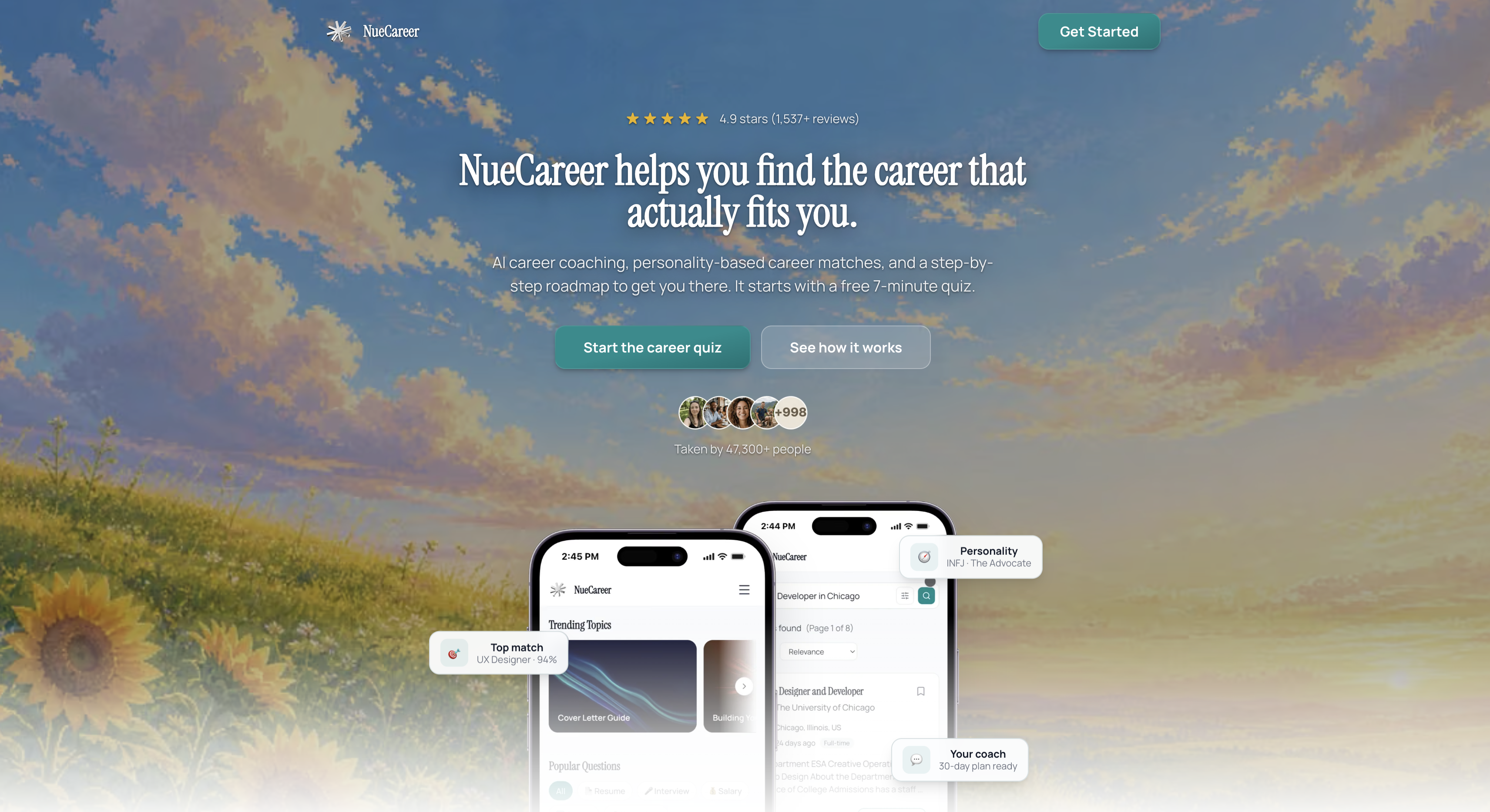
The fastest way to make a coaching chat useful is to arrive with a clear picture of your strengths. The 7-minute NueCareer quiz identifies those strengths and matches you to career paths built around who you are, including careers you may never have considered. From there, the platform gives you a personalized roadmap, 24/7 coaching chat, job boards tailored to your target roles, and a suite of resume and cover letter tools, plus interview prep.
If you want to try individual tools first, the free career tools page includes a cover letter generator, an ATS resume checker, mock interview practice, a salary negotiation email tool, career clusters and a Holland Code test. When you are ready for the full path from quiz to application, start at nuecareer.com.
Our perspective
Most people who feel stuck do not lack effort. They lack a clear target. When you do not know which roles fit you, every resume feels like a guess and every coaching question feels too big to ask.
That is why we put the quiz first. In about seven minutes it gives you a picture of your strengths, and from that picture a chat can be specific. "Help me with my career" becomes "help me move from store management into operations, using the strengths I just identified." The conversation gets better because the starting point is you.
We also built coaching to be there when you need it. Career decisions do not wait for office hours. They come up on a Sunday night, after a hard meeting, or the minute you spot a posting that might be the one. Having a coaching chat open at that moment, connected to your roadmap, your job board and your resume tools, keeps momentum going.
Our advice: use chat as a working session. Share real detail, ask for something you can use today, and confirm names, dates and figures before you act. Do that, and a few focused conversations can turn a vague wish to change careers into a plan with dates and next steps.
Shane
FAQ
Is text-based career coaching as good as talking to a coach?
It serves a different need. Chat is strongest for concrete work such as choosing target roles, drafting resumes and rehearsing answers, and it is available whenever you are. A study of an AI coaching tool found it helped with resumes, cover letters and interview prep. Many people use chat for daily progress and add other support for the moments they want it.
What should I send in my first message?
Send your current role, your years of experience, two or three duties you do well, what you want to change, and the one outcome you want from the conversation. Then answer any follow-up questions the coach asks. The more specific your first message, the more specific the reply.
Is it safe to share my resume in a coaching chat?
Share what the task needs and no more. Guidance for career professionals recommends leaving out names, addresses, emails and financial details when using public AI tools, and turning off any option that lets the tool train on your data. You can add your contact details back into the final document yourself.
Can a chat help if I have no idea what career I want?
Yes, especially when it starts from an assessment. Our 7-minute quiz identifies your strengths and matches you to career paths, including ones you may not have considered. You can then use the chat to compare those paths, ask what each involves, and build a roadmap toward the one that appeals most.
How often should I use a coaching chat during a job search?
Use it at decision points: when choosing roles, before sending each tailored application, and ahead of each interview. Short, focused sessions of 15 to 20 minutes tend to work well, because you leave each one with a draft or a next step.
Sources
- MDRC: Using AI To Help (SkillUp AI brief)
- MDRC: Integrating AI into Career Navigation Services
- JFF: Career Coaching and Generative AI Field Guide