

TL;DR:
- Effective job search coaching provides a personalized, goal-oriented plan that enhances strategy, accountability, and measurable outcomes. It helps candidates refine their narrative, build consistent routines, and use targeted outreach to reduce unemployment duration and improve interview success. Tracking key metrics and embracing honest feedback are essential for maximizing coaching effectiveness and accelerating career progress.
Most job seekers send dozens of applications and hear nothing back. The silence is demoralizing, and the instinct is to send more applications faster. That rarely works. The real problem is usually strategy, not effort. Learning how to optimize your job search with coaching gives you something a job board never will: a structured, personalized plan built around your specific strengths, targets, and gaps. This guide covers exactly how to prepare for coaching, execute proven routines, avoid common traps, and measure whether your efforts are actually moving the needle.
Table of Contents
- Key Takeaways
- What professional job search coaching actually does
- How to prepare before your first coaching session
- Executing coaching strategies: routines, outreach, and applications
- Common mistakes that undermine your coaching progress
- How to measure whether your coaching is working
- My honest take on what coaching actually changes
- Start your search smarter with Nuecareer
- FAQ
Key Takeaways
| Point | Details |
|---|---|
| Coaching has proven impact | A meta-review of 54 studies found coaching produces a moderate positive effect on performance and goal attainment. |
| Preparation multiplies results | Clarifying your career goals and target roles before coaching starts dramatically increases what you get from each session. |
| Structured routines reduce unemployment | Measurable outreach routines tied to coaching feedback significantly reduce how long job searches take. |
| Tracking is non-negotiable | Using a simple tracker for applications and follow-ups keeps momentum visible and prevents important leads from slipping away. |
| Success is measurable | Define clear outcomes like interview calls and networking meetings so you can tell when your strategy is working. |
What professional job search coaching actually does
The term "job search coaching" gets used loosely. At its core, professional career coaching is a structured, goal-oriented relationship where a trained coach helps you identify what is holding your search back and build a plan to fix it. It is not therapy, and it is not a recruiter placing you in a role. It sits in a distinct space between self-help content and hands-on career services.
A meta-review of 54 coaching studies found a moderate positive effect (Hedges' g = 0.58) on professional outcomes including performance, emotional competence, and goal attainment. Individualized, long-term programs consistently outperformed short or generic interventions. That distinction matters when you are evaluating your options.
What does coaching actually deliver? Depending on the program and coach, you can expect:
- Resume and LinkedIn reviews with specific, measurable feedback rather than vague suggestions
- Mock interviews that simulate real pressure and give you a chance to refine your answers before the stakes are real
- Networking guidance tailored to your industry and comfort level
- Positioning work to help you articulate your value clearly and consistently
- Accountability structures that keep you moving even when the search feels stagnant
The difference between coaching and self-help content is accountability and personalization. A blog post gives you frameworks. A coach watches you apply them, notices where you stall, and adjusts the approach. If you want to understand when coaching makes sense for your specific situation, that distinction is the right place to start.
How to prepare before your first coaching session
Most people waste their first few coaching sessions because they show up without clarity. They know they want a better job. They do not know what role, at what level, in what industry, or why. That vagueness costs time and money.
Before coaching starts, do this groundwork:
- Define your target roles. Pick two or three specific job titles you are genuinely pursuing. Broad pivots in multiple directions at once dilute your energy and confuse your positioning.
- Write your professional narrative. Practice explaining your career arc in two minutes. What have you built, solved, or led? Where are you headed and why does it make sense?
- Set measurable goals. Decide what success looks like in 30, 60, and 90 days. Think in concrete numbers: applications submitted, networking conversations had, interviews secured.
- Commit to weekly action. Structured coaching programs require active weekly participation, including outreach, applications, and peer accountability. Going through the motions between sessions produces nothing.
- Take a skills assessment. A free career skills assessment before your first session gives your coach a clearer picture of your strengths and gaps, so you spend less time on discovery and more time on strategy.
Pro Tip: Bring a list of your three biggest career wins to your first session. Quantify each one with numbers or outcomes. This single exercise often unlocks the positioning angle that makes your entire search sharper.
The mindset shift that matters most is openness to honest feedback. Coaching works best when clients actively embrace difficult truths about their resumes, their targeting, and their interview presence. If you treat coaching as validation rather than challenge, you will not get the results you are hoping for.

Executing coaching strategies: routines, outreach, and applications
Knowing what to do and actually doing it consistently are two different things. This is where most job searches break down. Coaching helps you build routines that make consistent action feel less overwhelming and more automatic.
Here is a practical execution framework drawn from coach-recommended practices:
- Start with the "9 before 9" rule. Performance coach Tim Castle advises contacting nine opportunities by 9 a.m. each day. Early outreach captures decision-makers before their day fills up and signals genuine motivation.
- Build and maintain a tracker. Coach Castle specifically recommends using Excel or Notion to log every application, contact, and follow-up. Without a tracker, leads disappear and you lose the data your coach needs to help you recalibrate.
- Quantify your resume. Generic bullet points like "managed a team" do not land. Work with your coach to translate your experience into measurable impact. "Managed a team of 8 and reduced onboarding time by 30%" is a completely different sentence to a hiring manager.
- Activate your network with intention. Referrals convert at a dramatically higher rate than cold applications. Your coach can help you script outreach messages that feel natural and specific rather than transactional.
- Use AI tools as a starting point, not a final product. AI can draft cover letters and suggest resume language, but generic AI-generated content without personalization weakens your application. Your coach helps you layer in the authentic details that make you sound like a person, not a template.
- Build skills during the search. Taking a short course or certification relevant to your target role gives you something concrete to discuss in interviews and signals continuous growth to employers.
Pro Tip: Pair your tracker with a weekly review ritual. Every Friday, spend 15 minutes comparing your outreach volume to your response rate. If you sent 40 applications and got zero callbacks, the problem is likely your resume or targeting, not your effort. That data is what your coach needs to help you pivot.
Here is a simple weekly activity benchmark to work toward with your coach:
| Activity | Weekly Target | Tracking Method |
|---|---|---|
| Job applications submitted | 10 to 15 tailored | Spreadsheet or Notion |
| Networking outreach messages | 5 to 10 contacts | Tracker with follow-up dates |
| Follow-ups on open applications | All pending over 7 days | Flagged rows in tracker |
| Mock interview or skills practice | 1 session | Calendar block |
| Coach check-in or accountability call | 1 session | Scheduled weekly |
Research from Missouri's reemployment services program found that customized coaching services significantly reduced unemployment duration and improved earnings compared to standard job search support. Structure and personalization are what make the difference.
Common mistakes that undermine your coaching progress
Even with a great coach, certain patterns will slow you down or stop your progress entirely. Recognizing them early saves weeks of frustration.
- Targeting too broadly. Trying to pivot into three different industries at once means your resume, your narrative, and your networking are all diluted. Pick a primary target and go deep before expanding.
- Relying on volume over quality. Sending 100 generic applications feels productive. It rarely is. Tailored applications to well-researched roles consistently outperform mass submissions.
- Treating AI as a ghostwriter. AI tools are useful for structure and speed, but they produce recognizable patterns that hiring managers notice. Your coach helps you personalize what AI generates.
- Skipping the tracker. Disorganized searching creates anxiety and blind spots. You cannot improve what you cannot see.
- Confusing feedback with discouragement. A coach who tells you your resume is not working or your target is unrealistic is doing their job. That honesty is the value you are paying for.
"Employers value personality traits such as energy and empathy in interviews, which can distinguish candidates beyond resume qualifications." — Performance coach Tim Castle
This is worth sitting with. You can have a perfect resume and lose an offer to someone who was more present, more curious, and more genuinely engaged in the room. Coaching for interview preparation should include work on how you show up, not just what you say. The interview preparation resources that help you practice presence are just as important as the ones that help you craft answers.
How to measure whether your coaching is working
Coaching is an investment of time and money. You deserve to know whether it is paying off. The mistake most people make is measuring success only by whether they got a job offer. That is a lagging indicator. You need leading indicators to know if your strategy is on track weeks before an offer arrives.
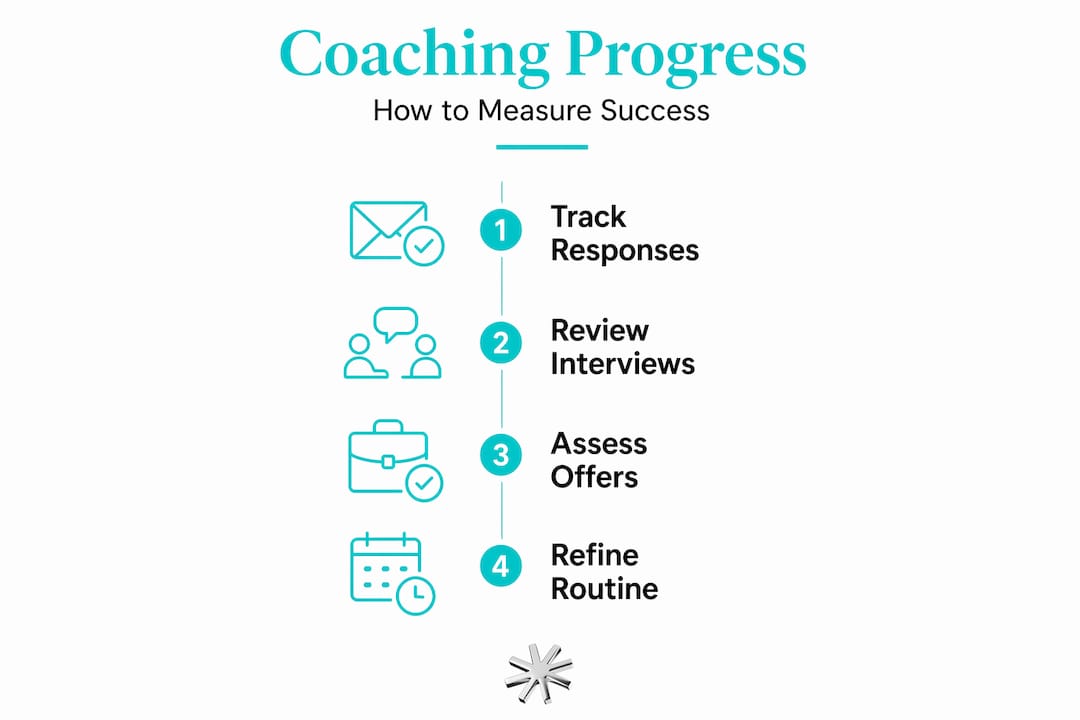
| Metric | What it tells you | Review frequency |
|---|---|---|
| Application response rate | Whether your resume and targeting are resonating | Weekly |
| Networking meeting conversion | Whether your outreach messages are compelling | Bi-weekly |
| Interview-to-offer ratio | Whether your interview performance is strong | Per interview cycle |
| Coaching session action completion | Whether you are executing between sessions | Weekly |
| Confidence self-rating (1 to 10) | Whether your narrative clarity is improving | Monthly |
Expect the first two to four weeks to feel slow. You are building systems and clarity, not yet harvesting results. By week six, you should see measurable movement in at least two of these metrics. If you are not, bring that data to your coach and ask for a direct assessment of what needs to change.
Sustained coaching engagement that creates structured routines and measurable outcomes consistently leads to better job search results. Progress is not always linear, but it should be visible.
My honest take on what coaching actually changes
I have seen a lot of job seekers go through coaching programs. The ones who get results are not always the most qualified or the most polished. They are the ones who treat coaching as a working relationship, not a service they are receiving.
What I have observed is that coaching changes the internal story before it changes the external results. People come in believing the market is broken or that they are somehow unhireable. What shifts first is their narrative clarity. They stop describing themselves in vague terms and start speaking with specificity about what they have built and where they are headed. That shift shows up in interviews before it shows up in offers.
The misconception I hear most often is that coaching is a shortcut. It is not. It is a structure that makes your effort more precise. The job seekers who struggle with coaching are usually the ones who want the coach to do the searching for them. The ones who succeed show up between sessions, execute the agreed-upon actions, and bring real data to each conversation.
My honest advice: go into coaching ready to be challenged. The most useful thing a coach can do is tell you something true that you did not want to hear. That is not discouragement. That is the work.
— Shane
Start your search smarter with Nuecareer
If you are ready to put these strategies into practice, Nuecareer was built for exactly this moment. Whether you are changing careers or trying to break through a stalled search, the platform gives you the tools and guidance to move forward with confidence.
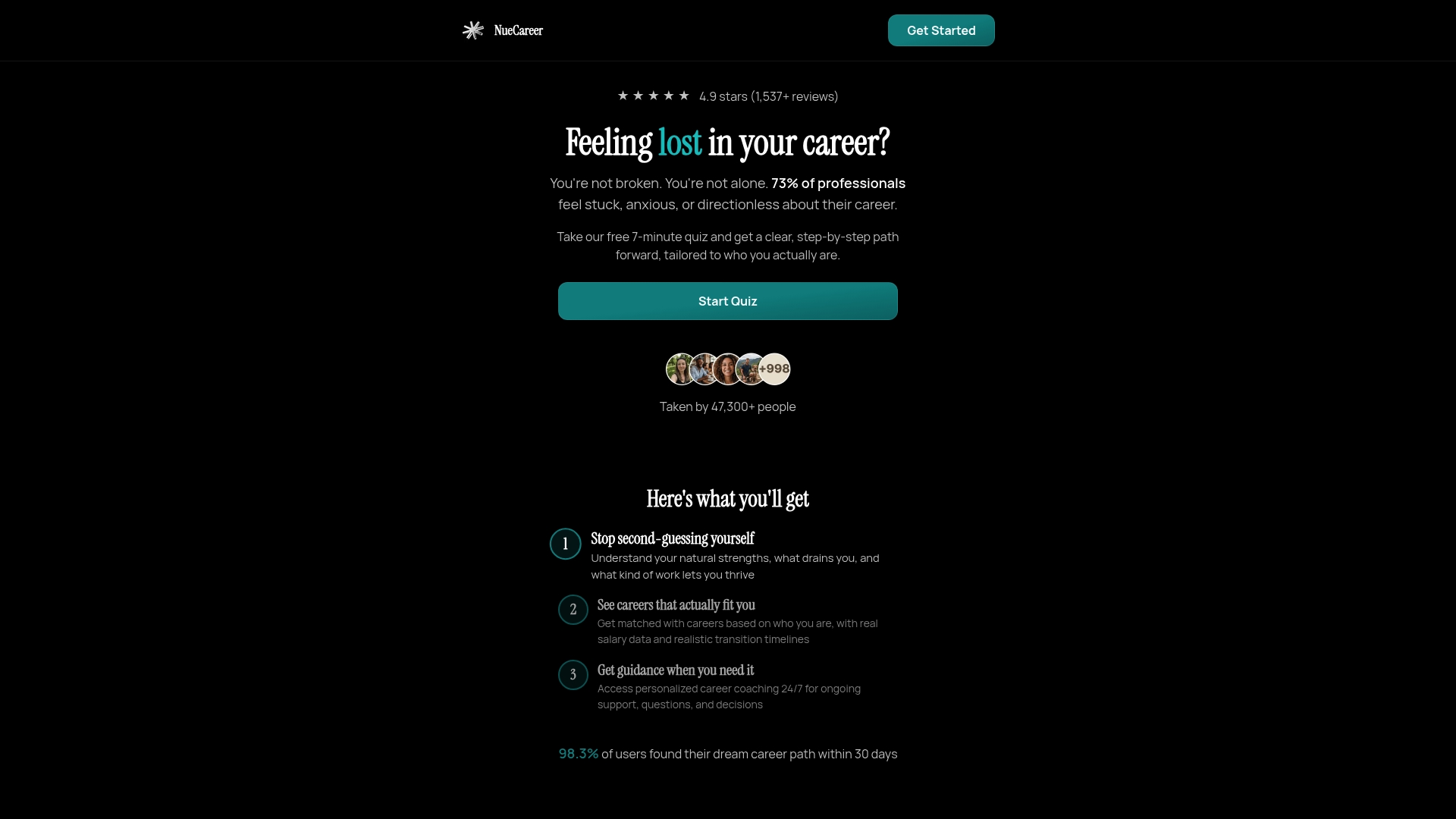
Start with the 7-minute career quiz to identify your strengths and get matched to career paths you may not have considered. From there, you can access a free job description analyzer to tailor every application to what employers actually want, and a free cover letter generator that creates personalized letters aligned with your target roles. Nuecareer also includes 24/7 coaching chat, personalized roadmaps, and a built-in resume tool suite so you are never starting from scratch. You can also explore the best coaching services to find the right fit for your goals and budget.
FAQ
What does a job search coach actually do?
A job search coach helps you clarify your target roles, refine your resume and interview skills, and build structured outreach routines. Unlike a recruiter, a coach works on your strategy and execution rather than placing you directly.
How long does job search coaching take to show results?
Most people see measurable progress within four to six weeks when they execute consistently between sessions. Individualized, long-term programs produce stronger outcomes than short-term engagements.
How do I find a career coach that fits my needs?
Look for coaches who specialize in your industry or career stage, offer structured programs with clear deliverables, and provide accountability between sessions. Nuecareer's coaching services overview is a good starting point for comparing options.
Can I use AI tools alongside coaching?
Yes, but use AI to draft and structure, not to finalize. Personalized coaching helps you layer authentic, specific details onto AI-generated content so your application stands out rather than blending in.
What metrics should I track during a coached job search?
Track application response rates, networking meeting conversions, and interview-to-offer ratios weekly. These leading indicators tell you whether your strategy is working before a job offer confirms it.