

You can use AI to tailor your resume in about 20 to 40 minutes per job. Paste in your real resume and the job description, ask the AI to compare them, and let it point out where your genuine experience already matches. Then you make the edits yourself. The AI finds the overlap and suggests language. You decide what is true and what goes on the page.
If you are changing careers or have been searching for a while, tailoring can feel like one more mountain. It doesn't have to be. With a clear workflow, it becomes a repeatable routine, and each application gets easier than the last.
TL;DR
- Start with your own draft resume and one specific job description. Ask AI to compare them rather than write from scratch.
- Use prompts that tell the AI to work only with facts you provide and to ask questions when something is missing.
- Review every suggestion. AI can invent or inflate details, and you are the one who has to talk about them in the interview.
- Keep your voice, check keywords against the posting, and read the final version out loud before you submit.
- Check your employer's rules on AI use and protect personal details when you paste text into any tool.
Table of Contents
- What resume tailoring with AI really means
- Before you open an AI tool
- A 7-step workflow for tailoring your resume
- How to keep your real experience intact
- Keeping your own voice
- A worked example: a career changer tailoring for a new role
- AI-tailored resumes and applicant tracking systems
- Where NueCareer fits in
- Our perspective
- A quick checklist before you submit
- Common mistakes to avoid
- FAQ
- Sources
What resume tailoring with AI really means
Tailoring means adjusting your resume so the experience most relevant to a particular job is easy to see. You are not changing who you are or what you have done. You are choosing which parts to lead with, and describing them in language the employer recognizes.
AI helps with three parts of that work:
- Reading the posting. It can pull out the skills, tools and phrases a job description emphasizes.
- Spotting matches and gaps. It can show which of your experiences line up with what the employer wants, and where you might be underselling yourself.
- Rewording. It can suggest clearer bullet points and translate your experience into the employer's vocabulary.
Career offices at universities describe the same uses. Brown University's CareerLAB lists tailoring a resume to a job description, identifying keywords and qualifications, improving bullet points, and translating academic or technical experience into clearer employer language.
What AI should not do is decide what you have accomplished. That part always comes from you.
Before you open an AI tool
A little prep makes the AI output far better, and it keeps you in control.
Write your own draft first
Brown's CareerLAB advises drafting your resume first and then using AI to improve it, rather than asking AI to write the whole thing from scratch. A draft gives the AI real material, and it gives you something to measure the output against. Even a rough master resume that lists every job, project and result is enough.
Pick one real job description
Tailoring works best against a single posting. Copy the full text, including the duties and the requirements. If you are applying for several similar roles, do them one at a time. Each posting uses slightly different words for similar work.
Check the employer's rules
The University of Colorado Boulder notes that employers may have guidelines about using AI with applications, assessments, interviews or writing exercises. Read the application page. If it says anything about AI, follow it.
Protect your privacy
UC Santa Barbara Career Services advises protecting your privacy when using AI. A practical way to do that: remove your home address, phone number and email from the text before pasting it, and add them back in your final document. Your name, employer names and dates are rarely needed for the AI to do its comparison work either, so keep what you share to the minimum the task requires.
A 7-step workflow for tailoring your resume
Here is the routine we recommend. It matches the human-in-the-loop approach in our own guide to resume tailoring with AI and human checks.
Step 1: Ask the AI to compare, not to rewrite
Start by asking for analysis. MIT's Career Advising & Professional Development office suggests feeding the AI your resume and the job description and asking it to identify relevant experiences, gaps, and places where you might be underselling yourself.
A prompt along those lines:
Here is my resume and a job description. Identify which of my experiences are most relevant to this role, where I may be underselling myself, and which requirements my resume does not address. Use only what is on my resume.
Step 2: Pull out the language the employer uses
Next, ask what the posting emphasizes. MIT CAPD suggests a follow-up asking which language or keywords the job description stresses and where your resume could reflect that language without changing its meaning.
The key phrase is without changing its meaning. If the posting says "stakeholder communication" and you wrote "updated department heads weekly," that is the same work in the employer's words. If the posting says "Salesforce" and you have never used it, that word does not belong on your resume.
Our resume keywords workflow walks through this step in more detail, and our free skills for a job application tool can help you sort which skills to feature.
Step 3: Use a prompt that blocks invention
This is the most important step. Colorado Boulder recommends a prompt that asks the AI to compare your resume with the job description, identify five qualifications supported by experiences already listed, suggest where to make those connections clearer, and not add skills, accomplishments or experiences you haven't provided.
You can adapt it:
Compare my resume with this job description. Identify five qualifications from the job description that are supported by experiences already on my resume. Suggest where I could make those connections clearer. Do not add skills, accomplishments, numbers or experiences I have not provided. If information is missing, ask me a question instead of guessing.
That last sentence matters. When the AI asks a question, you get to supply a real detail. When it guesses, you get a plausible-sounding fabrication.
For more prompts built on this principle, see our collection of ChatGPT resume prompts that keep every claim true.

Step 4: Rework your bullet points one at a time
Pick the three to five bullets that matter most for this job. Paste each one and ask for two or three alternative phrasings that bring forward the skills the posting emphasizes. Keep the facts exactly as they are.
A strong bullet usually has an action, the thing you worked on and a result. If you don't have a measured result, don't invent one. Describe the scope instead: how many people, how often, what kind of project. Our guide to resume bullet points shows how to do this, and our action verbs list helps when you keep reaching for the same word.
Step 5: Reorder and trim
Tailoring is as much about order as wording. Ask the AI which bullets and skills the employer would care about most, then move those up. UC Santa Barbara notes that prompting AI to align your resume with the job description can add keywords and rearrange the resume to highlight those areas. Treat that as a suggestion for layout, and cut anything that doesn't support this application.
Step 6: Ask for a critique
UC Santa Barbara also recommends asking AI to respond as a university career counselor and suggest five improvements to your resume using the job description. This surfaces weak spots with examples. It is a good final pass before you start editing by hand.
Step 7: Edit by hand and check every line
This is where your resume becomes yours. We cover it in detail below.
How to keep your real experience intact
AI tools are built to produce fluent text, and fluent text isn't always true. MIT CAPD warns that AI will sometimes invent details or exaggerate experience to match a job description, especially when asked to identify gaps. Its advice is to review every suggestion skeptically so you don't end up in an interview being asked about an experience you've never had.
Colorado Boulder is just as direct: review every suggestion for accuracy, and never let AI add responsibilities, skills, accomplishments, numbers or results that aren't true.
Here is a simple review routine:
- Highlight every number. Can you point to where it came from?
- Check every tool and skill. Could you answer three follow-up questions about it?
- Check every verb. Did you "lead" a project or "support" it? Use the one that is accurate.
- Check titles, dates and employers. AI should never touch these.
- Read each bullet and ask: "Could I talk about this for two minutes?" If not, change it or cut it.
Ohio State's Engineering Career Services puts it this way: you should always be the final editor, reviewing and refining generated content so it is accurate to your qualifications and experience. The goal is to avoid explaining discrepancies in the interview room.
Keeping your own voice
A resume that sounds like a template is easy to skim past. MIT CAPD advises against relying on AI so heavily that you lose your voice, and suggests attaching an earlier version of your resume as a sample and asking the AI to keep your voice in mind. It also recommends reading edits closely to see whether they feel authentic and whether you could actually discuss them in an interview.
Brown's CareerLAB adds that you should revise AI suggestions so the final product reflects your own voice. UC Santa Barbara advises against copy-pasting AI-generated content, which can lack originality and contain inaccuracies, and recommends using it as a starting point and editing significantly.
A quick test: read the resume out loud. If a sentence is something you would never say to a hiring manager, rewrite it in plain words.
A worked example: a career changer tailoring for a new role
Here is an illustrative example. It is invented to show the process and doesn't describe a real person.
Imagine a retail store manager moving toward a customer success role. The posting asks for onboarding customers, tracking account health and working with a product team.
Original bullet: "Trained new hires and handled customer complaints in a busy store."
What the AI comparison surfaces: The posting values onboarding, issue resolution and cross-team communication. The resume shows training and complaint handling but doesn't describe either in those terms.
Tailored bullet: "Onboarded new team members and resolved customer escalations, passing recurring issues to the regional office."
Nothing was added that didn't happen. The manager confirms that they did pass recurring issues to the regional office before keeping that phrase. If they hadn't, it would come out.
This is the heart of tailoring for a career change. MIT Sloan's Career Development Office recommends using ChatGPT to ask about the skills a target career needs, describe your work history and aspirations to identify transferable skills and phrasing, and generate industry-specific keywords and collaborate on bullets. It also notes that ChatGPT is not meant to write your resume bullets for you. You bring the experience, and the AI helps you translate it. Our career change resume tips go deeper on this.

AI-tailored resumes and applicant tracking systems
Most mid-size and large employers in the US use an applicant tracking system, or ATS, to collect and organize applications. Recruiters typically search and filter inside it, so the words on your resume matter. That is one reason tailoring pays off: when your resume uses the same terms as the posting for work you really did, it is easier to find and easier to read.
A few practical points:
- Use the posting's exact terms where they are true. If the posting says "project management" and your resume says "program coordination," consider which phrase describes your work more accurately and use it.
- Keep the format simple. Standard headings, a single column and common fonts are easier for software to read than elaborate designs.
- Don't stuff keywords. A list of buzzwords with no evidence reads poorly to a human, and a human is who you ultimately need to convince.
We explain the formatting side in our guide to what makes a resume ATS-friendly.
Where NueCareer fits in
Tailoring works best when you already know which roles fit you. If you are not sure, tailoring a resume for the wrong job just makes you faster at applying to something that won't satisfy you.
That is why we built NueCareer as one platform. The 7-minute quiz identifies your strengths and matches you to career paths, including ones you may not have considered. From there you get a personalized roadmap, 24/7 AI coaching chat, job boards tailored to your target roles, and resume and cover letter tools to help you start applying with confidence.
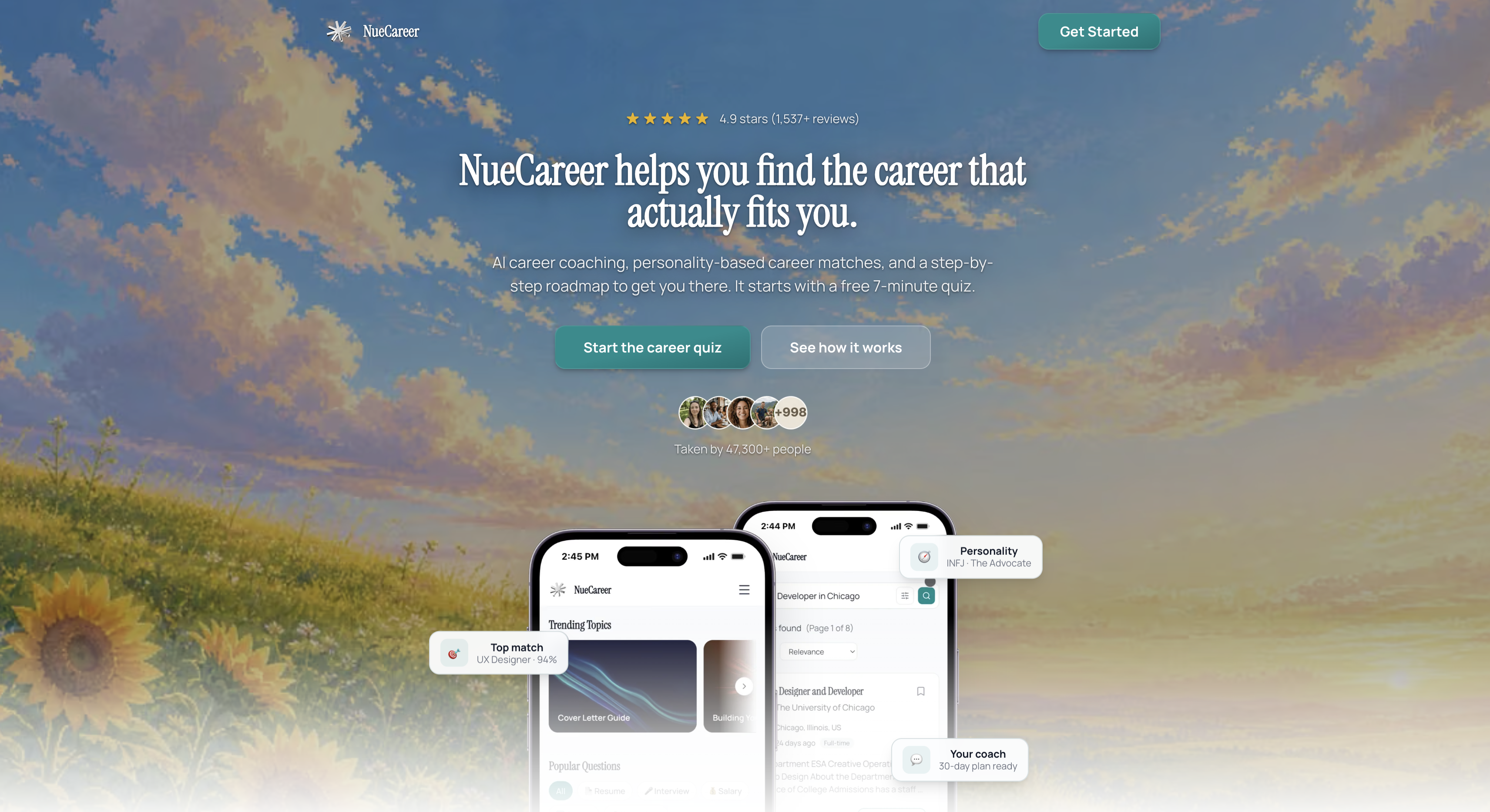
If you want to begin with direction, take the 7-minute career quiz. If you already have a target role, you can try the free ATS resume checker and other application tools or explore the full platform. For the bigger picture on using AI across your search, read our post on fixing your AI job search.
Our perspective
Most people who feel stuck in their careers don't have a resume problem first. They have a clarity problem. They send out dozens of polished applications to roles that were never quite right, then conclude that something is wrong with them.
We see AI as a way to carry the heavy parts of the process: reading a long posting, spotting overlap, suggesting cleaner wording. It is not a replacement for knowing what you are good at. That is why we start with strengths and pair the quiz with coaching and tailored application tools, so the tailoring you do points at a role that fits.
Our approach is built on a simple rule. AI suggests, you verify. Your resume should be a truthful, well-organized account of your real work, and you should be able to stand behind every line of it. When you do, tailoring stops feeling like gaming a system and starts feeling like telling your story to the right audience.
Shane
A quick checklist before you submit
- The job title and employer name match the posting.
- The top third of the resume reflects what this employer cares about most.
- Every number, tool and skill is something you can discuss.
- Keywords from the posting appear where they are accurate, in natural sentences.
- The resume sounds like you when read aloud.
- Formatting is clean, with standard headings and no unusual layouts.
- Personal contact details are back in, and the file name is professional.
- You have followed any AI instructions in the application.
Save each tailored version with the company name, so you can look at it again before an interview. Having the exact version the employer saw is a real advantage when you are preparing answers.
Common mistakes to avoid
Pasting the AI output straight in. It may read smoothly and still contain claims you can't back up.
Tailoring to every word. You don't need to match every line of a posting. Aim for the main requirements you can honestly speak to.
Skipping the cover letter. A short, tailored letter reinforces the same points. Our cover letter generator can give you a starting draft that you then personalize.
Letting every version drift. Keep a master resume with your full, accurate history. Create each tailored copy from that master so errors don't carry from one version to the next.
Ignoring the summary. A tailored summary of two or three lines often does more work than any other section. See our resume summary examples for ideas.
FAQ
Can I use AI to tailor my resume without lying?
Yes, as long as you use it to compare and reword rather than to invent. Give the AI only facts you can stand behind, tell it not to add skills or results, and review every line. Career offices at schools such as MIT and Colorado Boulder both stress checking every suggestion for accuracy.
What should I paste into an AI tool, and what should I leave out?
Paste your work history and the job description. Leave out your home address, phone number, email and any other details you would not want stored. You can add contact information back to the final document yourself.
How long should tailoring one resume take?
Once you have a master resume, expect roughly 20 to 40 minutes per application, including your own review. The first few take longer while you build your routine. Tailoring only the summary, top bullets and skills section is usually enough.
Is it okay to use AI if the employer doesn't mention it?
Often yes, but check the application page and any instructions first. Employers can set rules for AI use in applications and interviews, and you should follow them. Whatever you use, make sure the final resume reflects your real experience and voice.
I'm changing careers. Can AI help me find the right keywords?
It can. Describe your past work and your target role, and ask which of your skills transfer and how people in that field describe them. Then keep only the terms that honestly match what you have done.
Sources
- MIT CAPD: Using AI for your resume and CV
- UC Santa Barbara Career Services: AI Job Search
- Brown University CareerLAB: Resumes and Cover Letters with AI
- Ohio State Engineering Career Services: Using AI on Your Resume
- University of Colorado Boulder: 5 ways to use AI in your job or internship search
- MIT Sloan Career Development Office: 3 Ways Career Changers Can Use ChatGPT