
Self-Assessment for Career Change: What You Need to Know

Discover the role of self assessment career change. Gain clarity on strengths, map skills, and boost your confidence for a successful transition.
Self-assessment is the single highest-leverage first step for a deliberate career change. Structured self-assessment significantly influences the likelihood of making a successful move, helping you target roles that align with your clarified needs rather than chasing options that look good on paper. Career-development theory, from Super to Bandura to Lent, positions self-assessment as the foundational stage of any intentional transition: it builds an explicit vocational self-concept that guides everything that follows.
When you invest time in self-evaluation before you start applying, here is what you can expect:
- Clarity on strengths and values so you know what kind of work actually energizes you
- A map of transferable skills that shows what you already bring to a new field
- Identified skill gaps you can address before they become rejection reasons
- Confidence to test two or three realistic options instead of spinning on a single anxious choice
Table of Contents
- What self-assessment is and why the type matters for a career change
- How self-assessment delivers real benefits during a career change
- Are you ready to change careers? A practical readiness checklist
- How to turn assessment outputs into career options and a test plan
- Trusted U.S. tools and resources for self-assessment
- How long assessments and the decision process typically take
- A 6-step action plan to follow after you finish your self-assessments
- What the research says about self-assessment and career-change outcomes
- Key Takeaways
- The assessment mistake most career changers make
- Nuecareer gives you a faster path from assessment to application
- Useful sources and next-step links
- FAQ
What self-assessment is and why the type matters for a career change
Self-assessment, in the career context, is a structured process of gathering evidence about yourself — your skills, interests, values, personality, and strengths — and comparing that evidence against career options. It is different from informal reflection ("I think I'd like marketing") because it uses validated instruments or deliberate frameworks that surface patterns you might miss on your own.
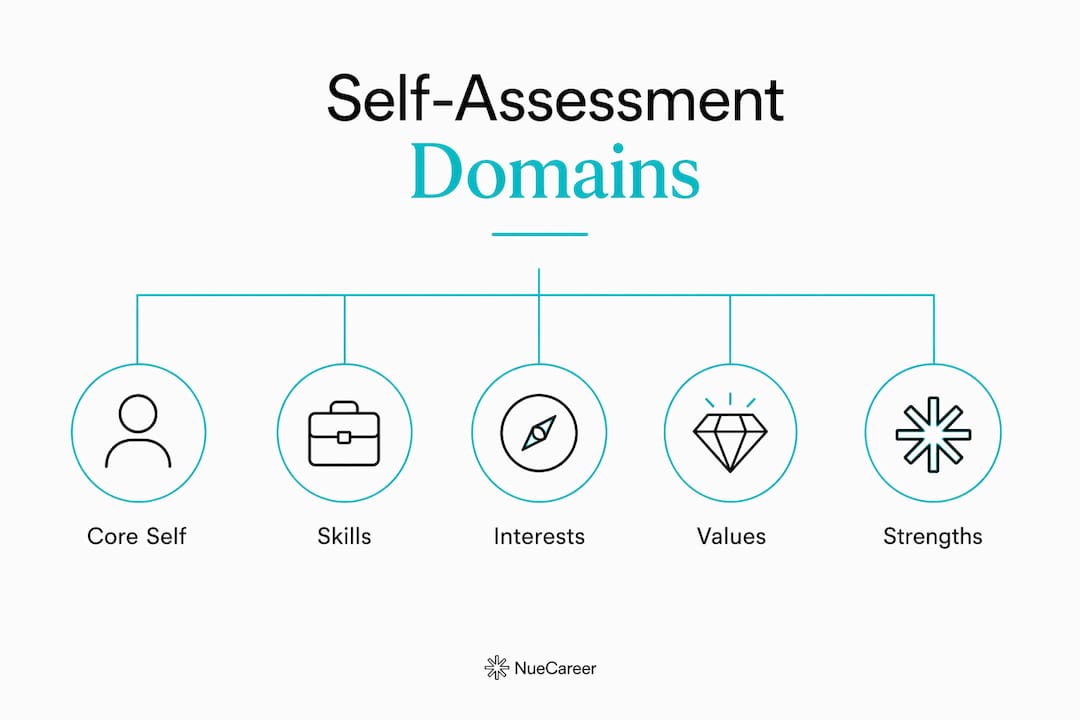
There are five domains every career changer should cover:
- Skills: What you can do well, including both technical and transferable abilities. Skills assessments reveal your current competency baseline and highlight where reskilling is needed. A work-sample review or skills inventory works well here.
- Interests: What you genuinely enjoy doing, separate from what you are good at. The O*NET Interest Profiler, available free through the U.S. Department of Labor, maps your interest patterns to hundreds of occupations. Research consistently shows that interests guide career decisions more reliably than salary alone.
- Values: What conditions make work feel meaningful. The Work Importance Profiler, a validated government-backed tool, identifies your top work values (achievement, independence, recognition, relationships, support, working conditions) and matches them to occupations.
- Personality: How you prefer to work, communicate, and solve problems. Validated Big Five instruments give you a stable, research-grounded personality profile. Personality results are best treated as context, not a career prescription.
- Strengths: The specific activities that produce your best output and leave you energized rather than drained. Strengths assessments help you build a career identity around what you do at your best, not just what you have done.
Covering all five domains gives you a multi-dimensional picture. Relying on just one, say, a personality type alone, is one of the most common mistakes career changers make.
How self-assessment delivers real benefits during a career change
The practical benefits of self-evaluation in a career change go well beyond knowing yourself better. They are operational.
Clarity is the first payoff. When you map what energizes you versus what drains you, you narrow a field of hundreds of possible careers to a short list of realistic fits. That narrowing is not arbitrary; it is driven by your own evidence.

Focus follows from clarity. Self-assessment makes your decision criteria explicit: your values, your non-negotiables, your preferred work style. Once those are on paper, comparing two job offers or two career paths becomes a structured exercise rather than a gut-call made under pressure.
Confidence and market fit come from surfacing transferable skills. Many career changers underestimate how much of their current expertise crosses over. Structured self-analysis helps you organize those strengths into language that resonates with employers in a new field, which directly improves your application documents and interview preparation.
Risk reduction is the benefit people overlook most. Reactive career moves, the ones made out of burnout or frustration without prior self-reflection, often recreate the same misalignment in a new setting. A majority of professionals report that self-assessment significantly influences making a successful career move; those who conduct thorough self-assessment describe greater clarity about their direction and stronger alignment with their new roles.
Pro Tip: Treat your assessment outputs as patterns, not verdicts. A single score on a single instrument means very little. What matters is the theme that appears across three or four different tools. That through-line is your signal.
Are you ready to change careers? A practical readiness checklist
Wanting a career change and being ready for one are two different things. Work through this checklist before you commit to a direction.
- Motivation and goal clarity. Can you articulate why you want to leave your current field, not just what you want to escape? Vague dissatisfaction is a starting point, not a plan. Write one sentence describing the kind of work you want to move toward.
- Financial runway. Do you have sufficient financial reserves saved, or a clear plan for income during a transition? Reskilling, networking, and a longer job search all take time. Financial pressure compresses your options.
- Minimum viable skill set. Have you identified the two or three skills your target role requires that you do not yet have? A reskilling plan does not need to be complete before you start, but you need to know what the gap is.
- Support and accountability. Do you have at least one person, a mentor, a peer group, or a career coach, who will give you honest feedback and hold you accountable? Isolation is a transition killer.
- Timeline and milestones. Have you set a realistic timeline? A part-time transition (exploring while employed) typically takes several months to a year. A full-time transition with dedicated reskilling can move faster, often within a few months, but requires the financial runway from step two.
- Resume and profile readiness. Is your resume current? Can you articulate your career goals clearly in an interview? The University of Michigan's HR career toolkit frames these as direct readiness tests: if you cannot state your skills and goals confidently, you are not ready to apply.
Red flags to pause on: If you cannot answer items 1, 2, or 3, pause before you invest in paid tools or coaching. Address those gaps first.
How to turn assessment outputs into career options and a test plan
Assessment results are raw material. Here is how to convert them into a concrete direction.
- Aggregate your results in one place. Gather outputs from every instrument you completed: skills inventory, interest profile, values ranking, personality notes. A simple spreadsheet works fine.
- Look for the through-line. What themes appear across multiple tools? If your values profile highlights autonomy, your interests cluster around analysis, and your strengths center on problem-solving, that pattern points toward roles like data analysis, consulting, or research, regardless of your current job title.
- Map transferable skills to target roles. Take your top five transferable skills and search job descriptions in your two or three candidate fields. Good assessments give you language and clues that help you articulate a coherent pivot story. Use that language in your resume and LinkedIn profile.
- Handle conflicting results by triangulating. If your interest profile says "creative fields" but your skills inventory shows strong analytical ability, do not pick one and discard the other. Seek roles that require both, UX research, content strategy, or product management, for example. Work samples and trusted feedback from colleagues or a coach are the best tiebreakers when instruments disagree.
- Pick two or three candidate paths, not one. Committing to a single option before you have tested it is premature. Identify two realistic paths and run small experiments on each.
- Run micro-experiments. Informational interviews (three to five per target field), a short freelance project, or relevant volunteer work all give you real-world signal that no assessment can replicate. Use Nuecareer's free job description analyzer to match your skills profile against actual postings in your target roles before you invest months in a full pivot.
For deeper guidance on framing your pivot story in interviews, the career changer interview guide walks through exactly how to translate assessment insights into compelling answers.
Trusted U.S. tools and resources for self-assessment
Start with validated or government-backed tools. They are free, research-grounded, and designed for the U.S. labor market. Paid instruments add value later, once you have a clearer direction and want deeper insight.
| Tool | What it measures | Time | Cost | Best for | Output type |
|---|---|---|---|---|---|
| Work Importance Profiler | Work values | — | Free | Deciding between options | Values ranking + matched occupations |
| CareerOneStop Interest Assessment | Interests | — | Free | Exploring new fields | Career suggestions by interest cluster |
| California CareerZone | Interests, skills, values | — | Free | Exploring + deciding | Career profiles, salary data, education paths |
| O*NET Interest Profiler | Interests | — | Free | Early exploration | Interest code + occupation matches |
| MIT CAPD Self-Assessment | Values, interests, personality, skills | Varies | Free | Structured exploration | Guided reflection across four domains |
All five tools above are free and U.S.-relevant. MIT's Career Advising and Professional Development recommends covering all four components, values, interests, personality, and skills, before drawing conclusions about fit.
When to invest in paid options:
- Career Maze (fee-based) offers a compact vocational strengths and interests questionnaire with specific career-option outputs; useful once you have narrowed to two or three fields and want a more detailed profile.
- A certified career coach (typically $100–$300 per session) adds the most value at decision points: when assessment results conflict, when you are choosing between two serious options, or when you need accountability through a reskilling plan.
Pro Tip: Before paying for any instrument, complete the free government tools first. Most career changers find that the Work Importance Profiler and CareerOneStop together answer 80% of their early questions.
For a practical next step on identifying the right career before you start applying, Nuecareer's guide walks through how to match your assessment outputs to real job options.
How long assessments and the decision process typically take
| Stage | Time to complete | Typical cost |
|---|---|---|
| Single free tool (O*NET, CareerOneStop) | — | Free |
| Full free multi-tool battery (3–4 instruments) | 2–4 hours | Free |
| Paid multi-instrument coaching package | multiple hours across sessions | varying costs |
| Full exploration + decision cycle (part-time) | several weeks to a few months | costs vary |
| Full exploration + decision cycle (full-time) | several weeks | costs vary |
A realistic weekend plan: complete two or three free tools on Saturday, review and note patterns on Sunday, then schedule one informational interview for the following week. That sequence alone moves most career changers further than months of passive research.
Pay for a coach or a premium instrument when your free-tool results conflict, when you are choosing between two serious options, or when you need structured accountability. The career change roadmap at Nuecareer outlines realistic pacing for both part-time and full-time transitions.
A 6-step action plan to follow after you finish your self-assessments
- Aggregate and identify patterns. Within 24 hours of completing your assessments, compile all results in one document and highlight the themes that appear in two or more tools.
- Pick two candidate paths. Choose two realistic career directions that align with your through-line. Write one sentence explaining why each fits your values, interests, and skills.
- Schedule three informational interviews per path. Reach out this week. Real conversations with people in your target roles will confirm or challenge what your assessments suggested faster than any additional instrument.
- Build a targeted skill-up plan. Identify the one or two skills each path requires that you do not yet have. Find a specific course, certification, or project that addresses each gap. Set a completion date.
- Update your resume and profile. Translate your assessment-identified strengths into the language of your target field. Use Nuecareer's skills-to-application tool to convert your self-assessment outputs into job-application language quickly. For resume framing, the career change resume guide covers how to position a pivot persuasively.
- Run a small market test. Apply for one role, take on one freelance project, or attend one industry event in your target field within the next four weeks. Real-world feedback is the final validation layer.
Reassess at decision points. Practitioners recommend re-running your key assessments at major milestones: when you receive your first offer in a new field, when a path stalls, or when your priorities shift. Quarterly check-ins during an active transition keep your self-concept current.
What the research says about self-assessment and career-change outcomes
Career-development theory has positioned self-assessment as foundational for decades. Super's life-span model, Bandura's self-efficacy framework, and Lent's social cognitive career theory all treat explicit self-knowledge as the prerequisite for effective career exploration. Without it, exploration is random; with it, exploration is targeted.
The practical evidence supports the theory:
- Professionals who conduct thorough self-assessment before a transition report greater clarity about their direction and stronger alignment between their new role and their actual needs.
- MIT's career advising framework frames career satisfaction as stemming directly from a clearer understanding of values, interests, personality, and skills, and recommends revisiting that understanding throughout a career, not just at the start.
- The most useful assessment profiles, according to career-development research, combine structured self-report, objective evidence (work samples), and trusted feedback from others. Any one source alone is insufficient.
The practical implication: if you are deciding whether to invest two to four hours in free tools before starting a job search, the evidence says yes. The time spent on structured self-assessment reduces the probability of a post-change mismatch, which costs far more in time and energy than the assessment itself.
Key Takeaways
Self-assessment is the foundational step for a successful career change: it converts vague dissatisfaction into clear, testable career options grounded in your values, skills, and interests.
| Point | Details |
|---|---|
| Start with free, validated tools | Work Importance Profiler, CareerOneStop, and O*NET Interest Profiler cover values, interests, and skills at no cost. |
| Look for the through-line | Patterns across multiple tools, not any single score, are the reliable signal for a career direction. |
| Test before committing | Informational interviews and small projects validate assessment results faster than additional instruments. |
| Reassess at decision points | Re-run key assessments when priorities shift or a new offer arrives, not just at the start of a transition. |
| Nuecareer accelerates the process | The 7-minute Nuecareer quiz identifies your strengths and matches you to career paths, with free tools to help you apply confidently. |
The assessment mistake most career changers make
The conventional advice is to "take a personality test and see what comes up." That framing is where most people go wrong.
A single instrument, used once, at the start of a transition, treated as a verdict, is almost useless. The Myers-Briggs type, the Enneagram number, the single interest code: none of these alone tells you what career to pursue. What they do, when used correctly, is add one data point to a larger picture. The problem is that most career changers stop there, pick the first career suggestion that appears in the results, and call it a plan.
The more productive approach is to treat self-assessment as an iterative process. Complete three or four tools across different domains. Look for the pattern that appears in all of them. Then test that pattern against reality through informational interviews and small projects before you commit. The assessment is not the answer; it is the question generator. The real answers come from the market.
There is also a subtler mistake: ignoring feedback from people who know your work. Assessments are self-report instruments, which means they reflect your perception of yourself. A trusted colleague, a former manager, or a career coach who has observed you in action will often surface strengths you have normalized and blind spots you have rationalized. The most confident career-change decisions come from people who triangulate: their own assessment results, objective work samples, and external feedback, all pointing in the same direction.
Nuecareer gives you a faster path from assessment to application
Most self-assessment tools tell you what you are good at and stop there. Nuecareer takes the next step with you. The 7-minute quiz identifies your strengths and matches you to career paths built around who you are, including fields you may never have considered. From there, you get a personalized roadmap, 24/7 coaching chat, and a job board filtered to your target roles.
When you are ready to apply, Nuecareer's free suite handles the translation work: the job description analyzer shows you exactly what a posting is looking for, and the cover letter generator turns your assessment-driven narrative into a document ready to send. No agency, no long wait, no guessing what to write. Start with the free quiz, get your skill map, and take your first concrete step toward a career that fits.
Useful sources and next-step links
- CareerOneStop (U.S. Department of Labor): Free interest, skills, and values assessments aligned to the U.S. labor market; the most comprehensive free starting point for American career changers.
- MIT Career Advising and Professional Development: Covers all four self-assessment domains (values, interests, personality, skills) with curated tools and guidance on interpreting results.
- University of Michigan HR Career Toolkit: Readiness checklist and curated tool list from a major research university's career development office.
- Nuecareer Free Career Skills Assessment: A quick, practical tool to identify your strengths and gaps before you start applying.
- How to Choose the Right College Major: Useful decision frameworks for career changers considering an education-linked pivot or returning to school.
- Nuecareer Career Change Roadmap: Step-by-step pacing guide for both part-time and full-time career transitions.
FAQ
What is the role of self-assessment in a career change?
Self-assessment clarifies your strengths, values, interests, and skill gaps before you commit to a new direction. It converts vague dissatisfaction into specific, testable career options and reduces the risk of post-change mismatch.
Why is self-assessment the first step in career planning?
Starting with self-assessment before exploring options means your search is guided by evidence about what you need, not by what looks appealing in the moment. Career-development theory consistently positions it as the foundation of effective exploration.
What are the main types of self-assessment tools for careers?
The five core domains are skills, interests, values, personality, and strengths. Free U.S. tools covering these include the Work Importance Profiler, CareerOneStop Interest Assessment, California CareerZone, and the O*NET Interest Profiler.
How do self-assessments help with job satisfaction after a career change?
A majority of professionals who conduct structured self-assessment before a transition report greater clarity and stronger alignment between their new role and their actual needs, which are the two strongest predictors of post-change satisfaction.
How often should you revisit self-assessment during a career transition?
Practitioners recommend re-running key assessments at major decision points: when you receive a first offer in a new field, when a path stalls, or when your priorities shift. Quarterly check-ins during an active transition are a practical cadence.