

TL;DR:
- Career identity integrates motivation, interests, competencies, and values to shape how individuals see themselves in relation to work. It continuously evolves across life stages, influencing decision-making, satisfaction, and resilience in career transitions. Building a strong, values-aligned career identity through reflection and assessment promotes authentic professional fulfillment and growth.
Career identity is defined as the structured integration of your motivation, interests, competencies, and values linked to meaningful career roles as part of your broader self-concept. According to ResearchGate research, it functions as a network of meanings connecting who you are to the work you pursue. Two foundational frameworks shape how we understand this concept: Donald Super's developmental self-concept theory and John Holland's RIASEC model. Both confirm that career identity is not a fixed label you receive at graduation. It is a living structure that shifts as you grow, and understanding it is the first step toward work that genuinely fits.
What is career identity and why does it matter?
Career identity is the psychological framework through which you connect your inner world to your professional life. It answers the question most people quietly carry: "Am I in the right place?" When your work aligns with who you are, you experience clarity, energy, and purpose. When it does not, even a well-paying role can feel hollow.
The importance of career identity shows up most clearly in career decision-making. People with a clear sense of professional self-concept make more confident choices, recover faster from setbacks, and report higher satisfaction over time. Those without it tend to drift, accepting roles based on availability rather than alignment.
Understanding career identity also separates two things people often confuse: your job role and your career identity. Your job role is what you do. Your career identity is who you are in relation to work. A software engineer and a teacher can share the same career identity if both are driven by curiosity, a desire to solve problems, and a value for autonomy. The title is the surface. The identity runs deeper.
What components make up career identity?
Career identity is built from four interlocking elements. Each one contributes something distinct, and they work together rather than in isolation.

| Component | What it means | Career impact |
|---|---|---|
| Motivation | Your internal drive and sense of purpose | Determines direction and sustains effort over time |
| Interests | The activities and topics that energize you | Points you toward roles you will find engaging |
| Competencies | Your skills, strengths, and areas of expertise | Enables effective performance and builds confidence |
| Values | Your core beliefs about what matters in work | Predicts long-term satisfaction and meaning |
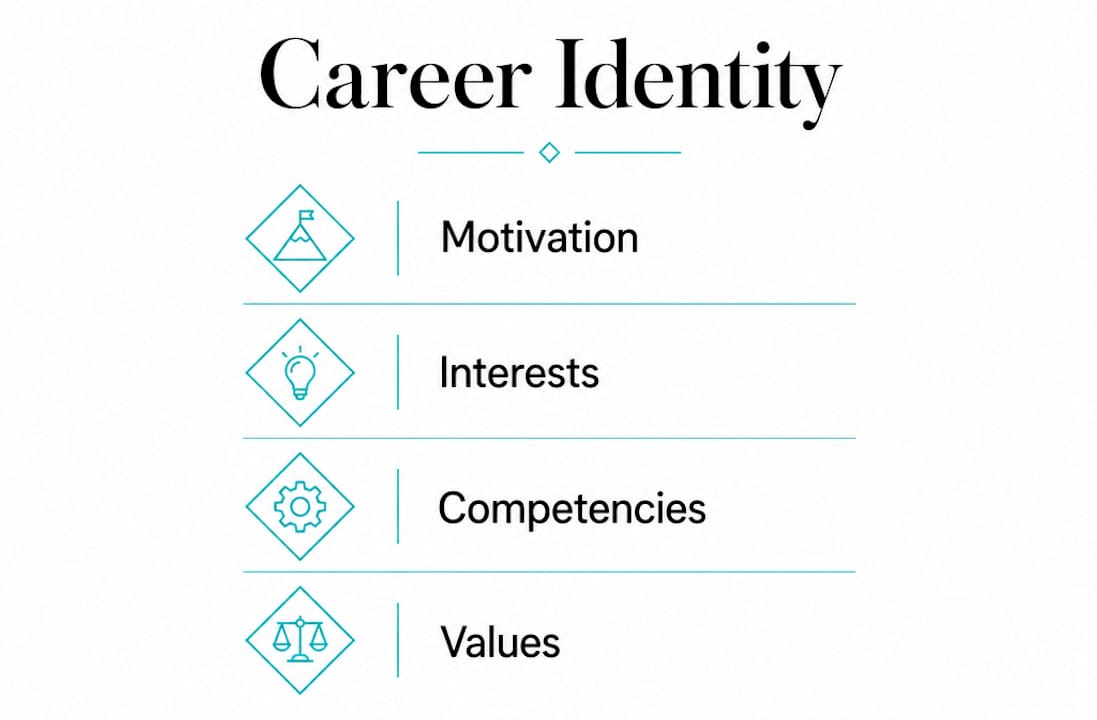
Motivation is the engine. It explains why you pursue certain goals even when progress is slow. Interests are the compass. They tell you which directions feel worth exploring. Competencies are the proof. They show you and others what you are capable of delivering. Values, however, are the highest-leverage element of the four.
Values congruence independently predicts career satisfaction, separate from skills or interest level. That means you can be skilled at a job and interested in the field, yet still feel unfulfilled if the role conflicts with what you believe matters most. Evaluating your top three to five values against any role you consider is one of the most practical filters available to you.
Pro Tip: When assessing a new opportunity, list your top five values before you read the job description. Then evaluate the role against that list, not the other way around. This keeps your identity in the driver's seat.
How does career identity evolve across life stages?
Career identity is not something you figure out once and carry forever. Super's developmental self-concept theory describes career development as a lifelong process of growth, exploration, establishment, maintenance, and disengagement. At each stage, your self-concept shifts, and your career identity shifts with it.
In your twenties, you are largely in exploration mode. You test roles, collect experiences, and begin forming a clearer picture of what fits. By your mid-career years, the picture often feels settled. Then something changes. A promotion that should feel like a win feels empty. A role you were good at no longer feels like yours. This is not failure. It is your identity signaling that it has grown beyond the container you placed it in.
The table below maps the major career identity phases and what each one typically demands:
| Life stage | Identity focus | Common challenge |
|---|---|---|
| Early career (20s) | Exploration and testing | Uncertainty about direction |
| Mid-career (30s–40s) | Establishment and deepening | Competence without meaning |
| Career transition (any age) | Rebuilding and reorienting | Losing the old identity before finding the new one |
| Late career (50s+) | Legacy and contribution | Separating worth from productivity |
Career transitions are identity events, not just job searches. LHH research confirms that the most effective approach to repositioning your career starts with rebuilding your adaptive work identity before updating your resume. Skipping this step leads to applying for roles that replicate the past rather than reflect who you are becoming.
Mid-career professionals in particular often confuse role competence with identity satisfaction. Being good at your job does not mean the job fits who you are. Separating "what I do" from "who I am" is the reset that makes genuine career change possible.
Pro Tip: Before sending a single application during a career transition, spend two weeks in reflection mode. Journal your energy peaks, your values, and the moments in past roles when you felt most like yourself. This work shortens your search and sharpens your targeting.
For a structured approach to this process, the career change guide at NueCareer walks through the psychological and practical steps in sequence.
What role do self-assessment tools play in developing career identity?
Self-assessment tools do not hand you a career identity. They create the conditions for you to discover one. Holland's RIASEC model, which categorizes vocational personalities into Realistic, Investigative, Artistic, Social, Enterprising, and Conventional types, is the most widely used framework in career counseling and education. RIASEC-based tools support vocational identity by prompting structured reflection and expanding the range of options you consider.
The key insight from 2026 Frontiers research is that these tools work best when treated as hypothesis generators, not definitive answers. Your RIASEC profile suggests directions worth exploring. It does not tell you exactly who you are or what you must do. Using it as a starting point for career experiments, rather than a final verdict, leads to stronger and more authentic identity development over time.
Here is what self-assessment tools do well, and where they fall short:
Benefits of self-assessment tools:
- They surface patterns in your interests and values that are easy to overlook on your own
- They introduce career paths you may never have considered
- They provide a shared language for discussing fit with counselors, coaches, or mentors
- They reduce decision paralysis by narrowing a vast field of options
- They support iterative exploration rather than one-time decisions
Limitations to keep in mind:
- Results reflect your current self-concept, which shifts over time
- They cannot account for context, culture, or lived experience
- Overreliance on a single tool can reinforce existing assumptions rather than challenge them
- No assessment replaces direct experience in a role or field
The NueCareer career clusters quiz applies interest-based assessment principles to match you with career paths built around your strengths, including options you may not have considered. For a broader comparison of available instruments, the best career assessment tools guide reviews the leading options in 2026.
How does aligning career identity with values enhance job satisfaction?
Values alignment is the difference between a career that pays well and one that sustains you. When your work reflects what you genuinely believe matters, you bring more energy, tolerate difficulty more easily, and find meaning in ordinary tasks. When it does not, even success can feel like a slow drain.
Identity leadership research published in 2026 shows that leaders who cultivate shared purpose within teams directly enhance their team members' sense of career calling. This means the organizational environment you work in shapes your ability to experience meaning, not just your individual values. Choosing environments that reflect your values is as important as choosing roles that match your skills.
There is also a risk on the other side of this equation. When work becomes the primary source of identity, the result is what researchers call identity fusion. Signs include anxiety during vacations, terror at the thought of role loss, and measuring personal worth entirely through professional achievement. The treatment is not to care less about your career. It is to build identity anchors outside of work: relationships, creative pursuits, community roles, and personal values that exist independent of any job title.
Practical guidance for evaluating values fit in a role goes beyond reading a company's mission statement. Ask current employees what decisions get made when values conflict with profit. Look at how the organization handled a public challenge. Observe whether the people you would work with reflect the kind of professional you want to become.
Pro Tip: When interviewing for a new role, ask: "Can you describe a time when the company had to choose between what was profitable and what was right? What did they do?" The answer tells you more about values alignment than any benefits package.
For a deeper look at how life stage intersects with values shifts, the goals after 40 resource explores the psychological reorientation that often drives mid-career identity transitions.
Key takeaways
Career identity is the integrated structure of your motivation, interests, competencies, and values, and aligning it with your work is the most direct path to sustained professional satisfaction.
| Point | Details |
|---|---|
| Career identity vs job role | Your job title describes what you do; your career identity reflects who you are in relation to work. |
| Values as the top filter | Values congruence predicts satisfaction independently of skills, making it the highest-leverage career decision tool. |
| Transitions as identity events | Rebuilding your self-concept before applying for roles leads to better-fit outcomes than jumping straight to job search tactics. |
| Self-assessments as hypotheses | RIASEC tools like Holland's model work best as starting points for exploration, not fixed labels. |
| Identity anchors matter | Building a sense of self outside of work protects against identity fusion and supports long-term resilience. |
Why career identity work is the most underrated career move you can make
Most people treat career confusion as a skills problem or a market problem. They update their resume, add a certification, or scroll job boards. What they are actually experiencing is an identity problem, and no amount of tactical activity resolves it until the underlying self-concept work is done.
I have seen this pattern repeatedly. Professionals who are objectively capable, with strong track records and real skills, feel completely lost because they have been optimizing for external markers of success rather than internal alignment. The job looks right on paper. The salary is fair. The title is respectable. And yet something feels fundamentally off.
The Forbes analysis of career exits makes this point clearly: practitioners who work with people in transition sequence the work deliberately. First, stabilize the self-concept. Then explore options. Then validate through testing. Rushing to applications before completing the first two steps is one of the most common and costly mistakes in career development.
What I find most encouraging is that career identity is fluid by design. A role that fit you at 32 is not supposed to fit you at 45. That discomfort you feel is not a sign that something went wrong. It is a sign that you grew. The goal is not to find one permanent answer. It is to stay curious about who you are becoming and build the self-awareness to recognize when your work needs to catch up with your growth.
Build identity anchors outside your job title. Know your values before you know your next role. And treat every career transition as an opportunity to meet a more developed version of yourself.
— Shane
Discover your career identity with NueCareer
If this article has you thinking about who you are in relation to your work, the next step is structured exploration, not more scrolling.
NueCareer is built for working adults who feel stuck or unclear about their direction. The 7-minute career quiz identifies your strengths and matches you to career paths built around who you are, including paths you have never considered. From there, you get personalized roadmaps, 24/7 coaching chat, and a full suite of resume and cover letter tools. If you want to start with your strengths, the free skills assessment gives you a clear picture of what you bring to any role. Your career identity is worth understanding. NueCareer helps you act on it.
FAQ
What is career identity in simple terms?
Career identity is the combination of your motivation, interests, skills, and values that shapes how you see yourself in relation to work. It goes deeper than a job title and influences every major career decision you make.
How is career identity different from a job role?
Your job role describes your responsibilities and title. Your career identity reflects your values, strengths, and sense of purpose in relation to work. Two people can hold the same job role and have entirely different career identities.
Can career identity change over time?
Yes. Super's developmental self-concept theory confirms that career identity evolves across life stages. Feeling that a once-fitting role no longer suits you is a normal signal of personal growth, not a sign that something went wrong.
How do I start defining my career identity?
Start with structured reflection on your values, energy peaks, and the moments in past roles when you felt most like yourself. Self-assessment tools like Holland's RIASEC model or the NueCareer career clusters quiz provide a useful starting framework for exploration.
What happens when career identity becomes too tied to one job?
When work becomes the sole source of identity, it creates what researchers call identity fusion. Signs include anxiety during time off and distress at the thought of role loss. Building identity anchors outside of work, such as relationships, creative pursuits, and community involvement, is the recommended response.