

You can write a strong resume after a career break by naming the break briefly, showing what you did and learned during it, and putting your most relevant skills and results first. You don't need to hide the gap or apologize for it. If you also aren't sure which role to return to, we built NueCareer for exactly that moment: our 7-minute career quiz matches your strengths to career paths, and our resume tools help you apply once you know where you're headed.
If you've been away from work for caregiving, health, relocation, a layoff or simply a reset, this guide walks you through the whole resume, step by step.
TL;DR
- Acknowledge a significant break in one short, matter-of-fact line instead of leaving a silent hole.
- Choose a combination or chronological format. Avoid a skills-only resume, which can look like you're hiding something.
- Include relevant unpaid work, training, certifications and volunteering, and add numbers wherever you can.
- Tailor the summary and keywords to each job, then prepare a 30-second spoken version of your story.
- A resume works best alongside people who know your work, so reconnect with your network too.
Table of Contents
- Why a Career Break Feels Harder on Paper Than It Is
- Step 1: Choose the Right Resume Format
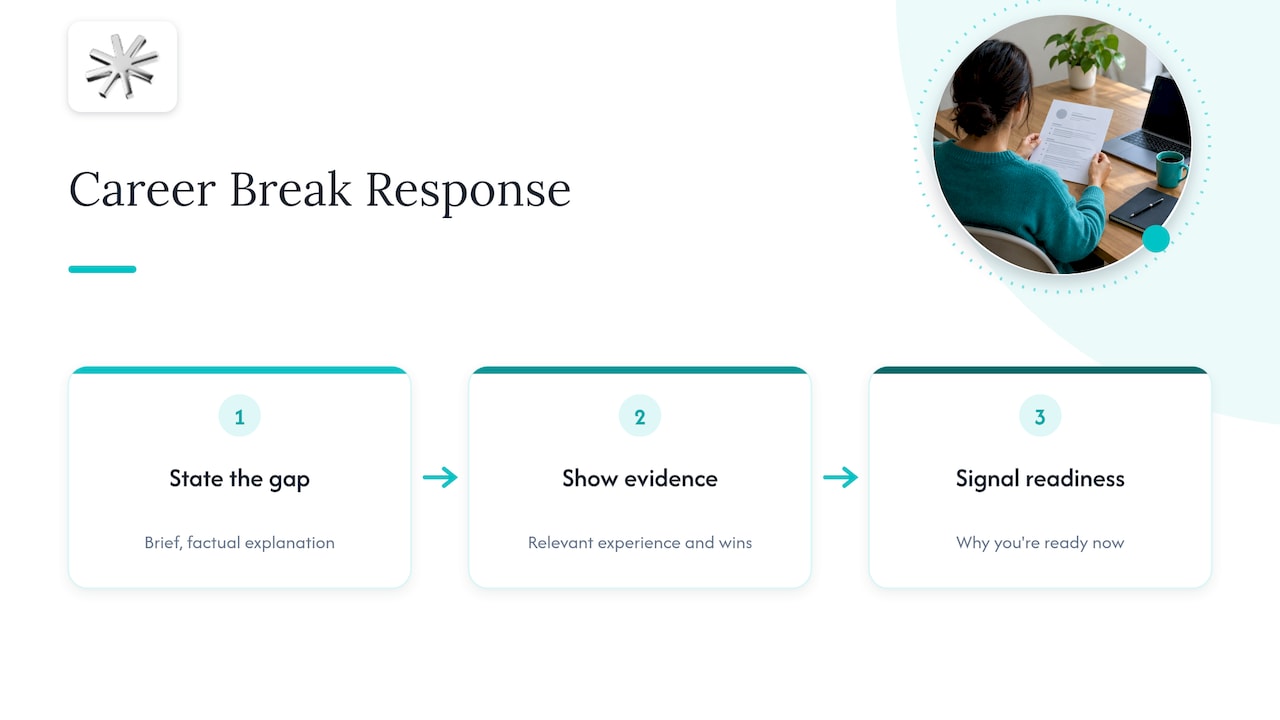
- Step 2: Acknowledge the Break in One Line
- Step 3: Show What You Did During the Break
- Step 4: Turn Activities Into Measurable Results
- Step 5: Tailor the Summary and Keywords to the Job
- Step 6: Prepare the Spoken Version
- Step 7: Don't Let the Resume Work Alone
- A Quick Pre-Submit Checklist
- What If You Don't Know Which Role to Return To?
- Our Perspective
- FAQ
- Sources
Why a Career Break Feels Harder on Paper Than It Is
A resume reduces years of life to dates and job titles, so a gap stands out visually. That's why it feels so loud to you. A recruiter skimming a page is mostly asking two things: can this person do the job, and are they ready to do it now? Your resume's task is to answer both quickly.
The guidance from universities and federal agencies is consistent on this. The U.S. Department of Veterans Affairs advises acknowledging a gap honestly and briefly, then directing attention to your present capability, recent accomplishments and enthusiasm for the role. Stanford Graduate School of Business advises being matter-of-fact rather than apologetic: state the reason briefly, then move straight to relevant experience and why you suit the role.
In other words, the gap is a fact, not a verdict. Your job is to give it one line and then get on with the evidence that you're ready.
Step 1: Choose the Right Resume Format
The U.S. Department of Labor's Resume Essentials guide describes three standard styles:
| Format | What it leads with | Best when |
|---|---|---|
| Chronological | Work history, newest first | You have steady experience in the same field |
| Functional | Skills grouped by theme | You have gaps or are changing careers |
| Combination | Skills plus work history | You want to show both what you can do and where you did it |
The Department of Labor notes that a combination resume shows skills and work history together, highlights accomplishments, and can present skills gained through volunteering or training. For most people returning from a break, that's the most flexible choice: a short skills and accomplishments section up top, followed by a dated work history.
One caution on the functional format. UVA Darden's career team advises against defaulting to a skills-only resume because it can appear that you're hiding something, and recommends a direct approach to the break instead. Keep your dates visible and let the combination format do the work.
Use years instead of months
Columbia Career Education suggests dropping the months from employment dates and listing years only, for example 2014 to 2016 instead of May 2014 to February 2016. This is a formatting choice, not a deception: your dates are still accurate. It simply keeps a few months of downtime from drawing the eye. Be consistent across every role, and be ready to give exact months if someone asks.
Step 2: Acknowledge the Break in One Line
A gap with no explanation invites guesses. A gap with a short, calm line closes the question. The Social Security Administration's Ticket to Work program says a significant employment break should be acknowledged, and that your explanation should focus less on why you weren't working and more on how you prepared to return.
Where does the line go? Put it in your work history as its own entry with dates, or in your summary at the top. Either works. What matters is that it's short and factual.
Wording that works
The VA suggests plain phrasing such as "Took time off to care for family" or "Pursued professional development." Here are a few ways to adapt that:
- Caregiving: Career break, 2021–2024: Full-time caregiver for a family member. Completed a project management certificate and managed a household budget and care schedule.
- Relocation or family: Career break, 2022–2025: Relocated internationally with family. Volunteered as a fundraising coordinator for a local nonprofit.
- Layoff and search: 2023–2025: Freelance and contract work in operations while pursuing a data analytics certification.
- Health: 2022–2024: Took medical leave and have fully recovered. Ready to return to full-time work.
On health: you don't owe anyone private details. The Ticket to Work guidance says that if the break involved a disability, private medical details are unnecessary, and that saying you took medical leave or were recovering from a health issue or injury is enough. Stanford GSB adds that when a family or personal health issue is now resolved, you can say so and then emphasize your readiness to return.
Don't oversharing, don't apologize
A good test: could a stranger read your line and move on in three seconds? If it contains an apology, a long backstory or a justification, trim it. One reason, one forward-looking fact, done.
Step 3: Show What You Did During the Break
Most career breaks contain more usable experience than people think. The Ticket to Work program recommends including relevant continuing education, certifications, professional-association activity, consulting, volunteering or mentoring that helped prepare you to return. The VA points to communication, organization, project management, volunteering, freelance work, certification courses and leadership developed outside traditional employment.
Columbia Career Education recommends grouping your experience into relevant categories and including volunteering, projects, professional-development courses, certifications and professional-association involvement. Here's how that looks in practice:
- Ran a school fundraiser for 300 families: budgeting, vendor coordination, team leadership.
- Managed a household move across states: timelines, contracts, logistics.
- Completed a Google Data Analytics certificate: current, job-relevant skills.
- Freelance bookkeeping for two small businesses: paid, client-facing, recent.
Skills-based roles are especially useful because they map directly to job requirements. If you gave your time as a volunteer accountant, event planner or mentor, skills-based volunteering is an established way for professional skills to be put to use outside a paid job, and it belongs on your resume in the same format as any other role.
Keep it substantive
UVA Darden recommends putting substantive, relevant unpaid activities, such as consulting projects and nonprofit-board work, in your experience section, while avoiding filler activities created only to close a gap. A recruiter can tell the difference. Include what you really did and what it produced.
Step 4: Turn Activities Into Measurable Results
Duties describe a task; results describe your value. The Department of Labor recommends describing relevant achievements with numbers, timeframes, financial savings or percentages where available. That applies to unpaid work too.
Compare these two bullets:
- Helped with the PTA budget.
- Managed a $14,000 annual PTA budget, cut printing costs by 20% and tracked spending for 120 families.
The second tells a hiring manager the scale, the responsibility and the outcome. Go back through your break and your earlier jobs and ask for each item: how many, how much, how often, how fast, how much saved? If you don't have an exact figure, a reasonable and honest estimate with a timeframe still helps. Never invent numbers you couldn't defend in an interview.
Step 5: Tailor the Summary and Keywords to the Job
The Department of Labor describes a targeted resume as one that removes unrelated details, highlights skills and accomplishments, and matches the employer's requirements and keywords. Columbia Career Education suggests a summary statement to focus employers on your skills.
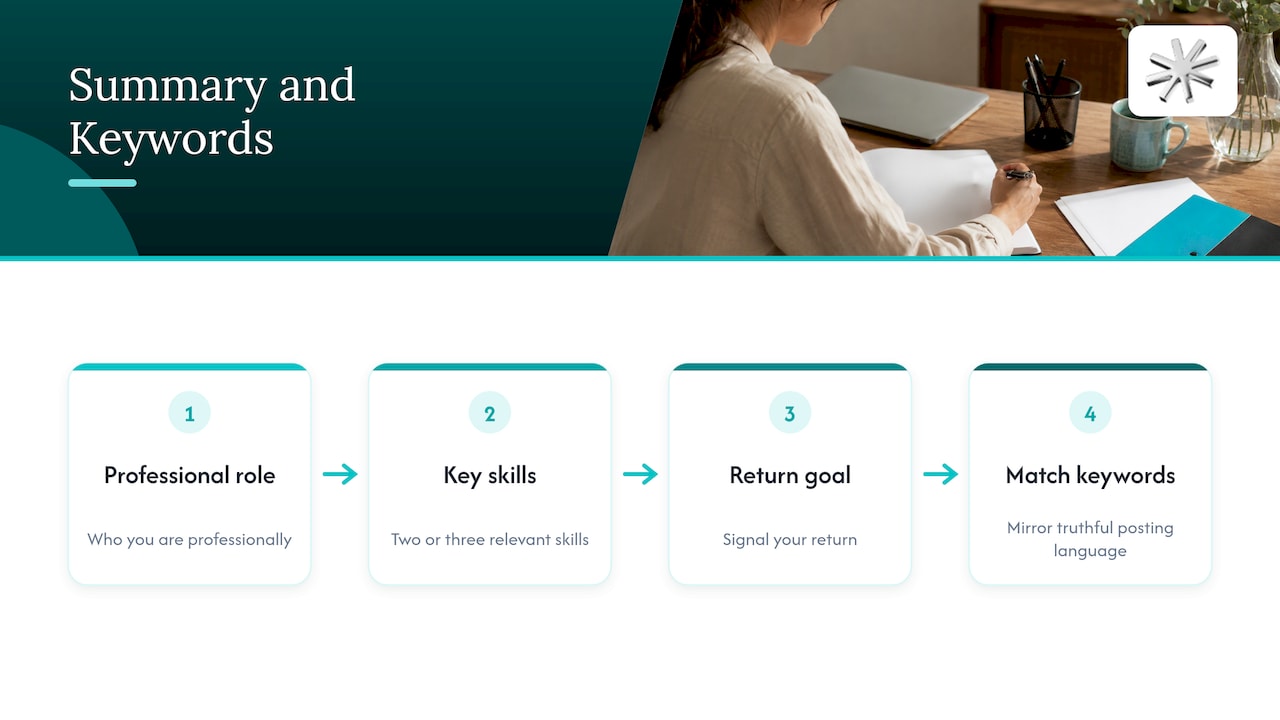
A strong post-break summary has three parts: who you are professionally, your two or three strongest relevant skills, and a nod to your return. For example:
Operations professional with eight years of experience in logistics and vendor management. Recently completed a supply chain certification and led a 40-person volunteer program. Seeking to return to a full-time operations role.
Then read the job posting closely and mirror its language where it's true of you. If the posting says "stakeholder communication" and you've done exactly that, use those words. Many employers screen applications with applicant tracking systems (software that scans resumes for relevant terms), so matching keywords matters.
Tailoring takes time when you're applying widely. Our guides on resume tailoring with AI and tailoring in 20 to 40 minutes lay out the process. If you're returning to a different field, career change resume tips cover how to reframe past work for a new target.
Step 6: Prepare the Spoken Version
Your resume gets you the conversation. The VA notes that a gap explanation can be expanded in an interview, where you explain the reason and pivot to how the experience prepared you for the next role.
Stanford GSB's Carol Fishman Cohen recommends a matter-of-fact explanation followed by a well-rehearsed anecdote from a prior job or volunteer position. Build yours in three beats:
- The reason, in one sentence. "I stepped away to care for my mother."
- The bridge. "During that time I also finished a certification and managed a volunteer team."
- The pivot. "I'm excited about this role because it uses exactly those skills."
Say it aloud until it sounds natural. For ready-to-adapt wording, see our 30-second scripts for explaining an employment gap and our career gap interview scripts. If you're changing fields as well, the career changer interview answers guide helps with the follow-up questions.
Step 7: Don't Let the Resume Work Alone
UVA Darden is blunt that a resume shouldn't be expected to stand alone after a long break. Networking and reconnecting with people who know your capabilities matter too. Message former managers, colleagues and clients, tell them what you're looking for, and ask who they'd introduce you to. A referral puts a person's endorsement next to your page, and it often makes the gap a non-issue.
A Quick Pre-Submit Checklist
- The break is acknowledged in one line, with years, not a long story.
- Format is combination or chronological, with consistent dates.
- Every break-period activity listed is real and relevant.
- At least three bullets carry a number, percentage or timeframe.
- The summary and keywords match this specific job.
- You can say the gap explanation out loud in 30 seconds.
What If You Don't Know Which Role to Return To?
Many people reach the resume stage and realize the old job title no longer fits. A break is often when priorities change: hours, pay, purpose, flexibility. Writing a targeted resume is much easier when you know the target.
That's the situation NueCareer is built for. Our 7-minute quiz identifies your strengths and matches you to career paths, including careers you may never have considered. From there, the platform provides a personalized transition roadmap, 24/7 AI coaching chat, job boards tailored to your target roles, and resume and cover letter tools. Our ATS Resume Checker, Cover Letter Generator and Mock Interview Practice are there for the steps above, and you can start with the career quiz.
If a cover letter is part of your application, our guide to a career change cover letter shows how to address a break or a pivot in a few sentences.
Our Perspective
We talk with a lot of working adults who feel stuck, and the pattern is familiar: the career break itself isn't what holds people back. The doubt is. People assume a gap disqualifies them, so they either hide it or over-explain it, and both make the resume weaker.
Our view is that a break is simply part of a working life, and a resume should treat it that way: one honest line, followed by proof of what you can do. That proof is easier to write when you're clear on your strengths and on the direction you want to take, which is why we start with a 7-minute quiz that matches you to paths built around who you are.
Once you have a target role, everything else gets simpler. Your summary has a focus, your keywords come from real job postings, and your interview answer has a destination. Our personalized roadmaps, 24/7 coaching chat and resume and cover letter tools are designed to carry you through those steps, so you can apply with confidence instead of guessing.
If you've been away, you haven't fallen behind a standard. You're starting a next chapter, and you can write it clearly.
Shane
FAQ
Should I list a career break on my resume?
Yes, if it's significant. The Ticket to Work program and the VA both advise acknowledging a meaningful gap briefly instead of leaving it unexplained. One factual line with years is enough, and the rest of the page should focus on your skills and results.
Is a functional resume a good way to hide a gap?
It usually isn't. UVA Darden warns that a skills-only resume can look like you're hiding something. A combination resume, which pairs a skills section with a dated work history, lets you lead with strengths while staying transparent.
What if my break was for health reasons?
You don't have to share medical details. Saying you took medical leave or were recovering from a health issue is sufficient, according to the Ticket to Work guidance. If the matter is resolved, say so and emphasize that you're ready to return to work.
Can volunteering and caregiving count as experience?
Relevant volunteering, freelance work, certifications and leadership developed outside a paid job all belong on a resume, according to the VA and Columbia Career Education. List them like any role, with the skills used and any results you can measure.
How long should my explanation be?
On the resume, one line. In the interview, aim for about 30 seconds: the reason, a bridge to what you did or learned, and a pivot to why you're right for this role.
Sources
- Resume Essentials Participant Guide, U.S. Department of Labor
- How to Explain Employment Gaps, Columbia Career Education
- Pro Tips: How to Describe a Career Break on a Resume, UVA Darden Career Corner
- Closing the Resume Gap, Ticket to Work
- Turning resume gaps into opportunities, VA Careers
- Explain Career Gaps and Transitions on Your Resume, Stanford GSB