
Career Change Cover Letter: Examples and Templates

Learn to explain your career change cover letter effectively. Grab attention with key transferable skills and tailored examples!
TL;DR:
- Start your cover letter by clearly naming the target role and highlighting your strongest transferable skill.
- Use concrete examples and recent upskilling evidence to demonstrate your readiness and value.
Start your career-change cover letter with one sentence that names the role you want and the single strongest transferable value you bring. That sentence does more work than the next three paragraphs combined, because recruiters immediately understand your pivot and can stop wondering why you applied. Everything else in the letter builds on that foundation.
Here is the core structure to put in your opening paragraph:
- One-line objective: "I'm applying for the [Target Role] position at [Company], bringing [X years / specific skill] from [Prior Field] that directly supports [key job requirement]."
- Commitment line: "Since deciding to make this move, I've completed [course, certification, or project] to close the skills gap."
- Bridge sentence: "What draws me specifically to [Company] is [mission, product, initiative, or value] — and I want to contribute to that work."
Adapt those three sentences and you have a cover-letter opening that any recruiter can follow in under 30 seconds.
Table of Contents
- How do you write each paragraph of a career-change cover letter?
- How do you identify transferable skills that employers actually care about?
- Three annotated sample cover letters for different pivot scenarios
- How should your cover letter change at different career stages?
- How do you explain a career break in a cover letter without over-sharing?
- What mistakes do career changers most often make in cover letters?
- What should you check before sending a career-change cover letter?
- Key Takeaways
- What career changers get wrong about cover letters
- Nuecareer makes the cover letter process faster
- Useful sources and further reading
- FAQ
How do you write each paragraph of a career-change cover letter?
A career-change cover letter works best in four short paragraphs. Each one has a specific job. Here is what to put in each one, with sentence starters you can borrow.
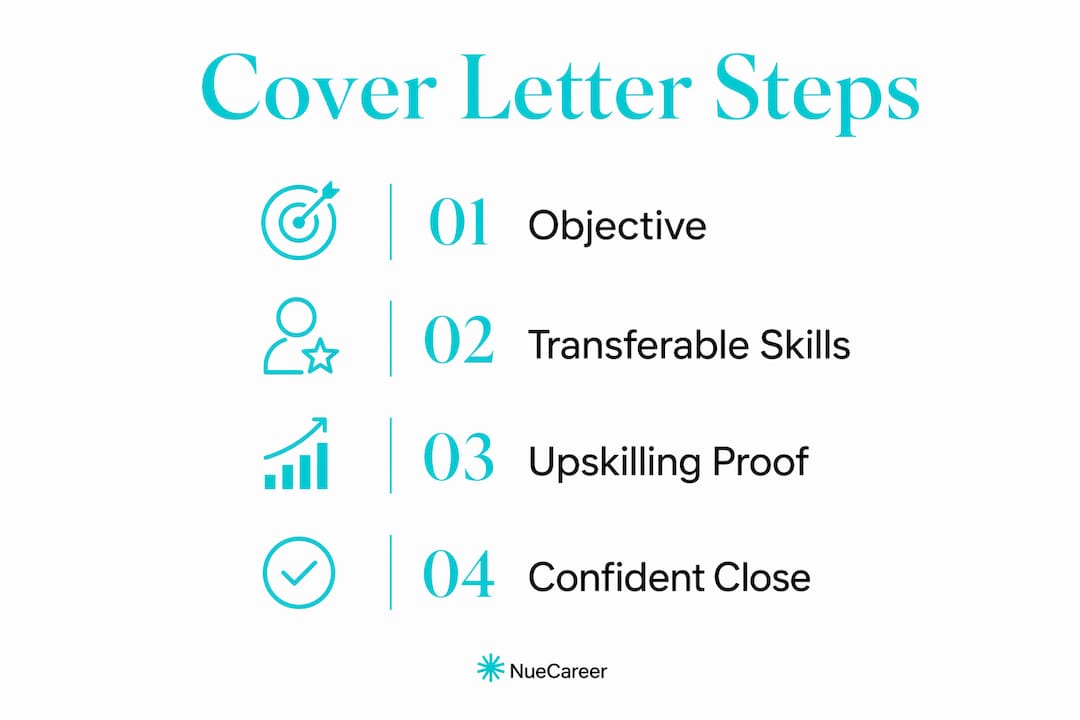
Paragraph 1: Your objective and the company bridge
Open with your one-line career-change objective, then add a company-specific sentence that shows you did your research. Employer-tailored sentences tied to a company's mission or recent project make applications feel genuine and reduce the perceived risk of hiring someone from outside the field.
Starter options: "After five years in [Prior Field], I'm making a deliberate move into [New Field] — and [Company]'s work on [specific initiative] is exactly the place where I want to contribute." "My background in [Prior Role] gave me a foundation in [core skill], and I'm now channeling that into [Target Role] at [Company] because of your focus on [specific value or product]."
Paragraph 2: Transferable skills with measurable evidence
Pick two concrete examples from your past work that map to the job description. Quantify at least one. A hiring manager reading a career-change letter is motivated to reduce hiring risk, so short, specific evidence does more than a paragraph of general claims.

Format: [Action] + [metric or outcome] + [relevance to new role]. "In my previous role, I managed a cross-functional team of eight that cut project delivery time by 20% — the same coordination and prioritization skills your job description lists as core requirements."
Paragraph 3: Upskilling proof
Show what you have done to prepare. Listing relevant courses, certifications, or projects demonstrates commitment and gives recruiters a concrete reason to trust your readiness. Frame this as readiness, not apology.
Starter: "To build on my existing skills, I've completed [Course/Certification] through [Provider] and applied that learning in [brief project or outcome]."
Paragraph 4: Confident close with a next step
End with a clear, active close. State your availability for a conversation and express genuine interest without over-explaining.
Starter: "I'd welcome the chance to discuss how my background in [Prior Field] can contribute to [Company]'s goals. I'm available [timeframe] and can be reached at [contact]."
Pro Tip: Read your letter aloud before sending. If any sentence sounds like an apology or a defense, rewrite it as a statement of readiness. Confident curiosity — not defensiveness — is the tone that gets callbacks.
How do you identify transferable skills that employers actually care about?
The most effective method is a three-step process: extract the skill, find the evidence, then translate it into the job's language. Transferable skills backed by short examples that demonstrate results are what career-change letters need most.
Step 1: Pull the job description and highlight three to five required competencies. Step 2: For each competency, find one past achievement that demonstrates it. Use this formula: Metric + Action + Outcome. Step 3: Rewrite the achievement using the job description's own language, without forcing keywords unnaturally.
Here is a compact mapping example:
| Your past task | Transferable skill | Job requirement matched |
|---|---|---|
| Trained new staff on compliance procedures | Instructional design / knowledge transfer | "Ability to onboard and develop team members" |
| Reduced customer complaint resolution time by 30% | Process improvement / stakeholder communication | "Strong problem-solving and client-facing skills" |
| Managed $150K annual event budget | Financial oversight / resource allocation | "Budget management experience preferred" |
Once you have this table filled in for your own background, converting a resume bullet into a cover-letter sentence is straightforward. Take the resume bullet "Managed annual event budget" and expand it: "Managing a $150K annual event budget taught me to prioritize resources under pressure — a skill your operations role requires daily."
Use Nuecareer's job application skills tool to generate a skills list matched to any job description, which makes this mapping step significantly faster.
Three annotated sample cover letters for different pivot scenarios
Early-career pivot: Marketing coordinator to UX researcher
[Objective — names role and top transferable value] I'm applying for the Junior UX Researcher position at Meridian Digital, bringing two years of consumer behavior analysis from my marketing role that aligns directly with your user-insight requirements.
[Transferable skill evidence] In my current role, I designed and analyzed surveys for a product launch campaign, synthesizing responses from over 400 participants into a report that shifted our messaging strategy. That research process — forming a hypothesis, collecting data, and presenting findings — mirrors the UX research cycle your team uses.
[Upskilling proof] To formalize this foundation, I've completed Google's UX Design Certificate and conducted two usability tests for a local nonprofit's website redesign.
[Confident close] I'd love to bring this combination of research experience and fresh UX training to Meridian Digital. I'm available for a conversation any time this week.
Dos and don'ts for early-career pivots:
- Do emphasize training, volunteer projects, and transferable coursework.
- Do show eagerness to learn without underselling what you already know.
- Don't open with "Although I don't have direct experience..." — start with what you do have.
Mid-career pivot: Operations manager to project manager (tech sector)
[Objective] With eight years leading cross-functional operations teams in manufacturing, I'm transitioning into technology project management — and [Company]'s agile-first culture is exactly the environment where my process discipline translates.
[Evidence] I led a facility-wide process redesign that reduced production downtime by 18% over six months, coordinating five departments and managing a $200K improvement budget. Scope management, stakeholder alignment, and risk mitigation were daily realities, not theoretical concepts.
[Upskilling] I've recently earned my PMP certification and completed a Scrum Master course to align my vocabulary and methods with software delivery environments.
[Close] I'd welcome a conversation about how operational rigor can strengthen your project delivery team. My contact details are below.
Dos and don'ts for mid-career pivots:
- Do lead with measurable results — they carry more weight than job titles.
- Do use the target industry's terminology (agile, sprints, stakeholders) naturally, backed by examples.
- Don't list every job you've held; focus on the two or three most relevant achievements.
Late-career or leadership pivot: VP of Sales to executive coach
[Objective] After 20 years building and leading sales organizations, I'm moving into executive coaching — and [Firm]'s focus on leadership development for mid-market companies aligns with the work I find most meaningful.
[Evidence] I've mentored over 30 sales directors across three companies, several of whom moved into VP roles within 18 months. That mentorship work — identifying blind spots, building confidence, and holding people accountable to growth — is the core of what executive coaching delivers.
[Upskilling] I've completed an ICF-accredited coaching program and am currently logging supervised coaching hours toward my ACC credential.
[Close] I'd value the opportunity to discuss how my leadership experience and coaching training can serve your clients. I'm happy to share references from former mentees.
Dos and don'ts for leadership pivots:
- Do emphasize strategy, mentorship outcomes, and how your experience accelerates others' results.
- Do reference credentials that signal you've taken the new field seriously.
- Don't frame the pivot as "stepping back" — frame it as applying your expertise in a new direction.
How should your cover letter change at different career stages?
Small adjustments in emphasis make a letter feel credible at each stage. The core structure stays the same; what shifts is which evidence you lead with.
| Career stage | Lead with | Tone emphasis |
|---|---|---|
| Early-career | Training, internships, volunteer projects, eagerness to learn | Curious and growth-oriented |
| Mid-career | Measurable results, cross-functional leadership, process impact | Confident and evidence-driven |
| Late-career / leadership | Strategy, mentorship outcomes, how experience accelerates team results | Authoritative and forward-looking |
| Blue-collar / frontline | Reliable outcomes, safety record, adherence to SOPs, team dependability | Practical and results-focused |
| White-collar / knowledge roles | Process metrics, stakeholder results, analytical or communication skills | Professional and data-grounded |
One nuance worth noting: blue-collar and frontline roles often value demonstrated reliability and safety awareness over abstract leadership language. If you're pivoting into a trade, logistics, or healthcare support role, lead with outcomes you can point to — attendance records, safety certifications, or production metrics — rather than soft-skill claims.
For a full picture of how to plan your pivot at any stage, the career change guide on Nuecareer walks through realistic timelines and re-skilling sequences.
How do you explain a career break in a cover letter without over-sharing?
One sentence is almost always enough. Be honest and brief when addressing gaps; a single clear line normalizes the break and keeps the focus on your readiness. Save the fuller story for an interview, where you can answer follow-up questions naturally.
One-sentence templates by gap type:
- Caregiving: "I took time away from full-time work to care for a family member and used that period to complete [relevant course or certification]."
- Health: "After addressing a health matter, I'm fully ready to return and have spent the past [X months] updating my skills in [area]."
- Reskilling: "I stepped back from [Prior Field] to complete a structured reskilling program in [New Field] and am now ready to apply that training."
- Short-term travel or personal development: "I took a planned career break for personal development and returned with [specific skill or perspective] that directly applies to this role."
When deciding whether to include a gap explanation at all, ask yourself: will a recruiter notice a gap of more than six months on my resume? If yes, one line in the cover letter prevents it from becoming a distraction. If the gap is shorter or recent employment fills the timeline clearly, you can leave it for the interview. The goal is to redirect attention to current readiness, not to justify the past.
For readers pivoting to remote roles after a break, the transition to remote work guide at Nomad Excel offers practical steps for building a portfolio and positioning yourself for location-flexible positions.
What mistakes do career changers most often make in cover letters?
The most damaging errors are not typos or formatting issues. They are tone and framing problems that signal uncertainty to a recruiter before they've finished the first paragraph.
Apologetic language. Phrases like "Although I don't have direct experience" or "I know I'm not the typical candidate" put the recruiter in the position of talking themselves into hiring you. A strong pivot letter reframes past roles as sources of transferable outcomes rather than deficits. Start from what you bring, not from what you lack.
Repeating the resume. A cover letter that lists job titles and dates in paragraph form adds nothing. Use the letter to add context, explain the "why," and show one or two achievements that the resume can't fully convey on its own. The resume is the record; the letter is the argument.
Vague claims without proof. "I'm a quick learner" and "I adapt easily to new environments" are the two most overused phrases in career-change letters, and they carry almost no weight without evidence. Replace them with a concrete example: "I completed [Certification] in three months while working full-time, which reflects how I approach new disciplines."
Tone that swings too casual or too defensive. A letter that reads like a text message loses credibility. One that reads like a legal brief feels cold. The target register is confident curiosity: direct, warm, and grounded in evidence. If you're unsure, read the letter to a friend and ask whether it sounds like someone they'd want to work with.
What should you check before sending a career-change cover letter?
Run through this list before every submission. It takes three minutes and catches the errors that cost interviews.
- Target role named: Does the first sentence name the exact role and company?
- Transferable evidence: Have you included one to two specific, preferably quantified, examples?
- Upskilling proof: Is there at least one course, certification, or project that shows recent commitment?
- Company-specific line: Does the letter include one sentence tied to the company's mission, product, or values?
- Active close: Does the closing paragraph state your availability and invite a conversation?
- Contact information: Is your email and phone number visible and correct?
- Length and formatting: Is the letter between 250 and 400 words, in a readable font, with standard margins?
- File name: Save as "FirstName-LastName-CoverLetter-RoleName.pdf" for clean submission.
3-sentence speed template for quick applications:
This template works for roles where you need to apply quickly and can refine the full letter for priority positions. Tailoring with job-description keywords in context — not stuffed — increases perceived fit without making the letter feel formulaic.
For parallel guidance on reshaping your resume to match your cover letter's narrative, the career change resume tips on Nuecareer cover how to reframe bullets and lead with transferable achievements.
Key Takeaways
A career-change cover letter works when it opens with a clear one-line objective, backs transferable skills with concrete evidence, and shows recent learning that proves you're ready now.
| Point | Details |
|---|---|
| Lead with your objective | Name the target role and your top transferable value in the very first sentence. |
| Back skills with evidence | Include one to two specific, preferably quantified, examples from your past work. |
| Show recent learning | Name at least one course, certification, or project to prove commitment to the new field. |
| Address gaps briefly | One sentence normalizes a career break; save the full story for the interview. |
| Nuecareer tools speed up tailoring | The free skills assessment and job description analyzer help you map your strengths to any role faster. |
What career changers get wrong about cover letters
Most career changers spend too much energy explaining why they left their old field and not enough energy proving they can succeed in the new one. That imbalance is the single most common reason a pivot letter fails to land an interview.
Here is what I've seen work consistently: treat the cover letter as a brief for the hiring manager, not a confession. Your job is to make their decision easier, not to process your career history in public. The Forbes guidance on this is direct — reframe past experience as assets, not deficits. That reframe is not spin; it's accuracy. Every skill you built in your previous career has a counterpart in the new one. Your job is to name it clearly and back it with a number.
One thing most guides skip: the company-specific sentence is not optional. A generic pivot letter that could have been sent to 40 employers signals low motivation. One sentence tied to a company's actual work — a product, a mission statement, a recent initiative — tells the recruiter this candidate did the work. That sentence often matters more than the credentials paragraph.
If you're unsure which of your skills to lead with, the Nuecareer strengths quiz takes about seven minutes and surfaces the competencies most relevant to your target roles. Start there, then write the letter.
Nuecareer makes the cover letter process faster
Writing a tailored career-change cover letter from scratch is time-consuming, especially when you're not sure which skills to highlight or how to match a job description's language. Nuecareer's free tools cut that process down significantly.
The free career skills assessment identifies your strongest transferable competencies in minutes, giving you the raw material for your cover letter's evidence paragraph. The job description analyzer extracts the exact keywords and requirements from any posting so you know precisely what to match. And the free resume objective writer generates concise opening sentences you can adapt directly into your cover letter's first line. Together, these tools handle the research and framing work so you can focus on writing. Take the 7-minute strengths quiz to get started.
Useful sources and further reading
- Coursera: How to Write a Cover Letter When You're Changing Careers — Covers the case for leading with a clear objective, listing upskilling credentials, and demonstrating readiness to reduce hiring risk. Referenced throughout the step-by-step and examples sections.
- Forbes: Writing Cover Letters for a Career Change — Strong guidance on reframing past experience as assets and opening with a role-specific objective. Used in the tone and common-mistakes sections.
- Indeed: How to Write a Career Change Cover Letter — Practical examples of combining a tailored company sentence with transferable achievement evidence. Referenced in the transferable skills and checklist sections.
- Prospects.ac.uk: Cover Letter for Changing Career — Annotated example letter showing how to link past experience to a new field, with guidance on structure and length.
- CalAgJobs: 8 Tips on Addressing Employment Gaps in a Cover Letter — Specific advice on keeping gap explanations brief and redirecting to current readiness. Cited in the career break section.
- Learning People: Cover Letter Examples for Career Change — Explains why employer-tailored sentences reduce perceived hiring risk. Used in the paragraph-structure and annotation sections.
- Nuecareer: Free Career Skills Assessment — Identifies transferable strengths to anchor your cover letter's evidence paragraph.
- Nuecareer: Free Job Description Analyzer — Extracts role keywords and requirements to guide tailoring.
- Nuecareer: Career Change Resume Tips — Companion resource for aligning your resume narrative with your cover letter.
FAQ
How do you explain a career change in a cover letter?
Open with a one-sentence objective that names the target role and your top transferable skill, then back it with one concrete example and one proof of recent learning. Keep the explanation brief and forward-focused rather than dwelling on why you left your previous field.
How do you address a career break in a cover letter?
One sentence is usually enough: state the reason briefly and pivot immediately to what you did during that time and why you're ready now. Honest, concise phrasing normalizes the gap without making it the focus of the letter.
What are the three most important rules for a career-change cover letter?
Lead with a clear role-specific objective, back every transferable skill claim with a concrete example or metric, and include at least one proof of recent learning or upskilling. These three elements address the recruiter's core concern: can this person actually do the job?
What is another way to describe a career change in a cover letter?
Instead of "career change," use phrases like "deliberate transition," "professional pivot," or "applying my background in [Field A] to [Field B]." These framings sound intentional rather than reactive, which signals confidence to a hiring manager.
How can Nuecareer help me write a career-change cover letter?
Nuecareer's free skills assessment and job description analyzer identify your strongest transferable competencies and match them to a specific role's requirements, giving you the evidence and language you need to write a tailored letter faster.