
5 Fixes for No Interview Callbacks: Tailor Resume in 10–15 Minutes

Discover why you get no interview callbacks with a 5 point self audit. Tailor your resume's top third in 10–15 minutes and target referral channels to get...
Most no-interview-callback problems trace back to five fixable causes: an ATS-unfriendly resume, an untailored application, the wrong submission channel, LinkedIn signals that don't match your resume, or missing follow-up. The single highest-leverage fix is tailoring your resume's top third to mirror the job posting's exact language, then submitting through a referral or recruiter message instead of the company portal alone.
TL;DR:
- Tailoring your resume's top third with exact keywords from the job posting significantly increases your chances of passing ATS filters and catching recruiter attention.
- Applying through referrals, recruiter outreach, or direct messaging yields much higher callbacks than submitting solely via company portals, which are overwhelmed with applicants.
- Ensuring consistency between your LinkedIn profile and resume, especially with titles, dates, and photos, prevents silent disqualification by recruiters reviewing your public footprint.
- Running a simple self-audit—including checking ATS readability, keyword matches, and applying early in the posting cycle—can identify the main obstacles delaying responses.
- Using targeted tools for resume optimization, follow-up email templates, and career assessments can streamline the process of fixing application issues and improve callback rates.
Table of Contents
- Why Am I Not Getting Interview Callbacks?
- Fix Your Resume and Beat ATS Screening
- Apply Through Better Channels: Networking, Referrals, and Recruiter Outreach
- Audit Your LinkedIn and Public Footprint
- Follow-Up and Timing: When to Reach Out and When to Stop
- If You Got Ghosted After Interviews: What to Say Next
- A Compact Self-Audit You Can Run on Every Application
- How NueCareer Helps When You're Not Getting Callbacks
- A Note on Staying Steady When the Silence Feels Personal
- Try the Tools That Turn Fixes Into Interviews
- Sources
- FAQ
Why Am I Not Getting Interview Callbacks?
The math is brutal before you even factor in your resume's quality. A single posting on a major job board can pull in hundreds of applicants within 48 hours, and most of those never reach a human recruiter at all. Understanding which of the following causes applies to you changes everything about what you fix next.
Applicant tracking systems filter you out before a person sees your resume. Resume-ATS mismatch is one of the leading reasons candidates get no response, because the software scans for exact keyword matches, standard section headings, and clean formatting. A resume with the right experience but the wrong phrasing gets buried in a queue nobody opens.
Your resume and cover letter are generic. Recruiters can spot a mass-produced application in seconds. If your summary reads like it could apply to any job in your field, it probably will not get chosen for this one. Rejected applications frequently fail simply because they never speak the employer's specific language back to them.
You are applying through the wrong channel. Company portals are the most crowded, lowest-yield entry point into a hiring process. Referrals and direct recruiter outreach convert at meaningfully higher rates because they skip the resume pile entirely and land in front of a person who already has context.
Your LinkedIn or public profile contradicts your resume. Recruiters check social profiles as a matter of routine now, and mismatched dates, titles, or missing profile photos are quiet application killers that never show up as a rejection. You just never hear back.
You applied late. Roles posted more than two weeks ago may already have candidates in the pipeline. Speed matters more than most job seekers assume, especially for high-volume roles at large employers.
The job itself may not be real, or it's already filled. Ghost jobs, postings kept live for talent pipelining, and internal candidates who get the offer before external applicants are even reviewed are common. Employer-side communication failures compound the problem, since many companies never send a formal rejection at all, leaving you guessing whether you were rejected or simply never seen.
Technical friction is killing applications you don't even know about. A typo in your email address, a voicemail box that's full, or a broken file upload during submission can quietly erase you from consideration. Peer discussions on job forums repeatedly surface this as an overlooked, fixable problem.
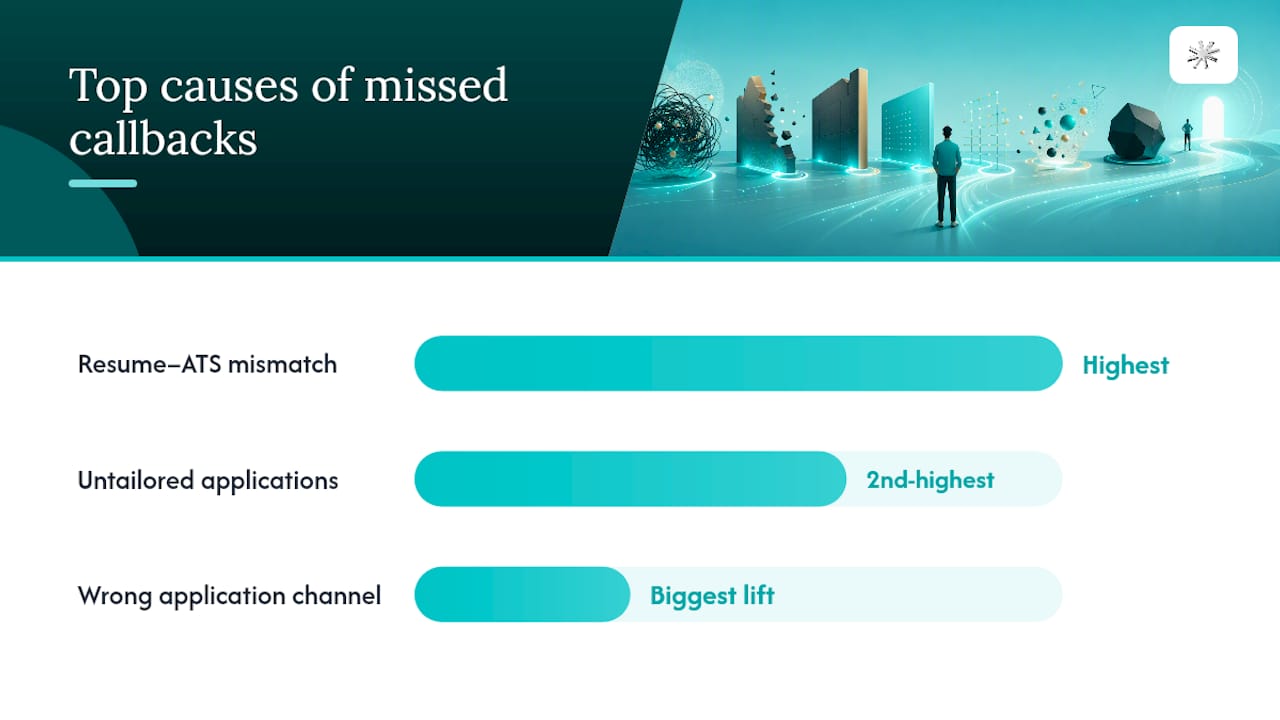
Here's the ranked priority list for where to focus your energy first:
- Resume and ATS mismatch — highest volume of rejections, fastest to fix
- Untailored applications — second-highest impact, requires 10 to 15 minutes per role
- Wrong application channel — bigger structural fix, but the biggest callback lift
- LinkedIn and profile inconsistencies — quick audit, prevents silent disqualification
- Timing and technical friction — low effort, easy to overlook
Fix Your Resume and Beat ATS Screening
Your resume needs to satisfy two readers in sequence: the ATS software, then the recruiter who spends about seven seconds on the initial scan. Neither reader forgives vague language or buried keywords.
Mirror the job description's exact phrasing, without inventing experience you don't have. If the posting says "cross-functional stakeholder management" and you managed a team across departments, use that phrase instead of your own paraphrase. The ATS matches strings, not concepts, and a slight wording gap can drop you out of consideration even when your actual experience fits.
Place your strongest keywords in three specific zones: your professional summary at the top, your first two bullet points under your most recent role, and a dedicated skills section. Recruiters and software both weight the top third of the page heaviest, so bury nothing important below the fold.
Format for parsing, not for design. Submit as a .docx or a simple PDF, avoid tables, text boxes, and headers or footers, and stick to standard section titles like "Experience" and "Education" rather than creative alternatives. Fancy fonts and columns look sharp to a human eye and often scramble into unreadable text for an ATS parser.
Here is a quick sequence for reworking your top third before you submit anything else:
- Rewrite your summary to include your target job title and two or three exact keywords from the posting.
- Reorder your top bullets under your most recent role so the most relevant achievement leads, not the most recent chronologically.
- Quantify one result per bullet where you can, using real numbers from your work history.
- Cross-check your skills section against the posting's required and preferred qualifications, adding any genuine match you left out.
- Save and rename the file clearly with your name and the target role, since some systems flag generic filenames.
Once your resume is edited, run this checklist before you hit submit:
- Does your file open cleanly with no broken formatting when converted to plain text?
- Do your section headings match standard resume language?
- Does your top third contain at least three keywords pulled directly from the posting?
- Is your contact information current, correct, and free of typos?
- Would a recruiter understand your value in the first seven seconds of scanning?
Pro Tip: Copy your resume text into a plain text editor and read only what's left. If the formatting stripped out your bullet structure or merged your sections into a jumbled paragraph, an ATS is seeing the same mess.
Tools like NueCareer's free resume summary examples and a library of resume action verbs can speed up this rewrite without starting from a blank page. Background on how these systems actually work is covered in NueCareer's guide to what an ATS is.
Apply Through Better Channels: Networking, Referrals, and Recruiter Outreach
Portal applications put you in a queue with hundreds of strangers. Referrals and direct outreach put you in front of one person who already has a reason to read your message. Recruiter-sourced advice consistently shows referrals and recruiter inbound outperform cold portal submissions, often by a wide enough margin to justify slowing down and applying to fewer roles more strategically.
Start by identifying who at your target company can actually see your application land. A former colleague, a alumni connection, or even a second-degree LinkedIn contact at the company can often forward your resume directly to the hiring manager, bypassing the ATS queue entirely.
When you message a recruiter or hiring manager directly, keep it short and specific:
- Reference the exact role and why your background fits it in one sentence.
- Ask a direct question, such as whether they're still actively reviewing candidates.
- Attach your resume or link to it rather than asking them to search for it.
- Keep the entire message under 100 words.
Asking for a referral works best when you're specific about what you need. Instead of "let me know if you hear of anything," try: "I saw the Senior Analyst role at your company. Would you be comfortable forwarding my resume to the hiring manager, or is there someone else I should reach out to?" That gives the person a clear, low-effort action.
Timing matters here too. Reach out within the first 48 hours of a posting going live, since that's when hiring managers are most engaged with new applications and most likely to fast-track a warm referral.
Track every application by channel, not just by company, so you can see over time which route is actually converting. A simple application tracker makes this pattern visible fast: if your portal applications sit at zero responses while even one referral led to a screening call, that's your answer about where to spend your time. Reviewing career change networking strategies can also help if you're pivoting into a field where your existing network is thin.
Audit Your LinkedIn and Public Footprint
Recruiters check your public profile before, during, or immediately after reviewing your resume. If what they find contradicts your application, they move on without telling you why.
- Confirm your job titles, employment dates, and company names match exactly between your resume and LinkedIn.
- Use a clear, professional headshot; profiles without one get skipped more often in recruiter searches.
- Write a headline that states your target role or specialty, not just your current title.
- Rewrite your About summary to match the direction you're job searching in now, not your career five years ago.
- Remove or explain any obvious gaps, especially if your resume already addresses them and your profile doesn't.
- Aim for regular activity, at least occasional posts, comments, or shares, since an inactive profile can read as a dormant job search.
Recruiter surveys and hiring-lab research point to social profile mismatches and small unforced resume errors as some of the quietest killers of applications, precisely because they never generate a formal rejection. You simply stop hearing back and have no idea why.
Pro Tip: Search your own name the way a recruiter would, in an incognito browser window. What comes up first is what they see first, and it should support your job search, not undercut it.
Follow-Up and Timing: When to Reach Out and When to Stop
Silence after applying doesn't always mean rejection. It often means the recruiter is buried, the process is slower than expected, or the role's timeline has quietly shifted. A measured follow-up cadence signals professionalism without becoming a nuisance.
- Wait 7 to 10 business days after applying before your first follow-up, unless the posting specifies a different timeline, in which case add a few extra days as buffer.
- Send one short, polite email referencing the role and confirming your continued interest, with no more than two or three sentences.
- After an interview, wait 48 to 72 hours before a thank-you follow-up, then wait the length of whatever timeline the interviewer gave you before checking in again.
- If a stated timeline passes with no update, send a second brief note rather than repeated messages in quick succession.
- Move on to full-priority job searching after two unanswered follow-ups, while leaving the door open if they resurface later.
Career-advice resources recommend waiting at least a week past any stated timeline before that first follow-up message, which keeps you from appearing anxious while still showing initiative.
Keep your follow-ups working for you, not against you:
- Never send more than two follow-up emails to the same contact for the same role.
- Avoid language that sounds like you're checking up on them; frame it as reaffirming interest instead.
- Keep your other applications active the entire time you're waiting to hear back.
A ready-made follow-up email generator removes the guesswork of finding the right tone here.
If You Got Ghosted After Interviews: What to Say Next
Getting ghosted after a strong interview is one of the most frustrating parts of a job search, but a calm, well-timed message can still get you an answer.
- One week after the interview, send a short note reaffirming interest and asking if there's an update on timeline.
- Two weeks after, if you've heard nothing, send one more message asking directly whether the role has been filled or is still open.
- If a recruiter goes fully silent for an extended stretch, a polite escalation to a hiring manager or department contact can work, but only when the tone assumes good intent rather than frustration.
Avoid lines like "I haven't heard anything, which is disappointing" or anything that implies blame. A message like "I wanted to check in, since I know timelines can shift on your end" keeps the relationship intact even if the answer is no.
Pro Tip: If two thoughtful follow-ups get no response at all, that silence is itself information. Redirect your energy toward active opportunities rather than a third message that rarely changes the outcome.
A Compact Self-Audit You Can Run on Every Application
Run this five-point check on any role where you haven't heard back within your expected timeline, so you know exactly where the breakdown happened instead of guessing.
- Keyword check: Compare your resume against the posting. Are at least three required qualifications mentioned in your exact language?
- ATS test: Paste your resume into a plain text document. Does the structure hold, or does it collapse into a jumbled block?
- Channel check: Did you apply cold through a portal, or through a referral, recruiter message, or warm contact?
- LinkedIn match: Do your titles, dates, and companies line up exactly between your resume and your profile?
- Contact and timing check: Is your contact information correct, and did you apply within the first few days of the posting going live?
Tracking whether your resume even registers views is one of the fastest ways to tell if the problem is your keywords or your channel. If a posting shows zero views after two weeks, invest your outreach energy elsewhere rather than repeatedly refreshing the portal.
| Self-audit result | What it tells you | Next action |
|---|---|---|
| Resume fails plain-text test | ATS formatting problem | Simplify layout, remove tables and columns |
| Fewer than 3 keyword matches | Untailored application | Rewrite top third to mirror posting language |
| Applied cold through portal only | Low-yield channel | Seek a referral or message the recruiter directly |
| LinkedIn dates or titles mismatch resume | Silent disqualifier | Update profile to match resume exactly |
| No response after 10+ business days | Normal delay or ghost job | Send one polite follow-up, keep applying elsewhere |
Log each outcome in a simple tracker so patterns emerge across applications rather than staying invisible one role at a time. If your results skew toward one category, that's where your next hour of effort belongs. A broader look at prioritizing quality over volume is covered in NueCareer's guide to mid-career job searching.
How NueCareer Helps When You're Not Getting Callbacks
Every fix above takes time to execute manually, which is exactly the gap NueCareer's tools were built to close. The 7-Minute Career Quiz starts by identifying your strengths and matching you to roles that genuinely fit, which solves the untailored-application problem at its root: you stop applying broadly and start applying to work you're actually positioned to win.
From there, resume and cover letter tools help rewrite your top third to mirror job-posting language without fabricating experience, addressing the ATS mismatch that filters out qualified candidates before a human ever opens the file.
- Resume and cover letter tools built around ATS-friendly formatting
- A follow-up email generator for the exact cadence outlined above
- Mock interview practice to build readiness while you wait on responses
- Coaching chat for real-time questions on channel strategy and outreach
Small, targeted edits to your resume's top third combined with a referral-first application strategy tend to outperform mass-applying by a wide margin, which is the exact workflow these tools are designed to support rather than replace your own judgment.
A Note on Staying Steady When the Silence Feels Personal
Weeks of no callbacks can start to feel like a verdict on your worth, and that reaction is human, not a flaw in your approach. The truth is more mechanical than emotional: most of what's stopping you is a keyword mismatch, a crowded channel, or a system that filtered you out before a person ever read your name.
Keep your pipeline active even while you're fixing what's broken. Momentum compounds, and candidates who treat each rejection as diagnostic data, rather than a referendum on their ability, tend to course-correct faster and land stronger fits. Coaching and structured feedback loops exist precisely because an outside perspective catches patterns you can't see from inside your own frustration.
— Shane
Try the Tools That Turn Fixes Into Interviews
Reading about ATS keywords and referral strategy only helps once you actually apply it to your own resume and your own target roles, which is where most job seekers stall out.
NueCareer's 7-Minute Career Quiz gives you a faster starting point than guessing which roles fit your background: it matches you to career paths built around your actual strengths, including ones you may not have considered. Pair that with the platform's free career skills assessment to spot the qualification gaps quietly costing you callbacks, and the job application skills tool to generate ATS-ready language pulled straight from your target postings.
From there, personalized roadmaps and 24/7 coaching chat walk you through exactly which channel, resume edit, or follow-up template applies to your specific situation, instead of leaving you to piece it together alone. Take the quiz, run the skills assessment, and see what NueCareer's free tools recommend for your next move.
Sources
- No Response After Job Applications? 7 Reasons + What To Do (2026 Checklist) | ResuTrack
- Why You're Not Getting Interview Callbacks | TopCandidate | Top Candidate
- You crushed the interview, then heard nothing. Here’s what to do next. – DNYUZ
- Indeed
FAQ
Why am I not getting interview callbacks?
The most common causes are ATS keyword mismatches, generic and untailored resumes, applying only through crowded portal channels, LinkedIn profile inconsistencies, and skipping follow-up entirely. Running a quick self-audit against each of these usually reveals which one applies to your situation.
What happens if you don't get a callback after an interview?
Silence usually means the process is delayed, the timeline has shifted, or the role was filled internally, not necessarily that you were rejected outright. A short, polite follow-up one week after the interview, and a second one two weeks after, is the standard next step before moving on.
What is the 80/20 rule in job interviewing?
There's no single agreed-upon rule specific to interviewing; the advice is to focus most of your prep on the roles and channels most likely to convert, such as referrals over cold portal applications, rather than spreading effort evenly across every posting.
Is it appropriate to apologize for being nervous during an interview?
A brief, natural acknowledgment of nerves rarely hurts you, since interviewers generally understand that stress affects delivery. Repeated apologies or dwelling on it can distract from your answers, so a quick reset and moving forward usually serves you better than addressing it directly.