
30 Second Interview Scripts to Explain an Employment Gap

Use 30 second interview scripts tested by recruiters plus one line resume and cover letter sentences to turn any employment gap into a clear, verifiable...
Name the gap in one sentence, give a neutral reason, note that it's resolved, and pivot straight to what you bring to this role. That four-part formula, the same logic behind Cornell's career-center guidance, works whether you're drafting a resume line or answering it out loud. Tools like an AI-powered Answer Generator can help you turn that sentence into words that actually sound like you.
TL;DR:
- Gaps under three months are generally unnoticed by recruiters and do not require explanation, while those longer than nine months benefit from a clear, honest reason upfront.
- Listing a career break with verified activities like courses, volunteer roles, or freelance work strengthens credibility and reduces suspicion about employment gaps.
- In cover letters and interviews, concise statements explaining the reason, what was accomplished during the break, and readiness for the role prove most effective.
- Avoid over-explaining, vague language, or inconsistent stories across resume, cover letter, and interview to prevent raising unnecessary questions.
- Practice your explanation to sound natural, truthful, and confident, focusing on verifiable proof and a forward-looking attitude.
Table of Contents
- Does Your Employment Gap Actually Need an Explanation?
- Resume Tactics That Show a Gap Without Highlighting It
- What to Say in a Cover Letter About the Gap
- The 30-Second Interview Answer That Actually Works
- Copy-Ready Lines You Can Adapt Today
- Practical Help From NueCareer to Draft and Test Your Explanation
- Handling Sensitive Gaps Without Overexposing Yourself
- Turning Downtime Into Proof You Can Point To
- Matching Your Explanation to the Industry and the Interviewer
- Common Mistakes That Undermine an Otherwise Good Explanation
- Keep It Honest and Short, Then Practice Until It Sounds Natural
- Draft Your Gap Answer in Minutes, Not Days
- Sources
- FAQ
Does Your Employment Gap Actually Need an Explanation?
Not every gap needs a spotlight. The length of the break, and how recent it is, should decide how much airtime you give it.
- Under about 3 months: usually invisible to recruiters and applicant tracking systems, and generally does not require explanation.
- 3 to 9 months: often worth a short, calm line on your resume or in your cover letter to acknowledge the gap.
- 9 months or more, or a gap you're still in: it is advisable to address it directly and in your own words early in your application.
Applicant tracking systems don't flag gaps the way people assume. They parse dates, but a human still decides whether the gap matters. That decision usually comes down to recency and consistency: a two-year-old gap on an otherwise steady resume barely registers, while a current, unexplained gap combined with inconsistent dates invites more questions. Career-center guidance from Cornell is consistent on this point: the gap itself is rarely disqualifying. What raises concern is silence, vagueness, or a story that doesn't add up under light scrutiny.
Pro Tip: If you're unsure whether a gap needs explaining, ask yourself: would a recruiter have to guess? If yes, you explain it. If no, you move on.
Resume Tactics That Show a Gap Without Highlighting It
You have two solid options, and the right one depends on how long the gap ran and whether you're staying in your field or pivoting.
- List it as a timeline entry. Treat the break like a job title: "Career Break — Family Caregiving, March 2024–January 2025." This keeps your chronology intact and signals you're not hiding anything.
- Switch to a hybrid, skills-first format. Put a summary of core skills and accomplishments up top, then a lighter chronological section below. This works well when the gap overlaps a career pivot, a point hiring specialists writing about career breaks also recommend for exactly this situation.
Whichever format you pick, only list activities you can verify if someone asks — this approach is similar to those featured in career transition stories that highlight authentic pivots and verifiable steps. Northeastern University's career guidance is specific on this: completed courses, named volunteer roles, and freelance projects with a client or reference to belong on the page. Vague phrases like "independent study" or "personal projects" don't hold up under a follow-up question.
A few formatting notes that matter more than people expect:
- Use month and year ("March 2024–January 2025"), not just years, since year-only dates can look like you're hiding a longer gap.
- List a career-break entry the same way you'd list a job: title, dates, one line of substance.
- Never invent a consulting LLC or freelance title to paper over unemployment. Recruiters check LinkedIn and references, and a fabricated business is far easier to unravel than an honest gap.
What to Say in a Cover Letter About the Gap
One sentence is enough. Any more and you're writing an apology instead of a pitch.
The sentence should acknowledge the gap, add a fact that shows you used the time well or that the issue is resolved, and then hand the conversation back to the employer's needs. Here's the shape that works across most situations:
- Layoff: "After my role was eliminated in a company-wide restructuring, I spent the past several months sharpening my [skill] through [specific activity], and I'm ready to bring that directly to your team."
- Caregiving: "I stepped away from full-time work for a period of caregiving, and I'm now returning with the same project-management skills that made me effective in my last role."
- Health: "I took time away to address a health matter that's now fully resolved, and I'm eager to bring my full focus back to [field]."
- Sabbatical or upskilling: "I used the past year to complete [certification/program], and I'm looking for a role where I can apply it right away."
Keep the focus on the employer's problem, not your personal timeline.
The 30-Second Interview Answer That Actually Works
Recruiters aren't looking for a confession. They're checking whether you can talk about a hard topic calmly, which recruiter-sourced interview guidance frames as a simple four-move sequence you can memorize:
- State the timeframe. "I was out of full-time work from spring 2024 through early 2025."
- Give one neutral reason. "My previous position was eliminated in a round of layoffs" or "I took that time for a family health situation."
- Say what you did with it. "During that time, I completed a certification in [skill] and did freelance work for two clients."
- Pivot to the role. "That experience sharpened exactly the skills this position needs, and I'm ready to apply them."
Adapt move two to your situation, but keep it one sentence. Layoffs, caregiving, health issues, intentional pauses, and career pivots all fit the same structure. If the interviewer probes further, answer the specific question asked and return to your pivot line rather than re-explaining the whole gap from scratch.
Pro Tip: Say your script out loud, at least five times, before the interview. A line that reads fine on paper can sound stiff or defensive the first time you say it out loud, and that first awkward run should happen in your kitchen, not in the interview.
Copy-Ready Lines You Can Adapt Today
Seeing a vague line next to its fixed version usually makes the fix obvious.
- Before: "Took some time off." After: "Stepped away for eight months following a layoff; completed a Google Analytics certification during that time."
- Before: "Was dealing with personal matters." After: "Took a family caregiving leave from June to December 2024, then returned to freelance bookkeeping work."
- Before: "Gap in employment." After: "Career Break — Health Recovery, January–July 2025."
A resume line, a cover-letter sentence, and an interview answer should all tell the same story in different lengths. If they contradict each other, that's the detail a background check or a second interview round will surface.
Adjust the reason and the proof point, but keep the pattern: timeframe, reason, what you did, forward motion.
Practical Help From NueCareer to Draft and Test Your Explanation
Writing a truthful, confident line about a gap is easier with a starting point instead of a blank page. The 7-Minute Career Quiz maps your strengths to career paths, including ones you might not have considered, which gives you language for the "pivot to the role" part of your script.
- The Answer Generator turns your situation into a one-line reason you can drop into a resume, cover letter, or interview answer.
- NueCareer's resume and cover-letter tools help you format a career-break entry correctly the first time.
- A skill-gap analysis flags concrete proof points, certifications or projects, worth mentioning when someone asks what you did with the time.
Handling Sensitive Gaps Without Overexposing Yourself
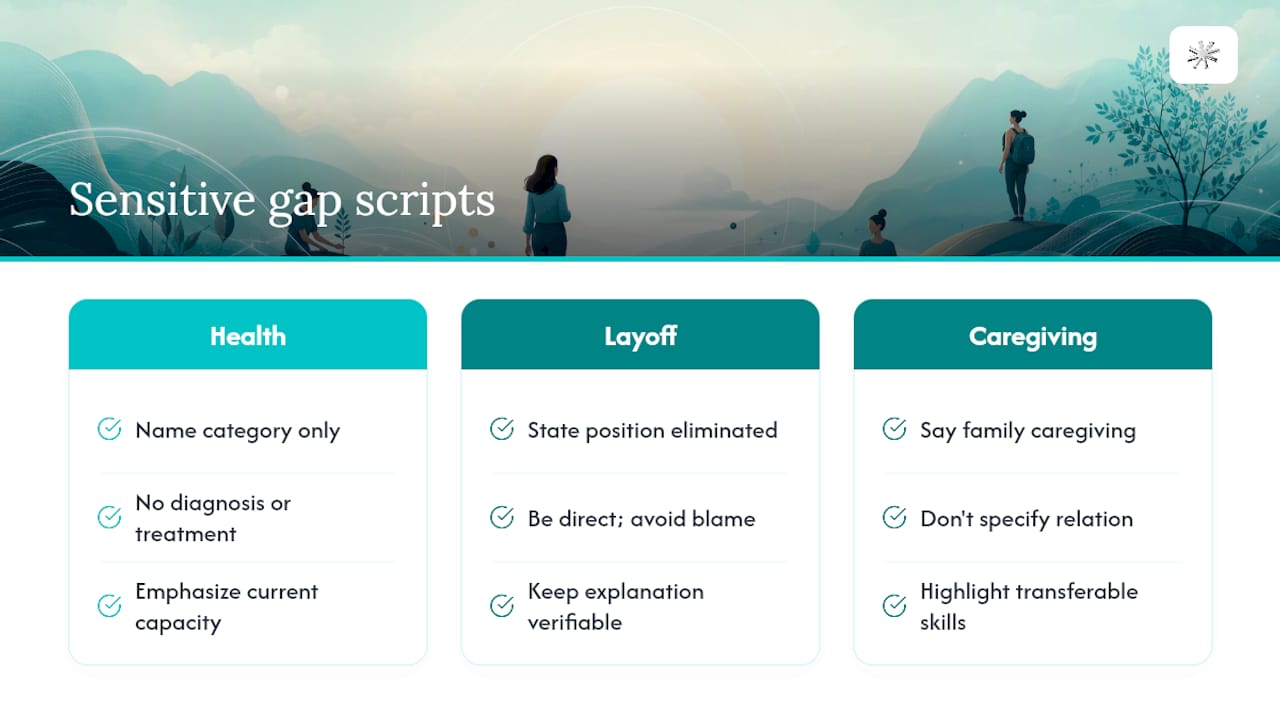
Health issues, layoffs, and caregiving are common reasons for a gap, and you're not required to disclose more than you're comfortable sharing. The goal is a reason specific enough to sound real, without handing over private medical or family details you'd rather keep private.
For a health-related gap, name the category without the diagnosis: "I took time away to address a health matter that's now resolved." That's a complete, honest sentence. Nobody needs the name of the condition, the treatment, or the specialist. If a health issue is ongoing but manageable, you can say so in general terms and focus the conversation on your capacity to do the job now.
Layoffs deserve directness rather than euphemism. "My position was eliminated in a company-wide restructuring" is neutral, common, and easy to verify if anyone checks. Avoid getting pulled into blaming a former employer or narrating internal company drama, even if it's accurate. That story tends to raise more questions than it answers.
Caregiving gaps benefit from the same restraint. "I stepped away for a period of family caregiving" covers a parent, a child, a spouse, or another relative without requiring you to specify which. Guidance for mature workers from the National Council on Aging frames caregiving explicitly as a period that builds transferable skills like time management and coordination, not a deficit to apologize for.
In every sensitive case, the discretion isn't about hiding the gap. It's about giving a reason that satisfies the question without opening a longer, more personal conversation you didn't sign up for.
Turning Downtime Into Proof You Can Point To
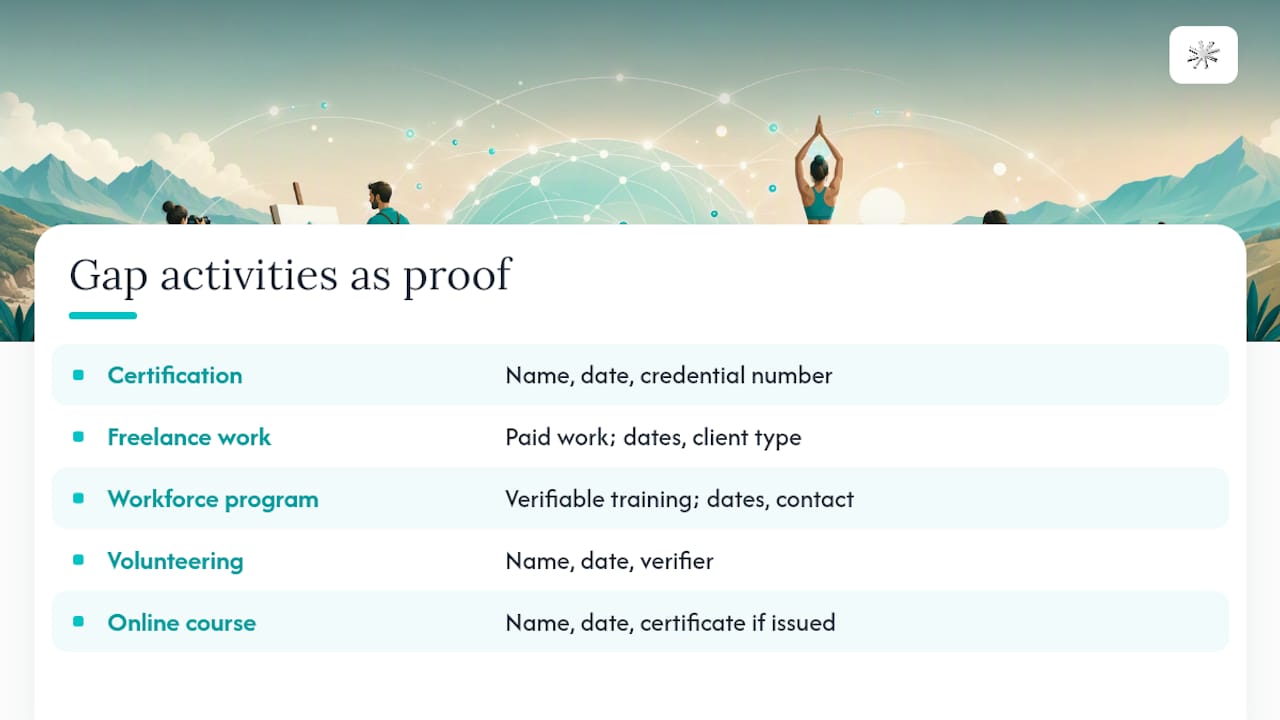
Volunteering and online courses get mentioned constantly in gap advice, but they're not your only options, and sometimes they're not even your strongest ones. Certifications and freelance work often carry more weight because they're easier to verify and closer to paid, professional output.
A certification gives you a fixed proof point: a name, a date, and often a credential number a hiring manager could look up. If you spent part of your gap working toward one, list it the way you'd list any other qualification, not as a side note explaining your absence.
Freelance work counts as employment, even when it's part-time or project-based. Bureau of Labor Statistics definitions treat any paid work activity, however limited, as employment for survey purposes, and hiring managers generally take the same view. If you did even occasional freelance or contract work during your gap, list it with dates and a client type, not necessarily a client name if confidentiality matters.
Local workforce programs are worth checking too. CareerOneStop's directory of employment and training resources lists programs that offer verifiable training or job-search support, which can become another concrete line on your resume rather than a vague reference to "self-directed learning."
The common thread: pick activities with a name, a date, and ideally a person who could confirm you did them.
Matching Your Explanation to the Industry and the Interviewer
A one-line gap explanation that lands well in a creative agency might sound underbaked in a compliance-heavy field like finance or healthcare, where hiring managers tend to want more precision and a clearer paper trail.
In regulated industries, expect more direct follow-up questions, and have a slightly more detailed version of your script ready for a second round, even if your first answer stays short. In creative or startup environments, hiring managers often care more about what you built or learned during the gap than the exact reason for it, so lead with the proof point.
Company size shifts things too. A large enterprise with a formal HR process will often screen gaps through the same lens every time, using standard job requirements and a structured interview guide. A small business owner interviewing you directly may ask more casually and read your tone as much as your words. Either way, the four-move script holds up. You're just adjusting how much detail you offer before pivoting.
Common Mistakes That Undermine an Otherwise Good Explanation
Most gap explanations fail for the same handful of reasons, not because the gap itself was a problem.
Over-explaining is the most common one. A candidate who spends two full minutes narrating a layoff, including the politics behind it, buries their own pivot line and leaves the interviewer with more questions than they started with. Keep the reason to one sentence and let the proof point do the rest of the work.
Vague resume language is a close second. Phrases like "focused on personal growth" or "explored opportunities" read as evasive, and Northeastern's career guidance specifically flags unverifiable entries as a red flag for reviewers who've seen the pattern before.
Inconsistency between your resume, cover letter, and spoken answer is the one that does the most damage, because it looks like a stretched or invented story rather than an honest one. And inventing a business or title to cover a gap creates exactly that risk: it's a detail that can unravel with one LinkedIn search or reference check.
Finally, don't apologize for the gap itself. A calm, factual tone reads as confidence. An apologetic one suggests you think the gap was a mistake, even when it wasn't.
Keep It Honest and Short, Then Practice Until It Sounds Natural
The advice in this piece comes down to one habit: say less, and make every word verifiable. A short, honest answer survives a background check and a follow-up question. An elaborate one rarely does, and the risk isn't worth the extra detail.
The behavioral part is just as important as the wording. Practice your 30-second line enough times that it sounds like a fact you're stating, not a story you're defending. That shift in tone is often the real difference between an answer that reassures a hiring manager and one that raises more questions than it settles.
— Shane
Draft Your Gap Answer in Minutes, Not Days
Writing a good one-line explanation is easier when you know what you're aiming for next. The 7-Minute Career Quiz gives you that target: it matches your strengths to career paths, including ones you may never have considered, so your pivot line points somewhere specific instead of trailing off vaguely.
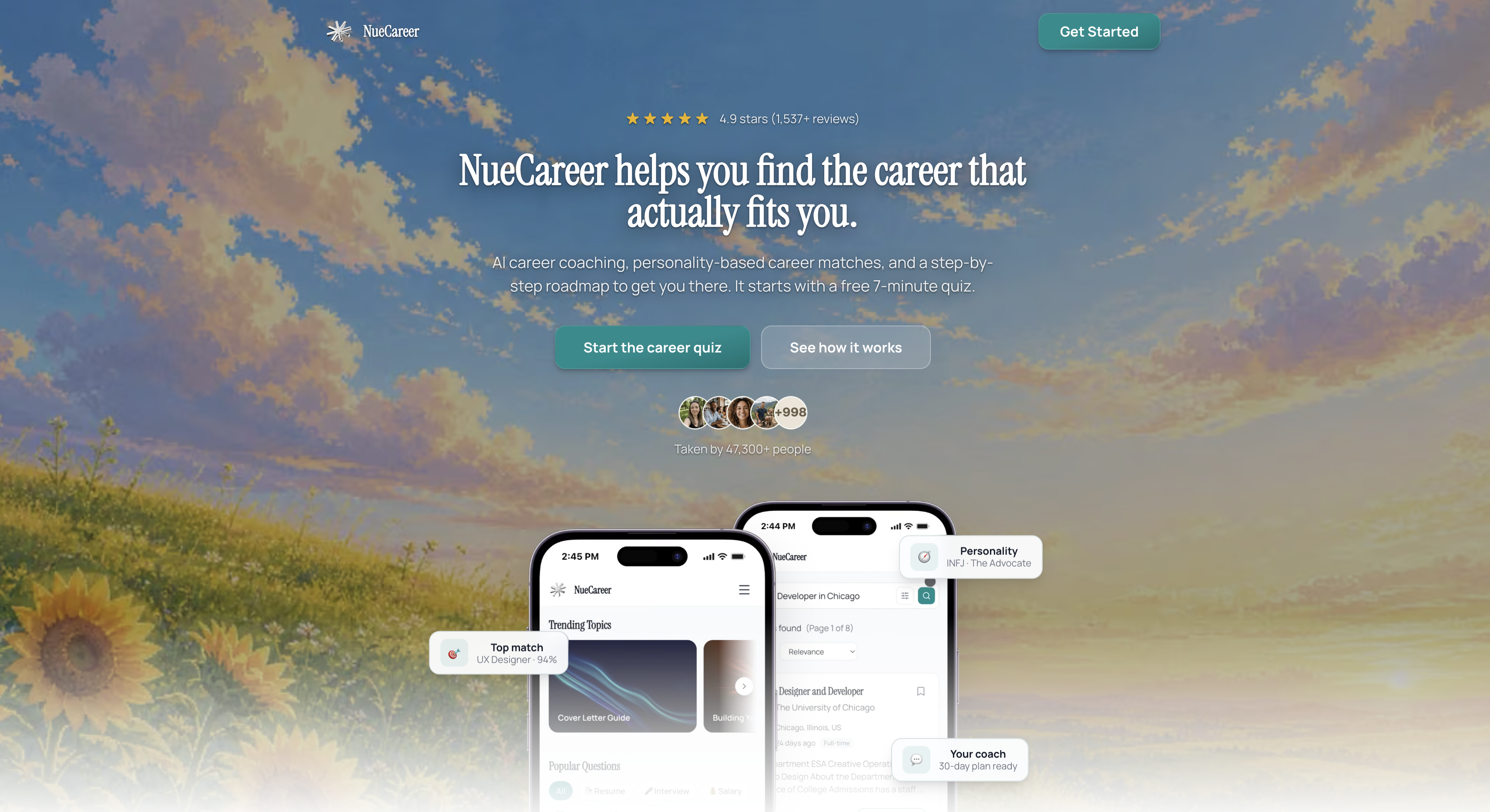
From there, NueCareer's Answer Generator turns your quiz results into a one-line reason you can drop straight into a resume, a cover letter, or your interview script. If your gap led you toward a different field entirely, the platform's guidance on finding careers you haven't considered can help you shape that pivot sentence with more precision than a generic template. Between the quiz, the generator, and the roadmap that follows, you leave with an explanation that's short, true, and ready to use, not just another draft sitting in a document. Take the quiz, get your matches, and turn today's uncertainty into tomorrow's opening line.
Sources
- How to Explain Employment Gaps with Confidence and Clarity | Cornell University
- How to explain gaps on resume | Northeastern University
- Current Population Survey (CPS) definitions | BLS
- How to Explain Gaps in Your Resume | NCOA
FAQ
How do I answer "Can you explain your employment gap?"
State the timeframe, give one neutral reason, mention what you did during that time, and pivot to why you're ready for the role. Keep the whole answer under 30 seconds.
Is a two-year employment gap bad?
Not inherently. A two-year gap explained with a clear reason and a verifiable activity, like a certification or freelance work, reads very differently than the same gap left unaddressed.
How long is considered a gap in employment?
Most career guidance treats anything under three months as unremarkable, three to nine months as worth a short mention, and nine months or more, or a current gap, as something to address directly.
How do I explain a three-month gap in employment?
A three-month gap usually needs only a brief line, not a full explanation. A resume note like "Career Break — [reason], [dates]" or one sentence in your cover letter is enough.