

Job search burnout is the emotional exhaustion, cynicism, and drop in effort quality that comes from a prolonged, low-feedback job hunt. It's different from ordinary discouragement, which lifts after a good night's sleep. Burnout doesn't lift. It compounds.
The fastest way out combines two moves: protect your energy with real structure, and cut your application volume while raising your conversion rate. Fewer, sharper applications beat scattershot ones, and they cost you less emotionally per attempt.
Start today with three things:
- Set a hard two-hour daily search block, then stop.
- Run one resume through an ATS or job-description check before sending anything else.
- Schedule one full day off this week with zero job-search activity, guilt-free.
Key Takeaways
Job search burnout eases fastest when you protect your energy with strict time limits and cut your application volume while fixing what stops those applications from converting.
| Point | Details |
|---|---|
| Burnout has a specific signature | Watch for exhaustion, numbness toward roles you'd normally want, and slipping application quality. |
| Ghosting drives frustration | Many job seekers name ghosting as their top complaint, per a 2024 survey. |
| Diagnose before you scale volume | Run an ATS check first; fix keywords if it's low, review interview performance if it's not. |
| Track inputs weekly | Set targets for applications sent, contacts made, and interviews prepped rather than tracking replies. |
| Nuecareer's quiz starts the roadmap | The 7-Minute Career Quiz identifies your strengths and builds a personalized plan to reduce aimless applying. |
Table of Contents
- What Does Job Search Burnout Feel Like, and Why Does It Happen?
- What Actually Prevents Job Search Burnout?
- How Do You Recover From Job Search Burnout?
- When Should You Get Professional Help for Job Search Stress?
- How NueCareer's Tools Fit Into This Plan
- A Realistic Weekly Routine That Actually Holds Up
- Try These Free Tools in the Next 15 Minutes
- Sources
- FAQ
What Does Job Search Burnout Feel Like, and Why Does It Happen?
Burnout shows up as a specific cluster, not just "feeling tired of applying." You'll recognize exhaustion that sleep doesn't fix, a flat numbness toward roles you'd normally get excited about, and a quiet drop in the quality of your applications because proofreading one more cover letter feels unbearable. Psychologist Christina Maslach's research frames burnout around three dimensions: exhaustion, cynicism or disillusionment, and reduced effectiveness, and UC Berkeley's coverage of that work points to structural boundaries as the strongest known protection.
The job hunt itself is built to produce this state. Applications vanish into applicant tracking systems with no acknowledgment. Estimates from career-research coverage suggest A large portion of applications get no response at all, which trains your brain into a kind of learned helplessness: effort stops predicting outcome, so effort starts to feel pointless. Add repetitive administrative busywork, custom-formatted applications, endless portal logins, and there's no finish line in sight.
By the numbers: A 2024 survey found that 72% of active job seekers say their search has harmed their mental health, and many named ghosting by employers as their top frustration.
This isn't just an emotional problem. A longitudinal study tracked job seekers over multiple years and found that those who developed depression during unemployment had roughly 67% lower odds of reemployment at the four-year mark compared to those who didn't. Left unaddressed, burnout doesn't just make the search miserable. It actively works against you getting hired.
What Actually Prevents Job Search Burnout?
Prevention works best when it hits both levers at once: protect your energy with practical recovery techniques, and make your applications convert better so you need fewer of them (Burnout recovery for women: a practical UK guide).
1. Timebox the work like a job, not a haunting. Pick a fixed window, say 9 to 11 a.m., and treat anything outside it as off-limits. A sample day might look like 30 minutes scanning new postings, 60 minutes on two tailored applications, and 30 minutes on outreach or follow-up. Maslach's research backs this specifically: designated hours with a clear stopping point protect against burnout better than open-ended effort does.
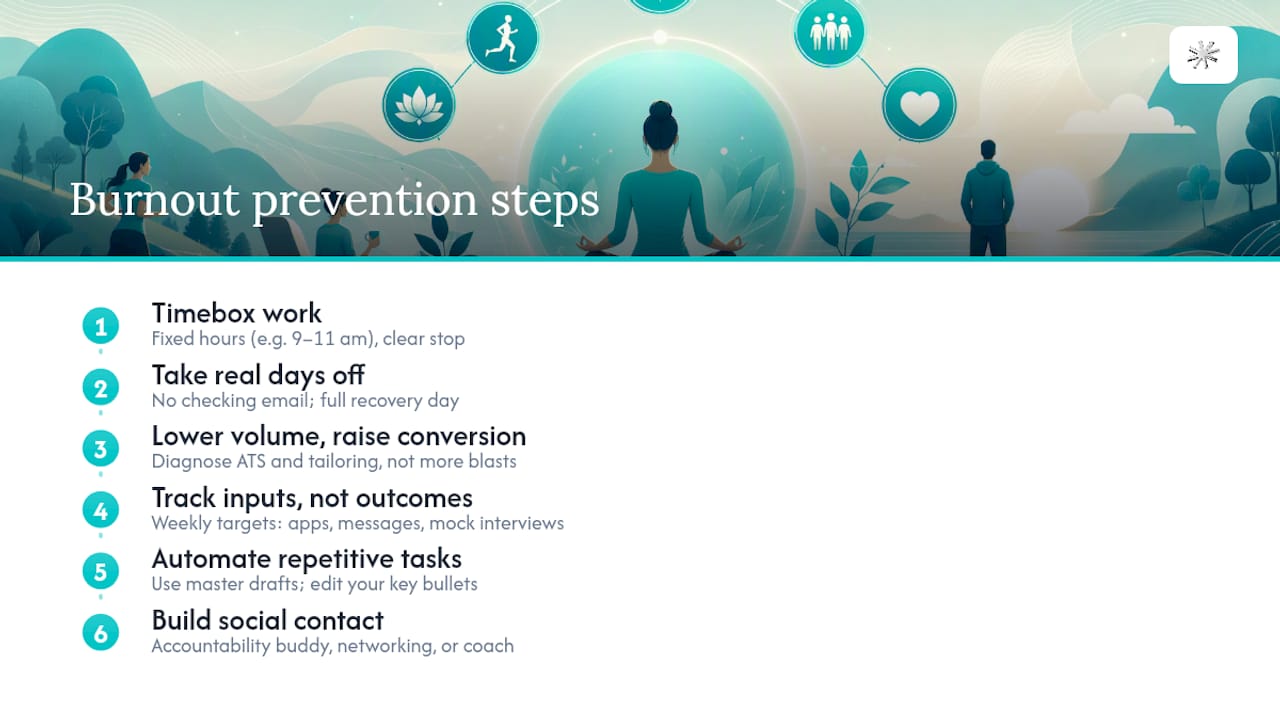
2. Take real days off. Not "light" days where you still check email. A day where the search doesn't exist. This isn't slacking. It's the recovery period that makes the other six days sustainable.
3. Lower your volume, raise your conversion. Instead of blasting 20 generic applications a week, run diagnostics first. Check whether your resume actually clears an ATS scan for the roles you're targeting. If it's failing there, the fix is language and keyword alignment, not more applications. If your resume scores well but interviews still aren't coming, the problem usually lives in your positioning or interview performance, not your volume. TailorCV's breakdown of this diagnostic sequence is a useful gut check.
4. Track inputs, not outcomes. You can't control whether a company calls back. You can control how many quality applications you send, how many people you contact for a coffee chat, and how many interviews you prep for. Set a weekly target like "8 tailored applications, 3 networking messages, 1 mock interview" and check those boxes instead of obsessing over silence.
5. Automate the repetitive parts, safely. Save master versions of your resume bullets, use tools to generate a first draft of a tailored summary, and reserve your own editing time for the sections that matter most, like your top three bullet points. Speeding up the boring parts frees energy for the parts that actually move the needle.
6. Build in social contact on purpose. Isolation intensifies burnout. An accountability buddy, a structured networking approach, or working with a coach all interrupt the spiral of applying alone into a void.
Pro Tip: Batch your tailoring. Write one strong "core" resume and cover letter, then spend 10 minutes per application swapping in role-specific keywords instead of rewriting from scratch. It cuts fatigue and usually improves your ATS match score.
How Do You Recover From Job Search Burnout?
Recovery works better as a staged plan than as a vague resolution to "take it easier."
Days 1 through 7: Full reset. Step back from applying entirely for a week if you can afford it, or at minimum cut your search to under 30 minutes a day. A true break means no job boards, no LinkedIn scrolling for openings, no mental tallying of who hasn't responded. Sleep, move your body, see people who have nothing to do with your job search.

Days 8 through 14: Diagnose before you resume. Run your resume through an ATS check. Debrief any recent interviews honestly: where did the conversation stall? Identify one or two real skills gaps rather than assuming everything is broken. A realistic career transition timeline helps here, because it resets expectations about how long this process legitimately takes.
Weeks 3 through 4 (Month 1): Rebuild the routine. Return to the two-hour timeboxed block. Set a modest activity goal, maybe five tailored applications and two networking touches a week. The goal is consistency, not intensity.
Weeks 5 through 8 (Month 2): Scale and refine. Increase volume only once conversion is trending up: more interviews per application sent. Keep tracking inputs weekly.
- Celebrate small wins as they happen: a recruiter reply, a completed mock interview, a resume that finally clears an ATS filter.
- Resist the urge to "make up for lost time" by overworking once you feel better. That's how the burnout cycle restarts.
When Should You Get Professional Help for Job Search Stress?
Some signs go beyond what routines and self-care can fix. If you notice a persistent inability to function day to day, a loss of interest in nearly everything (not just the job search) lasting more than two weeks, or any thoughts of self-harm, that's a signal to seek professional support immediately, not eventually.
- Persistent inability to get out of bed, eat regularly, or complete basic daily tasks
- Anhedonia, a flattened lack of pleasure in things you used to enjoy, lasting weeks
- Any thoughts of suicide or self-harm (call or text 988, the Suicide and Crisis Lifeline, right away)
- Panic symptoms or chronic insomnia that don't improve with rest
The stakes are real: emergent depression during unemployment was linked to 67% lower reemployment odds at four years in longitudinal research, so getting ahead of it matters for your career, not just your mood.
Start with your primary care provider, who can refer you to a licensed therapist, or explore teletherapy options if cost or access is a barrier. This isn't a detour from your job search. It's what makes finishing it possible.
How NueCareer's Tools Fit Into This Plan
Nuecareer built its free tools around the exact diagnostic steps this article recommends, so you don't have to guess where to start.
- The 7-Minute Career Quiz gives you an initial diagnostic: it identifies your strengths and matches you to roles, including ones you might not have considered, which replaces aimless applying with a targeted roadmap.
- The job description analyzer and resume tools cut tailoring time down to minutes, directly addressing the "raise conversion" lever from the prevention section.
- Pro Tip: Run one job description through the analyzer before you touch your resume. It shows you exactly which keywords and skills to mirror, so your edits are targeted instead of a full rewrite.
For ongoing guidance beyond the tools, Nuecareer's blog (written in part by author Shane) covers related ground like testing a new career before quitting your job.
A Realistic Weekly Routine That Actually Holds Up
Burnout research is data, but this search is still your life, and that's worth remembering on the hard days. My own suggested routine: two hours a day, split into 45 minutes of applications, 45 minutes of networking or follow-up, and 30 minutes of learning or interview prep. Everything outside that window is genuinely off. Rest isn't a reward you earn after the search ends. It's the strategy that gets you there.
Try These Free Tools in the Next 15 Minutes
Instead of another night of scrolling job boards with no plan, try starting where the diagnostics actually point: your strengths and your resume's real-world performance.
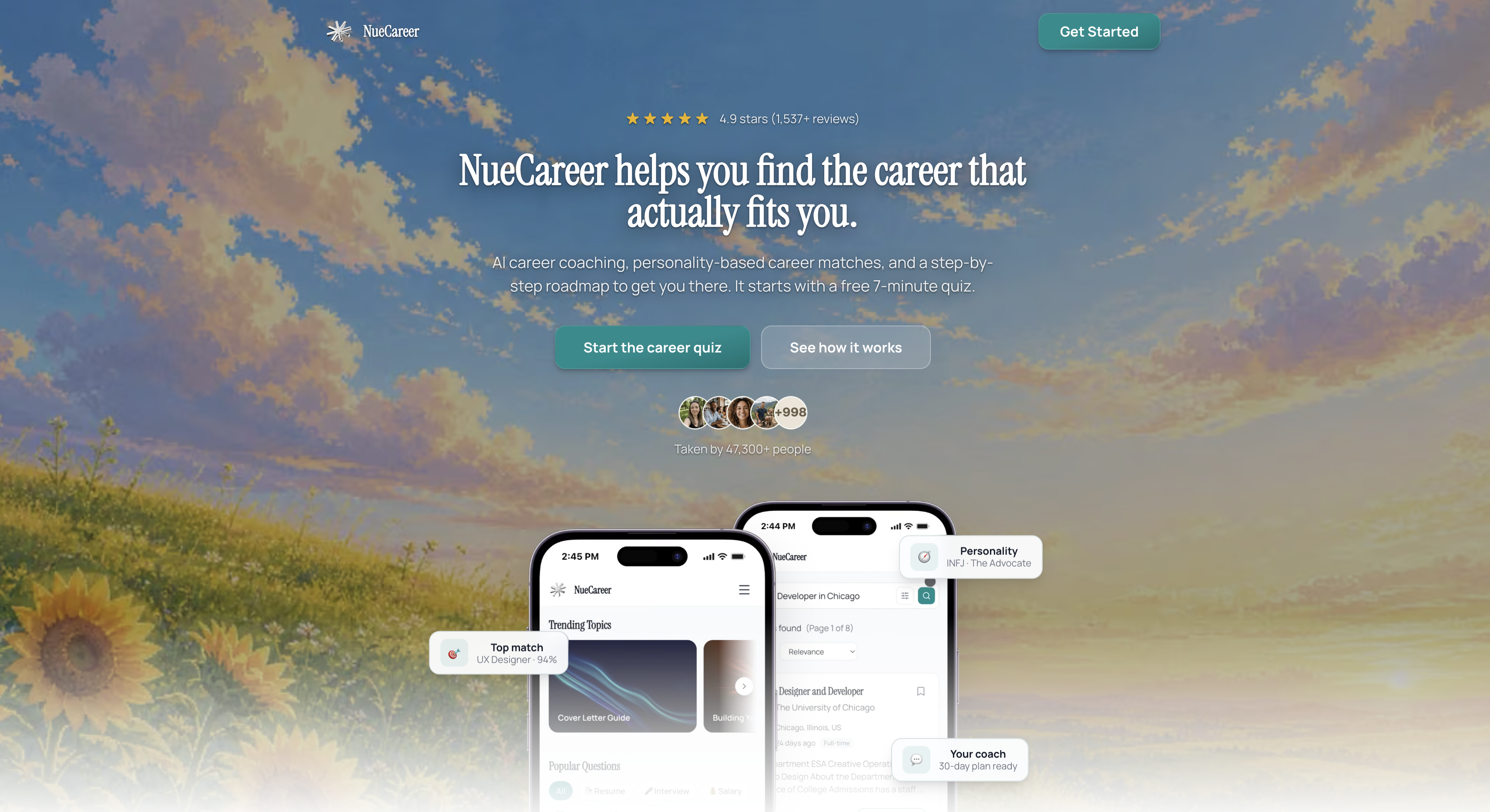
Take The 7-Minute Career Quiz first. It matches you to career paths built around your actual strengths, sometimes ones you'd never have searched for on your own, and gives you a personalized roadmap instead of a blank job board. Next, run one current job posting through the free job description analyzer to see exactly which skills and keywords that employer is filtering for. Then open your resume and export one tailored bullet point using that feedback before you close the laptop.
That's the whole first session: quiz, one job description, one improved bullet. No 20-tab research spiral required. If you want the fuller toolkit, including cover letter help and 24/7 coaching chat, the complete suite of free career tools is ready whenever you are.
Sources
- 72% of applicants say the job search has harmed their mental health
- Psychiatry Research — long-term unemployment and depression study (Stolove et al., 2017)
This article is general information, not a substitute for advice from a qualified doctor. Consult a qualified healthcare professional about your own circumstances before acting on anything here.
FAQ
What is the 42% rule for burnout?
There's no established clinical or research-backed "42% rule" for burnout; if you've seen this figure, it's likely a misremembered statistic rather than a recognized framework. What's well documented instead is that 72% of job seekers report mental-health harm from their search, with ghosting cited most often as the trigger.
Why is job searching so exhausting?
Job searching drains you because the process decouples effort from outcome: most applications get no response at all, which produces a form of learned helplessness. Repetitive administrative work and silence, rather than the job hunt's difficulty alone, are what wear people down.
How long is too long to be job searching?
There's no universal cutoff, but if your search has stretched past a few months with no improvement in interview rate despite consistent effort, it's time to run diagnostics rather than keep pushing volume. Persistent exhaustion or numbness lasting weeks is a stronger signal than any specific timeframe.
Why is finding a job so hard right now?
High application volume per posting, heavy reliance on automated ATS filtering, and inconsistent employer follow-up all combine to make modern job searching feel harder than the effort alone would suggest. Tools like The 7-Minute Career Quiz help by narrowing your target roles so your energy goes toward better-matched opportunities instead of broad, low-conversion applying.