
Job Search When Feeling Lost: A Clear Path Forward

Navigate your job search when feeling lost. Gain clarity and direction to enhance your career with expert insights and effective strategies.
TL;DR:
- Searching for a job without clarity leads to frustration and wasted effort.
- Prioritizing career direction and using an Ideal Job Description improves your chances of success.
A job search when feeling lost is defined as the process of seeking employment without a clear sense of direction, values alignment, or career purpose. Most people in this position apply broadly, hear little back, and grow frustrated. The fix is not more applications. It is clarity first. Career coaches consistently find that job searching and career direction are two separate tasks, and skipping the second one wastes months of effort. Nuecareer is built specifically for this moment: when you know you need to move but are not sure where.
Why job search when feeling lost requires direction first
Job searching is a tactical task. Career direction is strategic. Treating them as the same thing is the most common reason a search stalls before it starts.
Career coach Hallie Crawford notes that lack of career direction causes people to cycle through unsuitable roles repeatedly. Each cycle costs time, confidence, and energy. The pattern looks like this: apply widely, get a few interviews, accept a role that feels wrong, and repeat the whole process 18 months later.
The solution is to treat career direction as its own project before writing a single resume bullet. That means defining your values, identifying your strengths, and mapping the lifestyle your work needs to support. Only then does a job search become a targeted activity rather than a guessing game.
- Values alignment: Know what matters most to you at work, whether that is autonomy, impact, stability, or growth.
- Strengths inventory: Identify what you do well and what energizes you, not just what you have done before.
- Lifestyle fit: Factor in location, schedule, income floor, and work environment before evaluating any role.
- Career identity: Understand how your work connects to who you are. Nuecareer's career identity framework is a practical starting point for this work.
Pro Tip: Feeling lost in your career is not a problem to fix quickly. Terrylynn Smith's research shows it signals readiness for meaningful change. Treat it as useful data, not a personal failure.
How to create an Ideal Job Description to focus your search
An Ideal Job Description (IJD) is a written document you create before applying anywhere. It describes the role you actually want, not the role you think you can get. Experts recommend that using an IJD as a filter can be the difference between a three-month search that feels productive and a six-plus month search that becomes a grind.
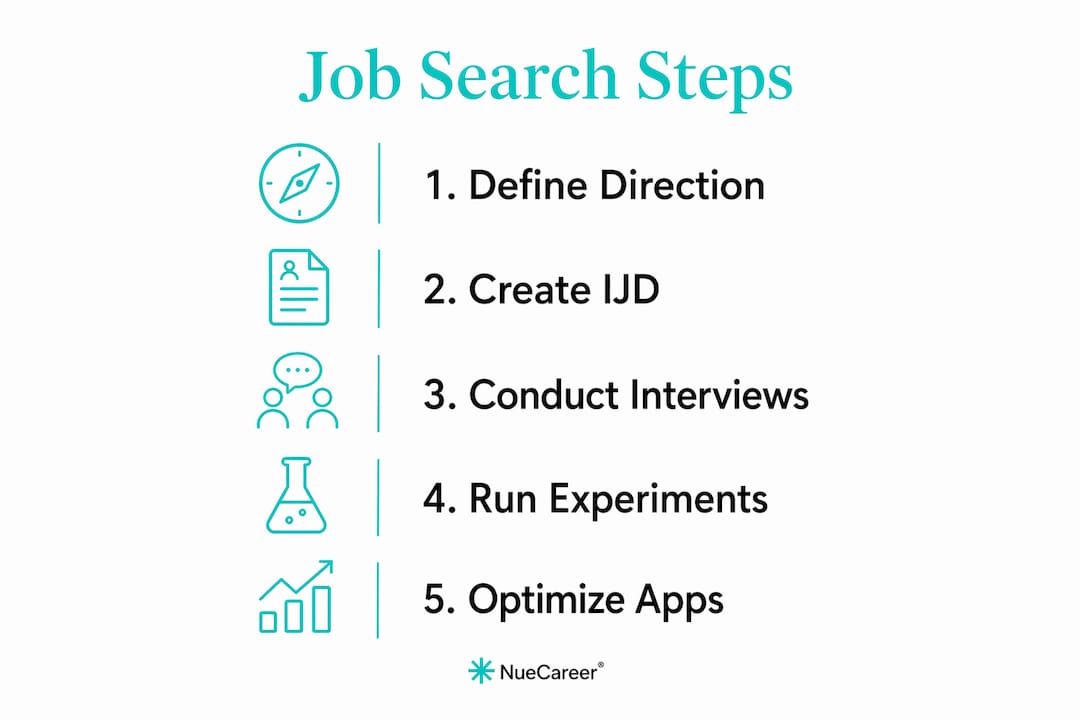
The IJD is not a wish list. It is a filter. Every job posting you evaluate gets measured against it. If a role fails on your core criteria, you skip it. That discipline saves weeks of wasted applications.
Here is how to build one:
- List your non-negotiables. Write down three to five conditions a role must meet. Examples include remote work, a specific salary floor, no travel, or a particular industry.
- Describe your ideal responsibilities. Be specific. "Leading cross-functional projects" is more useful than "management." Specificity helps you recognize the right role when you see it.
- Define your growth path. What does the role need to offer in two to three years? Promotion potential, skill development, or lateral movement all count.
- Identify your preferred work environment. Collaborative or independent? Fast-paced or methodical? Culture fit affects daily energy and long-term retention.
- Set your deal-breakers. These are conditions that disqualify a role regardless of other factors. Write them down explicitly so you do not rationalize past them under pressure.
Pro Tip: Use Nuecareer's free job description analyzer to compare real job postings against your IJD. It shows you exactly what employers prioritize so you can assess fit before investing time in an application.
Practical steps to job search effectively when you feel unclear
Once you have direction, the search itself becomes a series of small, testable experiments rather than a single high-stakes event. Career planning research confirms that establishing a testable hypothesis about your next role before writing your resume reduces burnout and improves alignment. Think of each application, conversation, and interview as a data point, not a verdict.

Conduct informational interviews
Informational interviews are 20-minute conversations with people in roles or industries you are considering. They strip away romanticized ideas about a career and replace them with real information. Ask about daily work, what skills matter most, and what they wish they had known earlier. Active engagement with the market is one of the fastest ways to find true direction when you feel confused about your path.
Run low-risk career experiments
Small experiments like freelance projects or short courses provide real insight with minimal risk. A weekend freelance project in a new field tells you more about fit than a month of research. Curiosity-driven exploration beats fear-driven rushing every time.
Optimize your applications
Targeted applications consistently outperform mass applying. Repositioning your resume to mirror employer priorities in the top third of the document creates a sense of inevitability rather than just capability. Employers should read your resume and feel you were built for the role.
| Tactic | What it tests | Time investment |
|---|---|---|
| Informational interview | Role and culture fit | 1–2 hours per conversation |
| Freelance project | Skill application and enjoyment | 5–10 hours per project |
| Targeted application | Resume and positioning quality | 2–3 hours per application |
| Short online course | Interest and aptitude in a new area | 4–8 hours per course |
Pro Tip: Before you apply to identify the right career, read Nuecareer's guide on choosing the right career path to make sure your direction is solid before you invest in applications.
Common pitfalls when your job hunt feels overwhelming
The most damaging mistake in a search without direction is applying randomly and calling it effort. More applications do not help if your targeting is wrong. Fixing one broken stage at a time improves both results and energy.
The second most common mistake is ignoring burnout signals. A search that drains you daily is a search that will fail. Protecting your energy is not optional. It is part of the strategy.
"Defining your 'why' for a job change, including your reason and your timing, helps focus and energize your entire search strategy." This clarity on your current versus target state improves both motivation and direction when the process feels long.
How to audit and relaunch a stalled search
When a search stops producing results, diagnose the specific stage that is broken before changing everything at once.
- No interviews? The problem is likely your resume or targeting. Revisit your IJD and reposition your application materials.
- Interviews but no offers? The problem is likely interview preparation or role fit. Conduct more informational interviews to recalibrate.
- Offers but wrong roles? The problem is your filter. Return to your IJD and tighten your criteria.
- No energy to search? The problem is burnout. Reduce daily application volume and add one restorative activity per day before resuming full effort.
Pro Tip: Career transitions require a different search strategy than a lateral move. If you are changing fields entirely, expect a longer timeline and plan your experiments accordingly.
Key takeaways
A job search when feeling lost succeeds when you prioritize career direction before tactics, use an Ideal Job Description as a filter, and treat each application as a testable experiment rather than a final answer.
| Point | Details |
|---|---|
| Direction before tactics | Define values, strengths, and lifestyle fit before writing a single resume bullet. |
| Build an IJD first | Use your Ideal Job Description to filter every role and skip poor-fit postings quickly. |
| Experiment, do not race | Treat informational interviews and freelance projects as low-risk data collection. |
| Diagnose before changing everything | Identify the one broken stage in your search and fix it before overhauling your approach. |
| Protect your energy | Burnout is a search killer. Reduce volume and add recovery time when motivation drops. |
What I have learned about searching when you feel lost
The conventional advice is to apply more, network harder, and update your LinkedIn. That advice is not wrong. It is just incomplete. In my experience, the people who struggle longest in a search are not the ones with weak resumes. They are the ones who never stopped to ask what they actually wanted.
Feeling lost is uncomfortable. Most people respond by speeding up, sending more applications, and hoping volume solves the problem. It rarely does. What actually works is slowing down long enough to build a clear picture of the role you are targeting, then moving with precision.
The experiment mindset changes everything. When you treat a conversation or an application as a test rather than a judgment, the emotional stakes drop. You learn faster. You adjust sooner. You stop taking rejection personally because each "no" is just information about fit, not about your worth.
Patience is not passive. It is the discipline to keep gathering data, refining your direction, and staying consistent when the process feels slow. The search that feels lost at the start often produces the most aligned outcome at the end. Give yourself the time to do it right.
— Shane
Nuecareer can help you find your direction
Clarity is not something you wait for. It is something you build, and Nuecareer gives you the tools to build it fast.
The 7-minute career quiz identifies your strengths and matches you to career paths you may never have considered, including roles that fit your values and lifestyle. From there, the free career clusters quiz helps you explore broader fields before narrowing your focus. Once you have a target role, Nuecareer's cover letter generator and job description analyzer help you apply with confidence. Every tool is free to start and built for working adults who are ready to move with purpose.
FAQ
What is the first step when your job search feels lost?
Define your career direction before applying anywhere. Start by identifying your values, strengths, and lifestyle needs, then write an Ideal Job Description to use as a filter for every role you evaluate.
How long does a job search take when you lack direction?
A search without clarity often runs six months or longer. Experts find that using an Ideal Job Description as a filter can reduce that timeline to roughly three months by eliminating poor-fit applications early.
What are informational interviews and why do they help?
Informational interviews are short conversations with people in roles or industries you are considering. They replace assumptions with real market insight and help you test career hypotheses before committing to a full application process.
How do I know if my job search strategy needs a reset?
Audit each stage separately. No interviews means a resume or targeting problem. Interviews without offers point to preparation or fit issues. Offers for the wrong roles mean your filter criteria need tightening.
Is feeling lost in a career search normal?
Feeling lost is a recognized signal of readiness for deliberate change, not a sign of failure. Career research confirms that active market engagement during this period is one of the most effective ways to find genuine direction.