
Career Transition Timeline: Realistic Planning for Professionals

Discover a career transition timeline for realistic planning. Learn how to audit your tasks and navigate your next professional move effectively.
TL;DR:
- A career transition usually takes six to eighteen months, depending on skill overlap, credentials, and industry hiring cycles. A task audit and evidence-building phase are crucial, with timelines adjusted by personal resources and market pace. Focused preparation and deliberate networking increase the chances of a successful, sustainable change.
A realistic career transition varies widely among professionals, ranging from a few months to several years, depending on factors such as skill overlap and credential requirements. The single most useful thing you can do right now, before you touch your resume or scroll job boards, is a two-week task audit: track every work task you do and mark which ones energize you versus drain you. That 30-minute setup gives you the raw data for every planning decision that follows.
A few quick signals to help you place yourself:
- Adjacent move: Your target role shares a substantial portion of your current skills, such as a marketing manager moving into content strategy, or a nurse shifting into health education.
- Common pivot (6–18 months): You're crossing a functional boundary but staying in a familiar industry, or vice versa. Most career changes fall here.
- Major reinvention (12–36 months): You're changing both function and industry, or the target field requires formal credentials. Nuecareer's career strengths quiz can help you map your starting point in about seven minutes and flag which bracket fits your situation.
Table of Contents
- What does a realistic career change timeline actually look like?
- Your phase-by-phase roadmap: from assessment to offer
- How do you tailor the timeline to your finances and life?
- How do you audit your skill gaps and build credible evidence fast?
- What outreach and rebranding tactics actually move the needle?
- How do hiring cycles by industry affect your calendar?
- Sample timeline templates you can use today
- What does the research say about goals, habits, and staying on track?
- Key Takeaways
- Why urgency is the enemy of a good career plan
- Nuecareer gives you a structured starting point, not a blank page
- Useful sources
- FAQ
What does a realistic career change timeline actually look like?
Not all career changes are created equal, and the biggest planning mistake professionals make is borrowing someone else's timeline without checking whether the underlying assumptions match their own situation.
The three timeline brackets
| Timeline Bracket | Typical Duration | Main Activities | Runway/Salary Impact | Hiring-Cycle Assumption |
|---|---|---|---|---|
| Adjacent lateral move | A few months | Skills audit, resume rebrand, targeted outreach | Minimal pay impact; short runway | Standard hiring cycle |
| Common pivot | Several months to over a year | Skills gap work, informational interviews, portfolio build | Possible pay adjustment; moderate runway | Medium-length hiring cycle; some credentialing |
| Major reinvention | Extended period | Formal credentials, field testing, full rebrand | Potential first-year salary reduction; longer runway | Slow cycles; licensing wait times |
What these estimates assume
These brackets rest on a specific set of conditions. If your situation differs, adjust accordingly:
- Your target role shares at least 60% of your current skills (compress the timeline) or less than 40% (extend it).
- US hiring cycles average 4–8 weeks for most private-sector roles, longer for government and healthcare.
- You have access to side projects, freelance gigs, or internal stretch assignments to build evidence while employed.
- You have 6–12 months of core expenses saved, or you're running a two-track approach while keeping your current income.
The brackets are starting points. What actually determines your timeline is the combination of skill overlap, financial runway, and how fast your target industry moves.
Your phase-by-phase roadmap: from assessment to offer
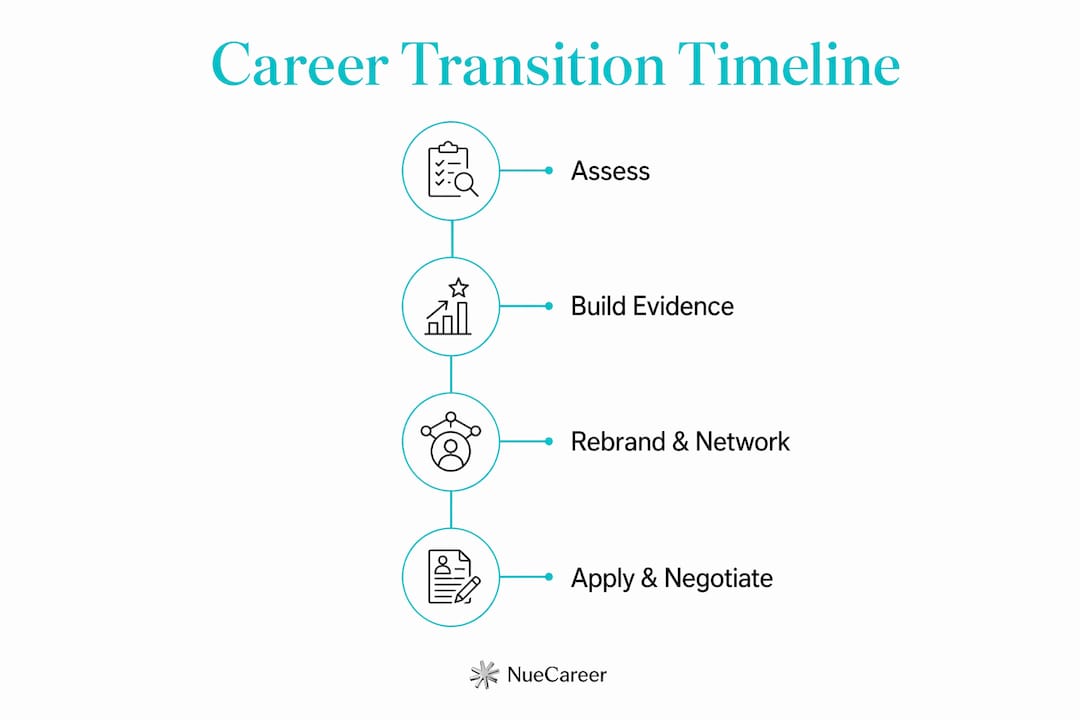
A career change is a project. Projects need phases, milestones, and checkpoints. Here's a four-phase roadmap you can adapt to any of the three timeline brackets above.

Phase 1: Assess (months 1–3)
The goal here is clarity, not momentum. Most people skip this phase and pay for it later with a false pivot.
- Complete a two-week task audit to identify which work energizes you and which drains you.
- Run a skills inventory: list your top 15–20 transferable skills with concrete evidence for each.
- Identify 3–5 target roles and pull 10 job descriptions for each.
- Map your skills against those descriptions and calculate your overlap percentage.
- Conduct 5–8 informational interviews with people already doing the target work.
- Calculate your financial runway (monthly core expenses × months of savings).
- Set a go/no-go decision gate at the end of month 3: does the evidence support the pivot?
Milestone metric: At least 5 informational interviews completed; skills overlap calculated for each target role.
Phase 2: Build evidence (months 4–6)
This is where you close the gap between where you are and where you need to be, without quitting your job.
- Identify the top 3 skill gaps from your overlap analysis.
- Start one side project or volunteer assignment in the target field.
- Complete one microcredential or short course that directly addresses a gap.
- Accumulate 20+ hours of hands-on work in the target field (projects, freelance, internal assignments).
- Document every piece of evidence with measurable outcomes, not just task descriptions.
- Expand your network by 5–10 new contacts per month in the target field.
- Begin drafting a portfolio or case study document.
Milestone metric: 20+ hours of target-field evidence; at least one completed project with a measurable outcome.
Phase 3: Rebrand and network (months 7–12)
Your evidence is built. Now you make it visible.
- Rewrite your resume around outcomes, not responsibilities.
- Update your LinkedIn headline and summary to reflect the target role.
- Add project links, portfolio items, and relevant keywords to your profile.
- Send 10 targeted outreach messages per week to contacts in the target field.
- Request at least 2 referrals or introductions per month.
- Attend 1–2 industry events or online communities per month.
- Run a weekly review: track outreach sent, responses received, and conversations advanced.
Milestone metric: Updated resume and LinkedIn; 40+ outreach messages sent; 5+ meaningful conversations with hiring-side contacts.
Phase 4: Apply and negotiate (months 13–18)
Applications without the groundwork from phases 1–3 rarely land. With that foundation, this phase moves faster.
- Apply to 5–10 roles per week that match your skills at 60%+ overlap.
- Customize each application using the job description as a keyword guide.
- Prepare transition-specific interview answers that frame your pivot as an asset.
- Track every application, interview stage, and follow-up in a simple spreadsheet.
- Research salary ranges before every offer conversation.
- Negotiate: most first offers have room, especially when you can show measurable evidence.
Progress review cadence: Monthly check-ins on leading indicators (applications sent, interviews booked, offers received). At month 9 and month 15, run a full decision gate: accelerate, pause, or extend based on what the data shows.
Statistic callout: According to research by Dr. Gail Matthews, people who write down their goals and share weekly progress with an accountability partner are notably more likely to achieve them. Build that into your monthly reviews from day one.
How do you tailor the timeline to your finances and life?
A roadmap that ignores your actual constraints isn't a plan. It's a wish list. Here's how to adapt the schedule to your real situation.
Financial runway and the quit-vs.-two-track decision
Financial preparation is the single most common reason career changes succeed or fail. The math is straightforward: divide your savings by your monthly core expenses. If the result is less than 6, you're not ready to quit. Run a two-track approach instead: keep your current income while building evidence on the side.
If your target field involves a full reinvention, plan for a potential first-year salary reduction. That number should be built into your runway calculation before you give notice, not discovered after.
Family, responsibilities, and weekly time budget
How many hours per week you can realistically dedicate to the transition determines how fast you move through the phases. Use this table to set honest expectations:
| Hours Available per Week | Recommended Activities | Realistic Phase Duration |
|---|---|---|
| Few hours | One microcredential module; some outreach messages | Longer phase durations |
| Moderate hours | One side project + networking; several outreach messages | Standard phase durations |
| Many hours | Side project + course + active networking | Shorter phase durations |
| Extensive hours | Full two-track build; multiple projects simultaneously | Faster adjacent moves possible |
If you have young children, a demanding job, or significant caregiving responsibilities, the 3–5 hour bracket is probably your honest starting point. That's not a failure condition. It just means your timeline is likely to be longer than the typical 9–12 month middle cluster, and that's a plan you can actually execute.
Industry hiring-cycle modifiers
Some fields move fast; others are deliberately slow. Tech startups can move from application to offer in two weeks. Federal government roles routinely take 3–6 months. Healthcare credentialing can add 6–12 months before you're even eligible to apply. Build those realities into your calendar.
Pro Tip: Use realistic career goals frameworks that integrate market data with personal constraints. Set quarterly reassessment dates in your calendar now, before you start. When life changes (a new baby, a layoff, a health issue), you'll have a built-in moment to adjust the plan rather than abandon it.
How do you audit your skill gaps and build credible evidence fast?
The fastest path to a new role isn't always the most expensive one. Before you spend money on a bootcamp or a graduate degree, run this audit.
The skills-gap audit template
Pull 10 job descriptions for your target role. Highlight every skill, tool, and qualification that appears in at least 6 of the 10 listings. Those are the threshold requirements. Now map each one to your concrete evidence:
- Strong match: You have a specific, documented example of doing this work.
- Partial match: You've done adjacent work but lack a direct example.
- Gap: You have no relevant experience or evidence.
If 60% or more of the threshold requirements fall in the "strong match" column, you're ready to apply and build the rest in parallel. Below 60%, focus on building evidence before applying.
Learning options ranked by speed vs. credibility
Not all credentials are equal, and not all gaps need a credential. Here's how the main options stack up:
- Side projects and freelance work: Fastest to start, highest credibility with hiring managers who care about outcomes over credentials. Aim for 20+ hours of documented work.
- Internal stretch assignments: Zero cost, immediate start, and they come with a built-in reference. Ask your current manager for a cross-functional project in the target area.
- Microcredentials and short courses (Coursera, LinkedIn Learning, Google Career Certificates): 4–12 weeks, low cost, and increasingly recognized in tech, data, and project management roles.
- Bootcamps: 3–6 months, higher cost, useful when you need a structured curriculum and a cohort for accountability.
- Formal degrees: 2–4 years, high cost, and often unnecessary unless the target field legally requires them (medicine, law, licensed engineering).
Transferable skills plus evidence are the primary bridge for most career changes. Credential requirements are often negotiable when you can show relevant outcomes. Start with projects; add credentials only where the gap genuinely requires them.
Pro Tip: Paste a target job description into Nuecareer's free job description analyzer to instantly surface the keywords and skills you're missing. It turns a 20-minute manual audit into a two-minute task.
If you're targeting a credential-heavy path into IT, a structured tool like the CertPath Roadmap Wizard can help you sequence certifications in the right order without wasting time on prerequisites you don't need.
What outreach and rebranding tactics actually move the needle?
Networking works when it's treated as a measurable pipeline, not a social obligation. Here's how to run it like one.
Informational interview outreach script
Keep your first message short. A template that works:
Follow up once after 5–7 days if you don't hear back. After two attempts, move on. The goal is 5–8 completed conversations per phase, not a perfect response rate.
Outreach tracking template
Treat every conversation as a pipeline stage:
| Contact Name | Date Reached Out | Response | Meeting Scheduled | Follow-Up Action | Referral Offered |
|---|---|---|---|---|---|
| [Name] | [Date] | Yes/No/Pending | [Date] | [Action] | Yes/No |
Review this tracker weekly. If your response rate is below 20%, revise your message. If conversations aren't converting to referrals or leads, adjust what you're asking for.
Resume and LinkedIn rebrand checklist
A rebrand sprint in weeks 4–8 should produce these specific outputs:
- LinkedIn headline: Target role title + one differentiating phrase (not your current job title).
- LinkedIn summary: 3–5 sentences that lead with your target field, name your transferable skills, and link to one concrete project.
- Resume headline and summary: Mirror the LinkedIn update; use keywords from the job descriptions you audited.
- Experience bullets: Rewrite every bullet to lead with a measurable outcome, not a task description.
- Project section: Add any side projects, freelance work, or volunteer assignments from the evidence-build phase.
- Skills section: Match the threshold skills from your audit; remove outdated or irrelevant entries.
For a deeper look at resume positioning for career changers, Nuecareer's career change resume tips walks through the exact framing that gets callbacks.
Measurable outputs for the rebrand sprint (weeks 4–8): Updated resume, updated LinkedIn profile, 10 outreach emails sent, 2 side projects documented with outcomes.
How do hiring cycles by industry affect your calendar?
Knowing when your target industry hires is as important as knowing what they hire for. Getting the timing wrong can add months to an otherwise solid plan.
Typical hiring timelines by industry
- Tech (established companies): Hiring cycles typically take several weeks; portfolio and GitHub evidence carry significant weight; hiring slows in late November through January.
- Tech startups: As fast as 1–3 weeks; culture fit and demonstrated output matter more than credentials; hiring is year-round but spikes in Q1 and Q3.
- Healthcare (clinical roles): 6–16 weeks; licensing and credentialing requirements can add 3–12 months before you're eligible; hiring peaks in spring and fall.
- Public sector and federal government: 3–6 months from application to offer; structured processes with fixed announcement windows; budget cycles drive hiring in Q4 and Q1.
- Consulting and professional services: 8–12 weeks; case interviews require dedicated prep (4–8 weeks minimum); recruiting cycles are heavily concentrated in September through November for major firms.
How slow cycles should reshape your earlier phases
If you're targeting healthcare or government, start networking 6–9 months before you want to be employed, not 3. That means moving the informational interview phase earlier and beginning the credential process before you feel "ready." A slow hiring cycle is not a reason to delay starting. It's a reason to start sooner.
Contingency planning for common delays
Build buffer into every timeline. Specific delays to plan for:
- Licensing wait times: Some states process applications in 4–6 weeks; others take 6–9 months. Research your state's timeline before you set a quit date.
- Long interview processes: Multi-round processes in consulting or tech can run 8–12 weeks. Don't give notice until you have a written offer.
- Rejection cycles: A 10–15% application-to-interview rate is normal for career changers. Budget for 30–50 applications before your first offer, and plan your runway accordingly.
- Market slowdowns: If hiring in your target field slows (watch job posting volume monthly), extend the build phase rather than flooding the market with applications during a freeze.
Sample timeline templates you can use today
These templates are starting points. Compress or expand each phase based on your skill overlap and runway math.
3-month sprint (adjacent lateral move)
| Week | Deliverable |
|---|---|
| 1–2 | Complete task audit; pull 10 job descriptions; calculate skills overlap |
| 3–4 | Conduct 3–4 informational interviews; identify top 2 skill gaps |
| 5–6 | Start one side project or stretch assignment; begin resume rebrand |
| 7–8 | Complete LinkedIn update; send 10 outreach messages; finish side project |
| 9–10 | Apply to 10–15 targeted roles; customize each application |
| 11–12 | Follow up on applications; prepare interview answers; negotiate first offer |
Adaptation rule: This sprint assumes 60%+ skill overlap and 6+ months of runway. If either condition is missing, extend to the 6–12 month plan.
6–12 month plan (common pivot)
- Q1 (months 1–3): Complete the full Phase 1 assessment (task audit, informational interviews, skills gap analysis, runway calculation).
- Q2 (months 4–6): Build 20+ hours of target-field evidence; complete one microcredential; expand network by 20–30 new contacts.
- Q3 (months 7–9): Full rebrand sprint; ramp outreach to 10 messages per week; begin applying to roles with 60%+ overlap.
- Q4 (months 10–12): Active application phase; interview prep; negotiate and accept offer.
Evaluation gate at month 6: If you have fewer than 20 hours of evidence and fewer than 10 meaningful network conversations, extend Q2 by 4–6 weeks before moving to the rebrand phase.
12–36 month reinvention (major career change)
| Phase | Timeline | Key Milestones |
|---|---|---|
| Explore and confirm | Months 1–3 | Task audit, 8+ informational interviews, field test (volunteer/shadow) |
| Credential and build | Months 4–12 | Formal credential or bootcamp; 3–5 portfolio projects; part-time work in target field |
| Rebrand and network | Months 13–18 | Full resume and LinkedIn overhaul; 50+ network contacts in target field; 2–3 referrals |
| Apply and land | 12–36 months | Active applications; interview cycles; negotiate first role (accept seniority reset if needed) |
Adaptation rule: If the target field requires state licensing, add 3–9 months to the credential phase and start the application process at month 6, not month 12.
For more detailed career change timeline examples with role-specific scenarios, Nuecareer's guide walks through several real-world bracket examples you can adapt directly.
What does the research say about goals, habits, and staying on track?
The behavioral evidence behind career transition success is clearer than most people realize. The practices that work aren't complicated. They're just consistently underused.
Dr. Gail Matthews and the writing effect
Dr. Gail Matthews' study found that people who write down their goals and share weekly progress with an accountability partner achieve them at a rate 33–40% higher than those who keep goals in their heads. For a career transition, that translates to one concrete habit: write your monthly milestone in one sentence, share it with one person, and report back at the end of the month.
The SMART-ER framework in practice
Standard SMART goals (Specific, Measurable, Achievable, Relevant, Time-bound) work well for 30–90 day milestones. Add Evaluation and Readjustment to form SMART-ER, and you have a framework that survives real life. Here's what that looks like for a 90-day milestone:
- Specific: "Complete Google's Project Management Certificate and apply to 5 operations roles."
- Measurable: Certificate completion date; number of applications submitted.
- Achievable: 6 hours per week available; certificate takes 8–10 weeks.
- Relevant: Target roles list project management as a threshold skill.
- Time-bound: Complete by the end of month 3.
- Evaluation: At day 45, check progress and identify blockers.
- Readjustment: If behind by more than 2 weeks, drop one application target and focus on the certificate.
For 3–12 month objectives, OKRs (Objectives and Key Results) add useful structure. For working through specific obstacles, the WOOP method (Wish, Outcome, Obstacle, Plan) helps you anticipate and plan around barriers before they derail momentum.
Three implementation experiments worth running
- Write and share: Write your next 30-day milestone tonight. Send it to one person and ask them to check in with you at the end of the month.
- Track leading indicators: Instead of measuring outcomes (job offers), measure inputs (applications sent, outreach messages, hours of evidence built). Inputs are in your control; outcomes aren't.
- Monthly 15-minute review: Set a recurring calendar event. Ask three questions: What did I complete? What's blocking me? What's the one priority for next month?
Pro Tip: Avoid the trap of measuring only outcomes during a long transition. A month with zero interviews but 20 hours of evidence built and 15 outreach messages sent is a successful month. Rewarding input metrics keeps motivation steady when the lagging indicators (offers, callbacks) haven't caught up yet.
Key Takeaways
A realistic career transition takes 6–18 months for most professionals, with the timeline shaped by skill overlap, financial runway, and the hiring pace of your target industry.
| Point | Details |
|---|---|
| Pick your bracket first | Adjacent moves take 3–6 months; common pivots 6–18 months; full reinventions 12–36 months. |
| Runway determines your strategy | Bank 6–12 months of core expenses before quitting, or run a two-track approach to protect income while building evidence. |
| Evidence beats credentials | Accumulate 20+ hours of hands-on target-field work before applying; projects and outcomes outperform credentials alone. |
| Written goals raise success rates | Writing goals and sharing progress with an accountability partner increases attainment significantly, per Dr. Gail Matthews' research. |
| Nuecareer accelerates the audit | Nuecareer's 7-minute quiz, job description analyzer, and personalized roadmap compress the assessment and skills-gap phases significantly. |
Why urgency is the enemy of a good career plan
There's a version of career transition advice that treats speed as the primary virtue. Move fast, apply everywhere, take the first offer that comes. That advice works for some people in some circumstances, and it fails quietly for a lot more.
What I've seen consistently is that the professionals who land well aren't the ones who moved fastest. They're the ones who spent the first 6–8 weeks doing the unglamorous diagnostic work: the task audit, the informational interviews, the honest skills inventory. They confirmed the pivot before they committed to it. That upfront investment looks slow. It isn't.
The emotional reality of a long transition is also underestimated. Around month 4 or 5 of a 12-month plan, most people hit a wall. The initial energy has worn off, the evidence is building but nothing has clicked yet, and the gap between where you are and where you want to be feels wider than it did at the start. That's not a signal to pivot again. It's a signal to review your leading indicators, reconnect with your accountability partner, and remind yourself that the phase you're in is supposed to feel slow.
One thing that genuinely helps: accept that your first role in the new field will probably not match your current seniority. That's not a step backward. It's the cost of entry into a field where you don't yet have a track record. Frame it that way to employers too: "I'm making a deliberate move into this field and I'm willing to earn my way up. Here's the evidence I've already built." That framing works far better than apologizing for the transition or overselling a seniority you haven't established yet.
The plan that gets you there isn't the most aggressive one. It's the one you can actually sustain.
Nuecareer gives you a structured starting point, not a blank page
Most professionals stall at the beginning of a career transition not because they lack motivation but because the planning work feels formless. Where do you start? What do you audit first? How do you know if your skills actually transfer?
Nuecareer is built specifically for that moment. The 7-minute career quiz identifies your strengths and matches you to career paths you may not have considered, including roles that align with what you're already good at. From there, the free job description analyzer turns any job posting into an instant skills gap report, so you know exactly what to build before you apply. The free cover letter generator tailors each application to the role in minutes, and the personalized roadmap maps your specific path from where you are to where you want to be.

If you're at the beginning of your planning process, the most useful next step is to take the quiz and run one job description through the analyzer. Both are free, and together they give you the two inputs the rest of this guide is built on: a clear picture of your strengths and a concrete list of what to build next. Start at Nuecareer's free tools and have your first target job description ready.
Useful sources
The sources below support the key claims and frameworks in this guide. Each is linked to the section where it's most useful.
- JobGetter: How to Change Careers — Supports the 6–18 month timeline range, the 9–12 month middle cluster, the 15–25% first-year salary dip estimate, and the five-step checklist (task audit, informational interviews, 20+ hours of evidence, runway, outcome-focused resume). Most useful in the BLUF, phase roadmap, and financial runway sections.
- CareerBldr: The Complete Career Change Guide — Supports the 6–12 month runway rule, the two-track approach recommendation, and the primacy of transferable skills and project evidence over credentials. Most useful in the tailoring and skills-gap sections.
- CareerEnlightenment: How to Set Realistic, Achievable Career Goals — Source for Dr. Gail Matthews' 33–40% goal-attainment finding, the SMART-ER framework, and the WOOP method for obstacle planning. Most useful in the behavioral research section and the monthly review habit.
- S.O.A.R.: Setting Realistic Career Goals — Supports the quarterly reassessment model and the integration of market data, personal constraints, and life priorities into goal-setting. Most useful in the tailoring and perspective sections.
- Nuecareer: Career Change Roadmap Step by Step — Detailed execution guidance for professionals who want a full step-by-step implementation plan alongside this timeline guide.
- Nuecareer: How to Switch Careers — High-level checklist and practical steps that complement the phase-by-phase roadmap in this article.
Nuecareer's free tools (quiz, job description analyzer, cover letter generator) centralize many of the audit and application steps described across these sources into a single workflow.
FAQ
How long does a realistic career transition take?
Most career transitions take 6–18 months, with the middle 50% landing around 9–12 months. Adjacent lateral moves with 60%+ skill overlap can close in 3–6 months; full reinventions requiring new credentials typically run 12–36 months.
What is the 30-60-90 rule for a new job or career change?
The 30-60-90 framework breaks the first three months into focused phases, starting with learning and assessment, then moving to building evidence and relationships, followed by demonstrating measurable output. Applied to a career transition, it maps directly onto the SMART-ER milestone structure with set goals, interim evaluation, and readjustment stages.
What are the five stages of career planning?
A widely used model covers self-assessment, career exploration, goal setting, action planning, and ongoing evaluation. In this guide, those stages map to the four-phase roadmap: assess (months 1–3), build evidence (months 4–6), rebrand and network (months 7–12), and apply and negotiate (months 13–18), with monthly evaluation checkpoints built into each phase.
What is the 3-month rule for jobs?
The 3-month rule refers to the idea that the first 90 days in a new role are the most critical for establishing credibility and demonstrating value. For career changers, it also applies to the transition itself: the first 3 months of planning should focus entirely on assessment and confirmation (task audit, informational interviews, skills gap analysis) before committing to a specific path.
How do I know if I need a 6-month or 12-month career change timeline?
If your target role shares 60% or more of your current skills and doesn't require new credentials, a 6-month plan is realistic. If you're crossing both a functional and industry boundary, or if the target field has a slow hiring cycle (healthcare, government, consulting), plan for 12–18 months and build your financial runway accordingly.