

A skills badge proves you can do one specific thing. A certificate proves you finished a broader course or program. Both are worth having when they match the job you want, but neither replaces the experience and clear skill evidence that hiring teams read first. If you are changing careers, the goal is not to collect the most credentials. It is to pick the few that back up the story your resume tells.
That is good news if you feel behind. You do not need a stack of logos. You need a clear picture of your strengths, a target role, and a small number of credentials that fit it.
TL;DR
- A badge usually recognizes a single skill or a short course. A certificate usually recognizes a completed program or broader body of knowledge.
- A certification is a third category: it typically involves a proctored exam, outside validation and renewal, and it is the one most consistently linked to pay gains.
- Employers weigh experience first. In one 2023 recruiter study, 84% rated years of experience important versus 37% for skilled credentials.
- Job-relevant credentials pay off more than unrelated ones, so choose by the role you are targeting, not by how easy the badge is to earn.
- List a credential with its issuer, date and a live verification link, and place it where it supports your role-aligned skills.
Table of Contents
- Badge, certificate, certification: the plain-English difference
- What a digital badge tells an employer that a PDF cannot
- What employers actually weigh: experience first
- Where skills assessments fit
- Does a credential raise pay? What the research shows
- Worked example: a retail manager moving into operations
- How to evaluate a badge or certificate before you spend time on it
- How to present credentials on your resume and LinkedIn
- Perspective: collect fewer credentials, tell a clearer story
- Start with a target, then choose your proof
- A simple decision rule
- FAQ
- Sources
Badge, certificate, certification: the plain-English difference
These three words get used interchangeably, and that is where the confusion starts. Here is how they usually differ.
A skills badge is a digital image with data behind it. It recognizes a specific skill or a short unit of learning. Asana's own training program is a clear example: its skill badge verifies a specific skill and does not expire, while its certificates cover broader knowledge and are verified with a capstone project and an exam.
A certificate usually marks completion of a larger program. Stanford Online's guide to digital credentials explains the split this way: badges represent completed courses and certificates represent completed programs.
A certification is the heavyweight. A 2026 Brookings analysis describes certifications as typically involving proctored exams, third-party validation and renewal. Think of a project management or cloud engineering credential that you must periodically renew.
| Skills badge | Certificate | Certification | |
|---|---|---|---|
| What it shows | One skill or short course | A completed program | Tested competence against an industry standard |
| Typical proof | Earning criteria and metadata | Program completion, sometimes a capstone or exam | Proctored exam, outside validation |
| Expiration | Often none | Varies by issuer | Often renewal or continuing education |
| Best use | Show a specific tool or skill | Show structured learning in a field | Meet a hiring requirement or stand out in a regulated or technical field |
SHRM's definition of alternative credentials covers all of these: badges, microcredentials, industry certifications, apprenticeship acknowledgments and course-completion certificates. It leaves out traditional degrees and required occupational licenses, which are a different conversation.
What a digital badge tells an employer that a PDF cannot
The biggest practical difference between a digital badge and a paper or PDF certificate is the data attached. A badge is built to be checked.
The University of Wisconsin-Madison's Center for Interprofessional Practice and Education describes digital badges as verifiable, portable credentials whose metadata can identify the issuer, the earner and the earning criteria. The Badging Commission's guide adds that an Open Badge can carry a description, skills tags, alignment to standards, issue and expiration dates, and evidence links.

In practice, that means a recruiter can click your badge and see who issued it, what you had to do to earn it, and sometimes the actual work you submitted. Stanford notes that employers can verify authenticity with a click or a QR-code scan.
A certificate can carry the same kind of verification when it is issued digitally. A scanned certificate with no link is harder to trust, simply because nobody can confirm it quickly.
What employers actually weigh: experience first
Here is the part that matters most for a career changer. Credentials help, but they sit behind experience in how most employers read applications.
- SHRM reported in 2023 that 84% of recruiters considered years of experience important and 83% considered type of experience important in the initial review, compared with 37% for skilled credentials.
- AARP Research's 2021 survey of 650 HR decision-makers found 56% rated prior experience using skills very important, versus 38% for skill credentials and 31% for pre-employment tests.
- The same SHRM recruiter study found skilled credentials could make up for below-minimum education in some simulated applications, but were not judged a substitute for insufficient experience.
Does that mean credentials do not matter? No. It means they work best as support. They can help a recruiter see that your experience is relevant to a new field, and they can close a gap in a formal requirement. They rarely carry an application alone.
If you are switching fields, your experience is not worthless. Much of it transfers, but it needs to be named in the language of the new role. Our guide to switching careers without a degree walks through how to build proof of that kind over 180 days.

Where skills assessments fit
The search also turns up a related question: how does a skills assessment compare with experience? They answer different questions.
- Experience shows you have done the work.
- A credential shows you completed learning or passed a standard.
- An assessment shows what you can do or where your strengths and gaps are right now.
Employers use assessments too. SHRM reported in 2022 that 56% of surveyed employers use pre-employment assessments to measure knowledge, skills and abilities, and that 79% of HR professionals who use them said skill evaluations were as important as or more important than traditional hiring criteria. A Census Bureau account of manufacturing credentials makes a similar point about formal records: they document skill attainment, often ending in an exam, and credential-holding manufacturing workers averaged $2,000 more a year and were more likely to be employed.
For a job seeker, the lesson is to know your own skills before you pay for anyone else's stamp of approval. A self-check of your strengths and gaps tells you which badge or certificate is worth earning and which would only duplicate what you can already show. Our free career skills assessment is built for that first step, and our guide to finding what you are actually good at explains how to read the results.
Does a credential raise pay? What the research shows
The Brookings 2026 analysis of U.S. worker resumes is the most useful recent look at this, and it makes a few points worth knowing:
- Badges and certificates were associated with a one-time wage premium, while additional ones added little or no value. Certifications, by contrast, showed positive returns as they accumulated when they were job-relevant.
- Relevance matters. A first job-relevant non-degree credential was associated with a 3.8% wage premium, compared with 1.8% for a first credential unrelated to the worker's occupation.
- Each additional job-relevant credential was associated with a further 1.0% increase, while piling up irrelevant ones produced no added return.
These are associations across many workers, not a guarantee for any one person. But the direction is useful. One well-chosen credential tied to your target role does more than five loosely related badges.
Worked example: a retail manager moving into operations
Let's say you have eight years in retail management and you want an operations coordinator role. You are deciding between a short badge in spreadsheet analysis, a certificate in supply chain fundamentals, and a certification in project management.
- Badge: quick to earn, and it shows one concrete tool skill. Good if job postings you want keep asking for that tool.
- Certificate: shows you studied the field end to end. Useful because your resume has no operations title yet.
- Certification: the strongest signal if your target postings list it, but it takes the most time and usually requires renewal.
The smart order is to read ten postings for the role first, note which credentials show up repeatedly, and start with the one named most often. Then pair it with the experience you already have: inventory, scheduling, vendor coordination, team supervision. Your resume should state those in operations language so the credential reads as confirmation, not as a replacement.
Our job application skills tool can help you decide which skills to put forward, and the resume skills guide shows how to list them.
How to evaluate a badge or certificate before you spend time on it
Not every credential is equal. The Aspen Institute's UpSkill America report, based on interviews with employers, says employers want credentials to explain the competencies, learning outcomes, assessment and rigor they represent, and how they match a job level. Use the same checklist on your side:
- Issuer. Is it a university, an industry body or a respected training provider that employers in your field recognize?
- Date earned. Technology moves fast, and an old credential may signal old tools.
- Expiration or continuing education. Know whether you must renew and what it costs in time.
- Type and rigor. Was it a quiz, a project, a proctored exam?
- Competencies assessed. Do they match the skills in your target postings?
- Proficiency level. Beginner, intermediate or advanced?
If a credential fails the relevance test, skip it, however quick it is. The Brookings numbers above are the reason: unrelated credentials add little.
How to present credentials on your resume and LinkedIn
Oregon State University's career guidance recommends choosing placement by relevance: use credentials to supplement role-aligned skills and experience, and give employers a link or context that makes the skills and issuer clear. The UpSkill America report likewise advises presenting credential details clearly and, when possible, offering a live link.
A simple approach:
- Put your top one to three relevant credentials in a "Certifications and training" section near the top if you have limited direct experience, or lower down if your experience is strong.
- Write each as issuer, credential name, date, and a short phrase on what it covers.
- Add the verification link on LinkedIn and, if space allows, in your resume.
- Leave off older or unrelated badges. A crowded section makes the important ones harder to find.
- Repeat the credential's skills in your experience bullets with real results, so the badge is backed by evidence.
It also helps to run your resume through an ATS check. ATS means applicant tracking system, the software many employers use to sort applications. Our ATS Resume Checker is one of the tools we built for this step.
Perspective: collect fewer credentials, tell a clearer story
We talk with a lot of working adults who feel behind because they have no certificate, or because they have too many. Either way, the worry is the same: "Do I look qualified?"
Our view is that credentials are proof, not direction. Before you earn another badge, you need to know which careers actually fit your strengths, including ones you may never have considered. That is why we start with a 7-minute quiz that matches you to career paths built around who you are.
Once you have a target, the credential question gets much easier. You can see which skills your target roles ask for, what you already have, and what is worth adding. A personalized roadmap turns that into steps, and our 24/7 coaching chat is there when you are unsure which credential or application move comes next.
You are allowed to change direction without starting over. Your experience counts. A good credential just helps the next employer see it.
Shane
Start with a target, then choose your proof
If you are not sure which role to aim for, credentials are a guess. NueCareer's 7-minute quiz identifies your strengths and matches you to career paths, then gives you a personalized roadmap, 24/7 coaching chat, job boards tailored to your target roles, and resume and cover letter tools to start applying.
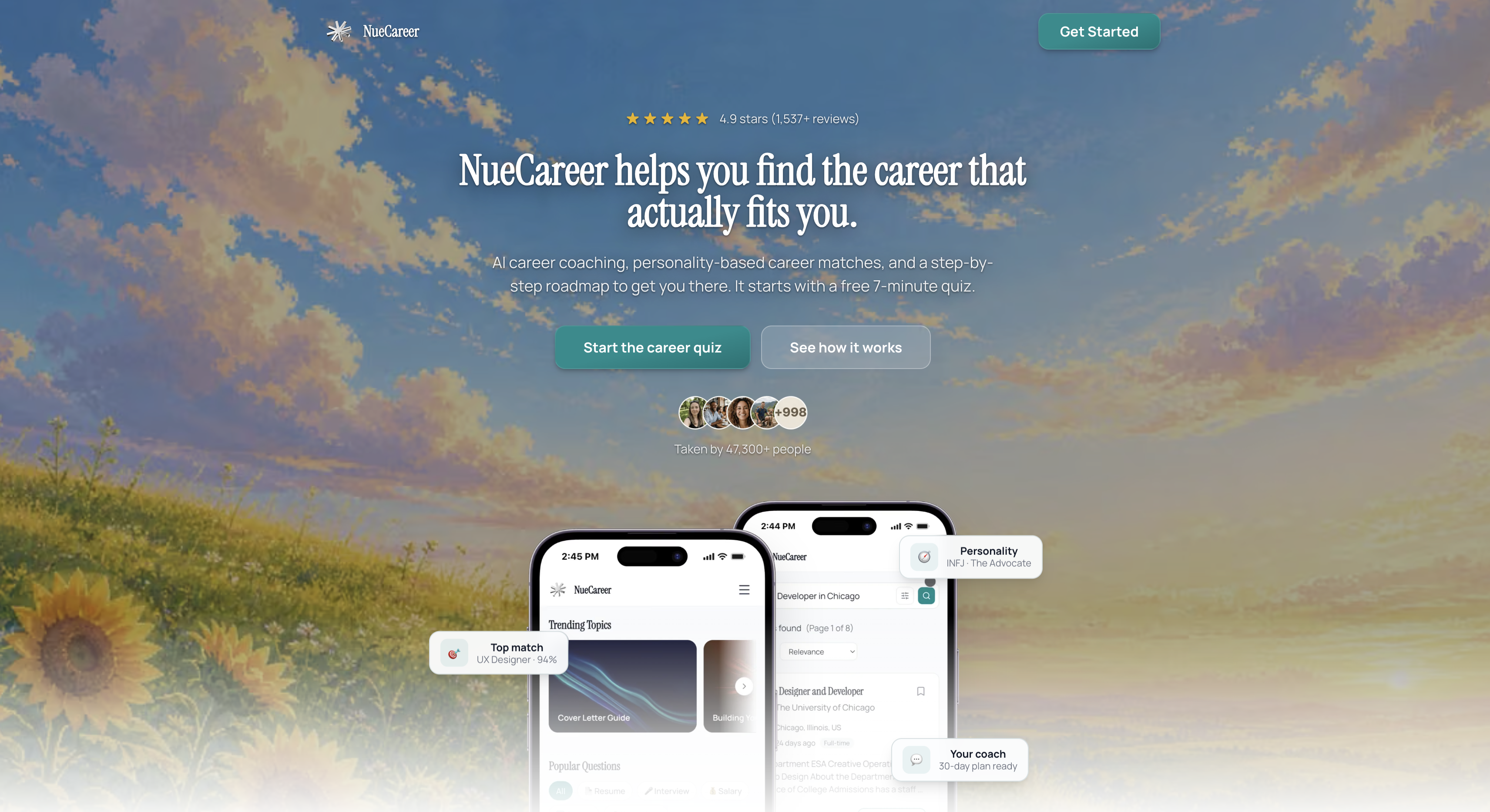
You can take the 7-minute career quiz to see your matches, or look at the full NueCareer platform to see how the pieces fit together. If you are weighing training routes, our guides to part-time career change courses, workforce development programs and apprenticeships for adults cover the main paths.
A simple decision rule
Use this order when you are deciding what to earn:
- Pick the target role and read several current job postings.
- List what the postings require and mark which items you already prove with experience.
- Fill gaps with the cheapest relevant credential. A badge may be enough for a single tool. A certificate suits a field you are entering. A certification suits roles that name it.
- Stop when the gaps are covered. More credentials past that point add little, according to the Brookings findings.
- Show the credential next to experience on your resume, with a link.
If you are worried about looking overqualified rather than underqualified, our guide on turning overqualified into an advantage covers the other side of the same problem.
FAQ
Is a digital badge worth putting on my resume?
Yes, when it matches the role you are applying for. A badge shows a specific skill and can include a verification link, so a recruiter can confirm it quickly. Keep to the few that line up with the job posting and leave off unrelated ones.
Is a certificate as good as a degree?
They do different jobs. A degree is a traditional academic credential, and many roles still ask for one. A certificate shows completion of focused training, and employers often read it as initiative and continuous learning, per the UpSkill America interviews. In SHRM's 2023 recruiter study, skilled credentials could offset below-minimum education in some scenarios, but not insufficient experience.
What are examples of credentials?
Common examples include digital badges, microcredentials, industry or professional certifications, apprenticeship acknowledgments and course-completion certificates. Degrees and required occupational licenses are usually counted separately.
Do employers care more about skills assessments or experience?
Experience usually comes first. AARP's 2021 survey found 56% of employers rated prior experience very important, versus 31% for pre-employment tests. Assessments still matter, since many employers use them, and they help you identify strengths to highlight.
Should I get a badge, a certificate or a certification?
Start from the target role. If postings name a certification, that is the strongest match. If you need to show structured learning in a new field, a certificate fits. If you need to prove one tool or skill, a badge is enough.
Sources
- Asana Certification
- The credential boom is here, but which ones actually help workers (Brookings)
- What is a digital credential? (Stanford Online)
- The Advantages and Values of Digital Badges for Learners (University of Wisconsin-Madison)
- How to read a digital badge (Badging Commission)
- Hiring for Experience: Employer Attitudes Towards Skills and Credentials (AARP Research)
- Industry-Based Credentials Offer Manufacturing Workers Higher Pay (U.S. Census Bureau)
- Using Skills Assessments Over Education, Experience (SHRM)
- Recruiters Say Experience Top Factor in Applicant Evaluation (SHRM)
- Employer Insights on Digital Credentials and Skills (UpSkill America, Aspen Institute)
- How to Add Digital Badges and Certificates to Your Resume and LinkedIn (Oregon State University)
- The Rise of Alternative Credentials in Hiring (SHRM)