

The formats that work best for busy adults changing careers are short bootcamps, professional certificates, project-based microcredentials, and 4-day decision sprints, and most job-ready outcomes land somewhere between six weeks and six months. Before you enroll in anything, take a short skills assessment to identify your target role, then confirm the course you pick ends in a real portfolio project and an employer-recognized certificate.
TL;DR:
- Courses with portfolio projects or real-world deliverables are more effective for job readiness than certificates alone, especially in competitive fields.
- Short bootcamps suit individuals targeting tech or design roles but require a substantial weekly time investment over several months.
- Flexibility-focused online certificates are ideal for learners with limited time, typically completing in six to sixteen weeks, in fields like IT and digital marketing.
- The most valuable credentials combine certification with demonstrable projects, which significantly increase chances of securing interviews.
- Using personalized assessments and coaching can optimize course selection and improve transition timelines, especially when balancing full-time work.
Table of Contents
- Career Change Courses: Which Format Fits Your Life?
- How to Choose the Right Course for Your Situation
- What to Expect: Timelines and Outcomes by Course Type
- How Nuecareer Helps You Choose and Apply
- What Actually Matters When You're Short on Time
- Ready to Match Your Strengths to a Course That Fits?
- Sources
- FAQ
Career Change Courses: Which Format Fits Your Life?
Not every course format solves the same problem, and that's the part most comparison lists skip. Some formats exist to build a skill from scratch. Others exist to sharpen a skill you already have into something employers will pay for. Knowing which one you need saves months.
Short bootcamps (cohort-based, intensive) run for several months and typically demand a substantial weekly time commitment on top of a full-time job. They fit best for career changers targeting IT support, data analytics, or UX design, where structured curriculum and peer accountability matter more than flexibility. The tradeoff is real: cohort schedules don't bend around your work calendar.
Professional certificates (platform-paced) are the workhorse option for people who need flexibility more than structure. Programs on marketplaces like Coursera and edX let you move at your own speed, and many wrap up in six to sixteen weeks at five to ten hours a week. These programs are built around fields already seeing steady demand: IT, data analytics, cybersecurity, project management, and digital marketing.
Project-based microcredentials matter for one reason: they force you to produce something. A certificate proves you sat through content. A finished project, a dashboard, a case study, a small app, proves you can do the job. When comparing two similar programs, the one with a graded, portfolio-ready deliverable almost always wins the resume comparison later.

4-day or weekend sprints solve a different problem entirely: clarity, not skill-building. These intensive programs prioritize decision frameworks and advisor feedback over content consumption, and they're built for professionals who already have transferable experience but need help pointing it at the right target. Research on high-impact career pivots backs this up. Structured decision sprints tend to produce faster clarity than passive course-browsing.
Finally, don't overlook local trade and licensing programs when your target field requires one (healthcare technician roles, certain skilled trades). And if budget is the real obstacle, state workforce and talent programs often list funded or subsidized training you can apply for directly.
How to Choose the Right Course for Your Situation
Picking a course backward from your bank account or a flashy ad is how people waste four months. Pick forward from the job instead.
- Name the target role first. Look at three real job postings for the role you want and note the recurring required skills, not the nice-to-haves.
- Match course outputs to that role. If the postings mention a portfolio or GitHub link, the course needs a project component, not just a quiz-based certificate.
- Check the weekly time cost against your actual schedule. A 20-hour-a-week bootcamp is not compatible with a demanding full-time job and two kids. Be honest here.
- Verify the credential's weight. Ask whether the certificate is recognized by employers in that field or just recognized by the platform selling it. Programs built around employer-recognized credentials and portfolio components tend to carry more weight in hiring conversations.
- Confirm what happens after you finish. Does the program offer coaching, resume review, or job-placement support, or does it end the moment you get the certificate?
- Price it against funding options. Ask directly about refund windows, payment plans, scholarships, and whether your current employer offers a tuition benefit before you assume you can't afford it.
Pro Tip: Email the program's admissions team one specific question: "Can you show me an example project a recent graduate submitted for hire?" Vague answers are a signal to keep looking.
What to Expect: Timelines and Outcomes by Course Type
Time-to-job varies a lot by format, and vague promises like "learn to code in weeks" rarely hold up. Here's what's realistic.
- 4-day sprints: four intensive days, often 6 to 8 hours daily, aimed at clarity and a concrete next step rather than a finished skill set.
- Part-time certificates (6 to 16 weeks): five to ten hours weekly; ends with a portfolio-ready project or applied certificate suited to IT support, data analytics, or digital marketing roles.
- Bootcamps (3 to 6 months): 15 to 25 hours weekly; positions graduates for junior UX design, entry-level data analyst, or project coordinator roles.
- Trade and licensing certificates: timelines vary by state and field, often three to twelve months depending on required clinical or supervised hours.
Employers increasingly validate readiness through tangible proof, not transcripts: a project repository, a live case study, a GitHub link, or a verified digital badge. A certificate alone rarely closes the gap. The combination of certificate plus visible project work is what moves a resume from "maybe" to "interview."
How Nuecareer Helps You Choose and Apply
Picking a format is only half the problem. Knowing which format fits you is the other half, and that's exactly where most career changers stall out.
Nuecareer's 7-Minute Career Quiz maps your existing strengths to realistic career paths, including roles you probably haven't considered, and points you toward the course format that fits your timeline and goals. From there, the platform builds around your next move:
- A personalized roadmap sequencing which skills to build first and which courses match them
- 24/7 coaching chat for questions that come up mid-course, not just at the start
- Resume and cover letter tools that translate a new certificate or project into language hiring managers recognize
- Transition timelines that set realistic expectations instead of vague promises
The goal is reducing the guesswork between "I finished a course" and "I got an interview."
What Actually Matters When You're Short on Time
Most career-change advice treats every course the same way, as if a certificate itself is the prize. It isn't. What moves the needle is a demonstrable project tied to a real target role, not a logo on a certificate. If you're working full-time, protect your income by pairing part-time coursework with small, applied projects rather than chasing a full-time bootcamp you can't sustain. Coached feedback and iterative practice applications consistently outperform solo, unguided study. Start with a seven-minute assessment to figure out where your strengths actually point before you spend a dollar on tuition.
— Shane
Ready to Match Your Strengths to a Course That Fits?
Most career-change guides stop at "pick a course." Nuecareer starts a step earlier: figuring out which career path actually fits your strengths before you spend time or money on the wrong program.
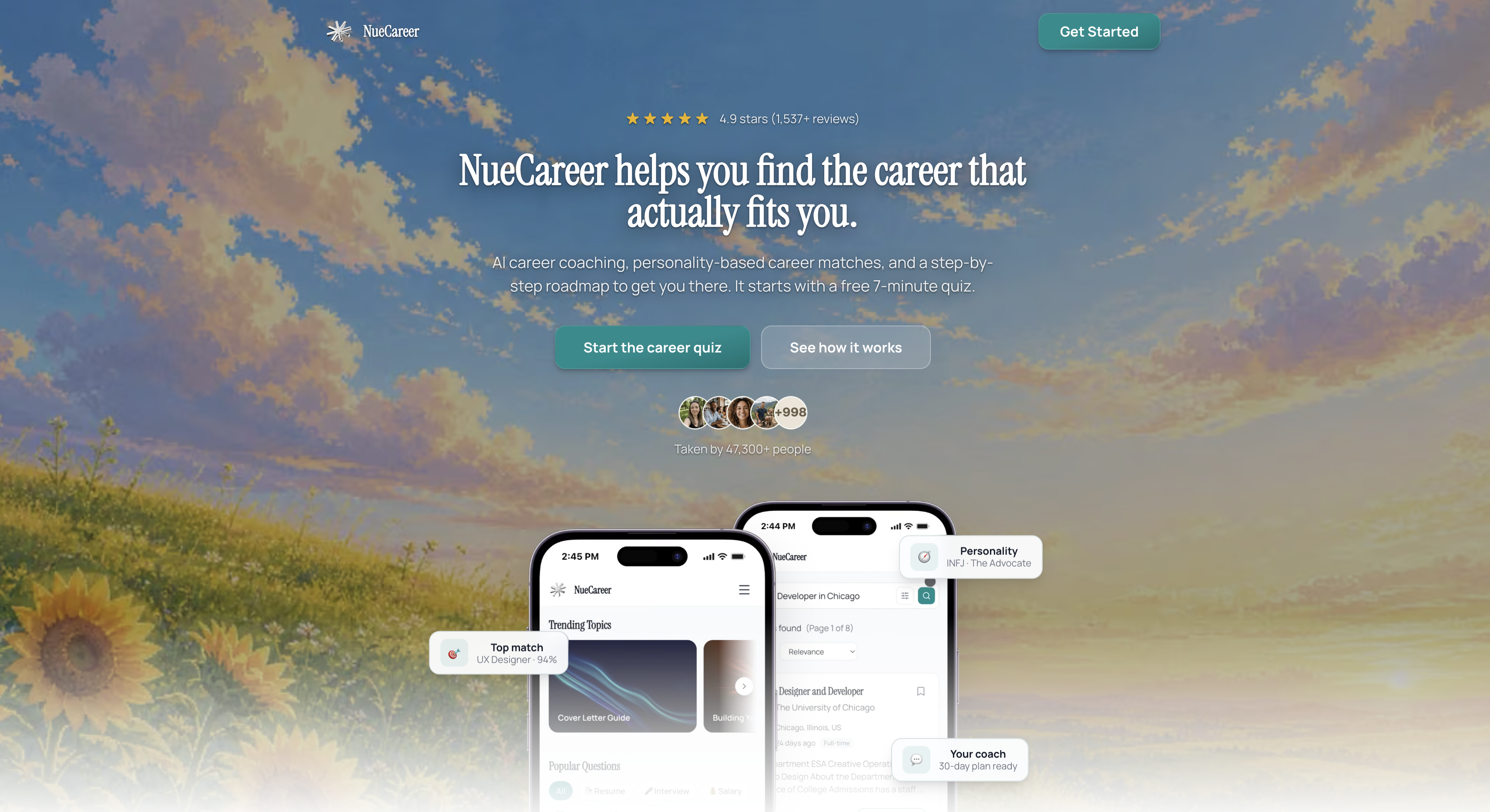
The 7-Minute Career Quiz takes your answers and matches them to career paths, some you've likely never considered, then points you toward the course format (bootcamp, certificate, or sprint) that fits your timeline. From there, Nuecareer's roadmap tools turn that course or project into an actual application: resume language that reflects your new skills, cover letter drafts, and 24/7 coaching chat for the moments you get stuck. If you're also rebuilding your resume around new coursework, this guide to career change resumes walks through exactly how to frame it. Take the quiz now and see which paths match your strengths before you commit to a single course.
Sources
- Make your high-impact career pivot | Effective Altruism
- Job Training Programs for Career Transition - Merit America
- Top online courses for career changers on edX
FAQ
Which course is best for a career change?
There's no single best course. The right pick depends on whether you need to build a new skill (a bootcamp or certificate) or gain clarity on direction first (a decision sprint), so taking a short assessment before choosing saves wasted months.
How can I make $10,000 a month with no degree?
No course guarantees a specific income, and treating any program as a shortcut to a fixed number is a mistake. Focus instead on high-demand fields like data analytics, cybersecurity, or project management, where employer-recognized certificates and a strong project portfolio drive earning potential over time.
What is the 30-30-30 rule for career change?
There's no widely established or standard "30-30-30 rule" in career transition research, and definitions vary depending on the source, so it's worth treating any version you encounter with caution rather than as settled advice.
What trade can I learn in three months?
Some trade and technical certificate programs, particularly in healthcare-adjunct roles or entry-level IT support, can be completed in around three months, though timelines vary by state licensing requirements and program intensity. Always confirm the exact hours and supervised training required before enrolling.
Do employers actually recognize online career change certificates?
Employers increasingly value certificates paired with visible project work, such as a portfolio, case study, or verified digital badge, over a certificate alone. Programs built around employer-recognized credentials and applied projects tend to carry more weight in hiring decisions than content-only courses.