
Workforce Development Programs: Change Careers in 2–6 Months, U.S.

U.S. workers: Learn how paid workforce development programs, strengths assessments, 24/7 coaching, and application tools can help you switch careers in...
Workforce development programs, in the sense that matters for a working adult ready to switch careers, are paid subscription platforms that pair a strengths assessment with personalized coaching, roadmaps, and job-search tools. If you are standing at that crossroads right now, the fastest way to get real direction is to take a short strengths assessment like the 7-Minute Career Quiz and let it build you a starting roadmap, informed by solid labor-market data from sources like the Occupational Outlook Handbook.
TL;DR:
- Most career platforms include a strengths assessment that matches your skills to specific job paths, with personalized roadmaps and realistic timelines.
- Evaluation should focus on assessment validity, roadmap specificity, coaching responsiveness, and measurable progress indicators before subscription commitment.
- Realistic career change timelines range from one to two weeks for exploration, four to twelve weeks for training, and another four to twelve weeks for active applying.
- Success depends on actively using the platform’s tools, building targeted resumes, and engaging in networking, especially for uncovering unadvertised opportunities.
- Combining subscription-based programs with outside resources like mentoring and industry-specific training often yields better results than relying solely on online tools.
Table of Contents
- What paid workforce development programs actually include
- How to evaluate and choose a subscription career platform
- What a realistic career change timeline looks like
- How to get more out of your subscription
- The different types of workforce development programs
- How to tell if a workforce development program is actually working
- What effective career support can look like in practice
- Support services that go beyond coaching and tools
- Addressing employment barriers within workforce development
- Where workforce development is headed next
- How NueCareer fits into your career change
- Subscriptions versus piecemeal tools: an honest take
- FAQ
- Sources
What paid workforce development programs actually include
When you pay for a career platform, you are buying structure for a process that otherwise feels shapeless. The best subscriptions give you a repeatable system instead of a pile of generic advice, and that system usually includes a handful of core pieces.
A strengths assessment, like the 7-Minute Career Quiz, starts the process by identifying what you are naturally good at and matching that profile to career paths, including ones you might never have considered on your own. From there, a personalized roadmap translates your results into a sequence of steps tied to a specific target role, with a realistic timeline attached rather than a vague "follow your passion" message.
Coaching is where most platforms differentiate themselves. Some offer 24/7 chat support so you can ask a question the moment it comes up, while others schedule periodic sessions. Either model can work, but the coaching should feel responsive, not like a one-time phone call followed by silence.
Rounding out a solid subscription:
- Application tools that include a resume builder, an ATS compatibility checker, and cover letter generation.
- Mock interview practice that lets you rehearse answers before they count.
- A job board filtered to roles that match your assessment results, not a generic aggregator feed.
Each piece solves a different bottleneck in a career change. Skip one and you will likely feel it later, usually right when you are trying to turn interest into an actual interview.
How to evaluate and choose a subscription career platform
Not every platform calling itself a "career development" tool delivers the same value, so it helps to test before you commit to a year of payments.
- Check assessment validity. Does the quiz produce specific, distinct role suggestions, or does it return the same three generic careers everyone gets?
- Look at roadmap specificity. A good roadmap names target roles, skill gaps, and a rough timeline, not just "update your resume and network more."
- Examine the coaching model. Ask whether coaching happens through scheduled calls, on-demand chat, or both, and how quickly you can expect a response.
- Review the toolset breadth. Confirm the subscription includes resume, cover letter, and interview preparation tools rather than linking out to other paid services.
- Ask about measurable outcomes. A platform should be able to describe how it tracks your progress, even informally, like applications sent or mock interviews completed.
During a seven to fourteen day trial, actually complete the assessment, generate one roadmap, and send a message to coaching support to see how fast you hear back. Ask directly about cancellation terms, refund policy, who the coaches are, how your data is handled, and whether job matches reflect the current U.S. labor market.
Pro Tip: If a platform cannot explain in one sentence how it measures your progress, treat that as a signal to keep looking.
Watch for red flags: no mention of measurable outcomes, coaching described only in marketing language, or a job board that never seems to update with real U.S. openings.
What a realistic career change timeline looks like
A career change rarely happens in a straight line, but most paid platforms map it to four rough phases. Exploration, where you complete an assessment and settle on one or two target roles, typically takes one to two weeks. Skills gap work and any needed training usually run four to twelve weeks, depending on how far the new role is from your current one. Active applying tends to take another four to twelve weeks or longer, and the offer and negotiation phase can move quickly once it starts.
Inside a subscription, you can track your own milestones:
- Finishing your assessment and reviewing your matched roles.
- Completing a personalized roadmap for at least one target role.
- Applying to a set number of roles each week rather than sporadically.
- Logging a few mock interviews before a real one is scheduled.
How fast you move depends on the size of the leap, your prior experience, and how much networking you do along the way, which is often the biggest variable of all.
How to get more out of your subscription
Paying for a platform does not automatically speed up your search. The readers who move fastest treat the subscription as a toolkit they actively use, not a service that works passively in the background.
Start by using your assessment results to name your transferable skills in plain language, then build a short learning plan around the one or two gaps that matter most for your target role. From there, lean into networking. The Bureau of Labor Statistics points out that networking and informational interviews are especially valuable for career changers because they help cover gaps that do not show up on paper and surface openings that are never advertised. A short, low-pressure way to start: reach out to one person in your target field and ask three questions, what a typical week looks like, what skill matters most that is not on the job posting, and who else they would recommend you talk to.
When you apply, tailor every resume and cover letter to the specific posting, run it through an ATS checker, and write a role-specific summary instead of recycling the same document everywhere. Use mock interview practice to refine your stories so they land clearly under pressure, not just on paper.
Finally, cross-check your platform's guidance against outside data. The Occupational Outlook Handbook is a reliable place to confirm wages, required training, and job outlook for hundreds of occupations before you commit months of effort to one direction.
Pro Tip: Treat your first week of networking messages like a small experiment: send five, see what comes back, and adjust your questions before sending five more.

The different types of workforce development programs
Paid subscription platforms are one option among several, and it helps to know where they sit relative to the others. Government-funded programs, often run through state workforce agencies and funded under federal law, provide free job training, career counseling, and sometimes short-term certificates, usually targeted at specific eligibility groups. Nonprofit programs frequently serve a similar role, offering free or low-cost coaching and training tied to a particular community or industry sector.
Employer-sponsored programs sit on the other end, built around tuition assistance, internal mentoring, or structured upskilling for current employees moving into new roles within the same organization.
Paid subscription platforms differ from all three in one key way: they are built for an individual who wants a self-directed, centralized experience rather than one tied to an employer, a government program's eligibility rules, or a nonprofit's local service area. The Bureau of Labor Statistics notes that free assessments are available through career centers, and that a range of paid and free tools exist alongside them, including short-term certificate programs where appropriate. The right starting point depends mostly on whether you want structure that comes from an institution or a flexible tool you control yourself.
How to tell if a workforce development program is actually working
Because a career change is personal, success looks different for every subscriber, but a few signals tend to hold up. The clearest one is momentum: are you applying to more targeted roles each week than you were a month ago? A second signal is interview conversion, whether your resume and cover letter revisions are translating into more callbacks relative to the applications you send.
A third, less obvious signal is clarity itself. If a platform helps you go from "I don't know what I want to do" to naming two or three specific target roles within the first couple of weeks, that is a meaningful outcome even before a single application goes out.
Beyond your own progress, it is reasonable to ask a platform how it defines success internally, whether that is roadmap completion rates, coaching response times, or job board match quality. A platform that can describe its own measurement approach, even informally, is more trustworthy than one that simply promises results without explaining how it tracks them.
What effective career support can look like in practice
Rather than inventing hypothetical success stories, it helps to think through what a well-used subscription actually accomplishes across a typical transition. Someone moving from retail management into project coordination, for example, might use an assessment to surface organizational and people-management strengths they had undervalued, then build a roadmap that targets entry-level coordinator roles while studying for a relevant certification in parallel.
Someone else shifting from teaching into instructional design might use a specialized assessment to connect classroom experience directly to curriculum development skills, shortening the translation work that normally makes a career change feel so uncertain. The 7-Minute Career Quiz is built for exactly this kind of pattern matching, surfacing roles a reader might not have considered without seeing their strengths mapped out plainly.
What both examples share is not luck but structure: a clear starting assessment, a roadmap with named target roles, and consistent application activity guided by that roadmap rather than by guesswork.
Support services that go beyond coaching and tools
A career change rarely happens in isolation from the rest of your life, and the strongest programs, paid or otherwise, account for that. Mentoring matters because it gives you a sounding board beyond scripted coaching sessions, someone who has made a similar jump and can speak to what actually mattered along the way.
Financial considerations also shape how far someone can stretch their job search before needing income again. Some government and nonprofit programs include financial aid or stipends tied to training completion, which paid subscriptions generally do not replace. Practical barriers like childcare and transportation are often the quiet reason a job search stalls, and while a subscription platform cannot solve those directly, local workforce agencies and nonprofit programs frequently build support for them into their services.
Recognizing which of these gaps apply to you helps you decide whether a subscription alone is enough, or whether it makes sense to pair it with a local resource that can cover what a software platform structurally cannot.
Addressing employment barriers within workforce development
People carrying extra barriers into a job search, including disabilities, veterans transitioning out of military service, and workers from underrepresented groups, often need more than a generic roadmap. Government and nonprofit workforce programs frequently build dedicated services for these groups directly into their design, from accommodations and assistive technology to veteran-specific career counseling.
Paid subscription platforms can still play a useful role here, particularly through assessments that surface transferable skills a veteran or career changer might not think to list on a traditional resume, military experience translated into civilian job language is a common example. Coaching can also help someone navigate disclosure decisions around a disability during an application process, though that kind of guidance works best alongside, not instead of, specialized legal or disability-employment resources when the situation calls for them.
The honest takeaway is that no single platform, paid or free, solves every barrier on its own. Combining a subscription's structure with targeted outside resources tends to serve these readers better than relying on either alone.
Where workforce development is headed next
Technology has reshaped how career support gets delivered, and the shift shows no sign of slowing. Virtual coaching, once a compromise compared to in-person counseling, is increasingly the default, partly because it fits around a full-time job far more easily than a scheduled office visit.
AI-assisted tools are showing up across resume writing, interview preparation, and even initial career matching, compressing tasks that used to take hours into minutes. That speed is valuable, but it works best paired with real coaching judgment rather than replacing it entirely; an algorithm can suggest a resume phrase, but it cannot fully weigh your specific history the way a coaching conversation can.
Subscription platforms are also moving toward more continuous, always-on support models instead of one-time counseling sessions, reflecting how career changes actually unfold: in bursts of activity spread across weeks, not a single tidy meeting. Expect that trend to keep deepening as more working adults treat career navigation as an ongoing need rather than a one-time life event.
How NueCareer fits into your career change
If you have read this far, you already know what a solid subscription career platform needs to include, and that list is exactly what we built. Our 7-Minute Career Quiz identifies your strengths and matches you to career paths, including ones you may never have considered, and from there we give you a personalized roadmap, 24/7 coaching chat, and a job board tailored to your target roles.
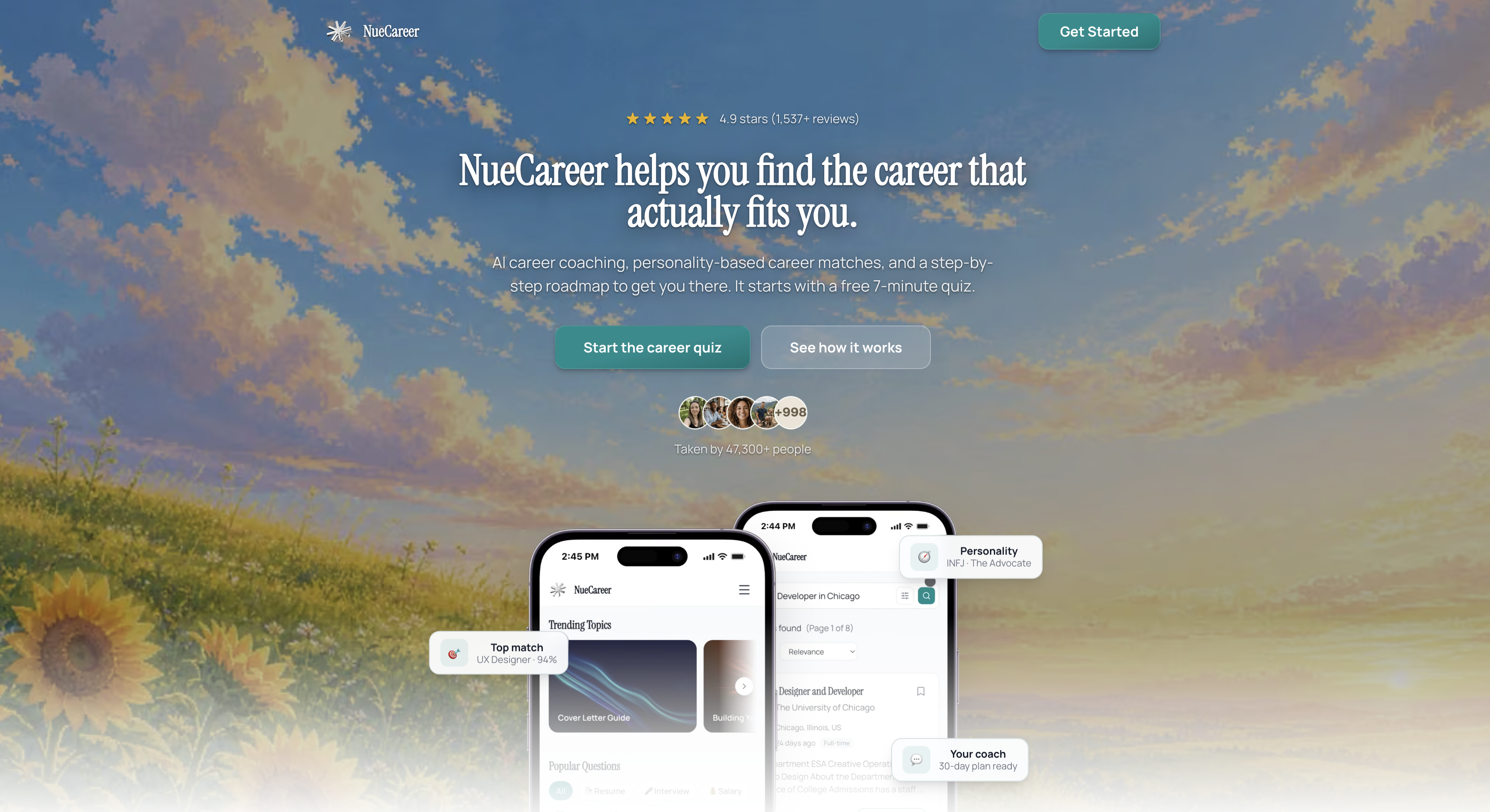
A full suite of application tools can help so you are not juggling separate subscriptions for each step:
- Resume rewrites and an ATS checker that flags formatting issues before a recruiter ever sees them.
- A cover letter generator built around your specific target role.
- Mock interview practice to help you walk into the real one prepared.
| What you need | What we provide |
|---|---|
| Strengths assessment | 7-Minute Career Quiz |
| Career matching | Personality-based career matches |
| Transition plan | Personalized transition roadmap |
| Ongoing support | 24/7 AI career coaching |
| Application tools | Resume, cover letter, and ATS tools |
If your target path is something more specialized, say aviation, a roadmap approach can work the same way: match your strengths, then point you toward concrete next steps, including industry-specific training programs like flight school pathways for aspiring pilots when appropriate.
The simplest next step is the one we opened with: take the 7-Minute Career Quiz and see what roadmap it builds for you.
Subscriptions versus piecemeal tools: an honest take
Stitching together a free quiz here, a resume template there, and an interview guide somewhere else works for some people, but it tends to multiply the number of decisions you have to make alone. A bundled subscription with coaching shortens that process because one coach can see your whole picture, not just one fragment of it. Free tools are fine for a light first look. For an actual transition, test one small paid step before committing further.
— Shane
FAQ
What counts as a workforce development program for career changers?
In this context, it means a paid subscription platform that combines a strengths assessment, personalized roadmap, coaching, and job-search tools built for individual working adults changing careers. It differs from government-funded or employer-run training programs, which serve different audiences and eligibility rules.
How long does a typical career change take once I start?
Exploration usually takes one to two weeks, skills gap work and training run roughly four to twelve weeks, and active applying often takes another four to twelve weeks or more. The total timeline depends heavily on how large a leap you are making and how much you network along the way.
Are free career tools enough, or do I need a paid subscription?
Free tools work well for a first look at your options, but a paid subscription tends to centralize assessments, coaching, and application tools in one place instead of scattering them across separate services. Whether you need that structure depends on how stuck you feel and how much guidance you want along the way.
What should I ask before committing to a career platform subscription?
Ask about the cancellation and refund policy, how coaching works day to day, how your data is handled, and whether job matches reflect current U.S. roles. A platform that cannot clearly answer these questions is worth reconsidering.
Does NueCareer replace networking and informational interviews?
No, and it is not meant to. Coaching and roadmaps inside NueCareer work best alongside active networking, which labor market research consistently points to as one of the most effective tactics for career changers.
Sources
Before committing to a new path, confirm the details with the Occupational Outlook Handbook for wages, tasks, and training, and cross-check with CareerOneStop or O*NET for skill and training alignment.
- New year, new career: 5 tips for changing occupations : Career Outlook: U.S. Bureau of Labor Statistics
- How to find a job : Occupational Outlook Handbook : U.S. Bureau of Labor Statistics