
U.S. Candidates: Turn Overqualified Into an Advantage in 7 Minutes

Research backed tactics for U.S. candidates labeled overqualified. Signal commitment, tailor your résumé, and use the 7 Minute Career Quiz to target roles...
Being labeled overqualified is common but fixable, and it rarely has to be a dealbreaker. Your immediate next move is to prepare a short commitment story, one or two sentences that explain why this role fits your goals right now, and start revising your résumé to highlight fit over rank. Before you send another application, take the 7-Minute Career Quiz to clarify what you actually want, since that clarity will shape every choice that follows.
TL;DR:
- Roles in changing companies, smaller firms, or positions requiring mentorship are more receptive to overqualified candidates.
- Tailoring your résumé with clear targets, role-specific accomplishments, and matching keywords reduces overqualification signals effectively.
- Address concerns about motivation and tenure upfront in interviews by providing specific reasons for your interest and long-term commitment.
- Building a coherent motivation statement that explains why the role aligns with your goals helps overcome employer hesitation about overqualification.
- Using targeted networking and referrals can bypass the overqualified filter, giving you access to hidden opportunities less influenced by concerns over experience level.
Table of Contents
- Why employers call applicants overqualified
- How to choose roles worth applying for and build a commitment story
- Résumé and cover letter tactics that reduce overqualified signals
- Interview scripts that show you're a motivated, long-term hire
- Deciding whether to accept a role below your level
- Our take on being overqualified
- Prepare tailored applications with NueCareer's tools
- Sources
- FAQ
Why employers call applicants overqualified
When a hiring manager flags you as overqualified, they are rarely questioning your ability. They are worried about what happens after you're hired. Four concerns come up again and again: they assume you will demand a higher salary than the role pays, they worry you will leave the moment something better appears, they suspect you will get bored in a role built for someone earlier in their career, and they wonder whether you will struggle reporting to someone with less experience than you.
These worries are backed by real data. SHRM's research on over- and underqualified hiring found that salary expectations and mismatched titles are the signals recruiters notice first, and that 75% of them name short tenure as their biggest concern when hiring someone overqualified.
A significant majority of recruiters say short tenure is their top concern when hiring an overqualified candidate, according to SHRM's research. That single number explains most of the pushback you will encounter, and it tells you exactly what to address in your application.
The intensity of these concerns depends on the type of role. In knowledge-intensive work, like strategy, analysis, or specialized technical roles, employers tend to be more open to hiring someone with a deeper background, because the extra experience shows up in the quality of the work. In routine or highly structured roles, the same experience can read as a mismatch, since there is less room for your judgment to matter day to day.
- Salary expectations: employers assume you will ask for more than the role pays.
- Short tenure: employers fear you will leave once a better offer appears.
- Boredom or role mismatch: employers worry the job will not challenge you.
- Reporting structure: employers wonder if you will resist direction from a less experienced manager.
How to choose roles worth applying for and build a commitment story
Not every job that looks like a step down actually is one. The trick is targeting roles where your extra experience solves a problem the employer already has, rather than roles where it just sits unused.
- Look for complexity behind a simple title, roles at companies going through change, turnarounds, rapid growth, or a messy transition period, where judgment matters more than the job description suggests.
- Favor teams that need mentoring, since a role that includes training junior staff turns your background into a stated part of the job rather than a liability.
- Consider smaller companies, where flexible job descriptions mean your added skills often expand the role instead of clashing with it.
- Read the posting for warning signs: a heavily scripted job description, rigid hour-by-hour tasks, or language emphasizing "entry-level only" usually signals a poor fit.
Once you've identified a promising role, you need a short line that answers the unspoken question before anyone asks it. Keep it to one or two sentences, and use a version of it in your cover letter, your LinkedIn outreach, and the top of your résumé.
A workable script looks like this: "I'm targeting this role because it lets me focus on [specific work] without the management overhead of my last position, and I'm committed to staying and growing here." Adjust the specifics, but keep the structure: what you want, why this role gives it to you, and a direct statement of intent to stay.
Pro Tip: Name the trade-off you're making on purpose, like trading a management title for hands-on technical work, so the employer hears a deliberate choice instead of a fallback.
For roles that never get posted publicly, targeted outreach and referrals matter even more. CV Made Better's guide to the hidden job market covers how direct networking can put you in front of decision makers before a listing exists, which sidesteps the overqualified filter altogether. Our guide on prioritizing roles instead of mass applying walks through how to narrow your list before you start sending anything.
Résumé and cover letter tactics that reduce overqualified signals
Your résumé should never hide what you've done. Research from the Annual Review synthesis on overqualification found that honesty paired with role-focused editing and clear commitment signals outperforms leaving experience off entirely. Reframe your background rather than erase it.
Start with a summary line that states your target directly instead of listing every title you've held. Group older or more senior roles under a single "Earlier Experience" heading with a brief description, rather than giving them the same weight as your most recent positions. Choose accomplishments that map to the job posting's language, and swap high-level strategy language for specifics that match the role you want next.
- Lead your summary with the role you want, not the title you're leaving behind.
- Collapse two or three senior positions into one "Earlier Experience" block with a short description.
- Match keywords from the job posting so applicant tracking systems don't filter you out before a person sees your résumé.
- Cut accomplishments that emphasize managing large teams if the target role is individual contributor work.
Your cover letter carries the weight your résumé can't. A simple four-part formula works well: state your motivation for this specific role, connect two or three relevant skills to what the posting asks for, add a one-line commitment statement, then close with a clear call to action requesting a conversation.
Recruiters cite salary expectations and title mismatch as the top signals of an overqualified candidate, according to SHRM's hiring research, which is exactly why your cover letter should address motivation before anyone has to ask about it. AARP's guidance on being labeled overqualified makes a similar point: tailor the content, don't strip it out.

Our career-change résumé guide has more detail on this kind of restructuring, and the Cover Letter Generator can help you draft the motivation-to-commitment structure quickly.
Interview scripts that show you're a motivated, long-term hire
The words "you seem overqualified for this" will come up in an interview eventually, so it helps to have an answer ready rather than improvising one under pressure.
- When asked directly, acknowledge the concern instead of deflecting it: "I understand why my background raises that question. Here's specifically why this role fits what I want right now, and here's how long I'm planning to stay."
- Reframe your experience as problem-solving capacity rather than rank: describe a time your background let you catch an issue or move faster than someone without it would have.
- Ask the interviewer about learning opportunities, rotation programs, or how the role has evolved for past employees, since these questions signal genuine interest in growth within the company rather than using it as a placeholder.
- Ask what success looks like in the first 90 days and how performance gets measured, which shows you're thinking about contribution, not just title.
On salary, tie your flexibility to a stated timeline rather than an open-ended concession. Something like: "I'm comfortable starting at this range given what the role offers in [specific benefit], and I'd want to revisit compensation after a defined review period" keeps the conversation grounded and shows you've thought it through. Our piece on convincing an employer to hire you as a career changer has more language for this kind of conversation.
Deciding whether to accept a role below your level
Sometimes the right move is to take the job anyway, but it helps to run the numbers and the growth signals before you do. Overeducated employment carries a real cost: BLS's review of the research found that more than a third of college graduates experience overeducated employment at some point, with wage penalties of 2.6% to 4.2% lasting roughly four years in the studies it examined. That's a meaningful trade-off to weigh against benefits, schedule, location, or stability.
Before accepting, look for signals the role can actually grow with you:
- A documented path to promotion, not just a verbal promise.
- Stretch assignments or projects beyond the base job description.
- A named mentor or manager invested in your development.
- Measurable KPIs tied explicitly to advancement or pay review.
Growth dissatisfaction, not pay alone, is what tends to push people to leave. Research in the Journal of Business and Psychology links perceived overqualification to actual turnover through dissatisfaction with growth, with pay softening that effect somewhat. If you do accept, set milestones for yourself at 3, 6, 12, and 18 months, with a plan to either grow into more responsibility or move on with a stronger résumé than the one you started with.
Our take on being overqualified
Most advice on this topic treats overqualification as a flaw to disguise. We think that's backward. The candidates who move the fastest through this barrier are the ones who stop apologizing for their background and start being specific about what they want next.
A strengths-based approach changes the conversation entirely. Instead of asking "how do I look less experienced," the better question is "which roles actually need what I bring." When someone takes a structured look at their strengths, energy, and priorities, the roles that once looked like a step down often turn out to be a genuine match, not a compromise. That reframing does more to reduce hiring hesitation than any résumé trick.
The gap between what you offer and what a role asks for isn't a problem to hide. It's information you can use to pick better targets.
The 7-Minute Career Quiz exists for exactly this moment: to help you name what you're actually looking for before you spend more time applying to roles that were never going to fit.
— Shane
Prepare tailored applications with NueCareer's tools
Being overqualified stops being a wall once you have the right tools to show fit instead of just experience. NueCareer's platform was built around that idea, and it maps directly to the steps in this article.
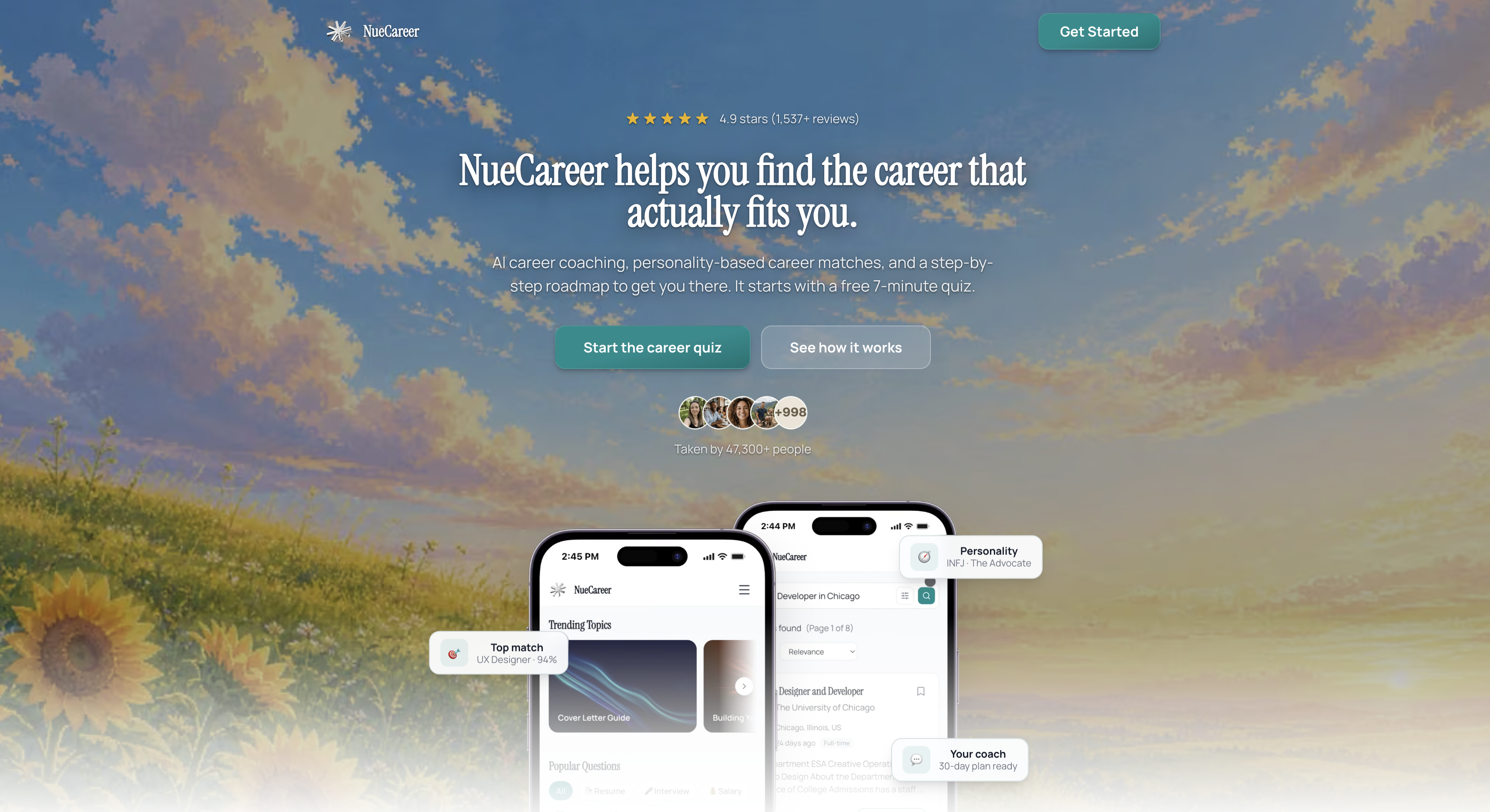
Start with the 7-Minute Career Quiz to identify what actually matters to you in your next role, since that clarity shapes everything from your résumé summary to your interview answers. From there:
- Use the ATS Resume Checker to confirm your role-focused résumé passes automated screening before it reaches a person.
- Try the job-application-skills tool to generate the specific skills and keywords that match your target postings.
- Draft your motivation-to-commitment cover letter with the Cover Letter Generator.
- Practice your "you're overqualified" answer with mock interview practice before it comes up for real.
Take the quiz, see your matches, and build your next application around a role that actually fits, not just one you're settling for.
Sources
This article draws on SHRM's over- and underqualified hiring research for employer concerns and hiring signals, BLS's analysis of overeducated employment for wage penalty data, and the Annual Review synthesis on overqualification for how commitment signals shift hiring reactions. Additional context comes from the Express Employment/Harris Poll on how many employers consider overqualified applicants.
- SHRM — Over- and Underqualified Hiring Research Report
- Annual Review — Overqualification literature review
- U.S. Bureau of Labor Statistics — analysis on overeducation
FAQ
Do employers reject overqualified candidates?
Not usually, but many hesitate. Express Employment's 2025 poll found that 70% of U.S. hiring managers say they typically consider overqualified candidates, though concerns about motivation and turnover remain common.
What is the 70/30 rule in hiring?
This isn't a formally defined standard in hiring research, so definitions vary depending on who's using the term. If you've seen it referenced for overqualified hiring specifically, treat it as informal advice rather than an established rule, and focus instead on addressing the documented concerns around salary fit and retention.
How do I overcome being overqualified for a job?
Address the concern directly with a short commitment statement explaining why the role fits your goals, then tailor your résumé and cover letter to highlight relevant accomplishments over rank or title. Pairing that with targeted interview answers about growth and staying power, as covered in the Annual Review's research, tends to work better than downplaying your background.
What does it mean to be overqualified for a job?
Being overqualified means your experience, education, or skill level exceeds what a role typically requires, which can lead employers to worry about salary expectations, engagement, or how long you'll stay. It doesn't mean you're a poor fit, since context, motivation, and how you frame your background all shape the outcome.
Is it worth taking a job I'm overqualified for?
It depends on what the role offers beyond title and pay, including growth paths, stability, schedule, or location. Research on overeducated employment shows a wage penalty of 2.6% to 4.2% lasting around four years, so it helps to weigh that cost against concrete advancement signals before accepting.