
Map Your Strengths vs Skills in 7 Minutes for Job Seekers

See how strengths differ from skills and use that insight to choose jobs that energize you. Try NueCareer's 7 Minute Career Quiz to map fit.
A skill is something you learn to do a task well; a strength is a pattern of thought or behavior that energizes you and fuels performance over time. The practical takeaway: use skills to judge whether you can do a job, and use strengths to judge whether you'll thrive in it. Confuse the two and you end up chasing roles that look good on paper but drain you by Wednesday.
TL;DR:
- Skills are learnable abilities that can be measured and acquired through experience, while strengths are natural patterns that energize and sustain you.
- Many skills do not automatically qualify as strengths, as a person might find tasks draining despite being proficient at them.
- Highlighting strengths in resumes and interviews demonstrates genuine motivation and long-term suitability, unlike simply listing skills.
- Using assessments and daily task logging can help identify personal strengths by revealing activities that energize and come easily.
- Focusing on strengths first can streamline job searches and career transitions, as roles are a better fit when they align with your natural patterns.
Table of Contents
- Strengths vs Skills: What Each Term Actually Means
- Real Examples: Strengths and Skills Side by Side
- How Strengths, Skills, and Competencies Fit Together
- How to Identify Your Own Strengths and Skills
- Putting the Difference to Work on Resumes and in Interviews
- Should You Develop a New Skill or Lean Into a Strength?
- Why Getting This Distinction Right Changes How You Job Search
- Try NueCareer's Free Tools to Map Your Strengths and Skills
- Sources
- FAQ
Strengths vs Skills: What Each Term Actually Means
The confusion usually starts because both words describe things you're "good at." But they answer different questions, and mixing them up leads people to build careers around abilities that quietly exhaust them.
A skill is a learnable ability tied to a task or body of knowledge. You acquire it through instruction, repetition, or experience, and you can usually measure it. Excel modeling, public speaking, coding in Python, active listening. All skills. The European Commission's Joint Research Centre defines skill as the ability to apply knowledge to complete tasks, which is why skills show up so cleanly on resumes and certifications.
A strength is different. It's a consistent pattern, often present since childhood or developed over years of practice, that produces energy rather than draining it. According to the University of Reading Careers Centre, strengths are things you're naturally good at that also energize you, while skills are learned and measured separately from how they make you feel.
Here's the boundary case that trips people up: a skill isn't automatically a strength just because you're competent at it.
- You can be an excellent public speaker (skill) and still find every presentation emotionally draining.
- You can be a strong strategic thinker (strength) without ever having taken a strategy course.
- You can develop a skill through sheer repetition at a job you dislike, which explains why some talented people burn out doing work that looks perfect from the outside.
Real Examples: Strengths and Skills Side by Side
Seeing the two side by side, in the same domain, makes the distinction click faster than any definition can.
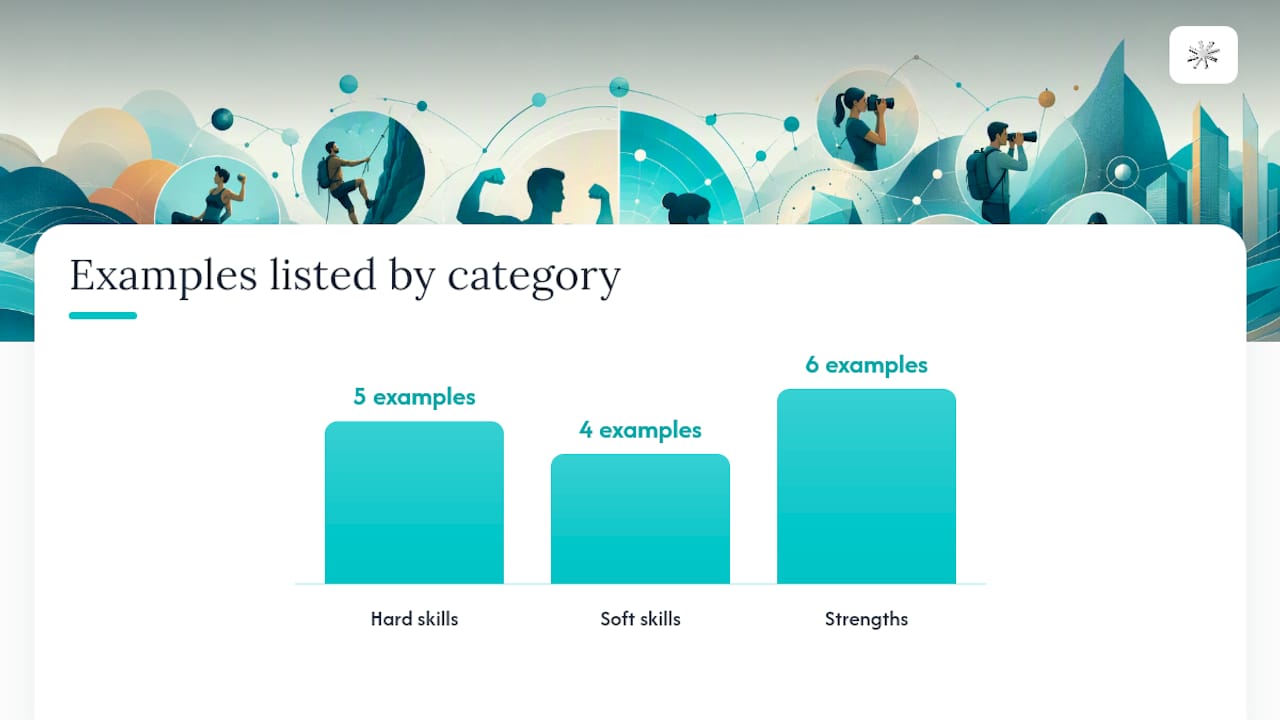
Common hard skills: financial modeling, SQL, graphic design software, medical coding, a foreign language. Common soft skills: delegation, negotiation, time management, conflict resolution. Common strengths: empathy, strategic thinking, adaptability, curiosity, decisiveness, persistence.
Now pair them by domain:
- Writing. The skill is grammar, structure, and editing technique, all trainable. The strength might be a natural pull toward storytelling that makes drafting feel effortless instead of exhausting.
- Sales. The skill is running a CRM and following a pitch script. The strength might be genuine curiosity about people's problems, which makes discovery calls energizing rather than performative.
- Management. The skill is running a performance review using a template. The strength might be an instinct for reading team morale before it becomes a problem.
Pro Tip: Run the "Tuesday afternoon test." Picture doing the task at 3 p.m. on a slow Tuesday, no deadline pressure. If you feel lighter afterward, that's a strength. If you feel competent but flat, it's just a skill, and that's fine to know.
How Strengths, Skills, and Competencies Fit Together
Job postings throw around "skills," "competencies," and occasionally "strengths" as if they're interchangeable, and that sloppiness costs candidates interviews when they misread what's actually being asked for.
A competency is broader than a skill. It's a combination of knowledge, skills, and attitudes applied successfully in a specific context. The ATD blog frames it this way: competency models bundle behaviors and attitudes on top of raw skill, which is exactly why they're harder to measure with a single test or certification.
A simple way to hold the three terms in your head:
- Skill answers "can you perform this task?"
- Competency answers "can you consistently apply the right skills, judgment, and behavior in this role?"
- Strength answers "does doing this energize you enough to sustain it?"
So when a job description says "strong stakeholder management competency," it usually means a blend of communication skill, situational judgment, and reliable behavior under pressure, not a single trainable technique. Strength sits underneath all of it as the driver that determines whether you'll still want to do that work in three years.
How to Identify Your Own Strengths and Skills
Most people can list their skills without much trouble. Strengths are trickier because they feel too automatic to notice, which is exactly why a structured exercise beats guessing.
- Keep a two-week activity log. Each evening, jot down two or three tasks from the day and rate each on two axes: proficiency (how well you did it) and energy (how you felt afterward). Patterns emerge fast. Tasks that score high on both are strengths in action; high proficiency with low energy flags a skill you've mastered but shouldn't build a whole role around.
- Run a feedback audit. Ask three people, ideally a manager, a peer, and someone outside work, one question: "What do you notice I do without being asked?" People rarely volunteer strengths unprompted, but they'll name them instantly when asked directly.
- Try a simple 9-box grid. Plot each task from your log on a 3x3 grid: proficiency (low, medium, high) against energy (low, medium, high). The top right box, high proficiency and high energy, is your strength zone. Everything else is a skill worth having but not a foundation to build a career around.
- Take a structured assessment. NueCareer's 7-Minute Career Quiz is built for exactly this step. It maps your answers to strengths patterns and matches them against career paths, including ones you may not have considered, which is often faster than a solo journaling exercise.
Pro Tip: If your activity log and your feedback audit disagree, believe the feedback audit. People are notoriously bad at rating their own energy in the moment but very good at spotting a colleague's natural strengths from the outside.
Once you have a working list, a free career skills assessment can help you separate the skills you've built from the gaps still worth closing.
Putting the Difference to Work on Resumes and in Interviews
A resume built entirely on skills reads like a checklist. A resume that shows how a strength drives those skills toward results reads like a person a hiring manager wants on their team.
- Resume bullet points should still lead with skills and quantified outcomes: "Managed a $2M vendor budget using advanced Excel modeling, reducing costs by 12%." That's skill-first, and it should stay that way in bullets, which get scanned in seconds.
- Summary statements are where strengths belong: "A detail-driven analyst who thrives on finding cost inefficiencies before they become budget problems." That single line signals both competence and fit.
- Tailor the language to the posting. If a job description repeats "collaboration" and "cross-functional," that's a competency signal. Mirror it, but back it with a specific skill and a specific strength so it doesn't read as filler.
For interview answers, use a simple framework: name the strength, tie it to a skill you used, and close with a measurable result. "I've always been energized by solving ambiguous problems (strength). I applied that by building a forecasting model from scratch in Excel (skill), which cut our reporting time by 30%." According to Indeed's career advice, strengths-based interview techniques specifically probe what energizes a candidate, not just what tasks they've completed, so an answer that only lists tasks misses what the interviewer is actually listening for. NueCareer's guide on answering strengths and weaknesses questions walks through more scripts if you want to practice this before a real interview.
Should You Develop a New Skill or Lean Into a Strength?
This is the decision that actually shapes a career, and most people never make it consciously. They just take whichever opportunity shows up first.
Weigh four factors before committing time to either path:
- Market demand. A skill in high demand (data analysis, a specific software platform) can justify a short-term investment even if it's not a natural strength, especially early in a career.
- Role fit. If a target role requires daily use of a skill that drains you, no amount of proficiency will make that job sustainable long term.
- Energy cost. Skills you've mastered through repetition but that leave you flat are the ones most likely to cause burnout, even when your performance reviews look great.
- Timeline to impact. A focused skill sprint (a few weeks of deliberate practice) can close a resume gap fast; redesigning a role around your strengths is a slower, higher-payoff move.
The trap to watch for is what shows up repeatedly in career coaching: people get good at a task, get asked to do more of it, and end up defined by a skill that was never a strength in the first place. Balancing strength alignment with targeted skill building, rather than picking one permanently, is what sustains momentum over a full career, a point echoed in James Cook University's employability guidance. If you're weighing a specific skill gap right now, AnyLearns' guide to identifying skill gaps offers a useful way to diagnose which gaps are worth closing versus which ones you should route around.
Why Getting This Distinction Right Changes How You Job Search
The gap between what people think they need to fix and what actually needs fixing is usually a strengths problem disguised as a skills problem. Someone stuck in their search assumes they need another certification when the real issue is they've been applying to roles that use their skills but ignore their strengths entirely. That mismatch is exhausting in a way no amount of skill-building resolves.
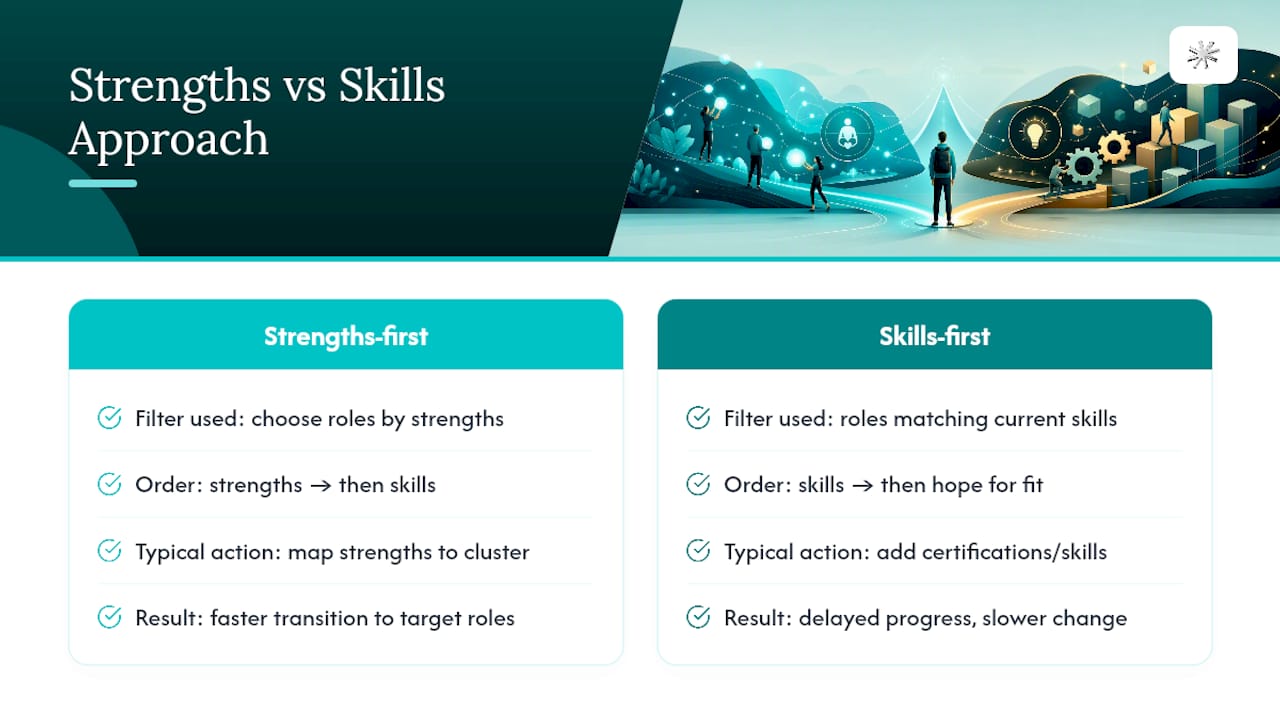
What tends to work is treating strengths as the filter for which roles to pursue, and skills as the filter for whether you're ready to pursue them. Someone who maps their natural strengths to a career cluster first, then identifies the specific gap skills needed for a target role, moves through a transition faster than someone who starts by cataloging every skill they own and hoping a role appears. That's the order that holds up across career changes, not just entry-level searches.
Where I'd push back on conventional advice: most career guidance treats skill-building as the default answer to feeling stuck. It's often the wrong first move. If you can't name your top three strengths with confidence, adding another certification just delays the real question.
— Shane
Try NueCareer's Free Tools to Map Your Strengths and Skills
NueCareer gives you a faster path to the self-assessment work covered above, without the two weeks of journaling. The 7-Minute Career Quiz does what the activity log and feedback audit are designed to surface, just compressed into a short set of questions that identify your natural strengths and match them to career paths, including ones you haven't considered yet.
Once you have your results, pair them with the free career skills assessment to see exactly which skills you already have covered and which ones stand between you and a target role. If you're still unsure which direction fits, the 16 Career Clusters tool breaks down broad fields by the strengths that tend to thrive in them. From there, NueCareer builds a personalized roadmap, so instead of a generic list of "skills to develop," you get a plan built around what actually energizes you. Start with the quiz, see your matches, and decide your next move from there.
Sources
- Defining skill and competence — European Commission (JRC)
- Strengths vs skills — University of Reading Careers Centre
- Understanding the difference between skills and strengths — Indeed
FAQ
Are skills and strengths the same thing?
No. A skill is learned and measurable, like coding or budgeting, while a strength is a natural pattern that energizes you, according to the University of Reading Careers Centre. Some skills overlap with strengths, but many don't.
What are examples of strengths and skills?
Common skills include data analysis, negotiation, and a foreign language. Common strengths include empathy, strategic thinking, adaptability, and persistence, most of which show up as consistent patterns across different jobs, not single trainable tasks.
What are five examples of personal strengths?
Five widely recognized strengths are empathy, decisiveness, curiosity, adaptability, and persistence. Each shows up as a repeated behavior pattern rather than something you studied to acquire.
What is a good answer when asked about your three strengths?
Name three strengths, then tie each to a specific example with a measurable outcome, rather than listing adjectives alone. A framework like "strength, skill applied, result" performs better in interviews because it shows what energizes you, not just what you're capable of doing, which is exactly what strengths-based interview techniques are designed to surface. NueCareer's 7-Minute Career Quiz can help you identify which three to lead with if you're not sure.