

TL;DR:
- Career quizzes measure interests, personality traits, and values but do not assess abilities or guarantee success in specific fields. They expand awareness, boost confidence, and serve as hypotheses for further exploration rather than definitive answers. Effective use involves multiple assessments, real-world testing, and pairing results with skill evidence to guide informed career decisions.
Career quizzes are self-assessment tools that measure your interests, personality traits, and values to help you identify career paths that align with who you are. Formally called career assessments or interest inventories, these tools have been used in career counseling for decades. Frameworks like Holland's RIASEC model and the Big Five personality inventory form the scientific backbone of the most trusted versions. Platforms like Coursera and Indeed now offer free, accessible versions that take under ten minutes to complete. Understanding why career quizzes are useful means understanding what they actually do well and where their limits begin.
How do career quizzes promote career exploration and confidence?
Career quizzes increase the number of career options you actively consider. That sounds simple, but it has a measurable impact. A 2026 Frontiers in Psychology review found that RIASEC-based self-assessment tools reliably boost exploration behaviors and expand the range of occupations people seriously investigate. This matters because most adults exploring career options tend to default to familiar paths rather than discovering roles that might suit them better.

The confidence benefit is equally real. The same body of research, drawing on a meta-analysis by Whiston et al. (2017), reports medium effect sizes for career decision-making self-efficacy (d = 0.45) and career maturity (d = 0.40). A d value of 0.45 is a meaningful shift in how certain and capable someone feels about making career decisions. That kind of confidence is what moves people from stuck to searching.
The mechanism behind this is person-environment fit theory. When your traits align with the characteristics of an occupational environment, career satisfaction follows. Career quizzes give you a structured way to map your traits before you invest time or money in a specific direction.
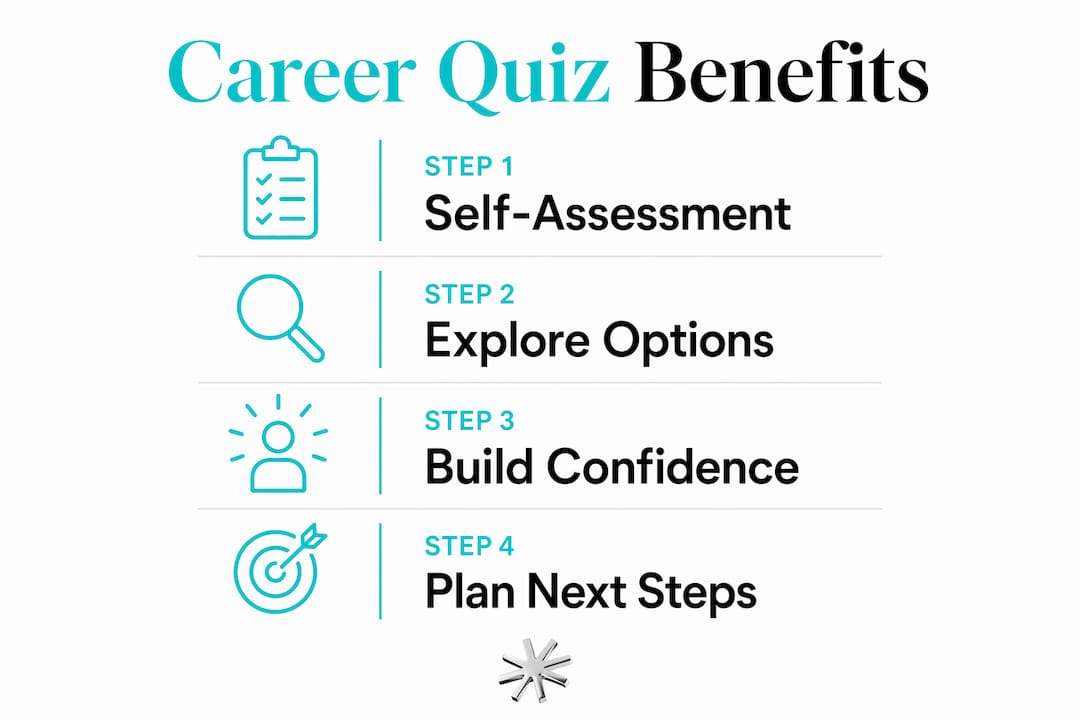
Here is what career quizzes do well in practical terms:
- Expand your awareness of roles you have never considered
- Reduce decision paralysis by giving you a concrete starting point
- Increase self-efficacy so you feel capable of making a choice
- Lower the time barrier to starting your exploration
Pro Tip: The Coursera career quiz uses 20 multiple-choice questions and delivers results in 5 to 10 minutes. If you have been putting off career exploration because it feels overwhelming, this is a low-stakes way to start.
One important clarification: quizzes build clarity and confidence, but they do not remove structural barriers like financial constraints, geographic limits, or credential requirements. They are a thinking tool, not a problem-solving tool.
What are the limitations of career quizzes you should know?
Career quizzes inventory your preferences, not your abilities. This distinction matters more than most people realize. UC Davis Student Health and Counseling Services states directly that career assessments measure interests, values, and personality traits but do not measure aptitudes. Liking the idea of surgery does not mean you have the manual dexterity or academic capacity for it. Confusing interest with ability is one of the most common and costly mistakes in career planning.
Not all quizzes are created equal. The Myers-Briggs Type Indicator (MBTI) is one of the most widely used personality tools in the world, yet MBTI faces reliability concerns because a significant portion of people receive a different type when retested weeks later. Frameworks with stronger research backing include the Big Five personality model and Holland's RIASEC code. When choosing a quiz, the scientific foundation matters.
"Quiz results are best understood as hypotheses about fit, not verdicts. They point you toward territory worth exploring, not destinations you are guaranteed to reach." This framing, supported by both the Frontiers 2026 review and UC Davis guidance, is the most honest and productive way to use any career assessment.
There are a few specific limitations worth keeping in mind:
- Preference bias: You answer based on how you see yourself today, which may not reflect your full potential
- Context blindness: Quizzes cannot account for labor market conditions, salary realities, or industry trends
- Self-report distortion: People sometimes answer how they wish they were, not how they actually are
- Single-snapshot problem: One quiz taken on one day captures a moment, not a trajectory
Pairing quiz results with real aptitude evidence from actual tasks and experiences is what separates useful self-knowledge from wishful thinking. A quiz can tell you that you are drawn to creative problem-solving. Your portfolio, feedback from colleagues, and past project outcomes tell you whether you are actually good at it.
How to use career quizzes effectively
Getting value from a career quiz requires more than clicking through questions and reading the results. The output is a starting point. What you do next determines whether it changes anything.
Take more than one quiz. A single result is a data point. Three or four results from different frameworks, such as a RIASEC interest inventory, a Big Five personality assessment, and a values inventory, start to reveal patterns. Consistent themes across multiple assessments are far more meaningful than any single career title a quiz suggests.
Treat results as an exploration checklist. If a quiz suggests you might thrive in healthcare management or UX research, your next step is not to enroll in a program. It is to schedule an informational interview with someone in that role, shadow them if possible, or take a short online course to test your genuine interest.
Connect quiz insights to lived experience. Look back at moments when you felt energized and effective at work or in life. Do those moments align with what the quiz identified? If your RIASEC code suggests investigative and artistic tendencies, think about when those tendencies showed up naturally. That alignment is meaningful evidence.
Validate with skill evidence. Use a free career skills assessment alongside your quiz results to identify where your interests and actual strengths overlap. That overlap is where the most promising career directions tend to live.
Revisit and iterate. Career exploration is not a one-time event. Your interests, values, and circumstances evolve. Taking assessments at different life stages often reveals shifts that are worth paying attention to.
Pro Tip: When reviewing your results, focus on the themes and patterns rather than the specific job titles. A quiz might suggest "architect," but the real signal might be that you love spatial thinking, structured creativity, and long-term project ownership. Those traits apply to dozens of careers.
The greatest value of career quizzes is turning vague interests into concrete exploration steps. That process supports career clarity and identity development in ways that passive reflection rarely does.
How do different types of career assessments compare?
Not every career quiz serves the same purpose. Understanding the differences helps you choose the right tool for where you are in your exploration process.
| Assessment type | Primary focus | Best used for | Example tools |
|---|---|---|---|
| Interest inventories (RIASEC) | Work preferences and environments | Early exploration, broadening options | Holland Code quiz, O*NET Interest Profiler |
| Personality assessments (Big Five) | Behavioral tendencies and traits | Understanding work style and fit | NEO-PI-R, free Big Five tests |
| Skills assessments | Demonstrated and transferable abilities | Identifying strengths and gaps | Nuecareer skills assessment, LinkedIn Skills |
| Values inventories | Core motivators and priorities | Evaluating long-term career satisfaction | Work Values Inventory, career values quizzes |
| Career aptitude tests | Combination of personality, skills, interests | Initial sense of job fit across dimensions | Indeed career aptitude tests |
Interest inventories are the right starting point if you feel genuinely lost about direction. They cast the widest net. Personality assessments add depth once you have a few directions in mind, helping you understand how you would likely function in different environments. Skills assessments are most useful when you are narrowing down options and need to know where you stand relative to role requirements. Values inventories are underused but often the most clarifying, especially for adults who have tried careers that looked good on paper but felt hollow in practice.
The best career assessment tools combine more than one of these dimensions, which is why multi-part assessments tend to produce more useful outputs than single-focus quizzes.
Key takeaways
Career quizzes are most valuable as exploration tools that build self-knowledge and confidence, not as definitive career prescriptions.
| Point | Details |
|---|---|
| Quizzes expand exploration | RIASEC-based tools reliably increase the number of occupations you actively consider. |
| Confidence gains are real | Research shows medium effect sizes on career decision-making self-efficacy and maturity. |
| Preferences are not aptitudes | Quizzes measure what you like, not what you are capable of. Pair results with skill evidence. |
| Framework quality matters | Big Five and Holland RIASEC have stronger research backing than MBTI. |
| Results are hypotheses | Treat quiz outputs as starting points for informational interviews and real-world testing. |
Why I think most people misuse career quizzes
I have seen a consistent pattern over the years. Someone takes a career quiz, gets a result like "environmental scientist" or "graphic designer," and either dismisses it entirely because it feels unrealistic or latches onto it as a revelation. Both reactions miss the point.
The quiz did not tell you to become a graphic designer. It told you that you are drawn to visual thinking, creative autonomy, and aesthetic problem-solving. That signal applies to product design, marketing strategy, architecture, film production, and a dozen other fields. The job title is a placeholder. The underlying traits are the real information.
What I have found actually works is using quiz results to generate questions, not answers. When a result surprises you, that surprise is worth investigating. If a quiz suggests you might thrive in a social or enterprising environment and your first reaction is "that's not me," ask yourself why. Sometimes the resistance reveals something true. Sometimes it reveals a limiting belief you have been carrying for years.
The other pitfall I see constantly is treating a single quiz as a complete picture. No assessment captures the full complexity of a person. The career clusters quiz at Nuecareer is a good example of a tool designed to broaden your thinking rather than narrow it to one answer. That is the right orientation.
Career exploration is an ongoing practice, not a problem you solve once. The adults who navigate it best are the ones who stay curious, test their assumptions in real situations, and update their understanding as they go.
— Shane
Take your next step with Nuecareer
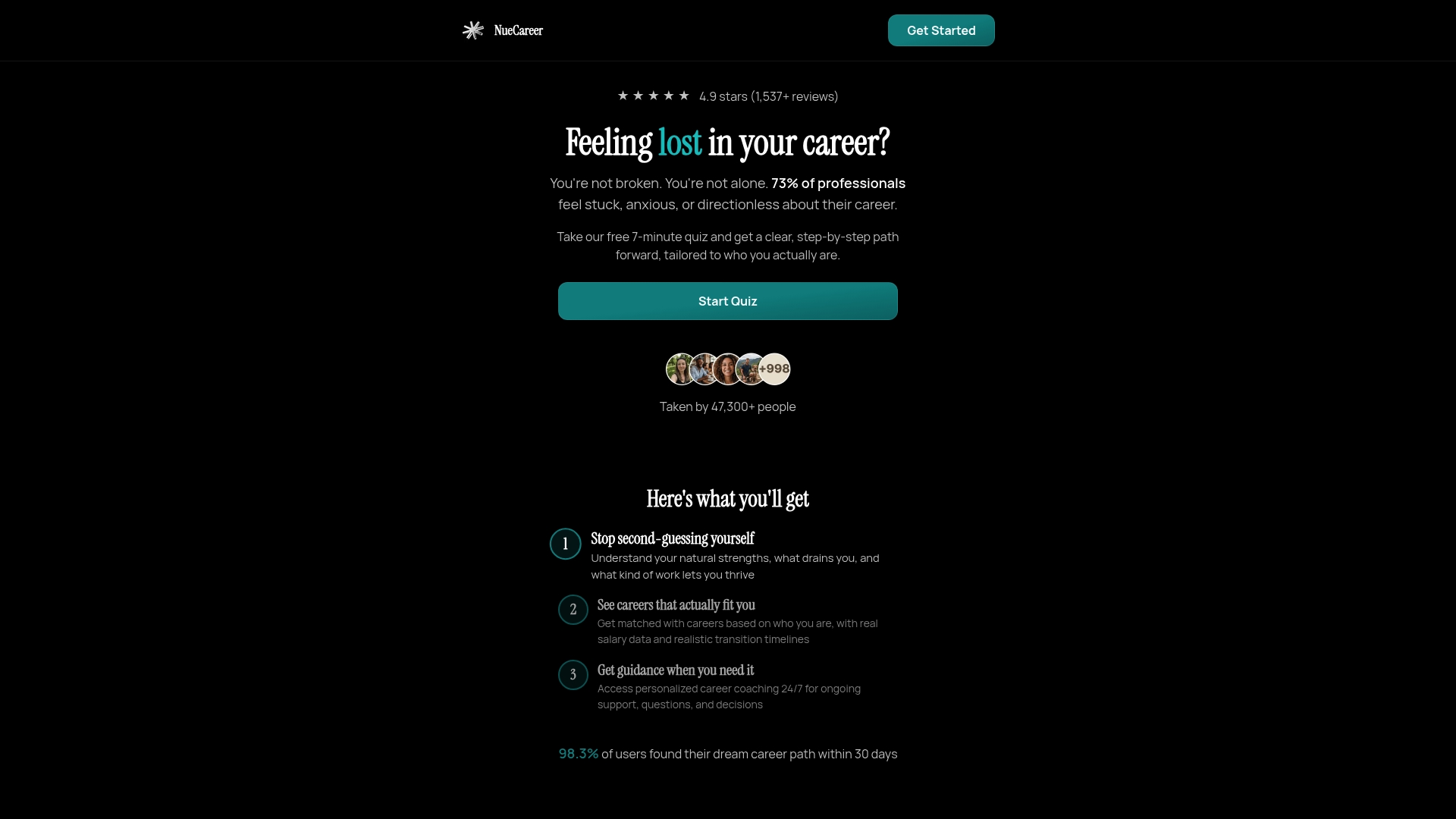
Career quizzes give you direction. Nuecareer gives you the full path forward. The 7-minute Nuecareer quiz identifies your strengths and matches you to career paths built around who you are, including roles you have never considered. From there, the platform provides personalized roadmaps, 24/7 coaching chat, and job boards tailored to your target roles. You can also use the free career skills assessment to see exactly where your strengths and gaps sit before you start applying. Everything you need to move from uncertain to confident is in one place.
FAQ
What are career quizzes actually measuring?
Career quizzes measure your interests, personality traits, and values. They do not measure aptitudes or predict guaranteed success in a specific field.
How reliable are career quiz results?
Reliability depends on the framework. Big Five and Holland RIASEC assessments have strong research backing. MBTI has known reliability concerns, with many people receiving different results when retested.
How many career quizzes should I take?
Taking three to four quizzes across different frameworks, such as interest inventories, personality tests, and values assessments, helps you identify consistent themes that are more meaningful than any single result.
Can career quizzes help adults who are already working?
Yes. Research shows that self-assessment tools improve career decision-making confidence and exploration behaviors for adults at any career stage, not just those entering the workforce.
What should I do after taking a career quiz?
Use the results as an exploration checklist. Schedule informational interviews, research the suggested fields, and validate your interest with a skills assessment to see where your preferences and actual strengths overlap.