

Use AI as an assistant for research, drafting, and interview practice, not as a stand-in for your judgment. It works best when you translate your real skills into role-aligned language, tailor every application, and rehearse answers out loud. Pair it with a structured course and a habit of editing everything it produces, and it becomes one of the most useful tools in your search.
TL;DR:
- AI effectively summarizes company news and prepares interview questions but cannot verify if a company's culture is authentic or promotional.
- Using AI for resume editing and application matching requires careful human editing and verification to prevent generic, unoriginal, or inaccurate submissions.
- Tailoring applications by mapping your skills and emphasizing specific achievements yields better results than relying on AI-generated, broad-stroke drafts.
- The most successful job seekers focus on understanding their strengths first and then use AI to craft personalized materials, not to draft without self-knowledge.
- Recruiters are increasingly screening for AI fingerprints, favoring targeted outreach and live problem-solving exercises over generic, AI-produced resumes.
Table of Contents
- What AI Can (and Can't) Do for Your Job Search
- Use AI Without Torching Your Credibility
- Step-by-Step AI Workflows That Don't Sound Robotic
- Courses Worth Your Time to Learn AI-Assisted Job Searching
- How NueCareer Fits Into an AI-Assisted Search
- How AI Is Reshaping Hiring and the Job Market
- Why Most AI Job Search Advice Gets the Order Backwards
- Try NueCareer's Tools Alongside Your AI Workflow
- Sources
- FAQ
What AI Can (and Can't) Do for Your Job Search
Most AI job search tools fall into five buckets, and each one has a ceiling. Knowing where that ceiling sits saves you from a rejection you didn't need to earn.
- Research and company analysis: AI can summarize a company's recent news, culture signals, and likely interview questions in seconds. It cannot tell you whether the culture is real or aspirational marketing copy.
- Resume and cover letter drafting: AI is strong at tightening language and matching keywords to a job posting. It's weak at knowing which of your accomplishments actually matters, so it tends to flatten everything into generic corporate phrasing unless you feed it specifics.
- Job matching and application tracking: AI-powered aggregators can surface roles you'd never have searched for and flag postings that match your skill set. They still misjudge fit constantly, especially for career changers whose titles don't map cleanly to their next role.
- Interview simulation: Practicing answers with an AI interview coach builds fluency and cuts down on filler words. It won't replicate the read-the-room instinct a live interviewer triggers.
- Automation agents: Tools that auto-apply to dozens of postings save time but produce the kind of generic, un-tailored applications recruiters have started to notice and discount. Speed is not the bottleneck in most job searches. Relevance is.
The pattern holds across categories: AI accelerates the parts of a search that are mechanical, and it degrades the parts that require your judgment. Use it accordingly.
Use AI Without Torching Your Credibility
Recruiters are getting sharper at spotting AI fingerprints, and it's changing how they screen candidates. Some hiring teams have started leaning more on referrals and live problem-solving exercises specifically because generic AI-generated applications are becoming easier to identify, and a flood of interchangeable resumes has made recruiters wary of anything that reads too smooth and too vague at the same time.
The fix isn't avoiding AI. It's using it the way career experts recommend: as a drafting partner you then personalize, not a ghostwriter you submit unedited. Follow four rules every time:
- Always human-edit the output. Read it aloud. If it doesn't sound like you, rewrite the sentence yourself.
- Verify every factual claim. AI tools invent dates, job titles, and even certifications. Check anything specific before it goes out.
- Replace vague phrasing with specifics. Swap "led cross-functional initiatives" for the actual project name, the team size, and the result.
- Avoid mass, unedited applications. Spray-and-pray automation tends to backfire because recruiters notice the pattern across a talent pool, not just in a single resume.
On privacy: never paste a former employer's confidential data, a colleague's personal details, or your own Social Security number into a public AI chatbot. Most job search prompts don't need that information anyway.
Pro Tip: Keep a "voice check" folder. Save two or three writing samples that sound unmistakably like you, and compare any AI draft against them before you send it.
Step-by-Step AI Workflows That Don't Sound Robotic
The most effective approach starts with identifying your transferable skills before you touch a resume draft. Skills-first sequencing, rather than jumping straight to application copy, is what separates a tailored application from a templated one.
- Map your skills. Ask an AI tool to list transferable skills based on a plain-language summary of your last three roles. Cross-check the list against your own memory. AI often misses soft skills that don't appear in job titles.
- Analyze the target role. Feed the job posting into an AI tool and ask it to extract the top requirements and preferred qualifications. This tells you what to emphasize, not what to invent.
- Draft, then rewrite bullets. Use a prompt like "Rewrite this bullet to include a measurable outcome" and insert your actual numbers. Never let AI fabricate a metric.
- Build STAR answers for interviews. Ask AI to structure a rough story into Situation, Task, Action, Result format, then edit until it matches how you'd actually tell it out loud.
- Send outreach messages and track results. Draft two versions of a networking message, send each to a comparable set of contacts, and log response rates. A/B testing outreach and tracking replies is one of the most reliable ways to know whether your AI-assisted messaging is actually working, rather than just feeling productive.
Each step has a checkpoint where a human has to intervene. Skip the checkpoint and you get a technically correct application that says nothing about you.
Courses Worth Your Time to Learn AI-Assisted Job Searching
A good course doesn't just explain what AI can do. It hands you prompt templates and forces you to practice on your own materials instead of a hypothetical example.
- Google's Accelerate Your Job Search with AI runs four modules over roughly six hours self-paced: uncovering transferable skills, planning your search, managing applications, and interview prep, using tools like Gemini and Gemini Notebook throughout.
- The same curriculum, hosted on Coursera, works well if you prefer a structured, gradebook-style format with progress tracking rather than a standalone course page.
- University career center guides, like the tool roundups career offices publish, are useful for a quick orientation to tool categories, even if they're not full courses.
When comparing options, weigh time commitment against how hands-on the exercises are. A six-hour course that has you edit your own resume beats a two-hour video that only shows examples.
How NueCareer Fits Into an AI-Assisted Search
From there, NueCareer's tools map directly onto the workflow stages:
- A job description analyzer that extracts what a posting is actually asking for
- A cover letter generator tailored to that specific posting
- 24/7 coaching chat to catch the moments where a draft has drifted from your real voice
The gap in most AI job search advice isn't the technology. It's the missing step before the technology: knowing precisely what to tell it about yourself.
How AI Is Reshaping Hiring and the Job Market
The shift isn't just on the applicant side. Recruiters are adjusting how they screen and interview because AI has changed what a resume can signal.
When anyone can generate a polished, keyword-matched resume in minutes, the resume itself carries less weight than it used to. That's part of why hiring teams are leaning more heavily on referrals and live problem-solving exercises: they need a signal that's harder to fake than a well-formatted bullet point. Applicant tracking systems are also getting smarter about flagging patterns common to AI-generated text, which means the applications that stand out are the ones with specific, verifiable details AI wouldn't have known to invent.
For job seekers, this cuts two ways. AI has made it easier to apply to more roles faster, but it's made each individual application worth less unless it's genuinely tailored. The candidates gaining ground are the ones using AI to go deeper on fewer applications: researching a company's actual challenges, personalizing outreach to specific people, and walking into interviews prepared for the kind of live, unscripted questions that a template can't answer. The mass-application era isn't over, but its returns are shrinking fast, and that trend shows no sign of reversing.
Why Most AI Job Search Advice Gets the Order Backwards
Most guides tell you to open ChatGPT and start drafting. That's backwards, and it's why so many AI-assisted applications read the same. The research on this is consistent: the sequence that works starts with identifying your actual skills, then feeds that specific, verified material into AI for drafting, not the other way around.
The conventional advice treats AI as a shortcut past self-knowledge. It isn't one. AI can rewrite a sentence beautifully and still be rewriting the wrong sentence, because you fed it a vague summary of your career instead of a precise one. The candidates getting traction right now are doing something almost old-fashioned: they're spending real time figuring out what they're actually good at before they let a language model touch a single word of their application.
If you take one thing from this guide, prioritize the skills mapping step over the drafting step. A mediocre AI draft built on accurate self-knowledge will beat a polished AI draft built on a vague one, every time. Courses like Google's job search program get this right by putting skills discovery first. Most job seekers skip straight to module three.
— Shane
Try NueCareer's Tools Alongside Your AI Workflow
AI can draft, but it can't tell you what's true about your own experience. That's the piece NueCareer fills in. Start with the free quiz to get a clear read on your strengths and see career paths matched to who you actually are, some you may not have considered.
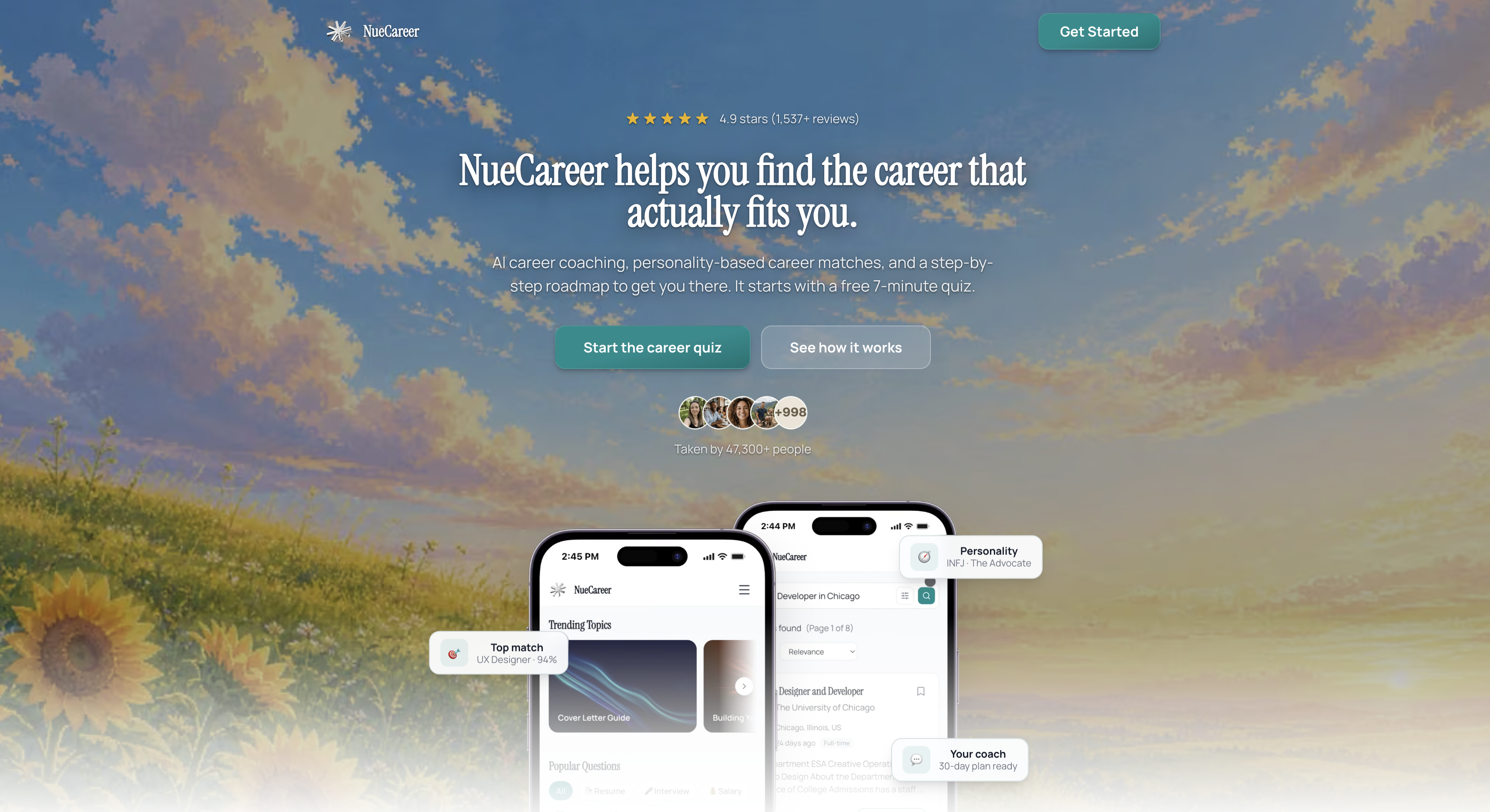
From there, run any job posting through the job description analyzer to see exactly what a role is asking for before you touch a draft, then use the resume summary tool or cover letter generator to produce a starting draft that already reflects your real background instead of generic filler. If a draft still feels off, the 24/7 coaching chat is there to help you edit it back into your own voice before it goes anywhere near a recruiter's inbox. Take the 7-minute quiz now and see what it surfaces about your next move.
Sources
- AI resumes are pushing recruiters back to referrals and live tests
- Accelerate Your Job Search with AI
- Google: Accelerate Your Job Search with AI (Coursera)
FAQ
Is There AI for Job Search?
Yes. AI tools now cover company research, resume and cover letter drafting, job matching, application tracking, and interview practice, though each category has real limits on accuracy and personalization.
Can ChatGPT Find Jobs?
ChatGPT can help you research companies, draft application materials, and prepare for interviews, but it doesn't have real-time access to live job postings unless paired with a search-enabled tool or plugin.
Which AI Agent Is Best for Job Search?
There's no single best agent. The strongest results come from combining a skills-mapping step, like the one NueCareer's quiz provides, with a drafting tool and a course that teaches the full workflow, such as Google's Accelerate Your Job Search with AI.
Do Employers Check if You Use AI?
Many recruiters now watch for generic phrasing and formatting patterns typical of unedited AI output, and some are shifting toward referrals and live exercises partly because of it. Editing AI drafts into your own voice is the best defense.