

A mid-career job search works best when you clarify your priorities first, sharpen your LinkedIn and resume, and run a targeted outreach campaign through your network and recruiters rather than mass-applying to job boards. Expect the process to take several months, typically a quarter to half a year. Your first three moves: rank what matters most to you right now, rebuild your resume around measurable accomplishments, and reconnect with five to ten trusted contacts who can open doors.
TL;DR:
- Prioritizing clear role filters based on specific factors like compensation, titles, and mission improves targeting more than broad applications.
- Reworking your LinkedIn headline and resume to focus on accomplishments and keywords enhances recruiter attention and ATS compatibility.
- Trusting warm contacts such as former managers and colleagues for referrals produces higher interview success than cold applying.
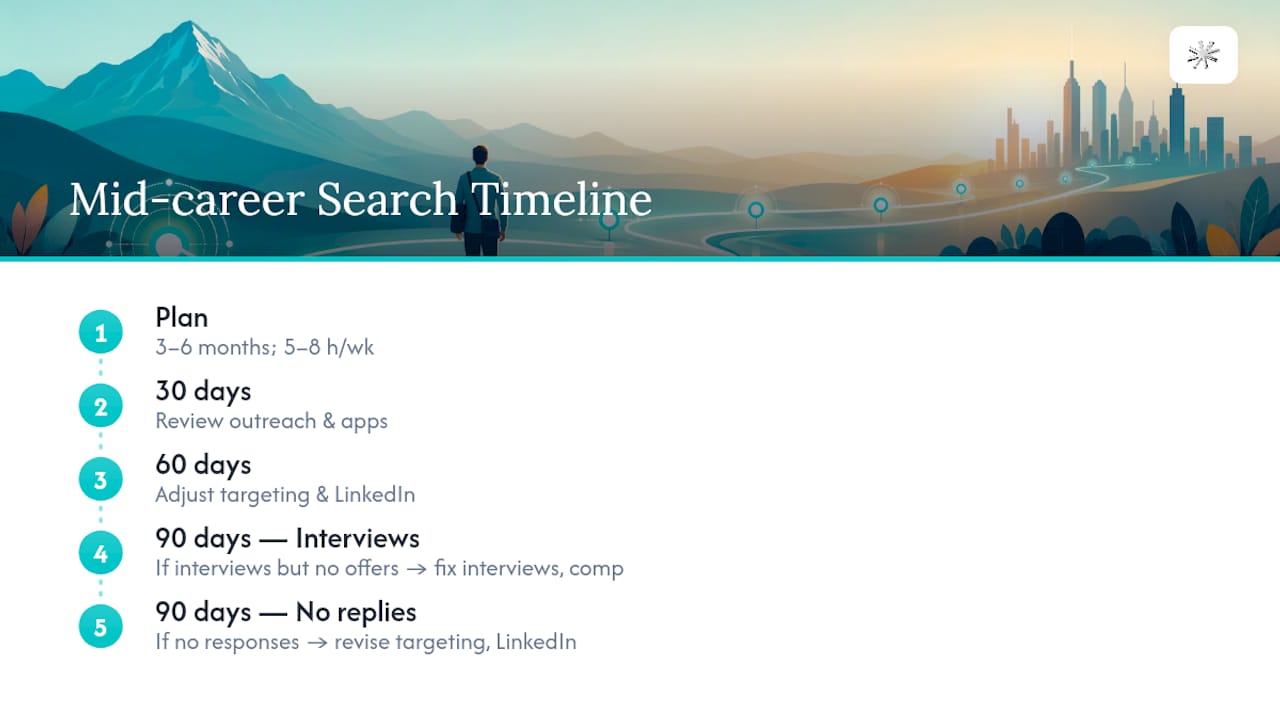
- A mid-career search typically takes three to six months, requiring disciplined effort and milestone reviews to stay on track.
- Framing experience to de-emphasize age and focusing on recent relevant skills helps mitigate perceived age bias in the job market.
Table of Contents
- Mid Career Job Search Checklist: 7 Steps to Start This Week
- How Do You Know It's Time to Start Looking?
- What Should Your Job Search Priorities Actually Be?
- What Should You Change on LinkedIn and Your Resume?
- How Do You Turn Your Network Into Referrals?
- Should You Work With a Recruiter, and How Do You Find One?
- How Should You Prepare for Interviews and Negotiate Pay?
- How Long Does a Mid-Career Job Search Take?
- How Do You Handle Age Bias in a Job Search?
- Should You Add Certifications or Courses to Your Search?
- How Do You Evaluate Cultural Fit Before You Accept an Offer?
- How Do You Negotiate an Offer Beyond Base Salary?
- A Straight Take on What Actually Moves the Needle
- Get Clarity Before You Apply to Anything Else
- Sources
- FAQ
Mid Career Job Search Checklist: 7 Steps to Start This Week
You don't need a perfect plan to start moving. You need a short list of actions that create momentum in the first seven days.
- Run the priorities exercise. Rank compensation, title, learning, work-life balance, mission, and stability from most to least important. This single step prevents you from wasting weeks chasing roles that don't fit.
- Fix your LinkedIn headline. Swap your current job title for a phrase that describes the value you deliver, and turn on "Open to Work" with recruiter-only visibility if you want to stay discreet.
- Rewrite three resume bullets. Convert your top three duties into accomplishment statements with numbers attached (revenue, headcount, percentage improvement).
- Map keywords to your resume. Pull five to seven skill terms straight from job postings you actually want and work them into your summary and bullets.
- List ten people to contact. Former managers, close former colleagues, and vendors you trusted tend to respond fastest and refer most generously.
- Draft one outreach message. Keep it short, specific about what you're looking for, and easy to forward.
- Identify two recruiters in your field. Search LinkedIn for recruiters who specialize in your industry and function, not generalists.
How Do You Know It's Time to Start Looking?
Not every bad week at work means it's time to job hunt. But certain patterns are reliable signals that a search is worth the time investment.
- Your role has been static for two or more years with no path to new responsibility, and conversations with your manager haven't changed that.
- Leadership turnover has repeatedly reset your priorities, projects, or reporting line.
- You've been passed over for a promotion you were qualified for, more than once.
- The skills you use daily are aging out of demand in your industry.
- Your compensation has fallen meaningfully behind market rate for your role and experience.
Weigh the move against real trade-offs before you commit real time. A mid-career jump carries more risk than an early-career one. You likely have more fixed expenses, less flexibility to relocate, and a narrower runway to recover from a bad fit. Balance that against the cost of staying stuck: stalled skills, eroding confidence, and compounding opportunity cost.
The safest way to test the waters is through exploratory conversations that don't commit you to anything. Reach out to former colleagues or industry contacts for a 20-minute call framed as "catching up" or "getting your read on where the market's headed." You'll learn more about real openings and hiring temperature in three or four of these calls than in hours of scrolling job boards, and you'll do it without tipping off your current employer.
What Should Your Job Search Priorities Actually Be?
Vague goals like "I want something more fulfilling" or "I need better pay" don't translate into a search strategy. You need role filters specific enough to point you at actual job postings.
Start by ranking these six factors from one (most important) to six (least important):
- Compensation and total pay
- Title and seniority level
- Learning and skill growth
- Work-life balance and flexibility
- Mission and company purpose
- Job security and stability
Once ranked, translate the top two or three into concrete filters: target industry, function, company size, and compensation band. A professional who ranks stability and compensation highest should filter toward established companies with predictable revenue, not early-stage startups. Someone who ranks learning and mission highest might accept a lateral title move to join a company solving a problem they care about.
Pro Tip: Write your top three priorities on a sticky note and keep it visible while you search. When a job posting looks exciting but doesn't match at least two of your three, skip it. That single filter saves you from a search that widens instead of narrows.
If you're weighing a full industry pivot rather than a lateral move, working through second career options before you touch your resume will save you from optimizing documents for the wrong target.
What Should You Change on LinkedIn and Your Resume?
Your LinkedIn profile functions as your first interview, and most recruiters read it before they read your resume. Both documents need mid-career-specific edits, not a cosmetic refresh.
On LinkedIn:
- Rewrite your headline around the value you create, not your current job title (for example, "Operations leader who cuts supply chain costs" beats "Senior Operations Manager").
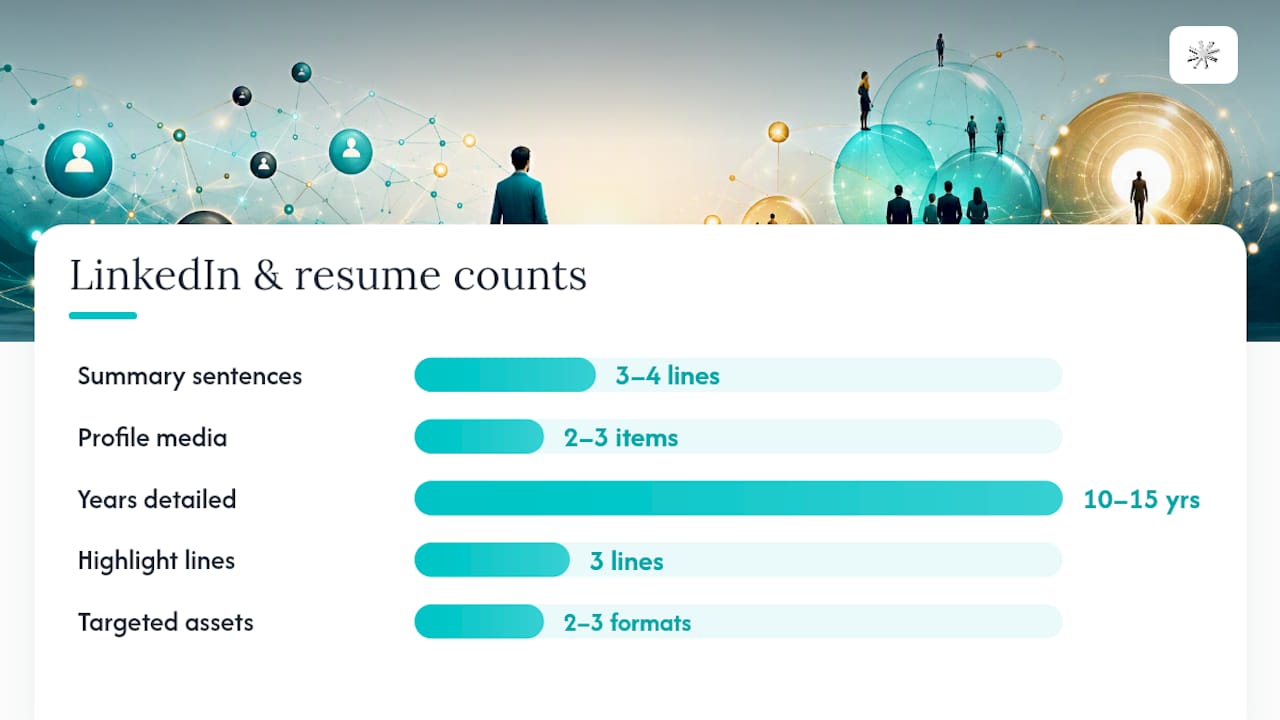
- Rewrite your summary as three to four sentences: what you do, who you've done it for, and the outcomes you drive.
- Set "Open to Work" preferences carefully, choosing recruiter-only visibility if you want to keep your search private from your current employer.
- Add media, case studies, or presentation decks to two or three of your experience entries; profiles with media get noticeably more attention from recruiters scanning quickly.
- Update your skills section to match the exact terms used in job postings for your target roles, since LinkedIn's search algorithm and recruiter searches both key off exact matches.
On your resume:
- Rewrite every bullet as an accomplishment with a number attached, not a description of a duty.
- Focus depth on the last ten to fifteen years of experience; older roles can be compressed to a single line.
- Map keywords from target job postings directly into your resume, since most companies still run resumes through applicant tracking systems before a human reads them.
- Cut objective statements and generic summaries in favor of a three-line "career highlights" section at the top.
Applicant tracking systems reward this kind of parsing accuracy, and career-change resume tips built for accomplishment-first formatting will help you avoid the formatting traps that get otherwise-qualified resumes filtered out before a person sees them.
Beyond your standard resume, build a second and third asset: a one-page achievements summary for quick recruiter conversations, and a portfolio link if your work supports visual proof. Job-search specialists increasingly recommend multiple targeted formats because different hiring workflows, from a five-minute recruiter scan to a formal application, call for different document lengths.
How Do You Turn Your Network Into Referrals?
Referrals and warm introductions consistently outperform cold applications in getting mid-career candidates to the interview stage, and networking research on midcareer professionals confirms warm contacts convert at a meaningfully higher rate than applications submitted cold. That makes your existing relationships the highest-leverage part of your search, not an afterthought after the job boards dry up.
Start with three groups:
- Former managers. They've seen your work directly and can speak specifically to your impact, which makes their referrals carry more weight than a peer's.
- High-trust former colleagues. People you worked closely with, especially those who've since moved to companies you're interested in.
- Vendors and clients. Professionals outside your direct chain who know your work quality but sit in a different network entirely.
Keep your outreach message short: state what you're looking for, ask for one specific thing (a conversation, an introduction, a referral), and make it easy to say yes. Follow up once after a week of silence, then let it go gracefully.
Pro Tip: Attach a two-sentence "ideal role" description to every networking ask. Contacts who understand exactly what to look for refer you to relevant openings; contacts left guessing usually do nothing, not because they don't want to help, but because vague requests are hard to act on.
Should You Work With a Recruiter, and How Do You Find One?
Recruiters split into two categories, and knowing which one you're talking to changes how you should approach them. Retained recruiters get paid whether or not they fill the role and typically handle senior, harder-to-fill searches; contingency recruiters only get paid on placement and tend to work faster, higher-volume searches at more accessible levels. Higher-level and specialized roles often move through retained searches that are never posted publicly, which means building a relationship with a recruiter is often the only way to access them.
To be genuinely useful to a recruiter, arrive with:
- A clear target: two or three specific titles or functions, not "open to anything."
- A realistic compensation band based on current market data for your role and region.
- A timeline for your search and any constraints (notice period, relocation limits).
- Three or four quantified achievements a recruiter can pitch to a hiring manager without you in the room.
Find function-specific and industry-specific recruiters through LinkedIn searches, industry associations, and referrals from your own network. A recruiter who places marketing directors in healthcare will do far more for you than a generalist agency working every industry at once.
How Should You Prepare for Interviews and Negotiate Pay?
Mid-career interviews test judgment and leadership more than early-career interviews do, which means your preparation needs to shift from "what did you do" to "how did you lead through it."
- Build a library of six to eight STAR stories (Situation, Task, Action, Result) that cover leadership, conflict resolution, a measurable business win, and a failure you recovered from.
- Practice delivering each story in under ninety seconds, since panel and case-based interviews leave little room for meandering answers.
- Rehearse across formats: video calls, panel interviews, and case exercises all reward slightly different pacing and body language.
- Prepare two or three thoughtful questions for the interviewer that show you've researched the company's actual challenges, not generic questions about culture.
Reviewing interview answer frameworks built specifically for career changers helps if you're pivoting functions or industries, since your STAR stories need to translate old context into new relevance.
On compensation, anchor your ask to real market data rather than your current salary, since your current pay may already be below market if you've been underpaid for years. Research the range for your target role and region before any conversation starts, and let the employer make the first offer when possible. If the number comes in low, decide in advance which trade-offs matter: a signing bonus, an accelerated review timeline, or additional equity can close a gap that base salary alone can't.
Pro Tip: Never negotiate compensation in the same conversation where you receive the offer. Ask for 24 to 48 hours to review it in writing, then come back with your counter. That pause alone improves most people's negotiating outcomes.
How Long Does a Mid-Career Job Search Take?
Set your expectations around a real number, not a Hollywood story about a job appearing overnight. The Bureau of Labor Statistics reports that mid-career job searches average three to six months, with senior-level and executive searches often running longer.
Budget your weekly effort accordingly: five to eight focused hours per week is sustainable alongside a current job, split between outreach, applications, and interview prep. Set milestone checkpoints at 30, 60, and 90 days to review what's working. If you're getting interviews but no offers by month three, the problem is likely interview execution or comp expectations, not your resume. If you're getting no responses at all, revisit your targeting and your LinkedIn presence first.
How Do You Handle Age Bias in a Job Search?
Perceived age bias is real, but the fix is mostly about framing and document choices, not apologizing for your experience. Career consultants advise reframing decades of work as a "track record of proven impact" rather than years served, which shifts the conversation from how long you've been working to what you've actually accomplished.
- Trim early-career roles to a single line, or drop anything beyond 15 years unless it's directly relevant to your target role.
- Remove graduation years and unnecessary dates that invite quick age math.
- Emphasize the tools, platforms, and methods you use today, not the ones you used a decade ago.
- In interviews, talk explicitly about learning agility: a recent course, a new tool you picked up quickly, a cross-generational team you led well.
Mistakes documented by AARP show that candidates often self-disqualify by assuming age is working against them before a recruiter even brings it up, which can show up as low energy or defensiveness in an interview. Confidence about your current relevance reads as more valuable than a defense of your history.
Pro Tip: Ask a colleague under 35 to review your resume and LinkedIn profile for anything that reads as dated, whether it's terminology, formatting, or a skills list missing current tools. A quick outside read catches signals you can't see yourself.
Should You Add Certifications or Courses to Your Search?
A targeted certification can shift how recruiters read your resume, but it only helps when it fills a specific, visible gap in your target role's requirements. Before enrolling in anything, go back to the job postings you're targeting and note which skills or credentials show up repeatedly that you don't currently have.
Short, recognized certifications tend to carry more weight than lengthy degree programs when you're already established in a field, since employers are usually testing for current competence, not academic credentialing. A project management certification, a data analytics course, or a platform-specific certification (a CRM, an analytics tool, a cloud platform) can close a gap in weeks rather than years.
Timing matters. If you're actively interviewing, list a certification as "in progress" with an expected completion date rather than waiting to add it until it's finished; most hiring managers read this as initiative, not incompleteness. If your search timeline allows six to eight weeks before you start applying in earnest, completing one focused credential before your outreach begins can measurably strengthen your positioning.
Resist the temptation to collect certifications broadly. A resume cluttered with five unrelated credentials reads as unfocused, while one or two directly tied to your target role reads as intentional. The goal isn't to look like a lifelong student. It's to close the specific gap between where you are and where the job posting says you need to be.
How Do You Evaluate Cultural Fit Before You Accept an Offer?
Cultural fit is easy to ignore when you're eager for an offer, and it's one of the most common reasons mid-career hires leave within the first year. Evaluating it takes deliberate effort during the interview process, not a gut feeling on day one.
Ask specific questions rather than generic ones. Instead of "what's the culture like," ask how the team handled its last major setback, how decisions get made when leaders disagree, or what someone who left the role in the past year cited as their reason. Answers to specific questions reveal far more than a rehearsed description of company values.
Pay attention to how interviewers treat each other and you during the process. A hiring manager who's rushed, dismissive, or vague about role expectations during the interview is unlikely to become more available once you're hired. Multiple interviewers giving conflicting descriptions of the role or team priorities is a signal worth taking seriously, not dismissing as normal onboarding confusion.
Cross-check what you hear against outside sources: employee review sites, former employees in your network, and public statements the company has made about its priorities. A mismatch between what leadership says publicly and what former employees report privately is worth investigating before you sign anything, not after.
Finally, weigh cultural fit against your ranked priorities from earlier in the search. If stability ranked highest for you, a company with high leadership turnover deserves extra scrutiny even if the role itself looks ideal on paper.
How Do You Negotiate an Offer Beyond Base Salary?
Salary is only one lever in a job offer, and treating it as the only one leaves real value on the table. Once an offer is in writing, look at the full package before you respond.
Benefits vary more than most candidates realize between employers: health coverage tiers, retirement matching percentages, paid time off structure, and parental leave policies can differ by thousands of dollars in effective value even when base salary is identical. Ask for the full benefits summary before you negotiate anything, since comparing two offers on salary alone can be misleading.
Work-life balance terms are negotiable more often than candidates assume. Remote or hybrid flexibility, core hours versus flexible scheduling, and travel expectations are all reasonable to raise, especially if you're moving from a role with different expectations. Companies that can't move on salary sometimes have far more flexibility on schedule or location.
Other levers worth raising: a signing bonus to offset unvested equity you're leaving behind, an accelerated performance review timeline (six months instead of twelve) to fast-track your next raise, professional development budget, and title, which affects your next search more than most candidates initially assume.
Prioritize using the same ranking exercise from earlier in your search. If flexibility ranked above compensation for you, negotiate schedule terms as hard as you'd negotiate pay. Trading a marginal salary increase for meaningfully better balance is often the better outcome, not a compromise.
A Straight Take on What Actually Moves the Needle
The priorities-first approach works because it's the opposite of what panic pushes you toward: applying to everything, updating nothing with real intention, and hoping volume compensates for vagueness. It doesn't. Clarity does.
This search will take real time and real emotional energy, especially while you're still showing up for a current job. That's normal, and it doesn't mean you're doing it wrong.
— Shane
Get Clarity Before You Apply to Anything Else
Most of the friction in a mid-career search comes down to one problem: not knowing exactly which roles to target before you start applying. NueCareer's 7-Minute Career Quiz solves that first, matching your strengths to specific career paths, including ones you haven't considered, and handing you a starter roadmap based on the result.
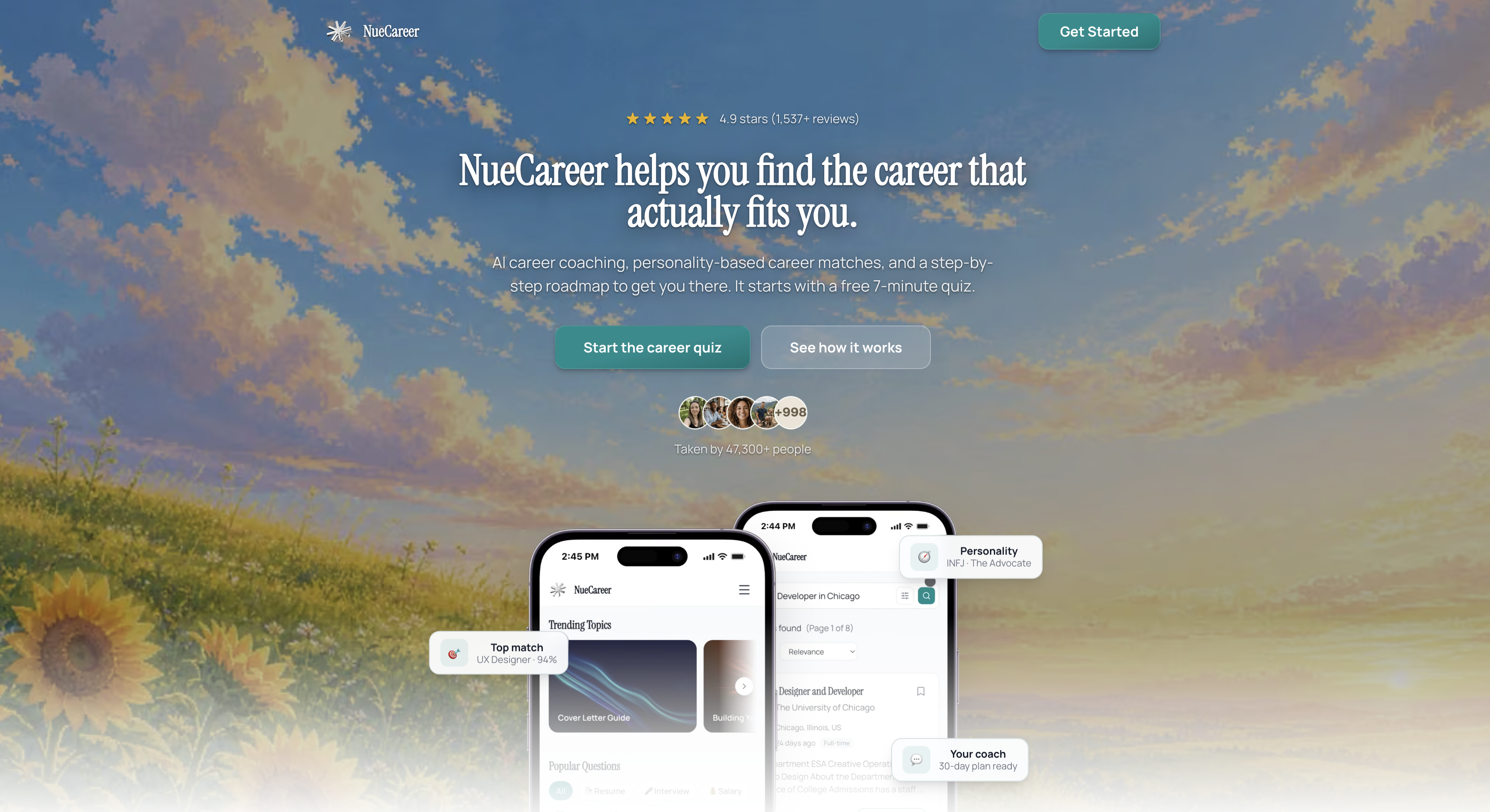
From there, coaching chat and tailored job boards can support you after clarifying your priorities, and built-in resume and cover letter tools can help turn your new direction into accomplishment-based application assets without starting from a blank page. If you've read this far and still aren't sure which roles fit your strengths, take the quiz before you touch your resume again. It's free, it takes seven minutes, and it gives you the target-role clarity every other step in this guide depends on.
Sources
- U.S. Bureau of Labor Statistics
- How to job search as a mid-career professional — Korn Ferry
- Experts share 7 midlife job search mistakes — AARP
- How to start a mid-career job search after years with the same company — Movement Search
FAQ
At What Age Are You Considered Mid-Career?
Mid-career generally describes professionals with about 10 to 20 years of work experience, though the label depends more on experience level than a strict age cutoff.
How Do You Find Mid-Level Jobs?
Combine targeted applications with active networking and recruiter outreach; the Korn Ferry approach of pairing LinkedIn optimization with value-based networking consistently outperforms applying broadly on job boards alone.
What Are Mid-Career Jobs?
Mid-career jobs are roles that require several years of demonstrated experience and judgment, typically at the senior individual contributor, management, or director level, rather than entry-level positions.
Is 37 Too Old to Switch Careers?
No. Thirty-seven falls squarely within the mid-career range, and a clear priorities exercise combined with targeted networking and skill-mapping, the exact approach NueCareer's 7-Minute Career Quiz is built around, works well for pivots at this age.