
Second Career Options over 40: Your 2026 Guide

Discover valuable second career options over 40 that leverage your experience. Transition smoothly and thrive in your new role in 2026!
TL;DR:
- Most career changes after 40 leverage existing skills to enter mid-level roles quickly. Building financial stability and earning industry certifications support a smooth transition. Remote work opportunities and experience premiums make fields like healthcare, project management, and UX appealing options.
The best second career options over 40 are roles that reward your existing expertise rather than asking you to compete with entry-level candidates on their terms. 82% of professionals over 45 successfully execute a career pivot, typically within 2–8 months. That number matters because it dismantles the myth that changing careers after 40 is a long shot. The standard industry term for this process is "career repositioning," and it differs from starting over. You are not rebuilding from zero. You are redirecting 15–20 years of judgment, leadership, and stakeholder experience toward a field that fits you better.
What are the best second career options for professionals over 40?
The strongest career change options for mid-career professionals are roles where experience commands a premium. Lateral moves that leverage transferable skills let you skip junior roles entirely and enter at a mid-to-senior level. That is the single biggest advantage you hold over a 24-year-old candidate.

1. Healthcare administration
Healthcare administration is growing 21.8% by 2034, with salaries ranging from $65,000 to $100,000. Most roles require only 3–8 months of targeted training. If you have managed teams, budgets, or operations in any industry, this field translates directly.
- Best fit for: Former operations managers, HR professionals, office administrators
- Key skills used: Scheduling, compliance, staff coordination, vendor management
- Training path: AHIMA or AAPC certifications, community college programs
2. Project management
Project management rewards people who can organize complexity and communicate across teams. The PMP certification from the Project Management Institute is globally recognized and takes roughly 3–6 months to prepare for. Salaries typically range from $80,000 to $120,000 depending on industry.
- Best fit for: Anyone who has led cross-functional teams or managed deliverables
- Key skills used: Risk assessment, timeline management, stakeholder communication
- Training path: PMP certification, Google Project Management Certificate
3. Cybersecurity compliance
Cybersecurity compliance roles focus on policy, auditing, and risk management rather than technical coding. That distinction matters for career changers. Certifications like CompTIA Security+ or CISA open doors within 4–6 months of study. Salaries start around $75,000 and rise quickly with experience.
- Best fit for: Former auditors, legal professionals, operations leads
- Key skills used: Risk analysis, documentation, regulatory knowledge
- Training path: CompTIA Security+, CISA, ISC2 Certified in Cybersecurity
4. Consulting and fractional executive roles
Consulting and fractional executive roles pay for experience rather than technical execution. A fractional CFO, COO, or CMO works part-time across multiple companies. This model suits professionals who want flexibility without sacrificing income or authority.
- Best fit for: Senior managers, directors, and functional leaders
- Key skills used: Strategic planning, financial oversight, leadership
- Training path: No formal certification required; a strong portfolio and network are the entry point
5. Corporate training and instructional design
Organizations spend billions annually on employee development. If you have deep domain expertise in any field, you can package that knowledge as training content. Instructional design roles in edtech and corporate learning pay $60,000 to $90,000 and are largely remote.
- Best fit for: Teachers, subject matter experts, HR professionals
- Key skills used: Curriculum design, presentation, adult learning principles
- Training path: ATD certifications, online instructional design courses
6. UX research
UX research is one of the clearest examples of a role where life experience is a direct asset. Researchers conduct interviews, analyze behavior, and translate findings into product decisions. Women over 45 find particular advantages in empathy-driven roles like this one, where lived experience sharpens insight. Salaries range from $75,000 to $110,000.
- Best fit for: Marketers, psychologists, educators, customer success professionals
- Key skills used: Interviewing, pattern recognition, written communication
- Training path: Nielsen Norman Group UX certification, General Assembly courses
7. Medical coding and billing
Medical coding is a remote-friendly role with steady demand and a clear certification path. The AAPC's CPC credential takes 3–6 months to earn. Starting salaries sit around $45,000, with experienced coders earning $60,000 or more. The work is detail-oriented and well-suited to professionals who prefer independent, focused tasks.
- Best fit for: Administrative professionals, former healthcare workers, detail-oriented generalists
- Key skills used: Medical terminology, accuracy, data entry
- Training path: AAPC CPC certification
Pro Tip: Before committing to any of these paths, run a skills audit to identify which of your existing competencies map most directly to your target role. This single step can cut your transition time significantly.
How to prepare financially and practically for a career change after 40
Financial readiness is the most underrated factor in a successful career pivot. Without it, you make decisions from desperation rather than strategy.
Build a 6–12 month financial runway. A 6–12 month runway before you pivot gives you the freedom to be selective. It means you can turn down a poor-fit offer and wait for the right one. Calculate your monthly expenses, then save or liquidate enough to cover that period comfortably.
Choose certificates over degrees. Avoid multi-year degree programs that create long opportunity costs. A two-year master's degree delays your income by two years and often teaches less than a targeted bootcamp or industry certification. Prefer credentials like PMP, CompTIA, AAPC, or Google Career Certificates that employers recognize and that take months, not years.
Start part-time before you quit. Many professionals test a new field through freelance work, consulting, or evening courses before leaving their current role. This approach builds credentials, generates income, and reduces risk simultaneously.
Account for the full cost of transition. Training fees, exam costs, and reduced income during ramp-up all add up. Build these into your financial plan before you start, not after. A step-by-step career roadmap helps you map these costs against a realistic timeline.
Use side consulting to bridge income gaps. If you have domain expertise, offer it as a consultant while you train for your next role. This keeps income flowing, builds your new network, and signals credibility to future employers.
Pro Tip: Adding a language skill like Spanish proficiency can open doors in healthcare, education, and government sectors. The 2026 guide on Spanish and career advancement outlines how bilingual professionals command higher salaries in several of these fields.
How to leverage your existing skills to land a new career over 40
Competing on judgment and stakeholder management rather than technical skills is the correct strategy for mid-career professionals. Trying to out-code a 25-year-old is the wrong race. Leading a team, managing a budget, and navigating organizational politics are skills that take decades to develop. Those are your competitive advantages.
Start with a skills audit. List every function you have performed across your career: hiring, budgeting, presenting to executives, managing vendors, resolving conflicts. Then map each skill to the requirements of your target role. You will find more overlap than you expect.
Reframe your resume for the new field. A career change resume does not lead with job titles. It leads with outcomes and transferable competencies. "Managed a $2M operational budget" speaks directly to a healthcare administrator role. "Led cross-functional teams of 12" speaks to project management. Translate your history into the language of your target industry.
Key roles where experience premiums pay off include:
- Operations management: Rewards process ownership and cross-team coordination
- Enterprise sales: Values relationship depth, negotiation history, and industry credibility
- Customer success management: Prizes empathy, communication, and problem resolution
- Program management: Requires the ability to manage ambiguity and lead without authority
The mindset shift is this: you are not a junior candidate in a new field. You are an experienced professional with a new specialization. Position yourself accordingly in every conversation and application.
What industries and roles favor workers over 40 with remote or flexible options?
Remote work growth continues to benefit mid-career switchers who prioritize flexibility. The table below compares the most accessible fields for new careers for older adults based on training time, salary, remote availability, and fit for experienced professionals.
| Field | Training time | Salary range | Remote friendly | Experience premium |
|---|---|---|---|---|
| Healthcare administration | 3–8 months | $65k–$100k | Partial | High |
| Project management | 3–6 months | $80k–$120k | Yes | High |
| Medical coding | 3–6 months | $45k–$60k | Yes | Moderate |
| Corporate training | 2–4 months | $60k–$90k | Yes | High |
| UX research | 4–6 months | $75k–$110k | Yes | High |
| Cybersecurity compliance | 4–6 months | $75k–$95k | Partial | Moderate |
| Consulting/fractional exec | Immediate | $80k–$150k+ | Yes | Very high |
Healthcare administration, medical coding, and customer success management stand out as top second job ideas for mid-life professionals because they combine remote availability with strong demand and short training windows. Skilled trades also offer apprenticeship models that welcome older workers, though they are typically in-person.
Pro Tip: Roles in UX research and corporate training actively value life experience. If you have raised children, managed a household, or navigated a major life transition, those experiences build the empathy and communication skills these roles require.
Key takeaways
The most successful career repositioning over 40 uses transferable skills to enter at a mid-level, skips long degree programs, and builds financial readiness before making the move.
| Point | Details |
|---|---|
| Repositioning beats starting over | Frame your pivot as a lateral move using existing skills, not a restart from entry level. |
| Financial runway is non-negotiable | Save 6–12 months of expenses before transitioning to preserve your ability to choose well. |
| Certificates beat degrees for speed | Short credentials like PMP, CompTIA, or AAPC get you hired faster than multi-year programs. |
| Experience commands a premium | Roles in operations, consulting, and healthcare administration reward judgment over technical speed. |
| Remote options are real and growing | Fields like medical coding, UX research, and corporate training offer genuine remote flexibility. |
What I have learned about career change after 40
The biggest mistake I see mid-career professionals make is treating a career pivot like an admission of failure. It is not. It is a recalibration. The professionals who transition most successfully are the ones who stop apologizing for their age and start leading with their track record.
The second mistake is the degree trap. I have watched talented people spend two years and $60,000 on a graduate program when a $500 certification and six months of networking would have gotten them the same role. The opportunity cost of a long degree is not just money. It is time, momentum, and confidence.
The third thing I have noticed is that women over 45 are particularly well-positioned for this shift, and most do not realize it. Roles in healthcare administration, UX research, and corporate training reward exactly the skills that come from managing complex relationships and navigating ambiguous situations. Those are not soft skills. They are high-value competencies that organizations pay for.
My honest advice: do the skills audit first, build the financial runway second, and pick the shortest credible path to your target role third. Networking shortens every timeline. A single warm introduction to a hiring manager is worth more than three months of cold applications.
— Shane
Nuecareer can help you find your next career path
Knowing which career to pivot into is the hardest part of the process. Most professionals have more transferable skills than they realize, but without a clear picture of where those skills lead, it is easy to stay stuck.
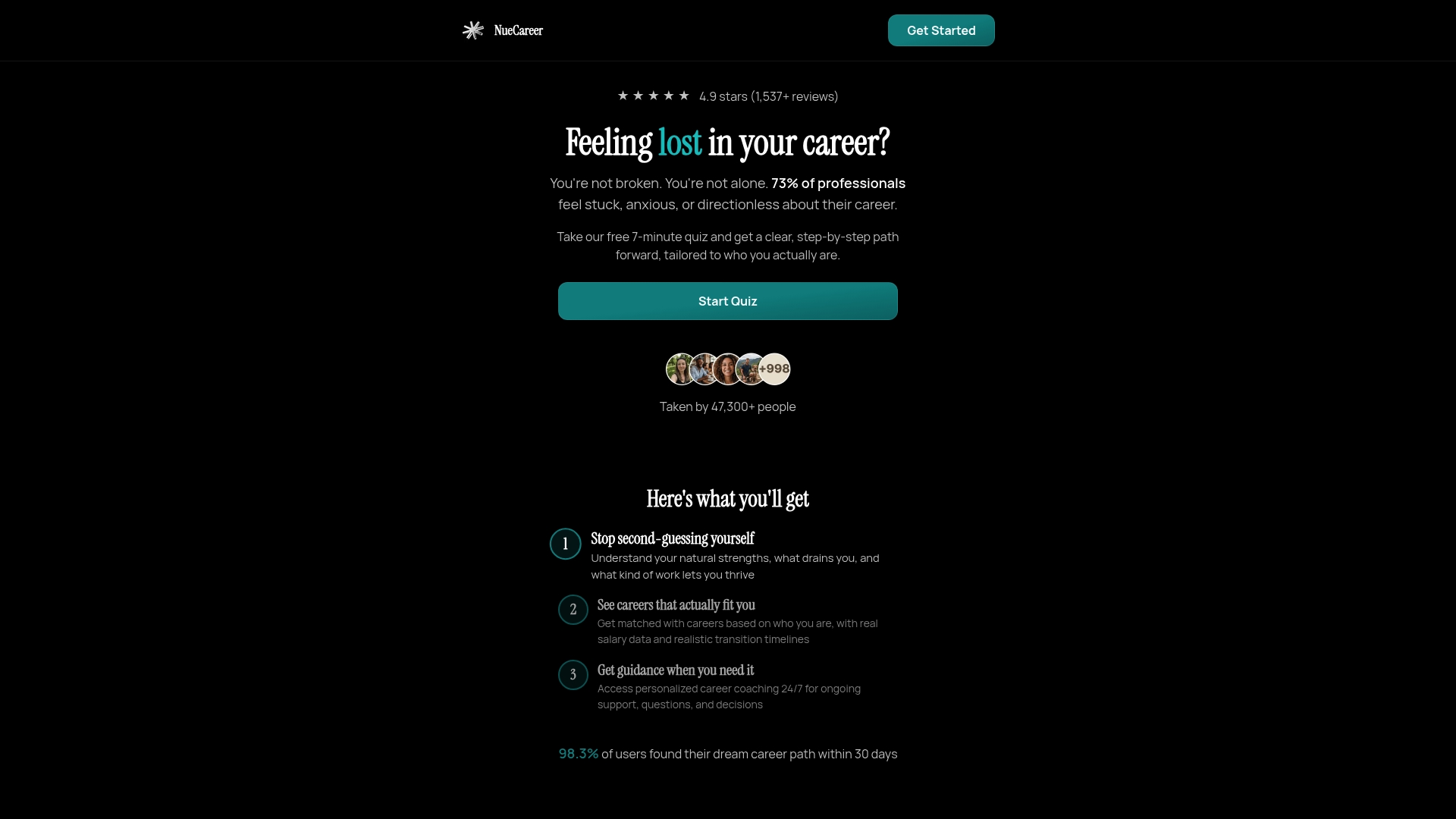
Nuecareer's free career skills assessment takes 7 minutes and maps your strengths to career paths you may never have considered. The platform then builds a personalized roadmap, connects you to relevant job boards, and gives you 24/7 coaching support. You also get access to resume and cover letter tools built specifically for career changers. If you are ready to move from "thinking about it" to "doing it," the assessment is the clearest first step.
FAQ
What is the success rate for career changes after 40?
82% of professionals over 45 successfully complete a career pivot, typically within 2–8 months. That rate reflects how much transferable experience mid-career professionals bring to new roles.
What are the best jobs for over 40 with no degree required?
Project management, medical coding, cybersecurity compliance, and corporate training all offer industry-recognized certifications that replace degree requirements. Most of these credentials take 3–6 months to earn.
How much money should I save before changing careers at 40?
Financial planning guidance recommends a 6–12 month financial runway before making a career change. This buffer lets you make decisions based on fit rather than financial pressure.
Can I change careers at 40 without going back to school?
Yes. Short certificates and bootcamps are the preferred path for mid-career changers. Multi-year degree programs create unnecessary opportunity costs when targeted credentials get the same result faster.
What industries are most open to hiring workers over 40?
Healthcare administration, project management, consulting, and corporate training actively value the judgment and leadership experience that mid-career professionals bring. These fields reward experience premiums rather than penalizing age.