

TL;DR:
- Strengths based careers focus on developing natural talents to increase fulfillment and performance. They involve identifying core strengths, aligning roles accordingly, and continuously adapting for growth. Research shows this approach boosts engagement, well-being, and long-term job satisfaction.
What are strengths based careers and how do they work?
A strengths based career is built on a simple but powerful premise: you grow faster and feel more fulfilled when you invest in what you naturally do well, not in patching what you don't. Rather than scanning your resume for gaps to fix, this approach starts with your innate talents, values, personality, and accumulated knowledge, then finds or shapes roles where those qualities are genuinely useful every day.
The shift from traditional career development is real. For decades, performance reviews highlighted deficiencies, and development plans were essentially lists of things you were bad at. The strengths based model, pioneered by Gallup researcher Donald Clifton and popularized through the CliftonStrengths assessment, flips that entirely. People who focus on developing their strengths are 6 times more likely to be engaged at work and 3 times more likely to report an excellent quality of life.
Here is what that looks like in practice:
- Talent identification: Using tools like CliftonStrengths to surface your natural patterns of thinking, feeling, and behaving
- Role alignment: Matching those patterns to daily tasks and environments where they create real value
- Ongoing development: Treating career growth as a continuous process, not a one-time promotion event
- Coaching integration: Working with a coach or mentor to interpret assessment results and build a concrete plan
- Sustainable satisfaction: Building a career path that energizes rather than depletes you over time
The result is not just better performance. It is a career that feels like a natural fit rather than a constant uphill climb.
What are the key components that make this approach work?
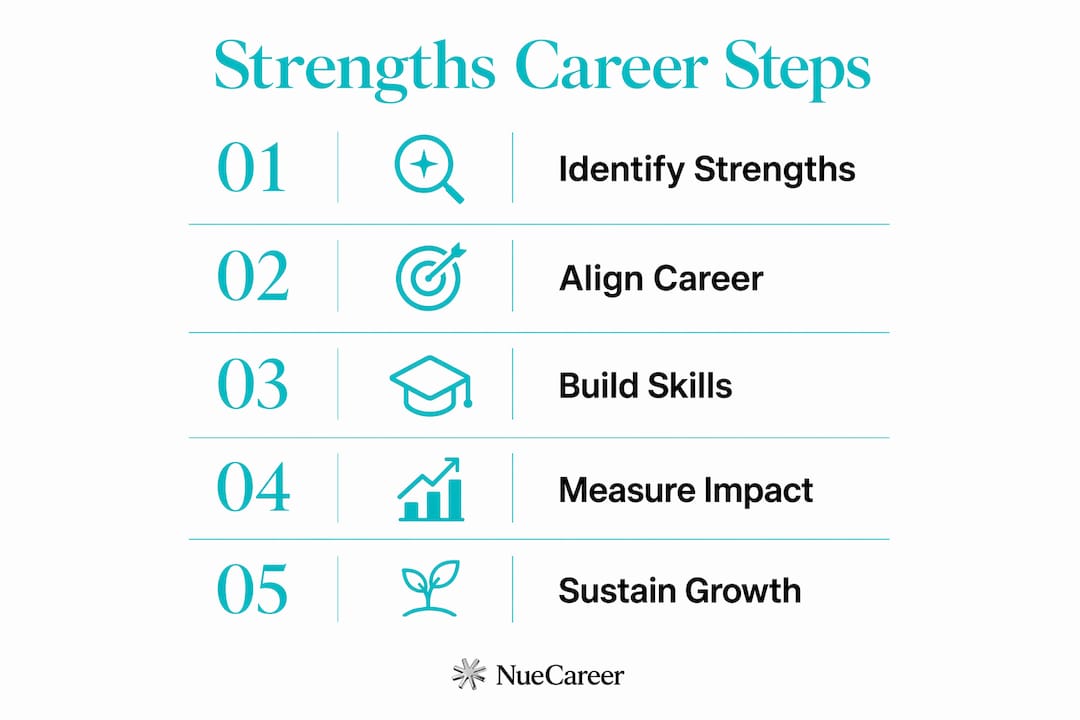
Strengths based career development draws on five interconnected components, and understanding each one helps you see why the approach produces results that generic career advice rarely does.
- Talents: Your natural recurring patterns of thought and behavior. These are the things you pick up quickly, do almost effortlessly, and return to instinctively. CliftonStrengths identifies 34 talent themes across four domains: Executing, Influencing, Relationship Building, and Strategic Thinking.
- Abilities: Skills you have built through practice and experience. Unlike raw talent, abilities are learned, but they are most powerful when they sit on top of a natural talent.
- Values: What matters most to you in your work. A role that conflicts with your core values will drain you even if it uses your talents perfectly.
- Personality: Your preferred ways of interacting, processing information, and making decisions. Personality and strengths are complementary lenses on the same underlying nature.
- Knowledge: The domain expertise and context you bring. Knowledge amplifies talent but cannot replace it.
Positive psychology, particularly Barbara Fredrickson's broaden-and-build theory, underpins the whole framework. When you use your strengths, you experience positive emotions that expand your cognitive resources, creativity, and resilience. Your brain enters flow states more easily, you learn faster, and you sustain energy longer. Working against your natural grain produces the opposite: mental fatigue and resistance.
Pro Tip: Pay attention to what energizes you, not just what you are good at. Competence without energy is a learned skill, not a strength. Building a career around skills you find draining leads to high achievement and deep unhappiness.
How does this differ from traditional career development models?
Traditional career development is deficit-focused by design. Annual reviews identify gaps, development plans target weaknesses, and employees spend years trying to become competent at things they are naturally poor at. Gallup research shows this approach actively contributes to disengagement.
The strengths model does not ignore weaknesses. It simply refuses to make them the center of gravity. Here is how the two approaches compare:
- Traditional model: Starts with job descriptions and required competencies, then identifies your gaps relative to them
- Strengths model: Starts with how you naturally think and work, then finds or shapes roles where that is an asset
- Traditional model: Treats promotion as the primary measure of development
- Strengths model: Treats career development as a lifelong process of choosing roles and projects that let you apply your talents daily
- Traditional model: Focuses on becoming well-rounded
- Strengths model: Focuses on becoming exceptional in your natural areas and managing weaknesses through systems or partnerships
Focusing solely on fixing weaknesses often causes disengagement and mediocre performance. The person who spends three years developing administrative skills they naturally lack will, at best, become adequate. The same person investing those three years in their natural strategic thinking ability can become genuinely world-class.
How do strengths assessments fit into career coaching and decision-making?
Assessments like CliftonStrengths are powerful, but their true value emerges when combined with coaching to interpret results and build real career strategies. A report sitting in your inbox does not change anything. A conversation with a skilled coach about what those results mean for your next move does.
Career coaches use strengths data in several concrete ways:
- Clarifying fit: Helping you evaluate whether your current role actually uses your top themes, or whether the misalignment is what is causing your frustration
- Career pivots: Analyzing which adjacent roles or industries would let you apply your strengths more fully
- Goal setting: Translating abstract themes into specific, measurable career objectives
- Job search strategy: Tailoring your approach to your natural style. A highly analytical person might research companies methodically; a natural relationship builder will get the same information through conversations
- Interview preparation: Building "strengths statements" that articulate your value clearly to employers
Pro Tip: When working with a coach, bring your CliftonStrengths report and a list of tasks from your current or most recent role. Rate each task on two scales: how well you perform it and how energized it makes you feel. That two-axis map tells you more about alignment than any job title comparison.
Understanding career coaching benefits is especially valuable for adults navigating a career change, because a coach can help you see patterns in your strengths that you have taken for granted your whole life.

How do you practically align your career through a strengths based approach?
Alignment is not a one-time decision. It is an ongoing practice of auditing, adjusting, and sometimes pivoting. Here is how to put it into motion:
- Take a structured assessment. CliftonStrengths is the most research-backed starting point. It surfaces your top talent themes based on your natural patterns, not your job history.
- Complete a daily activity audit. For two weeks, track every significant task and rate it on competence and energy. High on both means strength. High competence but low energy means learned skill, and those tasks will drain you if they dominate your role.
- Apply the 80/20 benchmark. Aim for at least 80% of your daily tasks to align with your top strengths. If you are below 50%, that misalignment is likely the source of your disengagement.
- Map strengths to role requirements. Rate the alignment between your top five strengths and your current role's core demands on a 1–5 scale. An average below 3 signals fundamental misalignment.
- Reshape before you pivot. Many roles can be adjusted. Talk to your manager about shifting responsibilities toward your strengths before concluding you need a new job entirely.
- Use strengths language in your search. When exploring new roles, ask: "Which of my preferred tasks show up here? What kind of environment does this role offer?" Start with how you work best, not which title sounds impressive.
- Reassess regularly. Your strengths do not change dramatically, but your understanding of them deepens. Revisit your audit every six months.
Aligning your career identity with your natural talents is not a luxury. It is the foundation of sustainable performance.
What are the common misconceptions and real limitations of this approach?
The strengths based model is not a magic formula, and treating it as one creates its own problems. Here are the most common pitfalls:
- Ignoring critical weaknesses entirely. If a weakness is actively derailing your career, such as poor communication in a client-facing role, you need to address it through training, systems, or role adjustment. Strengths based development manages weaknesses; it does not pretend they don't exist. Critical weaknesses require active management through systems or partnerships.
- Overusing your strengths. Every strength has a shadow side. Excessive strategic thinking becomes analysis paralysis. Excessive empathy becomes emotional exhaustion. Excessive achievement drive becomes workaholism. Monitor when your strengths tip from productive to destructive.
- Chasing a "perfect" role. Most successful careers use 3–4 core strengths regularly. You do not need a role that uses every single strength daily. Waiting for that perfect match means waiting indefinitely.
- Using strengths as an excuse. "That's not my strength" is not a reason to avoid necessary work. The approach is about strategic investment, not avoidance of anything uncomfortable.
- Confusing skills with strengths. You can be skilled at something you find draining. Competence without energy is a learned skill, not a strength, and building a career around it leads to burnout.
What do strengths actually look like in real careers?
Strengths are not abstract personality labels. They translate into specific behaviors and outcomes across every industry. Here are some concrete examples:
- Strategic thinking shows up as the consultant who sees three moves ahead in a client problem, or the product manager who maps market gaps before competitors notice them
- Communication drives the trainer who makes complex systems feel simple, or the sales professional who builds trust in a single conversation
- Empathy enables the HR leader who spots team tension before it becomes conflict, or the nurse who reads a patient's anxiety and adjusts their approach accordingly
- Analytical thinking powers the data scientist who finds the pattern everyone else missed, or the financial analyst who builds models that actually predict outcomes
- Resilience defines the entrepreneur who rebuilds after a failed launch, or the project manager who keeps a team steady through a difficult client relationship
- Relationship building creates the account manager whose clients never leave, or the team lead whose people consistently outperform because they feel genuinely supported
- Ideation fuels the creative director who generates ten viable concepts where others generate one, or the researcher who connects findings from unrelated fields
The diversity here matters. Strengths based careers are not limited to leadership or creative roles. Every domain, from operations to healthcare to education, has roles where specific talent combinations create exceptional outcomes. Choosing a career that fits your personality and strengths profile is how you find those roles.
What does the research actually say about strengths based career success?
The evidence behind this approach is not anecdotal. Gallup's research on CliftonStrengths is among the most cited in organizational psychology, and the findings are consistent across industries and geographies.
People who use their strengths daily are 6 times more likely to be engaged in their jobs and 3 times more likely to report an excellent quality of life. Yet Gallup also found that only 1 in 3 workers can strongly agree that they use their strengths at work every day. That gap between potential and reality is exactly what the strengths based approach addresses.
From a neuroscience perspective, performing activities aligned with your natural talents activates reward centers in the brain and reduces activity in stress regions. You enter flow states more easily, learn faster, and sustain energy longer. This is why the 80/20 rule carries real weight: aiming for at least 80% of daily tasks to align with your strengths is not an arbitrary target. It reflects the threshold at which engagement becomes self-sustaining rather than forced.
Career development experts also emphasize that many professionals remain unaware of their natural strengths because organizational culture has historically focused on gap-filling rather than potential-unlocking. Getting feedback from mentors and networks helps surface strengths you may have taken for granted because they come so naturally.
How do you use your strengths in job interviews?
Interviews are one of the most direct opportunities to put your strengths to work, and most people underuse them. The National Career Development Association notes that strengths assessment results can answer at least five common interview questions: "Tell us about yourself," "Why should we hire you?," "What do you bring to this position?," "What would your manager say about you?," and "What are your strengths?"
The key is building what career coaches call "strengths statements." These are specific, behavioral descriptions of how you work at your best. Instead of saying "I'm a good communicator," you say: "I use storytelling in group presentations to translate complex data into decisions my team can act on." That specificity is what separates memorable candidates from forgettable ones.
Prepare two or three STAR stories (Situation, Task, Action, Result) that each center on a top strength. The action step in each story should describe the strength in motion, not just the outcome. When an interviewer hears how you naturally operate, they can picture you in the role far more clearly than when they hear a list of competencies.
How do you identify and develop your personal strengths?
Identifying your strengths is a process, not a single test result. Here is a practical sequence:
- Take CliftonStrengths or a comparable validated assessment. This gives you a structured starting point grounded in decades of research.
- Run a two-week energy audit. Track daily tasks and rate each on competence and energy. The intersection of high competence and high energy points directly to your strengths.
- Ask five people who know your work well to answer one question: "What do you see as my greatest strength, the thing I do that seems effortless to me but valuable to others?" Patterns across responses reveal strengths you may not recognize in yourself.
- Group your findings into domains. Executing, Influencing, Relationship Building, and Strategic Thinking. Your dominant domain suggests your optimal career focus.
- Build a 90-day development plan focused on amplifying your top three strengths, not on fixing weaknesses. Assign specific projects, conversations, or learning experiences that put those strengths into active use.
Choosing the right career before applying becomes far easier once you have completed this sequence, because you are evaluating roles against a concrete picture of how you work best.
How do strengths based careers affect job satisfaction and performance?
The connection between strengths alignment and job satisfaction is direct and well-documented. When your daily tasks engage your natural talents, you experience what psychologists call flow: a state of effortless concentration where time compresses and performance peaks. That state is not accidental. It is the predictable result of working in your strengths zone.

Performance follows the same pattern. People who use their strengths daily show higher productivity, stronger retention rates, and better team outcomes. Organizations that adopt strengths based development see measurable gains in employee engagement and profitability, according to Gallup's workplace research. The individual benefit and the organizational benefit point in the same direction.
Job satisfaction also tends to be more durable when it is grounded in strengths alignment rather than external rewards alone. A promotion or salary increase produces a temporary satisfaction spike. A role that uses your top strengths every day produces sustained engagement, because the work itself is the reward.
How does the strengths approach fit with established career development models?
The strengths based approach does not replace established career development frameworks. It enriches them. Take the classic three-question model from career development: "Who am I? Where am I going? How do I get there?" Strengths assessments provide concrete, behavioral answers to all three questions in ways that generic interest inventories cannot.
Strengths data also integrates naturally with the Big Five personality model. High conscientiousness often maps to CliftonStrengths themes like Achiever, Discipline, and Responsibility. High extraversion correlates with Communication, Activator, and Command. Understanding both frameworks together gives you the most complete picture of your career potential.
Career coaches increasingly use strengths data alongside values clarification exercises and labor market research to build what the National Career Development Association describes as a full personal marketing plan. Your strengths inform your resume profile, your LinkedIn summary, your cover letter stories, and your interview answers. The assessment is not a standalone exercise. It is the foundation of a complete career strategy.
What role do employers play in strengths based career development?
Employers who actively support strengths based development see measurable returns. Gallup's research consistently shows that teams where managers focus on strengths have higher engagement, lower turnover, and stronger performance outcomes. The practical implication for you as an individual is that the workplace culture matters as much as the role itself.
When evaluating employers, look for these signals:
- Managers who ask about your strengths during onboarding, not just your experience
- Development conversations that focus on amplifying what you do well, not just closing skill gaps
- Project assignments that consider individual talent profiles, not just availability
- A culture where frequent, forward-looking coaching conversations replace annual performance reviews
If your current employer does not operate this way, you can still drive your own strengths based development. Initiate conversations with your manager about shifting responsibilities toward your top themes. Volunteer for projects that engage your strengths. Build relationships with mentors who can see your talents clearly and connect you to opportunities that fit.
Start identifying your strengths today
Knowing your strengths is the first step. Knowing what to do with them is where Nuecareer comes in. The free career skills assessment helps you identify your natural strengths and the gaps worth managing, then matches you to career paths built around who you already are. From personalized roadmaps to 24/7 coaching chat and built-in resume tools, Nuecareer gives you everything you need to move forward with clarity and confidence.
Key Takeaways
People who focus on developing their strengths are 6 times more likely to be engaged at work and 3 times more likely to report an excellent quality of life, making strengths alignment a highly evidence-backed path to sustainable career satisfaction.
| Point | Details |
|---|---|
| Strengths beat gap-fixing | People engaged by their strengths outperform those focused on weakness remediation in both productivity and wellbeing. |
| The 80/20 benchmark | Aim for at least 80% of daily tasks to align with your top strengths; below 50% signals serious misalignment. |
| Assessments need coaching | CliftonStrengths results produce the most value when interpreted with a coach who can translate themes into a concrete career strategy. |
| Most careers use 3–4 strengths | You do not need a perfect-match role; successful careers regularly engage 3–4 core themes, not all of them at once. |
| Weaknesses still need managing | Strengths based development manages critical weaknesses through systems or partnerships rather than ignoring them entirely. |
FAQ
How do you pass a strengths based interview?
Build two or three STAR stories where the action step centers on a specific strength in motion, not just the outcome. Use precise behavioral language ("I use data storytelling to turn complex findings into team decisions") rather than generic claims about being a good communicator or problem solver.
What are the main drawbacks of a strengths based approach?
The biggest risks are overusing strengths until they become liabilities (strategic thinking tipping into analysis paralysis), ignoring critical weaknesses that actively derail performance, and treating the approach as an excuse to avoid necessary but uncomfortable work.
What are examples of strengths in a career?
Common career strengths include strategic thinking, communication, empathy, analytical reasoning, resilience, relationship building, and ideation. Each translates into specific behaviors: a Communication strength drives a trainer who simplifies complex systems; an Analytical strength powers a data scientist who finds patterns others miss.
What are the 5 P's of career development?
The 5 P's framework is not a standard Gallup or CliftonStrengths model, and definitions vary across coaching traditions. The strengths based approach addresses similar ground through the five components of talents, abilities, values, personality, and knowledge, which together define where you are most likely to thrive.
How do strengths based careers improve job satisfaction?
When daily tasks engage your natural talents, you enter flow states more consistently, which produces sustained engagement rather than the temporary spike from external rewards like salary increases. Gallup research shows that people who use their strengths daily are 6 times more likely to be engaged and 3 times more likely to report an excellent quality of life.