

TL;DR:
- Unconventional careers often better match individual strengths and offer higher income and flexibility than traditional paths.
- Research, self-assessment, and testing through side work help explore niche roles before making full career changes.
Unconventional career exploration is the practice of identifying job paths outside your immediate professional awareness, specifically roles that align with your strengths but fall outside mainstream job boards and career counseling. Most working adults limit their search to roles they already know, which means they miss entire categories of work that could fit them far better. The good news is that the range of viable, well-paying careers is far wider than any single industry or job title suggests. This guide shows you how to find careers you never considered, use self-assessment to narrow your options, and take realistic steps toward a path that actually fits your life.
How to find careers you never considered
The first step is accepting that your current awareness of career options is incomplete. Most adults build their mental map of "possible jobs" from their parents' careers, their college major, and whatever roles appear on popular job sites. That map leaves out hundreds of legitimate, growing fields.
Career exploration, the formal term for this process, works best when it starts with curiosity rather than urgency. Urgency pushes you toward the nearest familiar option. Curiosity opens you to roles like medical sonographer, fire investigator, digital content strategist, or even niche positions you have never seen listed anywhere. The goal is to widen your awareness before you narrow your choices.
Unconventional career paths consistently outperform traditional ones on two measures: flexibility and income potential, particularly when you develop rare expertise in a niche field. That advantage grows as saturated fields like general marketing or entry-level management become more competitive. Exploring outside your comfort zone is not a risk. It is a way to find less crowded ground.
How do you identify your strengths for career exploration?
Self-assessment is the most reliable starting point for exploring new career options. Generic "best jobs" lists are built for the average person. Your situation is not average. Your income needs, physical capacity, tolerance for risk, and preference for remote or in-person work all shape which roles will actually work for you.
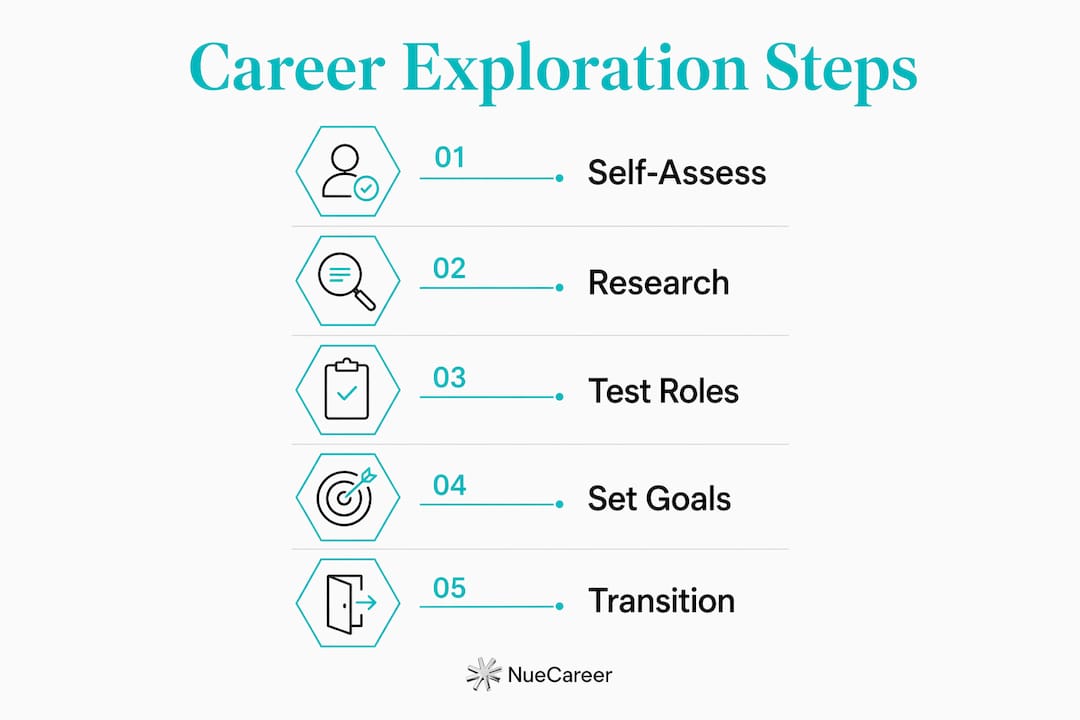
Career exploration succeeds best when it accounts for your personal constraints rather than presenting a one-size-fits-all ranking. A structured assessment asks the right questions: What drains your energy? What problems do you solve naturally? What work environment helps you focus? The answers point toward roles you would never find by scrolling a job board.
The Nuecareer career strengths quiz takes this approach further by matching your responses to career paths built around who you are, including roles you have likely never encountered. That kind of personalized matching is what separates a useful assessment from a generic personality test.
- Assess your energy patterns. Note which tasks leave you energized versus drained after a full day.
- List your transferable skills. Communication, analysis, coordination, and teaching apply across dozens of fields.
- Define your non-negotiables. Remote work, physical activity, creative freedom, or income floor all narrow the field usefully.
- Identify your curiosity clusters. The topics you read about for fun often point toward careers you have not yet considered professionally.
Pro Tip: Avoid ranking careers by prestige or familiarity. Rank them by fit. A role that scores high on your personal criteria beats a prestigious title that scores low every time.
What are some surprising careers you might not have considered?
Real-world examples make the abstract concrete. The following roles are genuine, paid positions that most working adults have never considered, and they illustrate just how wide the field of possible careers actually is.

A zoo in China offered $15,000 annually for a "bear costume performer" role in 2026, requiring six-hour shifts, four days off per month, and silent interaction with visitors except in emergencies. That role exists because visitor experience is a real business problem, and creative solutions create real jobs. A Chinese mountain resort paid $8,200 monthly for a "cloud sea watcher" to live on a mountaintop for 30 days, filming daily videos for social media. The hiring decision was based on social media engagement, not a resume. One European employer offered $3,000 monthly for a "Global Charisma Scout" to travel eight weeks scoring cities on social interaction ease, with all travel expenses covered.
These roles are unusual, but they point to a real pattern. Employers increasingly need people who can create content, connect with audiences, and represent brands in physical or digital spaces. Those skills exist in many working adults who have never thought to apply them professionally.
Beyond the headline-grabbing examples, a wide range of less visible but stable careers deserve attention:
| Career | Core skill required | Work environment | Income range |
|---|---|---|---|
| Medical sonographer | Technical imaging, patient care | Clinical, hospital | Strong, licensed |
| Fire investigator | Analytical, forensic thinking | Field and office | Competitive, public sector |
| Lab technician | Detail orientation, science | Laboratory | Moderate to strong |
| Digital content creator | Communication, video production | Remote or hybrid | Variable, scalable |
| Skilled trades (e.g., electrician) | Technical, hands-on | Field-based | Strong, high demand |
Each of these roles requires a specific skill set, but none requires a four-year degree in that exact field to get started. Many offer schedule and location control that traditional office careers do not. The challenge is that most adults never encounter them through standard job search channels.
How do you research and evaluate unconventional career options?
Research is where most career explorers stall. They find an interesting role, feel uncertain about how to evaluate it, and return to familiar options. A structured approach prevents that retreat.
- Map the industry trend. Search for the role on LinkedIn, the Bureau of Labor Statistics, and industry-specific forums. Growing demand reduces the risk of entering a new field.
- Assess the entry requirements. Identify whether the role requires a license, certification, degree, or portfolio. Many unconventional careers have shorter entry paths than traditional ones.
- Evaluate lifestyle fit. Ask whether the role's hours, location, and physical demands match your current life. A field role that requires travel does not fit every situation.
- Score your readiness. Rate yourself on a simple 1–5 scale across skills, education, and interest. Roles where you score 4 or 5 across all three are your strongest candidates.
- Run informational interviews. Contact three people working in the role via LinkedIn. Ask what a typical week looks like and what they wish they had known before starting.
Pro Tip: Before committing to a full career change, test the role through freelancing or a side project. Short-term gigs can generate cash flow within 30 days and give you real data on whether the work fits your life.
Setting personal work goals before you begin researching keeps your evaluation grounded. Without clear goals, every interesting role looks equally appealing, and you end up with a long list and no decision.
Strategies for transitioning into an unconventional career
A career transition into unfamiliar territory requires both practical preparation and a shift in how you think about professional identity. The two most common failure points are financial pressure and loss of purpose. Both are preventable.
- Build a financial buffer first. Mapping your money rules before you leave a stable role reduces the pressure that forces people back into jobs they dislike. Aim for three to six months of fixed expenses covered before making a full move.
- Write out your dream day. Describe in detail what a satisfying workday looks like: where you are, what you are doing, who you are with, and what problem you are solving. This exercise reveals which roles actually fit your vision and which only sound appealing in theory.
- Develop niche expertise deliberately. Unconventional careers reward people who go deep in a specific area. Pick one skill adjacent to your target role and spend 90 days building it visibly through writing, projects, or public work.
- Accept a non-linear path. Non-linear careers are admired in hindsight but feel uncertain in the moment. The discomfort of an unclear trajectory is not a sign you are doing it wrong. It is a normal part of building something original.
- Tell a legible story. Even if your path is unconventional, you need to explain it clearly to employers, clients, and collaborators. Practice a two-sentence summary of your direction that connects your past experience to your new focus.
The nonlinear career path is not a fallback. For many working adults, it is the most direct route to work that fits their actual life.
Key Takeaways
The most effective way to find careers you never considered is to combine structured self-assessment with deliberate research into emerging and niche fields, then test your fit before committing fully.
| Point | Details |
|---|---|
| Start with self-assessment | Use structured tools to identify your strengths, constraints, and curiosity before browsing job listings. |
| Real niche roles exist and pay well | Roles like cloud sea watcher and fire investigator show that unconventional careers offer genuine income and flexibility. |
| Research beats browsing | Informational interviews and readiness scoring give better data than job boards alone. |
| Test before you commit | Short-term freelancing or side projects reduce financial risk and confirm real-world fit. |
| Non-linear paths require a clear story | Accepting an unconventional path works best when you can explain it simply to others. |
What I have learned from stepping off the obvious path
I spent years watching people choose careers the way they choose a restaurant in an unfamiliar city: they pick the place with the most reviews because it feels safe. The result is a crowded field of people doing work that is fine but not right for them.
The roles that changed my thinking were not the glamorous ones. They were the specific, slightly odd jobs that someone had clearly designed around a real problem. A bear costume performer solves a visitor engagement problem. A cloud sea watcher solves a content production problem. A fire investigator solves a public safety problem. Every unconventional career exists because a real need was not being met by a conventional hire.
What I have found is that the adults who make the most satisfying career changes are not the ones who planned perfectly. They are the ones who stayed curious long enough to let a surprising option become a real possibility. Fostering non-linear growth is less about rigid planning and more about reading broadly, following genuine interest, and creating conditions where discovery can happen. That is not a soft strategy. It is the most practical one I know.
— Shane
Nuecareer can match you to careers you have not found yet
The hardest part of career exploration is not finding information. It is knowing where to start when you do not yet know what you are looking for.
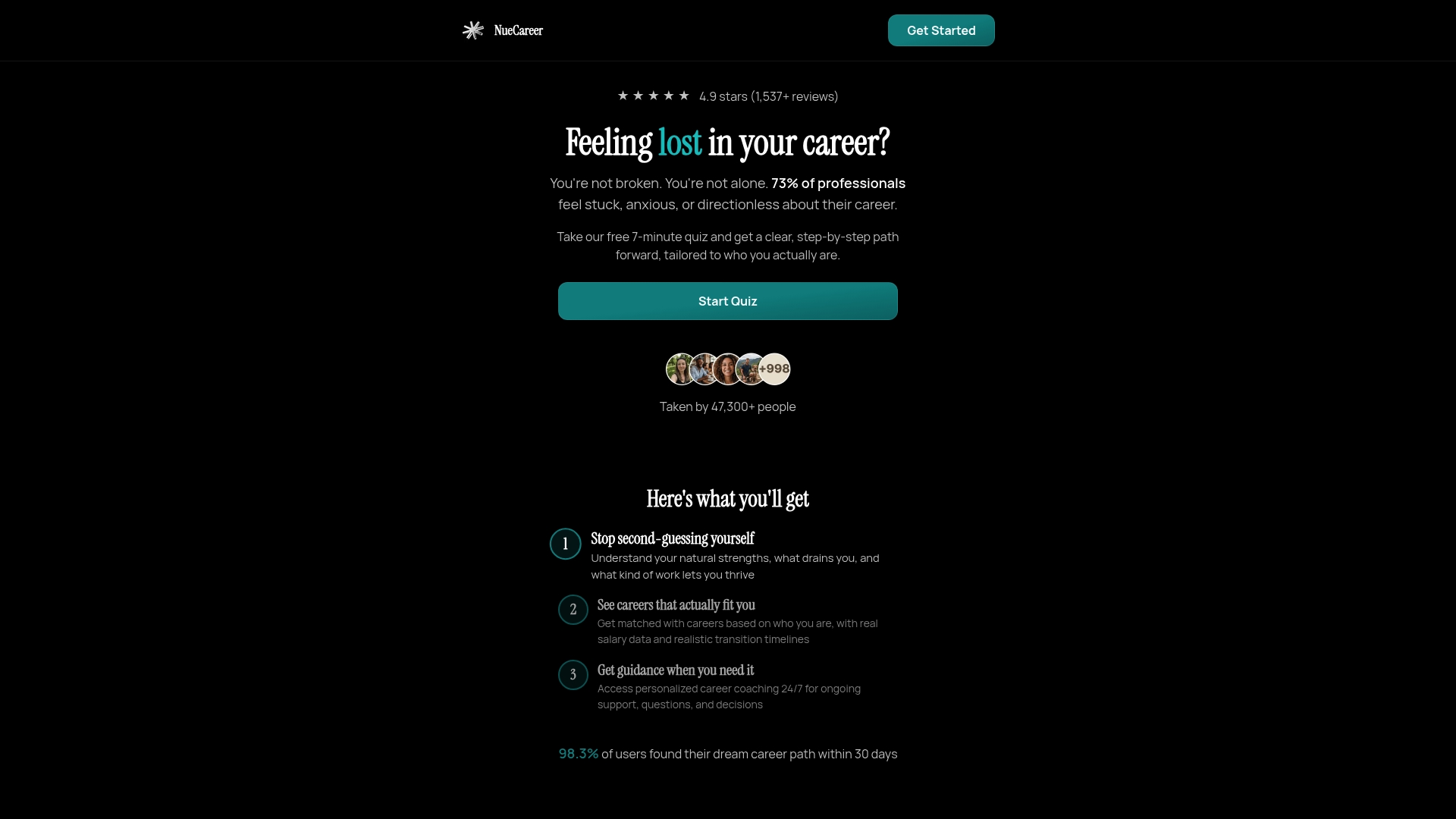
The Nuecareer 7-minute career quiz is built for exactly that moment. It asks about your strengths, preferences, and constraints, then matches you to career paths you may never have encountered on your own. From there, Nuecareer gives you personalized roadmaps, 24/7 coaching chat, and a full suite of resume and cover letter tools, all tailored to your target roles. If you are ready to move past the obvious options, the quiz is the clearest first step.
FAQ
What does it mean to find careers you never considered?
It means identifying job paths outside your current awareness, specifically roles that fit your strengths but fall outside mainstream job boards or traditional career advice. Career exploration is the formal term for this process.
How do I know if an unconventional career is right for me?
Use a structured self-assessment that accounts for your income needs, lifestyle preferences, and transferable skills. Generic "best jobs" lists do not account for your specific situation, so personalized tools give far more useful results.
Can unconventional careers pay as well as traditional ones?
Yes. Roles in skilled trades, clinical imaging, digital content creation, and niche consulting frequently match or exceed salaries in saturated traditional fields, particularly when you develop specific expertise.
How long does a career transition into a new field take?
The timeline varies by field, but most adults who test a new path through freelancing or part-time work before committing full-time report a smoother and faster transition than those who switch all at once.
What is a non-linear career path?
A non-linear career path is one that does not follow a single industry or job title progression. It combines skills and experiences from multiple fields, and it is increasingly recognized as a source of creative and professional advantage rather than a liability.