
Career Coaching Benefits for Adults: 2026 Guide

Discover the career coaching benefits adults experience. Accelerate job placements, boost salaries, and achieve your career goals faster today!
TL;DR:
- Career coaching helps adults find jobs faster and negotiate higher salaries through personalized guidance. It also builds confidence and communication skills essential for career growth and transition. Choosing a coach with relevant industry expertise enhances results and accelerates career progress.
Career coaching is defined as a structured professional development process where a trained coach helps adults clarify goals, remove obstacles, and accelerate career outcomes. The career coaching benefits adults experience go well beyond job placement. Research shows coached professionals land roles 3 times faster than those searching independently, with salary gains of 10–15% above initial offers. Platforms like Nuecareer pair this kind of professional guidance with AI tools, personalized roadmaps, and 24/7 coaching chat to give working adults a real edge. If you are considering a career change or aiming for advancement, understanding what coaching delivers is the right place to start.

1. Career coaching benefits adults who want faster job placement
Coached professionals typically land roles in 3–4 months. The average uncoached job search runs 6–7 months. That gap is not luck. It reflects a structured process that most independent jobseekers skip entirely.
The first step in effective coaching is diagnostic. Initial sessions identify bottlenecks like weak resume positioning, poor interview framing, or misaligned targeting before any applications go out. Skipping this phase wastes time and energy on the wrong problems. A coach who spots that your resume buries your most relevant experience can change your response rate overnight.
Role alignment is the other major gain. Many adults apply broadly and land roles that feel wrong within months. Coaching narrows the target to positions that match your skills, values, and growth goals. That alignment drives long-term satisfaction, not just a faster offer.
- Resume and LinkedIn positioning reviewed against target roles
- Interview preparation tailored to specific industries and seniority levels
- Salary negotiation coaching to close the 10–15% gap above initial offers
- Target company list built around fit, not just availability
- Accountability check-ins to maintain momentum between applications
Pro Tip: Ask your coach to review a real job posting you want and rebuild your resume summary around that specific role. Generic summaries are the single biggest reason qualified candidates get filtered out.
2. How coaching builds confidence and communication skills
85% of coaching clients report increased self-confidence. That number is not abstract. It shows up in how you present yourself in interviews, how you advocate for a promotion, and how you handle difficult conversations at work. Confidence is a career skill, and coaching builds it deliberately.
75% of coached professionals report better work performance and communication. This matters because most career stalls are not skill gaps. They are communication gaps. Adults who struggle to articulate their value, lead meetings, or manage up often have the technical ability but lack the language to make it visible.
"Coaching transforms professionals from relying on fleeting motivation to adopting structured, consistent career management habits." — JW Radford Career Coaching
Coaching also reframes how you see your own experience. A career changer moving from teaching to instructional design, for example, does not lack relevant skills. A coach helps translate classroom facilitation, curriculum design, and performance assessment into corporate language. That reframing is often the difference between rejection and an interview.
Key confidence and communication gains from coaching include:
- Clearer articulation of transferable skills across industries
- Stronger executive presence in interviews and performance reviews
- Improved ability to set boundaries and negotiate without anxiety
- Structured habit-building that replaces inconsistent motivation
3. Why coaching is a strategic investment, not a last resort
Career coaching is not something you pursue after everything else fails. Coaching is a strategic professional development tool, the same way elite athletes use coaches to sharpen performance at the top of their game, not the bottom. High performers use coaching to accelerate trajectory and clarify goals before a crisis forces the conversation.
The real cost calculation flips the usual question. The cost of staying in a misaligned job includes lost salary potential, reduced confidence, and burnout. A year in the wrong role at $70,000 when you could be earning $85,000 in a better fit costs you $15,000 before you count the energy drain. Coaching fees look different against that math.
| Reactive job search | Proactive coaching approach |
|---|---|
| Apply broadly and hope for responses | Target roles aligned to strengths and values |
| Negotiate from the first offer received | Prepare salary strategy before the first interview |
| Update resume only when desperate | Maintain a living career document continuously |
| Rely on motivation to stay consistent | Use structured accountability to build habits |
| Discover role misalignment after starting | Assess fit before accepting any offer |
86% of organizations report positive ROI from coaching. That figure reflects what happens when coaching is treated as a growth tool rather than a rescue plan.
Pro Tip: Before your first coaching session, write down the three career decisions you have been avoiding. Bring that list. The best coaches go straight to the hard questions, and you will move faster if you are ready for them.
4. How coaching supports adults through career transitions
Career transitions are where coaching delivers its clearest value. Adults changing industries, stepping into leadership, or recovering from burnout face a specific set of challenges that general career advice does not address. Coaching provides structured support at each stage.
Here is how the process typically works for adults in transition:
- Clarify the destination. The coach helps you define what you actually want, not just what seems safe or logical. This step prevents lateral moves that feel like progress but change nothing important.
- Audit transferable skills. Most adults underestimate how much of their existing experience applies to a new field. A coach maps your skills against target role requirements and identifies real gaps versus perceived ones.
- Build a positioning strategy. Your resume, LinkedIn profile, and interview narrative all need to speak the language of the new industry. Coaches with niche-specific expertise outperform generalists here, especially for transitions like operations to product management or education to corporate training.
- Prepare for compensation negotiation. Adults changing industries often accept lower offers than necessary because they feel they are "starting over." Coaching reframes your value and prepares you to negotiate from strength.
- Adapt to evolving industries. Adults moving into AI-driven fields or tech-adjacent roles need more than a resume update. Coaching helps prioritize which skills to develop first and how to present a learning trajectory as an asset.
Coaching paired with professional training can lift productivity by up to 88%, roughly four times higher than training alone. That gap exists because training gives you knowledge while coaching helps you apply it in your specific context.
Adults navigating burnout benefit from a different angle. Coaching surfaces the root cause, whether it is role misalignment, values conflict, or unsustainable workload, before recommending a path forward. Jumping to a new job without that clarity often replicates the same problem in a new setting.
5. What to look for when choosing a career coach
Choosing the right coach determines whether you get real results or expensive conversation. Matching a coach's expertise to your industry or career challenge predicts success more reliably than credentials alone. A coach who has worked extensively in healthcare hiring will serve a nurse moving into health administration far better than a generalist with a certification.
Ask three questions before committing. First, what specific career transitions have you coached successfully? Second, what does your diagnostic process look like in the first session? Third, what do you expect from clients between sessions? The last question matters most. Success in coaching depends heavily on client engagement and completing assignments between sessions. A coach who does not set expectations upfront is not running a results-driven process.
Coached leaders demonstrate sharper decision-making and measurable goal attainment across projects. That outcome requires a coach who pushes you, not one who validates every instinct. The best coaching relationships feel challenging, not comfortable. Adults exploring career coaching services should compare coaches on specificity of process, not just testimonials.
Key takeaways
Career coaching delivers measurable results for adults, including faster job placement, higher salaries, and stronger confidence, when paired with active client engagement and the right coach match.
| Point | Details |
|---|---|
| Faster job placement | Coached professionals land roles in 3–4 months versus 6–7 months without coaching. |
| Higher salary outcomes | Coaching produces salary gains of 10–15% above initial offers through negotiation preparation. |
| Confidence and communication | 85% of clients report increased confidence; 75% report better work performance. |
| Strategic investment | The cost of career stagnation, including lost salary and burnout, exceeds typical coaching fees. |
| Coach selection matters | Matching a coach's expertise to your specific industry or transition predicts better outcomes. |
What I have learned from watching adults use coaching well and poorly
The adults who get the most from career coaching share one trait: they treat it like training, not therapy. They show up with specific problems, complete the work between sessions, and push back when something does not feel right. The ones who struggle treat coaching as a place to process feelings without taking action. Both groups pay the same fee and get very different results.
I have also seen adults waste months with the wrong coach. A generalist coach can help you feel clearer about your values. But if you are a mid-career engineer trying to move into product management at a Series B startup, you need someone who has coached that exact transition. The specificity of the coach's experience is not a nice-to-have. It is the variable that determines whether your positioning actually lands with hiring managers.
The other thing most articles will not tell you: coaching works best when your career is going reasonably well, not when it has completely stalled. Adults who start coaching from a place of stability, even mild dissatisfaction, have more options and more leverage. Waiting until you are burned out or unemployed limits what coaching can do for you. Start the conversation before the crisis hits, not after.
— Shane
Take the next step with Nuecareer's career tools
Coaching works best when you have the right tools supporting your applications between sessions. Nuecareer gives you exactly that.
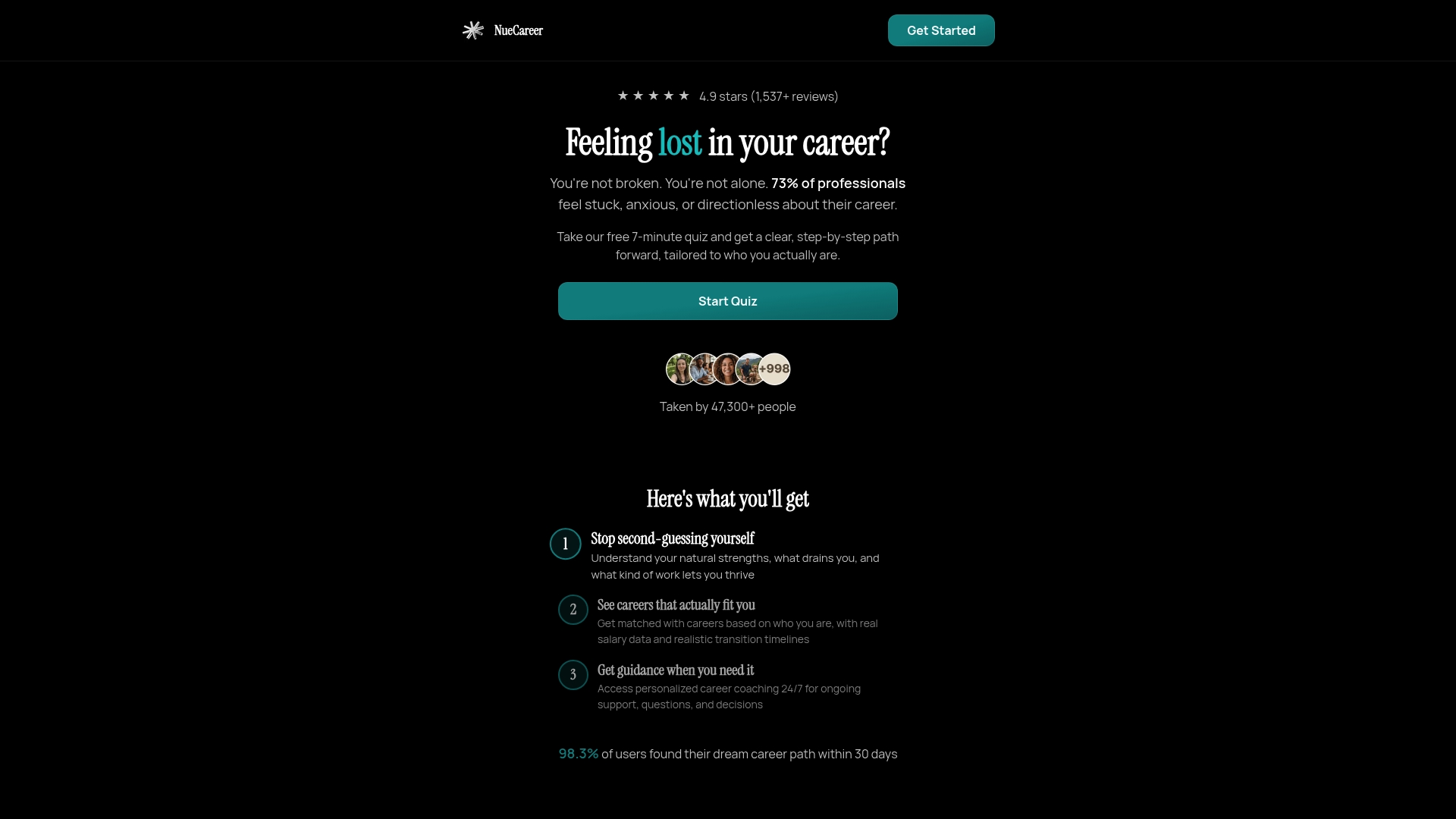
Nuecareer's free AI tool helps you identify the right skills to highlight on every job application, so your materials reflect what hiring managers actually want to see. Pair that with Nuecareer's personalized career roadmaps, 24/7 coaching chat, and built-in resume tools, and you have a complete system built around your specific goals. Whether you are changing industries or pushing for a promotion, Nuecareer gives you the structure and support to move forward with confidence. Explore the full suite of free career tools and start applying with clarity today.
FAQ
What are the main career coaching benefits for adults?
Career coaching helps adults land jobs faster, negotiate higher salaries, and build confidence. Research shows coached professionals are 3 times more likely to secure a role within 3 months compared to searching independently.
How long does career coaching take to show results?
Most coached adults land roles in 3–4 months. Results depend on client engagement and how consistently assignments are completed between sessions.
Is career coaching worth the cost?
Career coaching delivers ROI of 5–7 times the investment for most clients. The cost of staying in a misaligned role, including lost salary and reduced confidence, typically exceeds coaching fees within a year.
How do I choose the right career coach?
Match the coach's experience to your specific industry or career challenge. Niche-specific coaches outperform generalists for transitions like moving from education to corporate roles or from individual contributor to leadership.
Can career coaching help with adult career transitions?
Career coaching is especially effective for adults changing industries, preparing for leadership roles, or recovering from burnout. Coaches help translate transferable skills, build positioning strategy, and prepare adults for compensation negotiation in new fields.