
Discover Your Strengths: Career Assessment Quiz Guide

Unlock your potential with our discover strengths career assessment quiz. Find your natural talents and boost your career satisfaction today!
TL;DR:
- A career strengths assessment quiz identifies your natural talents and guides you toward fulfilling roles. Most tools reveal your signature strengths and suggest career clusters, helping you make informed decisions. Reassessing periodically and applying results practically improves job satisfaction and professional growth.
A career strengths assessment quiz is a structured tool that identifies your natural talents and maps them to roles where you are most likely to thrive. If you have ever felt stuck in a job that drains you, or unsure which direction to take next, a discover strengths career assessment quiz gives you a concrete starting point. Employees aligned with their natural aptitudes are 6 times more engaged and 3 times more likely to report excellent quality of life. That single fact explains why tools like Gallup CliftonStrengths, HIGH5, and the Character Strengths Test have become standard resources for both students and working professionals across the United States.
How does a career strengths assessment quiz work?
A strengths quiz measures your natural patterns of thinking, feeling, and behaving, then ranks them to show where your energy peaks. The format varies by tool, but most fall into three categories.
- Multiple-choice questions present two or more options and ask which fits you best. They are fast and easy to complete honestly.
- Scenario-based prompts describe a work situation and ask how you would respond. These reveal behavioral tendencies more accurately than abstract questions.
- Rating scales ask you to score statements like "I enjoy leading group discussions" from 1 to 5. They capture intensity, not just direction.
The key concept behind most of these tools is signature strengths: the top 3–7 traits that feel most natural and energizing to you. Signature strengths distinguish energizing natural talents from learned skills, which is why they are a better predictor of career fit than your resume alone.
Personality tests like the Myers-Briggs Type Indicator describe who you are in broad archetypes. Strengths-based assessments go further. They describe what you do best and point toward specific roles or career clusters where those behaviors create real value.
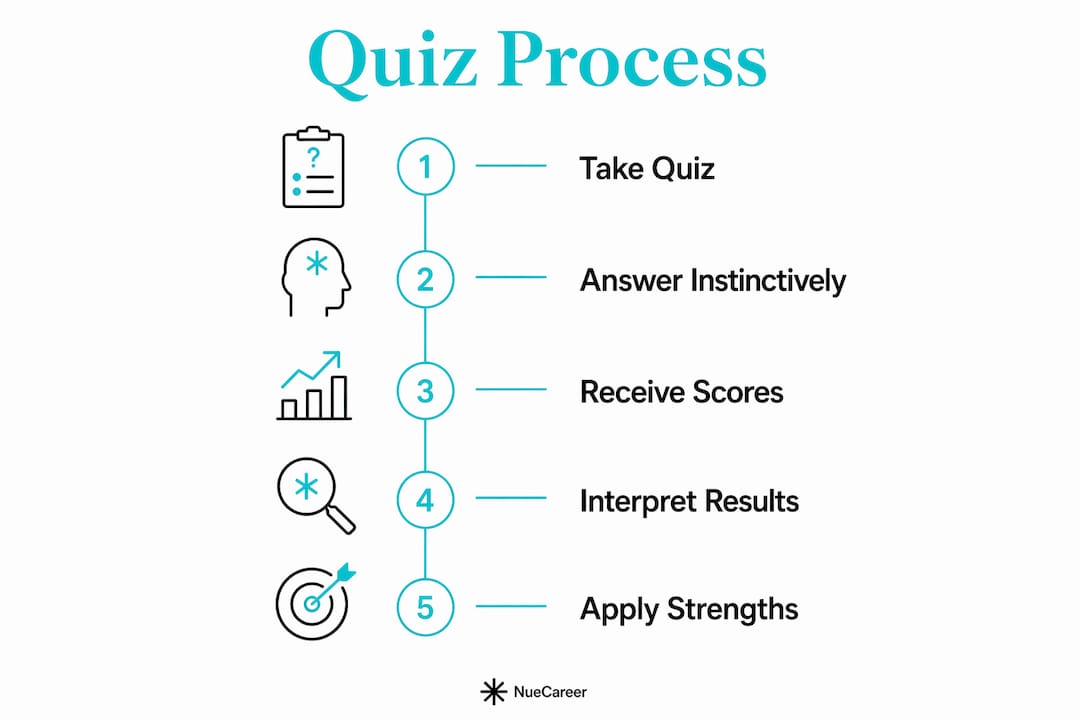
Pro Tip: Answer instinctively on your first pass. Overthinking your responses pushes you toward who you think you should be, not who you actually are. Your gut reaction is usually the most accurate data point.
Most tools score results by frequency and intensity, then present a ranked list. Professional assessments often use IPIP-60 or Big Five inventories, which are free, validated, and rich in data. That means you do not need to pay for a credible result. Understanding how career aptitude tests work helps you choose the right format before you start.

What tools are best for finding your career strengths?
The right strengths finder test depends on your goals, your budget, and how much career guidance you want after the results appear. Here is a comparison of the most widely used options available to US professionals and students in 2026.
| Tool | Cost | Time | Strengths Identified | Career Guidance |
|---|---|---|---|---|
| Gallup CliftonStrengths | $19.99+ | 30–45 min | Top 5 or all 34 | Limited without coaching |
| HIGH5 | Free (basic) | 20 min | Top 5 | Role suggestions included |
| Character Strengths Test | Free | 15 min | All 24 ranked | Happiness and work focus |
| CareerFitter | Free (basic) | 10 min | Career style profile | Career cluster matching |
| Nuecareer 7-Minute Quiz | Free | 7 min | Core strengths profile | Full career path matching |
Tools that rank strengths fully and suggest specific career paths are preferred over those that deliver simple labels. A label like "Achiever" or "Empathy" is interesting. A ranked list paired with career cluster suggestions is useful.
Gallup CliftonStrengths is the most widely recognized strengths finder test in corporate America. Its 34-theme framework is backed by decades of research. The limitation is cost: full results require a paid upgrade, and career guidance is thin unless you work with a certified coach.
HIGH5 and the Character Strengths Test both offer free, complete rankings. Providing complete rankings of strengths rather than paywalled top scores gives you a more useful self-view, including blind spots in lower-ranked traits. That transparency matters when you are making real career decisions.
Nuecareer's 7-minute quiz is built specifically for working adults who want clarity fast. It identifies your core strengths and immediately matches them to career paths, including ones you may never have considered. That combination of speed and specificity sets it apart from tools that stop at personality labels.
Pro Tip: Take two or three different quizzes and look for overlap. Combining results from multiple assessment types offers the richest self-knowledge. When the same strength appears across different tools, you can trust it.
For a broader review of what is available, the best career assessment tools guide covers seven options in depth, with notes on accuracy and usability.
How do you interpret quiz results and apply them to career planning?
Getting your results is step one. Knowing what to do with them is where most people get stuck. Here is a numbered process that moves you from raw scores to real career decisions.
Identify your signature strengths. Circle your top 3–7 traits. These are the ones that feel natural, not just the ones you are good at through practice. A learned skill and a natural strength are not the same thing.
Map strengths to career clusters. Each strength tends to align with specific types of work. Strategic thinking strengths point toward roles in consulting, analysis, or product management. Relational strengths point toward counseling, sales, or team leadership. Use a career clusters quiz to see which broad fields match your profile.
Translate strengths into resume language. Do not just list "strong communicator." Instead, write: "Led cross-functional team meetings that reduced project delays by 20%." Specificity turns a strength into evidence.
Prepare for interviews using the three-beat formula. Using a three-beat formula in interviews makes your answers memorable: name the strength, give a concrete example, share the result. "I am highly organized. In my last role, I rebuilt the onboarding process. New hire ramp time dropped from 8 weeks to 5."
Review lower-ranked traits without dismissing them. Lower scores reveal areas for growth and self-awareness. A low score in "competition" does not mean you lack drive. It means you are motivated differently, which is useful information for choosing the right team culture.
Career satisfaction improves significantly when roles match natural personality strengths rather than salary or availability. That research point is worth holding onto when you feel pressure to take any job that pays well.
Pro Tip: Use Nuecareer's strengths and weaknesses generator to turn your quiz results into polished interview answers. It removes the guesswork from one of the most common and dreaded interview questions.
What are the common challenges with strengths career quizzes?
A career assessment online is only as useful as the honesty and follow-through you bring to it. Several obstacles can limit the value you get.
- Paywalled results. Some tools show you a teaser and charge for the full picture. Avoiding paywalls and choosing assessments that provide usable career mappings improves both the experience and the outcome. Stick to tools that give you complete, ranked results for free.
- Inconsistent self-assessment. People often answer based on who they want to be, not who they are. Life coach Adrian Klaphaak advises combining introspective reflection on "flow" moments with external feedback to identify true strengths. Ask a trusted colleague or mentor to review your top results and confirm whether they ring true.
- Confusing jargon. Terms like "Woo," "Restorative," or "Ideation" mean nothing without context. Always read the full description of each strength, not just the label.
- Over-reliance on labels. A quiz result is a starting point, not a verdict. Treating "Introvert" or "Analytical" as a fixed identity limits your options. Use the results as a lens, not a cage.
"The goal of a strengths assessment is not to put you in a box. It is to help you see yourself clearly enough to make better decisions."
Analysis paralysis is real. Some people take five quizzes, read every result carefully, and still feel stuck because they are waiting for perfect clarity before acting. The fix is iteration. Take one quiz, apply one insight, and reassess in six months as your career grows. Career assessments that align daily tasks with innate cognitive styles can greatly improve long-term satisfaction, but only when you act on what you learn.
How does discovering your strengths improve professional outcomes?
Aligning your work with your natural strengths produces measurable results. 80% of individuals are dissatisfied with their current jobs due to a mismatch between perceived and actual strengths. That is not a minor frustration. It is a widespread, solvable problem.
Focusing on signature strengths boosts happiness and reduces depression for up to 6 months. That finding comes from positive psychology research, not career coaching marketing. It means that knowing and using your strengths has a direct effect on your mental health, not just your job performance.
Strengths-based career assessments should be action-oriented to guide users toward tangible career decisions rather than just personality labels. The difference between a useful quiz and a forgettable one is whether it tells you what to do next. Engagement, quality of life, and performance all improve when your daily tasks align with how your brain naturally works. A free career skills assessment can complement your strengths quiz by showing you where your current skills match your strengths and where gaps exist.
Key takeaways
A strengths-based career assessment quiz is the most direct path from career confusion to career clarity, provided you choose a transparent tool and act on the results.
| Point | Details |
|---|---|
| Strengths quizzes reveal natural talent | They measure what energizes you, not just what you have learned to do. |
| Signature strengths drive satisfaction | Focusing on your top 3–7 traits boosts engagement and reduces career dissatisfaction. |
| Transparent tools outperform paywalled ones | Choose quizzes that provide full, ranked results and career path suggestions. |
| Results need a follow-through plan | Map strengths to career clusters, update your resume, and prepare interview answers. |
| Iteration beats perfection | Reassess every 6–12 months as your skills and goals evolve. |
What i have learned from years of watching people use these quizzes
Here is something most career articles will not tell you: the quiz result is rarely the breakthrough. The breakthrough happens when someone reads their top strength and says, "I have always known that about myself, but I never thought it counted."
That moment of recognition is the real value. The quiz just gives it a name.
What I have seen trip people up most often is chasing their highest-ranked strength instead of their most energizing one. Those are not always the same. You might score high on "Analytical" because you have spent years in finance, but if data work drains you, that score reflects history, not direction. Pay attention to which results make you feel excited, not just validated.
Pairing your quiz results with honest feedback from two or three people who know your work well is the single most underrated step in this process. Self-perception has blind spots. External input closes them.
Finally, do not wait until you have a perfect plan to start moving. Use your results to take one concrete step: update your LinkedIn headline, apply for one role in a new field, or book a conversation with someone doing work that aligns with your strengths. Clarity comes from action, not from more assessment.
— Shane
Take the next step with nuecareer's free career quiz
Ready to put this into practice? Nuecareer's 7-minute career quiz is built for working adults who want real answers fast. It identifies your core strengths and matches you to career paths built around who you are, including roles you may never have considered.
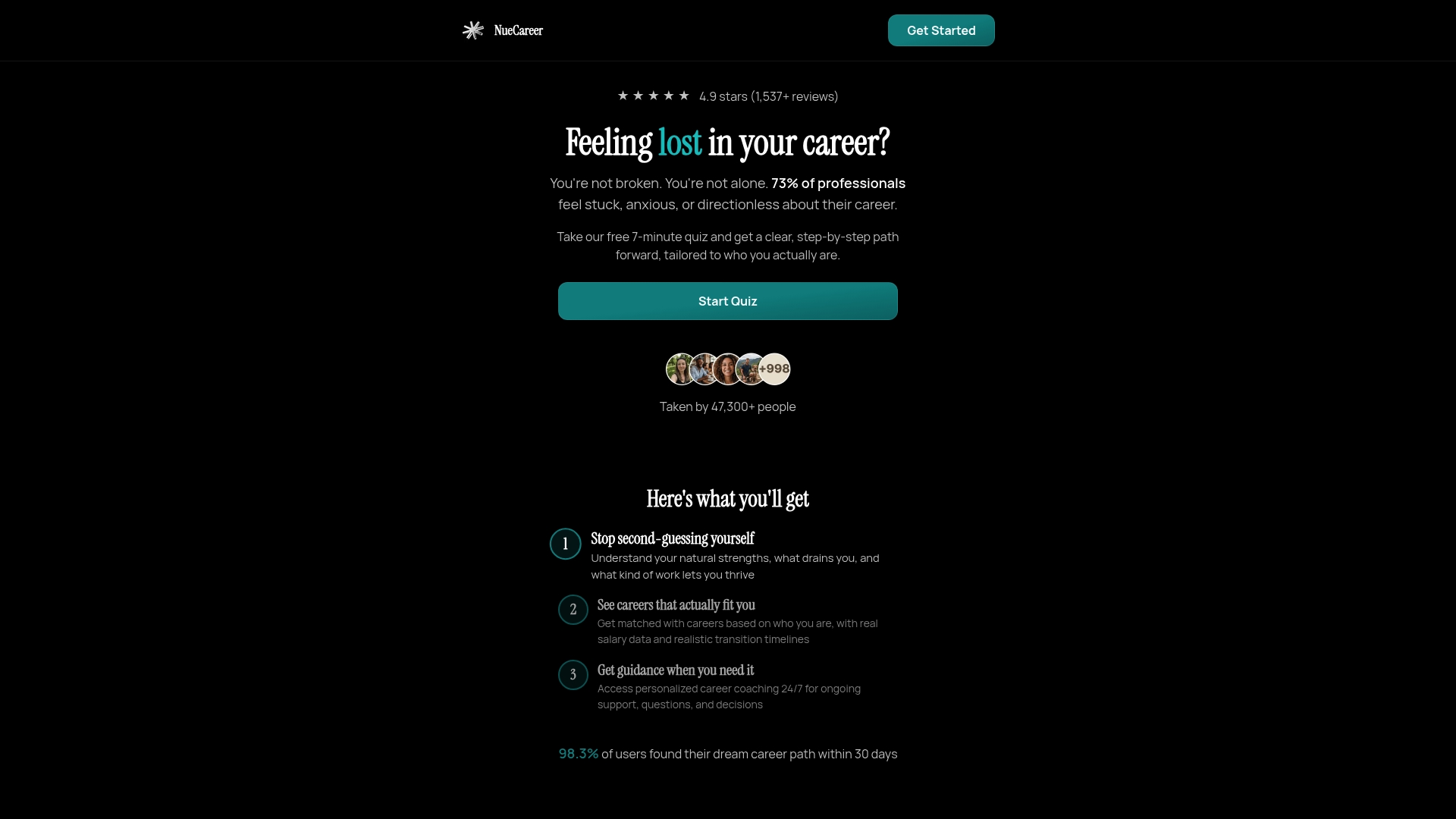
From there, Nuecareer gives you a personalized roadmap, 24/7 coaching chat, and a full suite of resume and cover letter tools. You can also explore the free career tools hub to run a skills assessment, analyze job descriptions, and translate your strengths into skills that stand out on any application. No paywall. No guesswork. Just a clear next step.
FAQ
What is a career strengths assessment quiz?
A career strengths assessment quiz is a structured tool that identifies your natural talents and ranks them to help you find roles where you are most likely to perform well and feel fulfilled. Most use validated frameworks like the Big Five or signature strengths models.
How long does a strengths finder test take?
Most strengths finder tests take between 7 and 45 minutes depending on the tool. Nuecareer's quiz takes 7 minutes and delivers immediate career path matches, while Gallup CliftonStrengths takes 30–45 minutes for a full 34-theme profile.
Are free career assessment quizzes accurate?
Free tools that use validated inventories like IPIP-60 or Big Five frameworks are research-backed and accurate. Tools that provide complete, ranked results without paywalls tend to be more useful than paid tools that withhold lower-ranked traits.
How do i use my quiz results to find a career?
Map your top 3–7 signature strengths to career clusters, then use the three-beat formula (name the strength, give an example, share the result) to communicate them in interviews and on your resume.
How often should i retake a strengths quiz?
Reassess every 6–12 months, especially after a major role change, new skill development, or shift in your goals. Strengths stay relatively stable, but your awareness of them deepens over time.